TikTok trends for coffee shops
TikTok trends for coffee shops Keeping up with TikTok trends as a local coffee shop is not about following whatever audio is trending this week and...
TikTok trends for coffee shops
Keeping up with TikTok trends as a local coffee shop is not about following whatever audio is trending this week and praying that it translates to tomorrow’s latte sales. It’s about working within established formats that you know TikTok will reward, filling in the variables with your location, your bar service, and your offerings, and getting in front of customers who can potentially come in for a drink. It’s about driving local awareness that you can convert to sales, not about racking up views, and you don’t need a content studio to make it happen. You just need a handful of templates, a brief shooting schedule that you can squeeze in between busy periods, and a direct line between every piece of content and a specific business result.
In this post, I’m going to share the repeatable trend formats coffee shops can rely on, the hyperlocal distribution strategies that get those videos in front of audiences living, working, or attending school nearby, and exactly how I’m attributing each trend to metrics like foot traffic, signature beverage sales, dessert pairing rates, and returning customers. You’ll gain more than inspiration, you’ll gain a set of templates you can repeatedly deploy weekly, along with examples I might use in a neighborhood coffee shop, and the exact metric each one is designed to impact. If you want an extra layer on planning, this pairs well with a social media content calendar.
Local coffee shop trends on TikTok: the trend formats I’d place a wager on this month
My money is on POV micro-stories and the “you are here” theme.
They both establish context in less than a second.
TikTok values that.
You start with a first-person hook, to get the viewer in the scene, you then present a micro conflict and quick pay-off that people will hang around for resolution of.
These can be shot in real life, during service: approach the bar, show the line, flash the ticket with the joke request, cut to the finished cup handoff and customer response.
The watch time moments are built on micro tension around “will it work?”, “will it spill?”, “will they like it?”, while the rewatch moments are built on quick cuts of on screen text people need to re-read, and blink-and-you’ll-miss-it moments like the secret topping or the latte art reveal.
Recurring series formats are the best way to convert viewers into repeat visitors since they teach viewers to return and they put your creativity into a repetitive format.
Use a serial format: Like Order of the day, Regular of the week, or One-minute barista school, with the first two seconds being the same every time so that the user can understand what it is while scrolling through.
The hook type that performs best is a promise with a qualifier, e.g. today’s order is less than five euros, or one hack to repair bad espresso, because it gives a clear incentive to keep watching.
The coffee shop variation: you face the camera to the ticket printer, you talk through one decision you made, and you close on a beauty shot and a sip.
I’ve noticed that series tend to do better than standalone videos in terms of retention, as people already know the format, so they can devote less time to figuring it out and more time to actually viewing it. This is the same logic behind building consistent social media growth week to week, not just chasing spikes-see consistent social media growth.
So, I’ve seen stuff like “hey, do a hack with this menu” or “build a drink with me, make this decision, make that decision” as a comment engine.
It’s a drink video but it’s just a comment engine.
And comments are huge on TikTok for distribution.
Not only you present a custom-made drink, you present the options and you let people decide, then you post their most voted comment as the next episode.
'Let's see two choices on screen, then put a caveat on there of only using ingredients that we have in the restaurant, then ask for their next choice in the captions so that people can play along.'
What you could do is film it in store while you are preparing syrups or whatever while you are down, just show all the ingredients, ask the viewer which base, how sweet, and what topping, and then show them the drink and dedicate it to the commenter.
Watch time is the open loop of which option wins, and the rewatch is the ingredient list flashed quick enough that people rewatch to copy it.
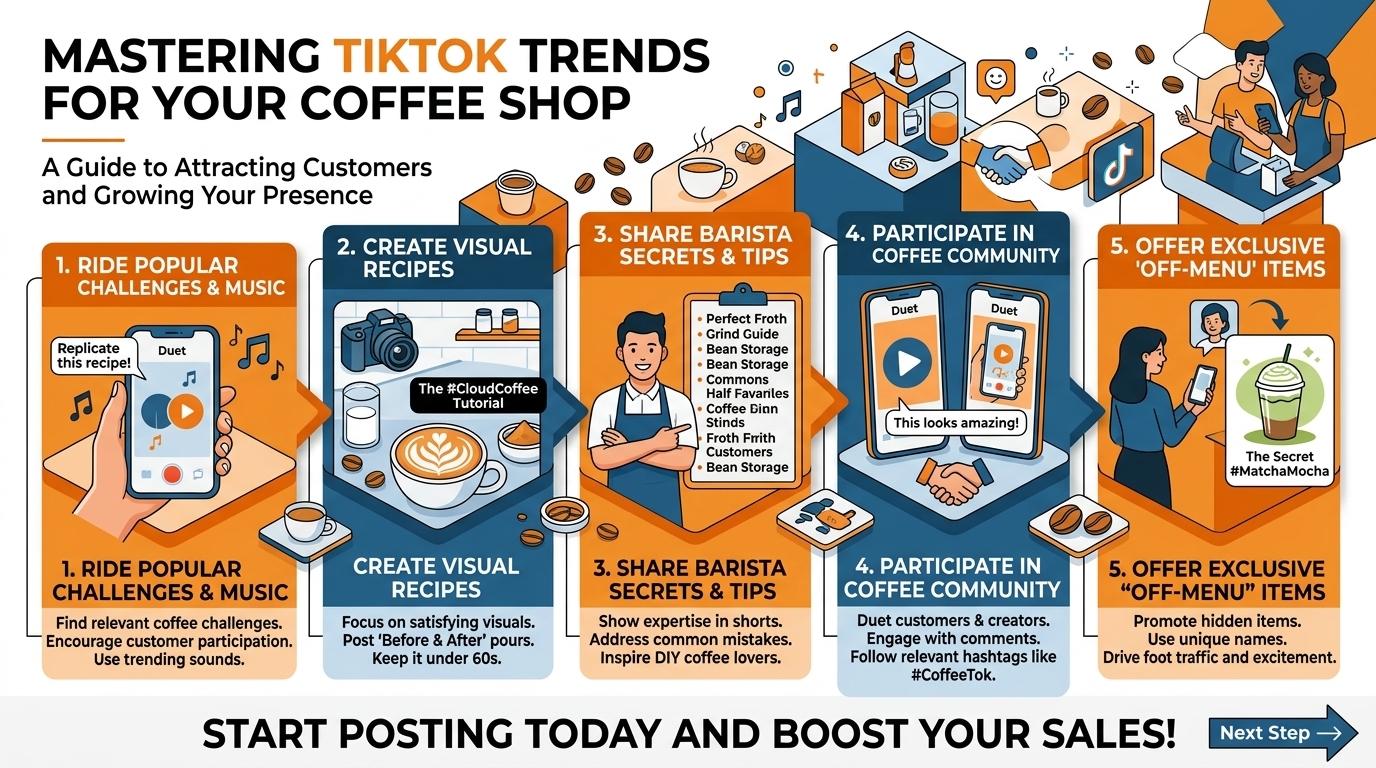
Before and after and stitch/duet prompts are the secret pairing I would use to attract locals and creators without overproducing.
Transformations work because your brain seeks completion: bar mess to clean, espresso shot to latte art presentation, pastry case to filling, and so on, all within a narrow time and with a definite end-point.
This is why duet and stitch prompts are successful; they’re a template you give to other users to fill: you rate the order, you try to guess their personality based on their go-to, you respond to someone talking about their daily coffee shop run.
Take things to do in your neighborhood framing as the wrapper and you get natural local discovery.
You show three stops in one short video and your shop is stop two, not the whole ad.
You want to keep it low-fi and captions first most of the time, since minimal editing tends to come across as more credible for small businesses.
Higher production can work, but it tends to erode credibility and make people think it is an ad, which can kill completion rates and overall show rate. If you want a deeper system for doing this without burning out, you can compare it to smart social media automation.
Local coffee shop trends on TikTok: making trends hyperlocal (so people who live near you see them)
Local coffee shop trends perform on TikTok if you convince the algorithm that you know where you are.
Add specific location markers to the first three seconds of video, by speaking the name of your neighborhood, including the name of your neighborhood on the screen, and including one identifying landmark in your first shot.
Instead of calling it morning rush, call it 8:12 train crowd, or the school drop-off line on Maple Street, because identifying your commute route functions as metadata for both humans and for TikTok’s algorithmic contextualizing.
I’ve made the same video twice, once with local hooks and once with a hyper-local hook, such as best iced latte near Central Station versus best quiet café to work in Riverside, and I’ve found that the second version tends to earn more saves and profile visits from local viewers because it more accurately matches what those viewers search and plan for. This aligns with how TikTok frames discovery: in TikTok as a search destination, TikTok reports that 61% of TikTok users discover new brands/products on the platform (TikTok’s brand discovery and search behavior).
A) If you need to grow your hyperlocal network quickly, try engaging with other places your audience already regularly go to.
You create a joint product post (e.g. your latte and the donut from the shop down the street) and have them create the counterpart (the donut and your latte) with the same call for engagement in the comments, so the customers can participate to close the loop.
The key is to not make this a sales-y thing: Instead, invite the audience to decide in the comments which of the two pairings is better, invite them to @-tag an account of a third location that should be the next stop on a three-stop hop, or ask them to describe their three-stop walk so that you could film a three-stop hop video based on how your customers get around during the day.
This reciprocal post will give you a second wind of engagement, because you tap into each other’s audience, but also because shared comment threads are interpreted by the algorithm as social activity, rather than just content.
You don’t need big dollars to create a local trend.
You need the right small creators and regulars.
Target micro-creators who are already creating content in your neighborhood and have decent engagement despite having 800-8,000 followers.
Local influence is about density of trust, not scale.
Invite regulars, campus clubs, and community groups to a “come film this drop” moment: a limited batch of pastries at 9:30, a new seasonal syrup to test at 2:00, or a latte art challenge during a slow period.
I’ve seen one filmed moment from a regular outperform a brand asset because it creates the I can actually go there factor and often leads to copycat content from their friends, which is the lowest cost distribution you can buy. A related lens here is how discussion volume is shifting: in H1 2025, TikTok coffee shop chain discussions rose to 240.3K (31.63% share), up from 73.6K (14.16% share) in H1 2024 (a report on TikTok and Threads discussion growth).
So you tap into local moments that make sense for a coffee shop: farmer’s market mornings, sports days, school exam periods, working hours, and rainy afternoons.
You construct them as video answers to local searches that’ll get you found in TikTok Search and discovery features:
- best iced latte near me
- coffee shop near me to work
- quickest coffee near me train station
- coffee shop near me open early around me hospital
And I post once during morning commute hours when they decide what to grab this morning, and a second time in the evening when they’re scrolling through their For You page and saving places for tomorrow; that’s how you get someone to come today and someone to save you for the weekend without adjusting your operations.
TikTok trends for local coffee shops: making your customers the channel (UGC loops that don’t feel like ads)
The biggest hidden benefit of TikTok trends for local coffee shops is that you have a steady flow of creators coming in every day, you just need to give them something to film.
Do that by designing moments worth filming that have a natural start, middle, and end in under 10 seconds.
Design one signature reveal that happens every day, like a lid-off cup reveal with a bold topper, a seasonal garnish that changes every week, a stamp card moment where the last stamp triggers some small ritual, or a latte art name moment where the customer sees their name appear in foam.

The metric you care about here isn’t views first, it’s how many people pull out their phone per hour: if you can get even 2 to 3% of transactions to turn into clips, you’re now feeding TikTok a steady stream of footage that doesn’t look like an ad at all and provides actual local proof. This ties into broader TikTok behavior: a DTC summary notes 61% of TikTok users discover new brands/products through the app (stats summary on TikTok brand discovery).
You’ll get more footage if you ask for it in the moment, but don’t ask for footage.
Use short, direct prompts that specify what to film, not how it will help your business.
Place the prompt exactly where the behavior should happen: at the pickup counter, on the table tent, or on the menu board right next to the item that will get the most impact.
You’re trying to inspire a micro-action: film your sip reaction, take a video of your cup reveal, film your stamp.
I like to keep the language very customer-centric and conversational, and stay away from anything overtly marketing-y; if the prompt describes the moment the customer already wants to share, it feels like a helpful reminder, not a campaign.
This should be measured by the flow of your repost queue: when prompts are effective, you should see more videos that start at the same point in your shop, meaning your environment is helping.
We talked about how UGC loops can be slow-burning. That’s why timed releases are a great way to hack them, since people feel pressure to post about it right away.
Develop timed releases designed around photogenic moments: Drinks that change color when you pour them, a hidden “code” on the menu that, when punched in, shows a different item, or a “next topping” policy, where the first commenter gets the next topping the following day.
The key is that the sharing mechanism is tied to the product itself, not to a one-time promotion.
Sometimes I like adding small puzzles to a menu board that someone has to explain, because “explainer” videos tend to have more watch time and comments than just a photogenic video, and TikTok will reward that video with reach.
Now, if you want to take that customer content and make it content for your channel, not just jacking it from customers, you need to have a permission and repost game going.
You want to ask in a non-intimidating manner, clarify exactly what you’re going to post, and always give credit in the first few seconds of the post so that they know you see them.
I have a repost style so people recognize it right off: same caption, same on-screen credit, and a quick tag to the customer.
Incentivize them in ways that don’t eat into your profit margins: early access to releases, a “shot of the day” with their name on the board, name a seasonal drink if it’s the best clip of the week.
And don’t make it creepy: demarcate filming areas, ensure staff know they can be filmed, respect anyone who doesn’t want to participate, and don’t film children or private convos.
Customers feel safe and respected, and that’s when they make more content for you, and that’s how you get paid.
TikTok trends for local coffee shops: connecting the dots between trend and foot traffic/sales (the way I always approach KPIs)
Most “TikTok coffee shop trend” articles cover what you should post. I close the loop by setting the KPI first, then choosing the trend format that drives it most predictably.
Need customer acquisition? You need hyperlocal, POV micro-stories and three-stop neighborhood hops because they drive saves and profile visits from people planning a route, which is as close as TikTok gets to intent.
Need drink trials? You need comment-built drinks, limited drops, and reveal moments because they create a reason to visit now and a simple script customers repeat to order.
Need off-peak business? You lean into time-anchored videos like the 2:00 quiet hour drink, study fuel, or rainy-day warm-up because they match the moment viewers are in and can smooth demand.
Need loyalty sign-ups? You make the loyalty moment the hero shot, not the fine print, and you tie it to a fast ritual at pickup so it feels like part of the experience.
Need catering business? You post B2B-friendly formats like tray builds, batch prep, and delivery-ready packaging because buyers are scanning for reliability, portions, and lead time, not latte art.
To keep this trackable with a small team, you need attribution that can happen at the counter without any training pain.
Use comment keyword redemption: you say comment MAPLE and I will tell you the exact build, then your staff only has to ask did you comment MAPLE and mark one tally on a note by the register, which gives you a clean count of TikTok-driven orders.
Use show-this-video offers that do not require negotiating: the offer should be one sentence, one item, and one rule like add a free flavor to the featured drink today, and your only process is staff tapping a button on the POS modifier they already use.
For loyalty, use a QR that goes straight to the sign-up page and name it by campaign so you can see sign-ups per video; when you compare sign-ups to total redemptions, you learn whether TikTok is driving one-time deal hunters or people who will actually return.
We don’t actually film during busy and not busy times the same way: busy we need proof, not quality: we need a line, a printer, a handoff, a wand and a reveal because they take no additional time but still provide retention.
Not busy we need the elements that make a series dependable: 1 drink build, 1 menu, 1 “POV”, 1 transformation.
I can capture 20 minutes’ worth of content and batch it by running a very small shot list: 6 hooks, 6 reveals, 6 localizers and then mix and match them for trend type videos with no need to reshoot. If you’re battling inconsistent output, this connects directly with inconsistent social media posting.
If you keep your first 2 seconds consistent throughout a series you will feel it in your repeat viewers, and repeat viewers are the ones that become customers.
The testing loop is relatively low-weight: you test 2 to 3 formats per week, keep what works, discard what doesn’t, and you use retention and local intent signals as the yardstick, not the standard view metrics.
The three signals that I monitor for the correlation with foot traffic are saves per 1k views (saves are a proxy for a visit plan), profile visits per 1k views (locals visit the page to find hours and address before visiting), and comment-to-redemption rate (does engagement turn into a transaction?)
When you hit a winner, you don’t just pop a champagne bottle and move on, you turn it into a series: same open shot, same theme, same day of the week, and a new variable to test for each episode.
That’s how something that could be a one-off trend turns into a repeatable machine that drives foot traffic. This also matters more as prices move: Toast’s Menu Price Monitor found the median price for a regular cup of coffee was $3.61, up 3.4% vs December 2024 (coffee menu prices up 3.4%).
O Fim
The greatest TikTok trends for your coffee shop are not necessarily the most glamorous, they are the ones that you can replicate week in, week out, that you can heavily localize, and that you can associate with one single in-store behavior that you can track.
By doing so, TikTok ceases to be a lottery and starts to resemble a flywheel: a format that will grant you retention, a local trigger that will grant you the right viewers, and a one step ask that will help you convert views into sales.
The best thing you have as a small shop is not production value, it’s that you can be local.
A format that’s 80 percent the same every week gets stronger and stronger as people come back and are able to identify it within the first second.
So then you make it local enough that it’s findable and saveable.
You put the neighborhood name on the screen, you have the landmark in the frame, you have the time or commute anchor that’s relevant to the actual intent that a real person would have.
Which is why I think saves and profile visits are leading indicators because a local save is usually a plan and a profile visit is usually somebody who is checking your hours, checking your location, checking your menu before they come.
If you want one weird way to measure whether or not you’re connecting with locals, just read your comments and watch what people are asking.
If it’s truly local, the questions go from abstract to logistical: are you open in the morning, do you have parking, do you have oat milk, can I work here, what’s the best thing to order, how much does it cost?
I’ve seen in real life a single hyperlocal edit of the same video (all the same shots, just different text on the screen with different neighborhoods listed) get less total views but more saves per 1,000 views, which is the perfect trade when you want foot traffic and not likes.
Now, for the next week: keep it simple as f**k: choose one trend format you can repeat (POV micro-story, comment-built drink, daily order series), choose one hyperlocal distribution lever you commit to (three-stop neighborhood hop with local, commute time local hook in the first 2 seconds), and choose one KPI you’ll look at daily. If you need help turning that into a repeatable operating rhythm, use a weekly social media system.
Make it a KPI that’s easy to count, like saves/1000 views, profile visits/1000 views, or actual counter metric like comment keyword redemptions or show-this-video counts, and you’ll know what to double down on the following week.
Related reads
4/27/2026
B2B SaaS social media benchmarks: Set the right targets.
B2B SaaS social media benchmarks: Set the right targets. The trouble with defining B2B SaaS social media benchmarks is that it's an inherently impe...
4/25/2026
Building a personal brand as a technical founder (without becoming a creator)
Building a personal brand as a technical founder (without becoming a creator) Creating a personal brand as a tech founder should feel less about ma...
4/20/2026
Creative Post Ideas for Sustainable Brands (That Don’t Sound Greenwashy)
Creative Post Ideas for Sustainable Brands (That Don’t Sound Greenwashy) That’s not what creative post ideas for sustainable brands should look lik...