Consistent Social Media Growth Without the Rollercoaster
Tired of unpredictable social media results? Learn how to achieve consistent growth, predictable reach, and content that converts eyeballs into sales without exhaustion.
Consistent Social Media Growth Without the Rollercoaster
If you’re looking for a way to achieve consistent social media growth, chances are you’re sick of the rollercoaster ride where one post goes viral, the next 10 posts get crickets, and your leads seem as unpredictable as a roll of the dice.
Consistency isn’t about posting every day. It’s about having a predictable reach, consistent growth in followers, and content that consistently converts eyeballs into clicks, leads, and sales… without exhausting you or taking up half your week.
The reason most social media strategies don’t work is because they focus on the frequency of posting, the type of content, and other surface-level things. Small businesses don’t need more noise in their life, they need a framework they can optimize.
And if you set it up right, when your growth stops, you can identify the “leaky pipe” and repair it, instead of throwing more effort at the problem.
I’ve noticed that the winners are the ones who approach social as a scalable engine that can be measured and perfected over time, rather than a “cool creative exercise.”
In this post, I’m going to walk through every step of that engine: Positioning to win the follow, testing to find what works, distribution to amplify reach, conversion to monetize views, and iteration to rinse and repeat the engine every week. If you want a deeper system for consistency, see weekly social media system.
Get your positioning right
Make sure each post adds to the last (not starts over).
Want to learn how to consistently build social media followers? Begin before you post.
Your profile is where viewers decide in seconds if you’re for them, and most small businesses don’t pass the test because they’re too broad.
The consequence is severe: You have to fight to win with each and every post, which means you’re relying on gimmicks, trends, and chance.
Strong positioning reverses this effect because each post reinforces the same promise, teaches the algorithm who your work is for, and teaches your audience what to expect, so attention compounds instead of disappearing.
Figure out and nail these three things down to the point they’re ridiculously clear:
- who you serve, 2) the result they want you to provide, and 3) why you’re uniquely qualified to provide it.
The who should be defined enough that a real human can say “yup, that’s me,” so drill down from something like “business owners” to something more like “owners of yoga studios.”
The what should be defined enough that it means progress, not just a feeling, so drill down from something like “improve their marketing” to something like “book 10 more appointments per month,” or “reduce no-shows by 30%,” or “get 20% more repeat purchases.”
The why could be your credentials, your system, your access, or even your limitations (if those enable your focus).
I’ve watched businesses go from, say, posting to getting consistent inquiries simply by going from a generic bio to a clear promise and one proof point, because having clarity just reduces the risk in the minds of readers that following you will work.
Now, convert that positioning into content lanes that align with the consumer’s path to a purchasing decision.
Those lanes should address pains, objections, and outcomes, since those are the three reasons people keep watching.
For example, if I owned a local gym, my lanes would be busy-parent workouts, nutrition planning for actual busy people, and exercise form corrections that avoid injury, because that addresses the pain, the objection, and the outcome.
Your task is to find lanes that you can endlessly repeat without running dry, since repetition builds trust, and trust drives views to become customers.
Lastly, test to see if every single post can be labeled with a lane and an outcome. If not, then it’s just entertainment.
This is another place where a tool like WoopSocial can be useful in a low-fi way: when you have lanes defined, being able to create a month’s worth of ideas in a matter of minutes is a feature, not a bug, because the tool is populating pre-defined buckets, not creating your strategy. If you want to speed up the “ideas to posts” step, an AI social media post generator can help.
Repetition is the aim: same audience, same outcome, same angle, repeated until your feed looks like one long promise to your customers.
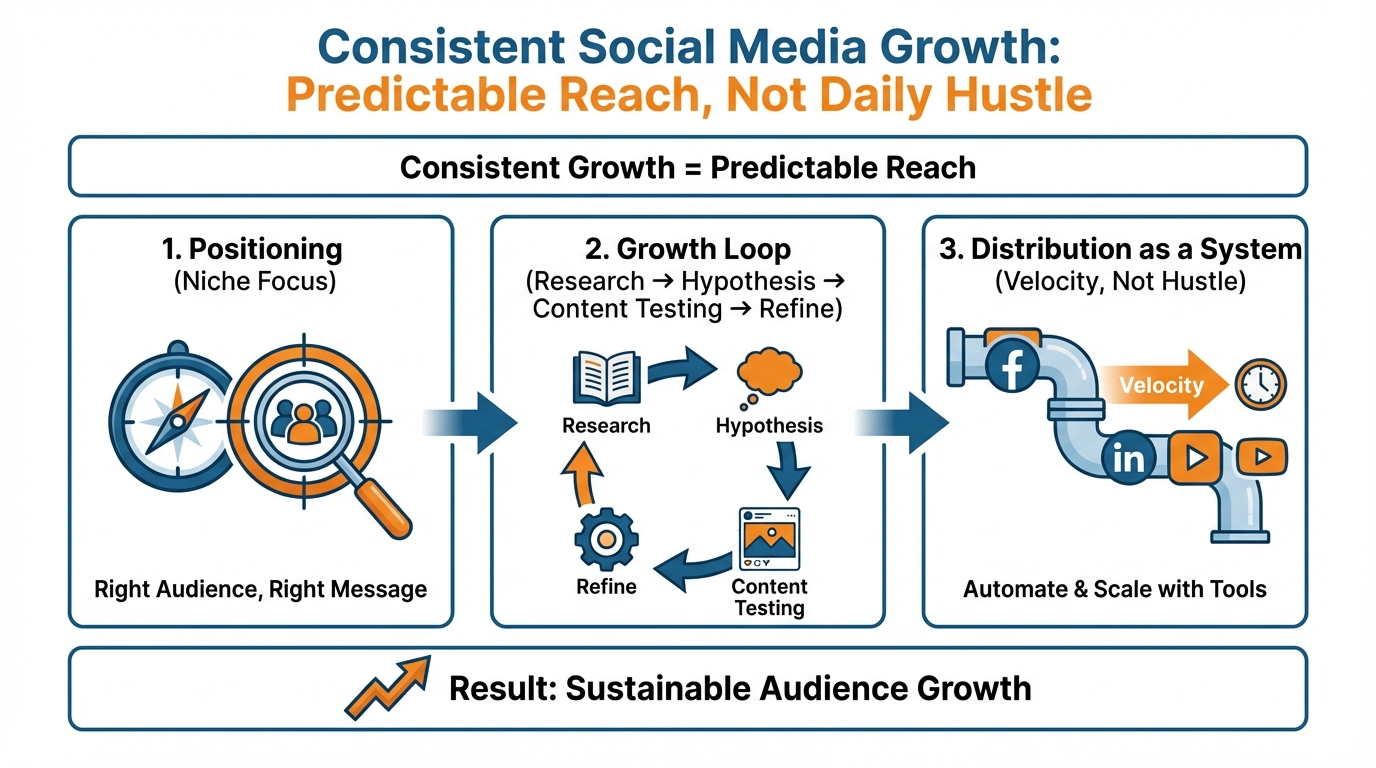
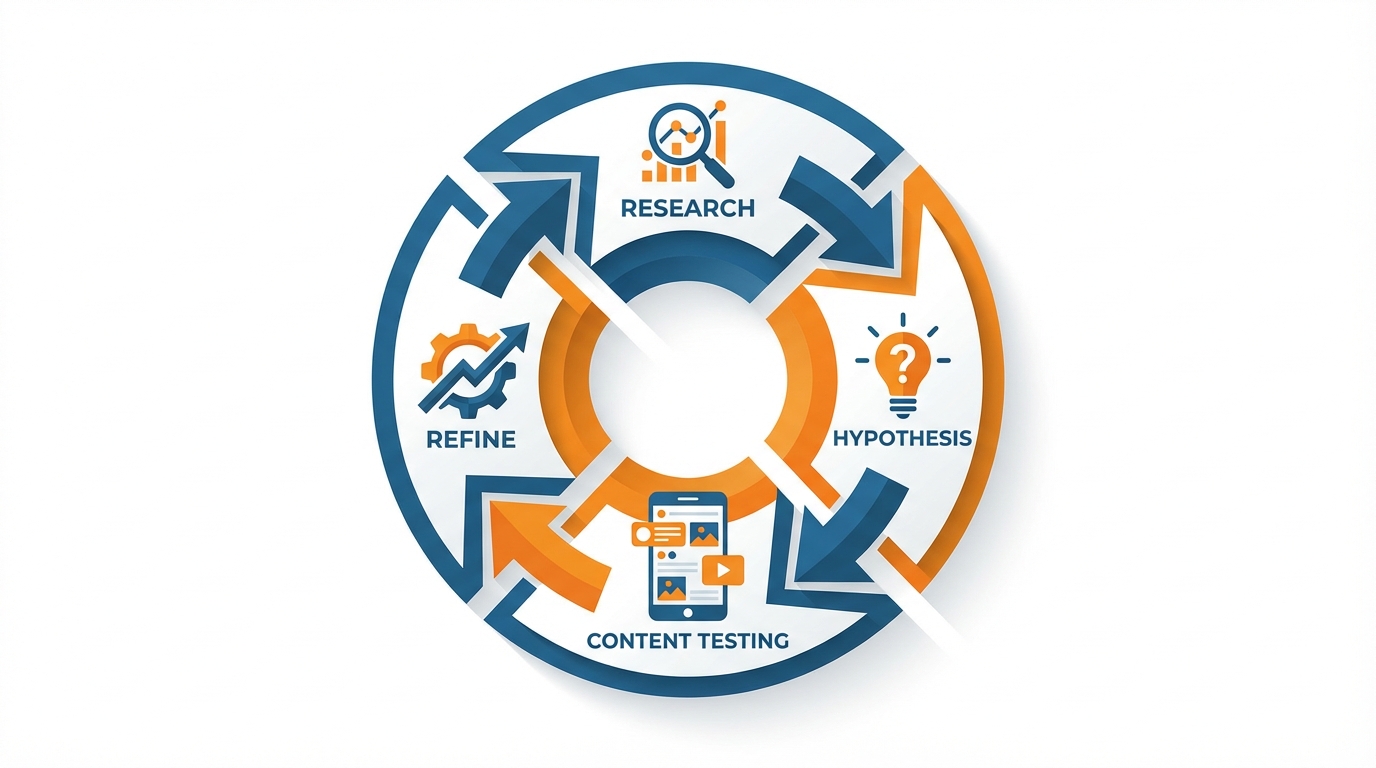
Form a growth loop: research → hypothesis → content testing → refine
If you’re posting blind, you’re just active.
Want to know how to gain followers on social media every month?
You need a cycle where you can turn engagement into inputs: study what’s working, form a hypothesis, test it, and adjust based on the results.
Use research that’s already been done for you: comments and DMs, content that your competition keeps pushing out, search queries (check out what appears in autocomplete, and recurring questions), and typical customer concerns pre-purchase.
You may find that saves, shares, and profile visits are more valuable intent signals than likes, because they’re precursors to later actions, not merely in-the-moment affirmations. This is also why it helps to understand vanity metrics versus signals that move the business; see vanity metrics.
Second, funnel that research into a hypothesis that’s simple to test.
Instead of “I should post more often”, try “I believe that if I post a 5 minute tutorial on [topic] with a counterintuitive headline, that I’ll get 20% more saves and 10% more profile views than my median performance in the last 10 posts in this lane.”
I say median performance, because you don’t want to compare to your top 10% post (outliers skew your direction), and I say last 10 posts because you want to compare apples to apples.
As a small business, you can attach a hypothesis to your real sales data; for instance, “When I post things that include [outcome] in the headline, I get more clickthroughs from people who are actually prepared to buy.”
Then conduct experiments like a scientist, not a gambler.
Test one thing at a time for long enough to get signal:
- Same topic, three different hooks.
- Same hook, two different formats.
A real-world minimum here is 6 to 12 posts in the same lane, because most platforms are so volatile from day-to-day that they can skew the outcome by 30% or more without anything actually changing.
I’ve watched accounts double their results just by identifying the best-working post structure, then posting five versions of it with different examples, because algorithms love patterns and audiences love familiarity.
Lastly, repeat by building a library of winners, not trends.
When you find something that wins, don’t sunset it.
Instead, make it a repeatable template and systematically publish derivative versions of it until it stops performing.
This is where I think a tool like WoopSocial can be useful in a targeted way: If you know your winning lanes, hypotheses, and templates, being able to produce a month’s worth of consistent variations quickly helps you stay in testing mode, rather than having to continually start from scratch. If you’re experimenting with templates by platform, an AI Instagram post generator can support fast iteration.
Consistency is a matter of stacking on wins, and your results become predictable when every week, you generate new evidence to lean on.
Think of distribution as a system (rather than a nice-to-have)
If you’re interested in how to grow your social media presence every single month… Don’t expect the platform to do the work for you.
Algorithms optimize for velocity, not hustle, and velocity is created with a distribution strategy.
My mental model is this: Treat every piece of content as invisible unless you have a systematic way of delivering it to the audience that has already opted-in to consuming it.
Otherwise you are relying on the For You page, Explore page, or newsfeed algorithm every single time you press “post”.
Stack these strategies into feedback loops that give you repeated exposure.
Rather than scattered interactions, you’re on the same high-leverage periscope every week: same discussion threads your target audience (and adjacent influencers) already frequent, same high-response-rate threads, same audience-overlapped content creators.
Partner content is most effective when it’s reciprocally based on distribution rather than doing a solid: you provide the content, they provide the audience, you both distribute the content, and you both gain trust faster than you would’ve individually.
I’ve seen small accounts gain more targeted followers off of one partner post than a month’s worth of content, because the audience is targeted and the attention is already primed.
That’s how you make distribution an evergreen, not a tactic.
You should have one list of people, pages, newsletters, podcasts, Meetup groups, communities, etc. that you know will share your content because they share content like yours.
And you should have a second list of people you’re trying to turn into the first list.
It’s quality over quantity: 25 really good distribution channels is better than 500 mediocre distribution channels because the more someone sees your work, the more they’ll recognize you.
Recognition is what gets clicks, and bookmarks, and emails.
This is how you keep growing when algorithms shift: your distribution isn’t just algorithmic, it’s based on other people.
To make this sustainable, decouple the content production from distribution execution.
You get into a weekly cadence where each post has a second push planned: a partner share, a community seed, or a conversation you need to start with a key insight pulled from the post.
And if you use WoopSocial to generate lots of versions of a successful idea that fit your brand even more quickly, the ultimate benefit is that you can use that time to grow and maintain distribution assets, and each post begins with leverage, not a prayer. If you want more on removing manual publishing friction, see social media auto publishing.
Algorithms also shift around how much engagement is available per post and per platform, so it helps to track wider benchmarks: Sprout Social analyzed 3+ billion messages from 1+ million public social profiles and reported that brands published an average of 9.5 social posts per day across networks in 2024 in their 2025 industry benchmark breakdown.
Automating consistency using an operations pipeline (and some magic automation)
Want to figure out how to get consistent social media growth? Quit using willpower and start using workflow.
Consistency becomes attainable when you eliminate the need to decide what to do each day and instead just run an idea through a workflow process to produce multiple pieces of content.
The silent killer for small businesses is context switching: each day you spend the time deciding “what should I post today?” you’re losing time, creative power, and confidence.
An operations pipeline eliminates this by systematizing the way ideas become content, meaning you can produce more, without the expected decrease in quality that comes with trying to publish more.
Let’s break the pipeline down into four steps: ideation, batch production, repurposing, and scheduling in bulk.
The first one is ideation, which means that you are just gonna sit down, think about what you wanna say, and I highly recommend that the majority of your ideas come from your positioning lanes and questions your customers already ask you because that’s a bottomless well that’s been proven.
Batch production is where you sit down and create a bunch of content in one go, which saves you time because you’re already in the mindset of the topic, already in the mindset of the tone, so it takes less time to actually produce.
Repurposing is where volume really gets simplified, because you can take one idea, turn it into a short video script, turn it into a carousel, turn it into a text post, turn it into a quick tip, and the algorithm is gonna reward you for that, because it helps the algorithm to understand how to categorize you.
And then scheduling in bulk removes the pressure of having to do it every single day, and also means that you don’t fall into the trap of only posting when you feel like it. If you want a companion framework for the calendar side, see social media content calendar.
To maintain the quality as you scale, you have to approach your content as an assembly line with quality control, not as a creative journal.
Here is a simple rule I apply: each piece of content must pass two tests, before I publish it.
Is this clearly aligned with one lane?
Does this clearly promise one result in simple terms?
This alone reduces random posting and makes your content feel consistent, which increases returning audience members, and returning audience members is one of the top indicators of whether your content is predictable and not just lucky.
If you do this, then consistency stops being a matter of motivation, and starts being a repeatable weekly function, which is precisely what you need as a small business, when the client work gets hectic.
That’s where low-maintenance automation comes into its own.
Not to do the planning for you, but to make it easy to do the planning and posting so you can follow through even when time is tight.
If you can get 30 days’ worth of on-message ideas in your categories in just a few minutes, and lay out a content calendar of posts across all channels in a single sitting, you’ve shielded your throughput from the biggest time-killer of all: distractions.
I’ve relied on WoopSocial for that sort of straightforward efficiency, to produce ideas that are still on-brand and then batch them into a schedule so they run without me needing to tend to them during heavy weeks.
Platform averages and behavior can also influence what “consistent” looks like: Dash Social reported an engagement rate of TikTok 5.0% vs Instagram 3.6% vs YouTube 3.4% (using the same engagement rate calculation) in their 2025 cross-platform benchmark report.
That’s a wrap: Growing your social media presence every day is a skill that you can systematize
Curious how to maintain a consistent social media following?
Quit measuring your work ethic and begin measuring your system on weekly optimization.
Your discipline is unreliable because it’s tied to your mood, client load, and circumstances.
Your system is dependable because it converts an unpredictable medium into a manageable machine: stronger messaging, narrower content buckets, cleaner delivery, and standardized testing.
Your weekly objective isn’t to publish more content, it is to refine your conversion rate between impressions to saves, profile views, website visits, and lead generation, because these metrics are most closely correlated with small business income.
I think about my social content as running a weekly ops meeting with a single KPI: median results, not my top performer.
I also try to think about staying in a single lane and changing one thing every 6-12 posts so that I have enough signal to learn something in a pretty noisy channel (e.g. the number of people who see your content can fluctuate by an order of magnitude day-to-day without anything actually changing).
When I began measuring this way, I no longer felt too flooded by the noise and started creating templates that beat my median.
And these templates have a compounding effect: your median result improves, your worst results improve, and the algorithm’s job of figuring out what to do with you gets easier.
Next, you minimize the role of luck by creating distribution flywheels to rig the outcome before hitting the publish button.
You do this by having scalable channels where your audience is already waiting and scalable allies who can bring your work to the perfect audience, giving you a boost without relying on the whims of the Explore page.
The most reliable flywheel is mutual: you build something that rewards a collaborator for sharing it, you both distribute it, and you both build trust faster than you would on your own.
For small businesses, one well-chosen share by a key partner can achieve more than weeks of mass posting because it bypasses the cold-start problem and drops you straight into a warm audience.
Last, make your process fit your months by moving content off your back to a funnel you can execute even when you’re busy, with content quality assured.
You should be able to content batch once and produce a content chunk that’s associated with a channel and objective, then fill your weekly content hours with message tuning and planning the next test, not filling up your feed.
If you need to reduce the production time and still maintain the message, I’ll occasionally use WoopSocial to quickly batch a month’s worth of ideas, with one voice, so I can redirect that time to the work that drives predictable results: planning, distribution, and iterating.
When you do this, consistency stops being a motivational challenge and starts being a machine you can optimize every week.
When you’re sense-checking performance, broader public benchmarks can help calibrate expectations: Socialinsider shows platform averages changing year-over-year (for example, average likes per post on X going from 40 to 15 from 2024 → 2025) on their up-to-date social platform benchmarks page, and HubSpot found that 30.9% of marketers post multiple times a week (most common cadence) in their posting frequency experiment. Audience behavior shifts matter too: Pew Research Center reported that the share of teens using Instagram “almost constantly” increased from 8% (2023) to 12% (2024) in their 2024 teen social media research.
Related reads
4/27/2026
B2B SaaS social media benchmarks: Set the right targets.
B2B SaaS social media benchmarks: Set the right targets. The trouble with defining B2B SaaS social media benchmarks is that it's an inherently impe...
4/25/2026
Building a personal brand as a technical founder (without becoming a creator)
Building a personal brand as a technical founder (without becoming a creator) Creating a personal brand as a tech founder should feel less about ma...
4/20/2026
Creative Post Ideas for Sustainable Brands (That Don’t Sound Greenwashy)
Creative Post Ideas for Sustainable Brands (That Don’t Sound Greenwashy) That’s not what creative post ideas for sustainable brands should look lik...