Saves: The Best Instagram Metric for Small Businesses
Saves: The Best Instagram Metric for Small Businesses I used to think of likes as the scoreboard. When I reached a certain amount, I knew it was a...
Saves: The Best Instagram Metric for Small Businesses
I used to think of likes as the scoreboard. When I reached a certain amount, I knew it was a successful post. When I didn’t, I tried a new hook, caption, format, etc. But the more I worked with small businesses, the more I realized how often posts that performed well in the moment didn’t move the needle on growth, leads, or sales. Instead, posts that performed well in the moment weren’t the ones that brought us success. It was the posts that people saved to come back to later. This is why I think Saves are the best metric for small businesses whose objective is to make Instagram a key revenue driver:
A save is when someone saves your post. As in, for later. For later reference. Because the information is valuable. That’s the difference between a save and a like or a comment or a view. You can like something by accident. You can comment out of social obligation. You can view something because you saw it in your feed. But you can only save something because it’s worth keeping. Because it’s worth coming back to. Because you have some intention of using it. When you save a post, you’re telling its creator that it was worth saving. You’re telling Instagram’s algorithm the post was worth saving.
If you’re trying to develop a content strategy that has some semblance of longevity, you need to start creating posts that people will save. Not like. Not comment on. Save. If you need a practical way to systematize that, use a social media content calendar so you can repeat the types of posts that earn saves.
Here in this post, I’m not going to give you some fluff about how saves are more valuable than likes. I’m going to give you the straight facts and tell you some anecdotal evidence. I’m going to give you a handy guide for when saves are more and less important based on what your objective is and what type of content you post. And I’m going to connect the dots between saves and what you’re really interested in as a small business owner: reach that extends beyond the 24 hour mark, better followers, more profile visits, and more repeat visitors when they’re ready to make a purchase.
Saves
Why Saves are the most important IG metric for understanding intent (not vanity)
Saves are intent manifest.
If a person saves your content, they are not just responding to it, they are making a plan to do something with it later: read, purchase, use, or share.
This is why saves are more important for small businesses than almost any other visible metric.
People like as a reflex, but save as a plan.
So, if you want to know if people are holding onto your content, pay attention to what they save, not what they tap while scrolling.
This psychology is important, because saving is a mix of self-protection and self-signaling.
People save to derisk, like I’ll come back to this when I need it because deciding now is too costly.
They save to signal, like this is who I am or who I want to be, which is why brand fit educational posts can accumulate saves even if the comments are empty.
And they save for utility, like this will be useful to me, which is the quickest way to become the account they think of when the problem arises.
That’s the intent you can build a business on.
This is also why saves are a better leading indicator for content-market fit than likes. A like is a response; a save is a hold.
The most qualified profile visits and lagged DMs I see in the data I look at always correspond to posts with a high saves per reach ratio, because they continue performing beyond the first impression. If you want the broader system behind that, this ties directly into social media automation as a way to keep publishing the kinds of posts that keep getting saved.
You should begin to interpret your saves as a hold metric: if your saves rate increases and your likes rate remains the same, you are typically becoming more useful to the right people, even if your vanity metrics aren’t acknowledging it.
Use saves as your guiding metric with educational, tactical, evergreen, and problem-solution content, since that type of content is meant to be utilized, not simply read.
You will inherently see a lower save rate on entertaining content, brand journalism, or timely news, but that does not necessarily translate to a content failure; it’s just a different objective.
With those content types, you should look to shares, comments, and completion, but when you need to generate leads and sales, look to optimize around the moment when the reader decides to save your content.
As context for what “normal” looks like in the wild, the average saves-per-post figure in Dash Social’s 2025 Instagram benchmarks shows “Saves Per Post” = 521* (customer data only), alongside “Shares Per Post” = 1.0K* and “Reach Per Post” = 222.6K*, which helps frame saves against other distribution signals.
The reason why Saves are the most important metric on Instagram, by surface
(What we know and what’s speculation).
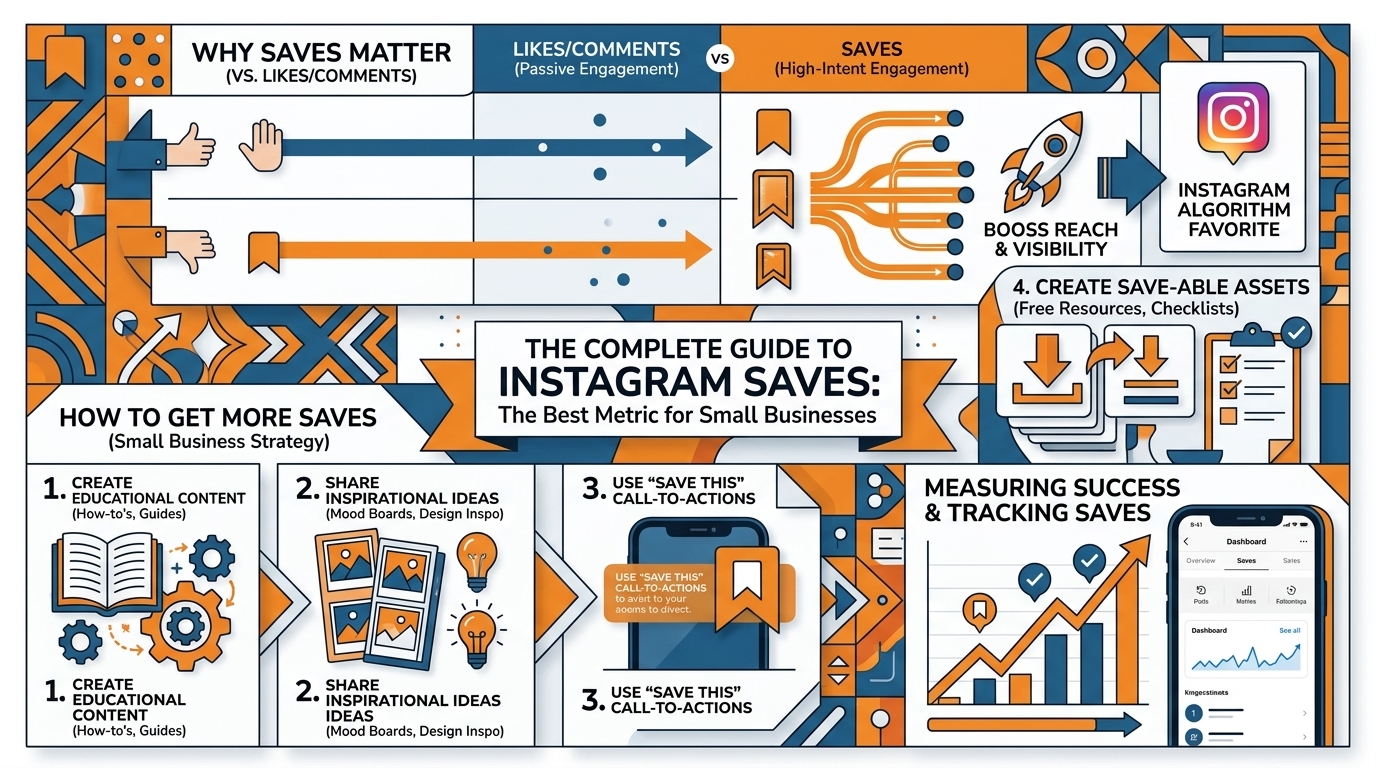
Instagram has been fairly explicit about the fact that it uses signals for ranking that predict what users will do next: dwell, interact, and return to do it again.
Saves occupy a strong vector in this context, because they’re intentional and show intent for the future rather than the past.
I can say this: Instagram talks about ranking as a prediction problem, and saves are one of the best visible evidence that your post delivered enough value to be retained for later.
I can’t say this: that saves always represent the number one factor, everywhere, because Instagram rarely publishes relative weightings by surface, and the industry typically fills the knowledge gap by loudly and opaquely guessing away.
I treat saves as a quality signal with repeatable business logic, not as an algorithmic cheat code.
How saves play a part: Obviously, the importance of saves varies depending on where you are getting evaluated.
On the home feed, saves are key because they predict enjoyment and whether or not someone will want to see something again, which ultimately give your post more opportunity to be displayed to other users and the same user again.
In explore, discoverability is the name of the game, so saves are helpful as a validation mechanism, but they are largely battling against other signals that scream wider appeal (such as shares and engagement velocity.)
On Reels, watch time, replays, and completion rate often carry more weight for distribution (because a Reel can perform with relatively low saves if people are watching it); saves still carry weight, but they are rarely the only lever to push. For example, Reels “gain the most reach and impressions” with a 33.83% impression rate (as reported in that Instagram statistics roundup), which helps explain why watch behavior can outrank saves on that surface.
On your profile and grid, saves play a role I think people under-appreciate: they make your content more likely to be revisited (which drives profile return behavior and causes your grid to become more of a library than a gallery.)
The metric I’m optimizing towards is straightforward: saves is how you get a second look and a second chance.
When you produce save-worthy content, you’re giving people a second reason to return, and that second visit usually translates into the engagement that SMBs are looking for: someone coming back to a saved price tip before they message, someone sending a saved checklist to a co-parent, or someone returning to your page when the decision actually gets priority.
I’ve observed it time and again in the metrics: posts with a higher rate of saves per reach are later generating secondary waves of profile visits and DMs, because when the reach dies down on the public page, it remains in a personal archive.
Finally, to the counterpoint that likes matter more: likes totally matter, for quick feedback and reach, and I still use them as a directional indicator.
I just will not allow likes to be the KPI that I make my content decisions around, because likes are cheap and saves are expensive.
My balanced take for you here is this: saves are your most reliable engagement metric for informative, tactical, evergreen content where you want leads and sales down the line, but you cannot ignore the fact that distribution can be more of a function of shares and watch time, particularly in Reels.
If you want a scoreboard that is closer to income, saves are probably the closest thing that Instagram has to offer, but you stack the deck to win faster when you use them in conjunction with the metric that most accurately represents the channel that you are competing in.
Why Saves is the most important metric to track in Instagram (as long as you track the right saves metric)
Saves are the best metric for the simple reason that, while saves don’t necessarily outrank every other signal, they’re the best indicator that your content was worthy of a return visit.
The problem I see is that people are sharing generic advice to calculate Save Rate as one all-encompassing metric. Some say divide saves by impressions, others by reach, and then they go ahead and compare the rate of a Reel and a carousel and share that as a benchmark.
This is why you end up optimising the wrong thing: it’s possible that you’re not actually worsening your content performance, you may have just changed the format, content type, or even the audience source.
If you want saves to inform business-critical decisions, you should be working with a saves metric that is relevant for the question you’re trying to answer.
Want to know your value per unique viewer? Use saves/reach.
This is my go-to for static posts and carousels because it asks me a very harsh question: out of the people who actually saw it, how many thought it was worth saving?
For content that can be rediscovered or re-viewed, I look at saves/impressions, because that will tell you whether the content becomes more save-worthy over time, not just on the first view.
And I look at saves/likes for a quick snapshot of usefulness versus popularity.
If that number keeps going up, it often means you’re posting things that don’t look so great in the moment but are really the things that people come back to your profile for later and DM you about.
I’ve had posts with mediocre likes but a high saves-to-likes ratio that still generated leads weeks after the reach had dropped off.
For that apples to apples comparison, make sure to also break it down into the following buckets:
- Reels vs. carousels: Because Reels can get impression counts based on replays, it’s not always fair to compare them to carousels. Break that out.
- Topic cluster: A pricing guide is going to have a very different save rate than a behind-the-scenes Reel, even if both are high quality. Break it out.
- Followers vs. non-followers: Cold audiences are going to have a different save rate than warm audiences. Non-followers are going to need value and authority before they save, whereas followers will save because they already trust you and need the content for later.
And this is where saves can become your secret small business weapon: Instead of obsessing over just one viral metric, you’ll be creating an indexed library that converts. If you want a clean structure for that library-building approach, this aligns with a weekly social media system so you can keep compounding the posts people come back to.
What is considered good is not some percentage you find online.
The only benchmark that you should be using is the one that you’ve created from your account, because your niche, offer, audience warmth, and content types are different.
Create an internal benchmark from your last 30-90 days: choose one content type, and one saves metric, and find your median and top quartile, so you have an idea of what is considered “normal” and “great” for your account.
Then, when you run a test post, you’re not hoping and praying that it did well, you’re determining if it outperformed your baseline, in the exact conditions that your account exists in.
Let's get real here.
When it comes to Instagram metrics that actually impact business outcomes, Saves reign supreme (and I'll show you why).
The reason saves are the best IG metric is simple: a save is a delayed action, and almost all business outcomes on Instagram are delayed action.
Almost all the advice out there treats a post as if it either worked in the first 24 to 48 hours or it failed, but saves operate on a different timeline.
When someone saves your pricing breakdown, your checklist, or your before-after breakdown, they aren’t congratulating you, they’re just bookmarking you for when the issue becomes critical.
THAT is the disconnect: if you measure saves using the same timing window you use for likes, you’ll never see the actual impact and you’ll conclude the content did nothing.
If you want to tie saves to results, you have to measure like a business, not like an artist looking for immediate validation.
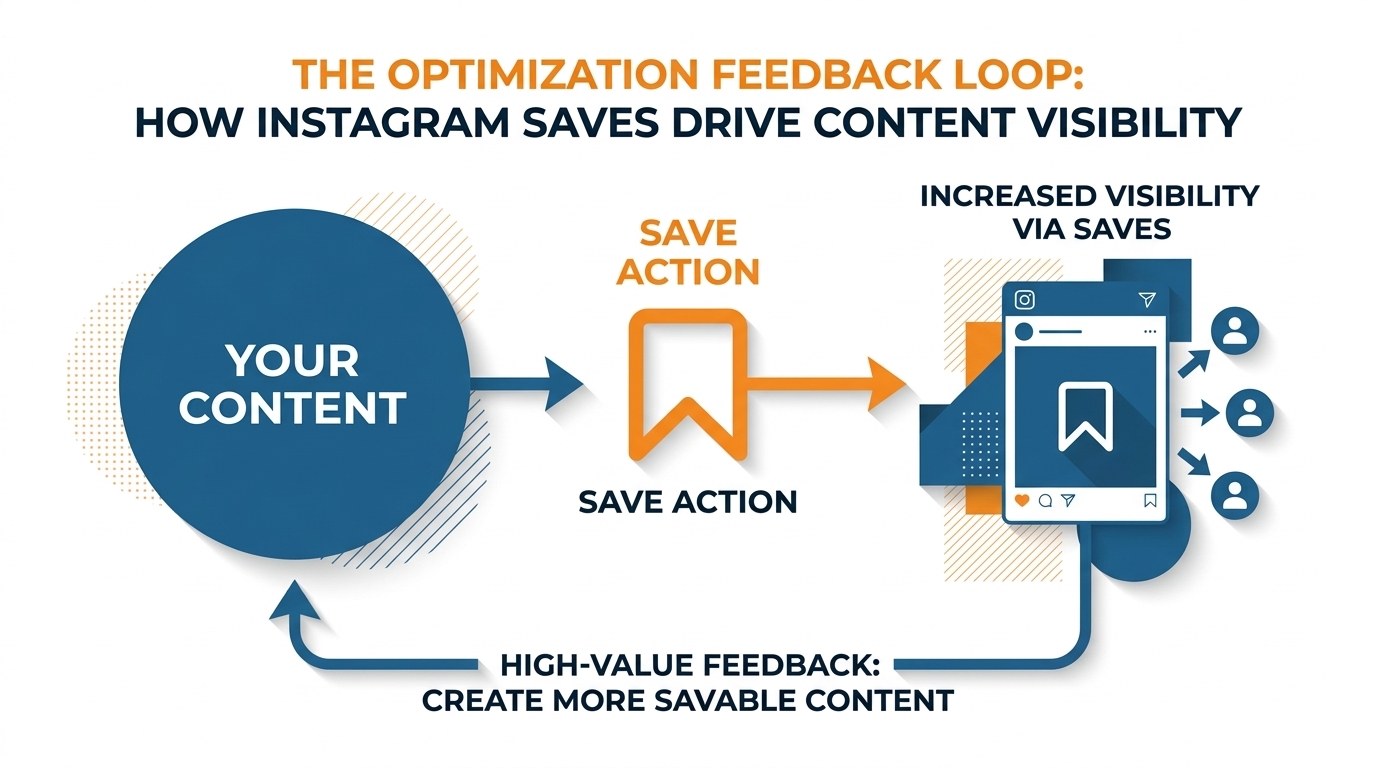
I label each post that hits my first quartile for saves by reach, then I monitor the subsequent 7-30 days for: profile views, website clicks, DM opens, email signups, and assisted conversions where Instagram was not the last-click but obviously appeared somewhere in the funnel. If you want to make that “assisted conversions” part cleaner, pair this with a UTM setup (see WoopSocial’s UTM generator) so you can track Instagram links consistently.
Then I cohort analyze for fairness: high save posts versus low save posts with the same content and formatting, posted to the same audience under the same conditions, so that I’m not attributing content strength to formatting bias or timing.
Across a few different small business accounts, the high save cohort always seems to generate a second spike in profile engagement days later, and it’s that second spike where the qualified conversations and site intent happen. In another benchmark dataset, an Emplifi 2024 benchmark recap notes Instagram improved 9% in brand post interactions per 1,000 impressions in the final two quarters of 2023, and that the dataset spans 325,000+ brand profiles across Instagram, Facebook, X, and TikTok-useful context for why intent-driven signals matter at scale.

A save becomes money in the bank only when you plan for what happens after the save.
And you do that when you make the post actionable, so the save is valuable, and then you make the next step clear: tell people what to do next, make sure your profile delivers on that next step immediately, and keep your positioning clear so that when people save your posts, they add up to a reason to buy from you.
If you offer a service, your posts should funnel people to one of three next steps: get a quote, get a diagnosis, or get on a call.
So the save isn’t an end point in someone’s saved posts.
Saves compound in ways other metrics do not, since they create a library for your audience and a bookshelf for your profile.
A single reference post can continue to gain traction long after the reach dies down because it continues to get resurfaced through saves, through private messaging, and through profile visits when ready.
You avoid over-optimizing for saves by balancing it with the metric that corresponds with your objective: if you want value that gets people to return, focus on saves; if you want discovery, balance saves with shares; if you want conversion, balance saves with DM starts and website taps.
That’s how you use saves as a business tool, not a vanity metric.
O Fim
The reason Saves are the most important metric is that the save is the most overt indicator someone received enough value from your content to save it.
Anyone can like anything. Anyone can comment on anything. Anyone can accidentally watch anything. But not everyone will save something.
And if they do, it’s because you’ve provided value to your customer as a small business. You’ve either helped them solve a real problem, answered one of their buying questions, or given them a process they think they’ll be able to replicate later.
Second, you’ll move faster if you use saves as the default KPI, not the sole KPI.
Some post types are optimized for other things: A Reel can rack up wins via watch time and shares even if it doesn’t get many saves, and a community prompt is a success if it drives comments and DMs.
That’s not a post that you want to force into being saveable.
It is, however, a post where you want to start with saves as your core signal of intent-driven growth, and then add the relevant metric for whatever that post’s purpose is.
A big part of winning in the future is planning and accurately measuring intentional content that you expect people to save.
And, measure it in the right proportions so you can make comparable decisions: Saves per reach to determine value per unique eyeball, saves per impression to determine value per repeat eyeball, and saves to likes to quickly determine usefulness vs. popularity.
If you do this, you aren’t chasing the one-offs, and you’re growing a content base that generates repeated value to those who matter most: your potential customers.
Then attach saves to business outcomes: use a time frame larger than 24-48 hours, and observe lagging metrics that demonstrate saves are translating to business value: subsequent profile views, website clicks, DM convos, and questions that come days or weeks later.
I view posts that get lots of saves as products that continue to sell past the initial minute, and you can use this same approach to see what types of content gets saved, create more of it, and measure if the saves yield the outcomes you need later on.
For additional benchmarking context, the Dash Social 2025 Home industry Instagram benchmarks list “Saves Per Post” = 663* (customer data only), alongside “Reach Per Post” = 119.5K* and “Shares Per Post” = 623*, and an example Instagram performance PDF report shows “Impressions” = 841,354, “Engagements” = 38,216, “Saves” = 464, and “Average Saves per Post” = 1.07-useful examples of how saves can appear in real reporting.
Related reads
4/27/2026
B2B SaaS social media benchmarks: Set the right targets.
B2B SaaS social media benchmarks: Set the right targets. The trouble with defining B2B SaaS social media benchmarks is that it's an inherently impe...
4/25/2026
Building a personal brand as a technical founder (without becoming a creator)
Building a personal brand as a technical founder (without becoming a creator) Creating a personal brand as a tech founder should feel less about ma...
4/20/2026
Creative Post Ideas for Sustainable Brands (That Don’t Sound Greenwashy)
Creative Post Ideas for Sustainable Brands (That Don’t Sound Greenwashy) That’s not what creative post ideas for sustainable brands should look lik...