Social media consistency: build a system, not a streak
Social media consistency: build a system, not a streak When it comes to social media consistency, the question is almost never how do I post more?...
Social media consistency: build a system, not a streak
When it comes to social media consistency, the question is almost never how do I post more? The thing that will actually move the needle is how can I show up predictably for my audience and the algorithm week after week, month after month, without falling apart the second my business gets busy? I’ve never met a small business that fails on social because they don’t have any ideas. I’ve met a lot of small businesses who fail on social because they’re dependent on motivation, and motivation is a terrible operating system for content.
When I say consistency, I’m talking about three things specifically: a sustainable frequency you can maintain, standardized templates that eliminate the need for daily planning, and a long enough lead time to avoid disappearing during the crazy weeks. That’s what makes it a system, and a system is what compounds. (Buffer’s studies show that consistent posting can lead to as much as 5x more engagement from brands that don’t adopt it, and the reason isn’t hard to grasp: it gives you more at-bats to figure out what works, not just more at-bats.)
Here, you’ll get actionable instructions to get to the root of your consistency problem, how to create a content pipeline that works for a small team or solo founder, how often to post on each platform, and the handful of metrics you need to keep on track even when life intervenes. You’ll have a clear idea of what you should do next, what you should stop doing, and how to make consistent posting feel boring in the best way possible.
To support realistic cadence planning, you can use benchmarks like cross-industry social benchmarks from a 5M-post dataset (it analyzed more than 5 million posts and 9 billion likes/comments/favorites across Facebook, Instagram, Twitter, and TikTok) or a 70M-post benchmark library across major platforms (based on analysis of 70M posts across TikTok, Instagram, Facebook, and X).
1. Identify the real reason you keep falling off (a fast diagnosis that alters the solution)
Want to master the art of social media consistency? Then quit pathologizing inconsistency. Start diagnosing it.
In SMBs, it’s almost always one of these:
- Lack of ideas
- Lack of time
- Perfectionism
- Lack of positioning
- Posting at random
- Low returns (early)
- Waiting on others’ approval or feedback
All of these kill consistency. In different ways.
If you have a lack of ideas, you’ll start (and stall) when your ideas run out.
If you have a lack of time, you’ll post in the slow periods, and disappear in the busy ones.
If you have perfectionism, you’ll move too slowly to maintain your chosen frequency.
If you have a lack of positioning, you’ll never know where to begin, so you’ll procrastinate.
If you have low returns (early), you’ll drift to a stop, even if returns in the early days are noisy and lagged, by weeks.
Here’s the diagnosis that actually solves the problem: symptom → cause → fix.
Symptom is what you see on the calendar, like I posted three times and then went dark for two weeks.
Cause is the bottleneck, like it takes me two hours per post because I invent the angle every time.
Fix is the smallest system change that removes the bottleneck, like defining three repeatable topics and posting rough drafts in 30 minutes.
That’s how you avoid the default advice of just being more disciplined.
I do this because two businesses might look the same in an inconsistent way from the outside, but require completely different fixes from the inside.
Do you need less platforms, less formats, shorter production cycles, or a smaller topical focus?
There’s just one thing you need to know: you can only produce as much content as your slowest step.
When you’re spread over three platforms, your slowest step is context switching, so fewer platforms wins.
When you’re mixing formats like video, carousels, and long captions, the slowest step is production complexity, so fewer formats wins.
When you’re spending days polishing, the slowest step is approval and perfection loops, so shorter production cycles win, which means publishing version one and iterating in public.
When your content feels random, the slowest step is decision making, so a smaller topical focus wins, which means choosing one clear promise, one audience, and a small set of recurring angles until your data tells you where to expand.
When I’m auditing a struggling account, the biggest leaps in consistency usually come from removing one platform or one format before we try to add anything new. If you need a process to verify what’s broken, this pairs well with a fast social media audit.
There is one rule for avoiding burnout here, and it’s straightforward: Consistency is a system problem, not a motivation problem.
Motivation can be fleeting, but a system can be relied on in a time of stress, and that’s what a small business is.
You want to get the number of decisions it takes to post as close to zero as possible: What to talk about? Already decided.
What does it look like? Already decided.
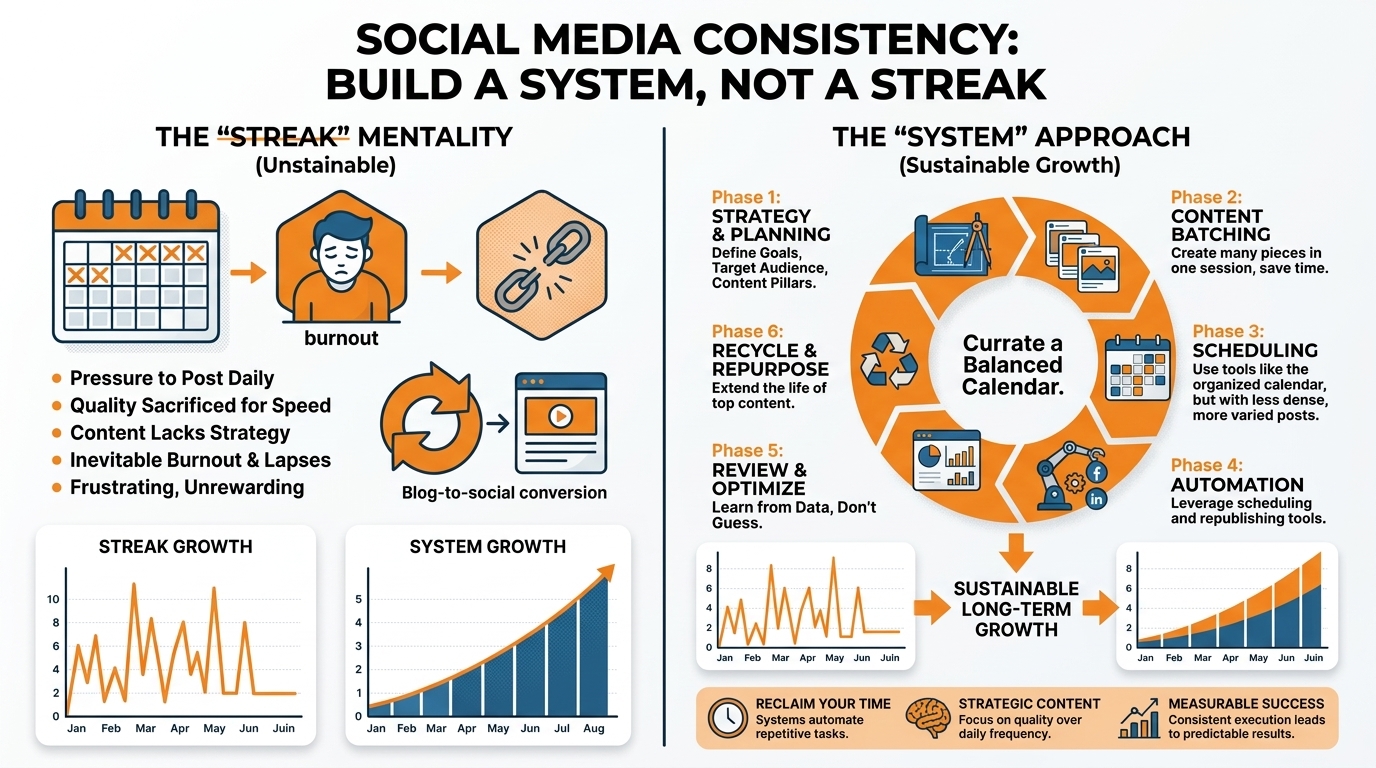
How long does it take? Already decided.
When does it go out? Already decided.
When you do that, consistency gets boring in the best way, and boring is what compounds.
And this is where a tool like WoopSocial can be a big help, in a very practical way: If your problem is that you don’t have enough ideas, or that drafting is too slow, and someone can give you a month of on-brand ideas and starting points to publish in minutes, then that helps remove the friction that kills your run. If drafting is your bottleneck, an AI social media post generator can speed up the “version one” phase.
4. Create a content pipeline that you can sustainably replicate
(consistency is key to something)
Want to know the secret to more consistent social media? Stop striving for brilliance. Start striving for repeat.
The best way to do this? Pinning down 3-5 content pillars that match what your customers are already asking, searching for, and thinking about. Not just what you feel like posting.
For a small business, my favorite content pillars mirror the buying journey. Namely: problems solved, how you solve them, proof it works, behind-the-scenes process, and objections answered.
Gut-check: if a content pillar isn’t helping someone decide, trust or buy, it is likely a vanity content theme.
Also, make sure each pillar is narrow enough to come up with 10 angles without breaking a sweat. Example: pricing transparency > tips.
Then, turn each pillar into a series, so you never have to start from scratch.
You’re not writing posts, you’re doing shows with a formulaic structure your readers come to anticipate.
So, maybe you’re gonna do one short myth-busting piece every week, one case study analysis piece every week, one “how-to” piece every week, all connected to your pillars.
I use series titles as a constraint, because constraints give you speed: once you set a series structure, the only question is, which example to do this week.
This is how you write more, without having to start from scratch.
Next, create a recycling flywheel that amplifies content from a core thought without coming across as repetitive.
For example, take a weekly anchor thought (e.g. most quotes are the wrong type for a home service business), and then segment it into different ways of looking at the same idea throughout the week (e.g. post 1: a quick post that describes the error, post 2: a simple checklist, post 3: a story about a real life example I’ve witnessed, post 4: a response to a common objection).
The secret is to vary the task each post performs, not just the language, and that is the key to keeping both the algorithm and the audience happy while you stay on theme.
A rough rule of thumb is that a healthy small business content pipeline can easily transmute 1 anchor into 4 to 8 platform-specific pieces, and that is how you scale content without scaling the stress.
Quality remains strong if you determine what’s “good enough” and decouple “thinking” from “making”.
Determine what your minimum viable bar is, something you can consistently clear, one key insight, one concrete example, one actionable takeaway, say, and eliminate everything that’s not necessary.
You should also “batch” the most difficult part of the process, which for me is always idea generation and curation, which I do in a single 45-minute session at the beginning of the week, before returning later for shorter bursts when my brain is fresher to handle the executional work.
And you can use subtle automation in the drafting phase, not the final content voice phase, sometimes I’ll use WoopSocial to create a first draft of a week of on-brand social media posts based on the description of a business website, then go back and humanize it by adding concrete examples, strengthening the hook, and personalizing the language to sound more like me (not a template). If you want to plan this more predictably, using a social media content calendar approach can help.
That way the work stays consistent, stays authentic, and stays manageable, which is the goal.
2. Set realistic platform-by-platform consistency (cadence tiers that match your capacity)
If you’re looking for advice on how to maintain consistency on social media, here’s a good place to start: stop thinking that every platform values the same things. Because they don’t.
LinkedIn seems to value weekly consistency, and POV-driven content, over pure volume, while Instagram and TikTok value content shape consistency, i.e. consistently returning to the same type of content shape that your audience understands in the context of Reels.
X seems to value session consistency: 15 minutes of engaging in replies and short-form posts in one sitting will typically beat a single, brilliant post every 3 days.
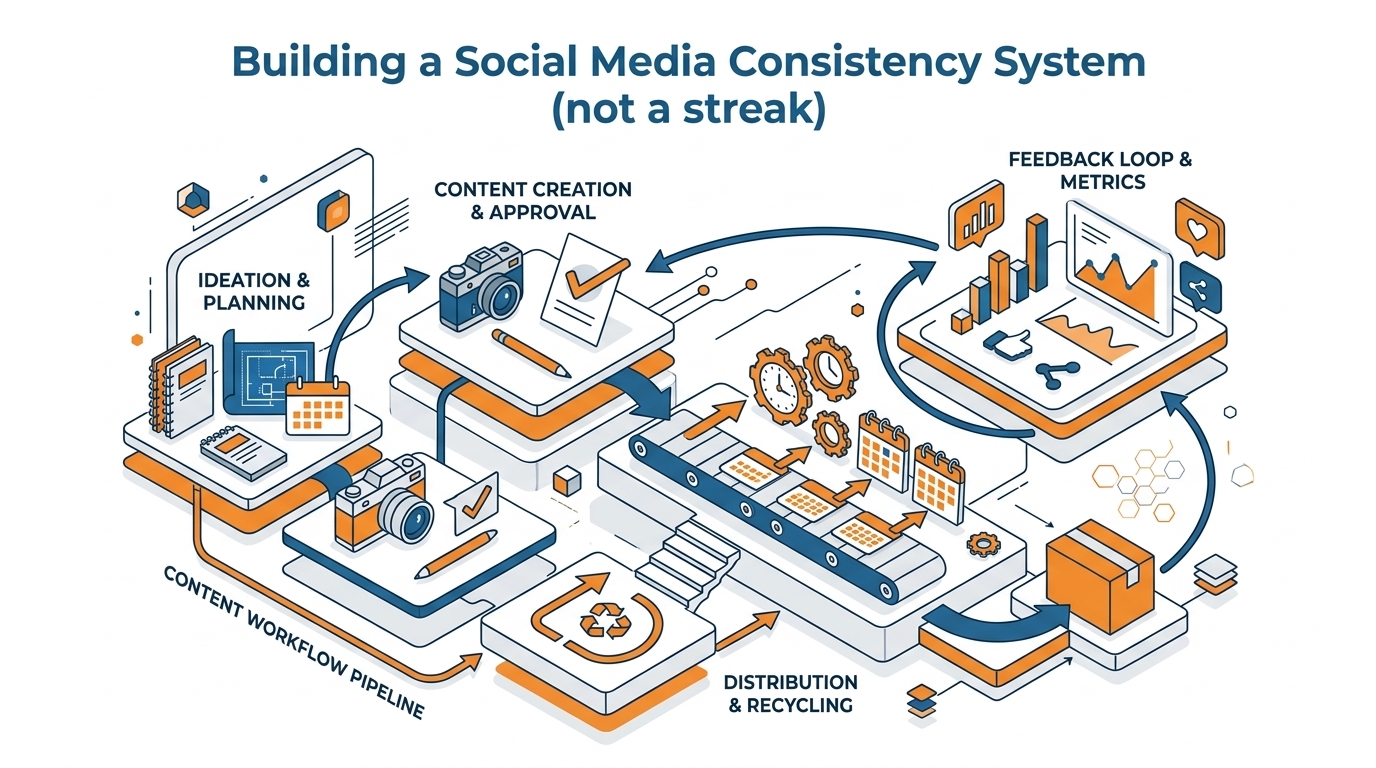
Figure out what the platform is valuing, and match that to your ability; pick the type of consistency that the algorithm seems to reward there, and build your rhythm off that.
Your consistency can be protected by deciding on a home platform where your best thoughts are able to be produced the most quickly and then only trying to keep 1-2 other secondary platforms going through recycling.
When things get busy, this is the decision that will keep you from disappearing on every platform.
For instance, I will typically decide that LinkedIn is going to be my home platform when I’m able to create quickly and then recycle my idea for an Instagram Reel script and a short X thread without having to recreate the entire message. If you’re actively building there, you may want to understand the LinkedIn algorithm in 2026.
You need to decide what your home platform is by asking yourself one thing: where can I consistently deliver a v1 in less than 30 minutes?
That is the platform that you can stay consistent on even during busy client weeks.
Second, define cadence tiers so you won’t have to haggle with yourself mid-month about when you can fit things in.
Lean bandwidth is what it takes to keep yourself top of mind without doing anything too deep: 1 meaty piece weekly on your main platform and 2 quick spin-offs, plus one short engagement period (commenting, etc.) or two.
Standard bandwidth includes a standing series post: weekly “case study of the week,” “fact of the week,” something like that.
Series require much less thinking than they take time to do, so they net out to being a time saver.
Aggressive bandwidth isn’t just posting more frequently: it’s posting on more media: you add in a higher-production post like a short video, a few more community comments, and one more long-form anchor that can be broken out into a few posts.
The important thing is that the tiers adjust the type of content and the workflow, not just the frequency, so you can shift between them if you need to.
Budget like an entrepreneur not an artist.
With 60 minutes a week you can support a single home-platform post, two repurposes, and a 10 minute ‘respond and engage’ burst, provided you have a template locked down.
With 2-3 hours you can produce a core concept, generate 4-6 native-platform formats and set them up for future posting so you don’t have to depend on daily motivation.
With 5+ hours you can add video, story depth, and more engagement without losing sales time.
If you require posting without daily time, block time in one go: I undertake a monthly ‘set it and forget’ session where I select 4 anchor topics, map them across my theme pillars, and load them up.
If you’re in the early stages where concept development and even basic template design are slowing you down, an end-to-end solution like WoopSocial might be worth exploring as it can quickly produce 30 days of on-brand starting points and pre-designed template for you to spend what precious time you have on examples, editing and posting.
Audience usage levels can also help you pick a sustainable posting rhythm: Pew’s teen social media and tech study (2023) notes that about half of teens use Snapchat and Instagram daily, while Pew’s updated report (2024) reports 96% of teens use the internet daily.
How to measure consistency (which metrics help you stay consistent, not just good)
Want to know how to improve social media consistency?
Stop measuring your progress by likes and reach, and start measuring the four metrics that can tell you whether you’ll still be posting a month from now.
- Week posted: because a week that’s perfectly planned and published doesn’t count as a streak if there’s nothing the week before and after.
- Cadence adherence rate: posts published divided by posts planned.
- Content buffer depth: how many days or weeks worth of posts do you have waiting in the wings?
- Production lead time: how long does it take, on average, from post creation to post publishing?
If you planned 12 posts, and published 9, you’re at 75%, and anything below 80% is generally a systems problem, not a discipline problem.
I consider 7 days a fragile buffer for small businesses, 14 days a stable buffer, and 21+ days a robust buffer during holidays, sales, or client emergencies.
If this number falls to the same day, all it takes is one busy afternoon to snap your streak.
The way you avoid getting off track is by separating consistency metrics from performance metrics and prioritizing them in that order.
You look at your consistency dashboard first to answer one question: is the machine running?
Then you look at performance, because performance metrics are noisy on a week-to-week basis and will fool you into tweaking your content before you’ve had enough time for patterns to develop.
Here’s a simple rule I follow: consistency metrics show you if your process is healthy, performance metrics show you where to optimize within that process.
This prevents you from going on the typical small business hamster wheel of chasing a viral anomaly, making your work more complicated, and then vanishing for two weeks because the new standard is too much to sustain.
When a metric falls, don’t adjust the goal; adjust the process.
If you’re missing your weekly pace, simplify the format or pivot to a series of posts with a standard format and simply swap out the example, instead of having to recreate the post each time.
If your buffer is getting thin, ‘batch’ the hardest part of your process, for me, it’s usually deciding on topics and a hook, and then ‘batch’ the execution, but make it easier and less time-consuming.
If you’re shortening the lead time (the time it takes to go from nothing to publish) then the blocks you’re building with are too large; either make them smaller, or make the drafting process faster.
When I need to rebuild my buffer, I’ll create a number of first drafts and then fill in the customer stories, objections, and evidence.
If you want the ‘draft’ phase to be almost instant, there are tools (like WoopSocial) that can get you a month’s worth of on-brand drafts in a matter of minutes, which makes it much easier to maintain your buffer without content creation taking over your life. If you want to quantify results alongside consistency, use an engagement rate calculator to track engagement trends.
The point of the monthly review cadence is to keep you consistent while increasing quality: 1 hour, once a month, no fuss.
You keep pushing the formats that allowed you to stay consistent with low lead time, because those are your compounding engines.
You kill anything that is regularly taking too long or making you miss weeks, even if it has the potential to do well, because those things will definitely fail when you’re busy.
Then you reuse what did work by converting your top few posts into next month’s pipeline as derivatives: same topic, different task, like one post is the myth, one is the checklist, one is the story, one is the objection handler.
Rinse and repeat and your consistency will stop being a personality quirk and become a competitive differentiator.
O Fim
So what is the secret to increasing social media consistency?
The truth is, that it has nothing to do with willpower.
Consistency is having a diagnosis, a content pipeline, a good rhythm, and measuring the right things.
If you approach it as a system, you will not get fooled by a busy week here and a low motivation day there and the noise of short-term results.
You just need to keep the machine going: publishing weekly, protecting the buffer, and monitoring a few consistency metrics that will tell you whether you will still be around a month from now.
The best way to become consistent is to commit to a lower frequency, sustainable system, and stack up some buffer while you try to do anything fancy.
Even if you don’t take anything else away, simplify your approach until you achieve a cadence adherence rate of 80 percent for four weeks, and then grow from there.
I’ve observed local businesses achieve better results by posting less frequently and more consistently, allowing the algorithm and your audience to finally establish what your regularity is and start rewarding it.
Want to lose friction fast?
The one session per month strategy is to choose 4 anchor subjects from actual customer inquiries, assign those to your central themes, and produce four simple versions of each that serve different purposes like myth-busting, evidence, checklist, and handling an objection.
Then stack a 2-3 week reserve to prevent getting derailed by one bad week.
As soon as your production lead time drops to same-day publishing, your consistency becomes vulnerable again, so treat the buffer like your cashflow: give it priority.
When you are ready to make it even easier, I suggest you try a system where your first drafts and your brand style are created at the same time, and you are left to add things like customer testimonials, data, and context, rather than starting from scratch.
I have used WoopSocial to create an on-brand monthly batch that helped me go from scratch to a fully loaded pipeline super fast, and then I only tweaked what I knew I could maintain.
And that’s the actual goal here, not to create more content, but to have a system that you can maintain in the background while you’re busy scaling your business.
Related reads
4/27/2026
B2B SaaS social media benchmarks: Set the right targets.
B2B SaaS social media benchmarks: Set the right targets. The trouble with defining B2B SaaS social media benchmarks is that it's an inherently impe...
4/25/2026
Building a personal brand as a technical founder (without becoming a creator)
Building a personal brand as a technical founder (without becoming a creator) Creating a personal brand as a tech founder should feel less about ma...
4/20/2026
Creative Post Ideas for Sustainable Brands (That Don’t Sound Greenwashy)
Creative Post Ideas for Sustainable Brands (That Don’t Sound Greenwashy) That’s not what creative post ideas for sustainable brands should look lik...