Weekly Social Media System for Small Businesses
Discover a simple weekly operating system for small businesses to manage social media effectively. Focus on consistent publishing, engagement, and conversion for real results.
The best way to manage social media for a small business is a weekly system
If you have ever felt that managing social media involves being on every platform, posting every day and trying to keep up with everything, I’d like to redefine that for you. The best way to manage social media for a small business is not a platform collecting hobby. It’s a simple weekly operating system that you can run even when you’re busy, tired, or don’t feel like getting on camera. For all intents and purposes, that operating system involves three wheels turning at once: there’s consistent publishing to help people remember you exist, consistent engagement to help conversations become relationships, and consistent conversion activities to help attention become leads, bookings, and sales.
This is the mindset I want you to have from the beginning: we’re not going for virality. Virality is a crapshoot and typically brings in lots of people who won’t convert. We’re going for consistent, targeted engagement that happens in a repeatable manner and has a built-in next step. I’ve seen smaller accounts outdo larger accounts because they approached social as a funnel and not a game of who can win the most likes. When you do, you won’t care why a post didn’t go viral. You’ll only care about whether you generated conversations and customers this week.
Which is why in this article, by best way, I’m talking about a system you can actually implement in a real small business. Where you have limited time, a limited budget, and maybe some uncertainty about being on camera. According to The Big Small Business Marketing Trends Report for 2026, 66% of small businesses surveyed use unpaid social media marketing, which is exactly why having a simple weekly operating system matters.
We’ll go through how to choose a realistic frequency, how to stay connected without needing to be glued to your emails, and how to create simple routines that enable you to actually profit from your content.
So how you can turn social media from a daily pressure-cooker into a weekly routine.
Decide which platforms to use, based on rules (not gut instinct)
The most effective social media management for small business begins with a filter of business model, because each model requires social to deliver different results.
As a local service, social’s job is to convince your potential customer that you’re nearby, legitimate, and easy to book (think proximity signals and proof over fanciful reach).
As an ecommerce outfit, social’s job is to generate demand for your products in a hurry and to keep that demand alive long enough to take advantage of repeat exposure turning into orders.
As a B2B or professional services operation, social’s job is to generate credibility and to reduce perceived risk because very few buyers are impulse buying what you have to offer.
And as a creator or education business, social’s job is to turn that attention into trust and then into a repeatable audience asset that remains yours in between launches.
Now, apply the “how do buyers decide” logic, and select 1-2 key channels based on which step they support best:
- Discovery channels are where people meet you before they realize they need you, so the algorithm is your wingman.
- Trust channels are where people go to verify that you’re legit, so social proof, clarity, and consistency rule.
- Intent channels are where people are actively seeking a solution, so being findable trumps being fun.
Your heuristic is dead simple: pick one channel that can connect you with new people, then pick one channel that makes them feel secure picking you, and then stop until both channels are generating leads or sales you can measure. For a reality check on where people actually spend time, Americans’ Social Media Use 2025 reports that 71% of U.S. adults say they ever use Facebook and 50% say they use Instagram.
Here are the minimum viable mixes that align with how SMBs purchase.
SMB local services can use Instagram or Facebook as your relationship pipe but you’ll still need GBP style content signals like fresh pics, proper services categories, updates and social proof because so much local intent happens after a user checks the location, reviews and recency.
SMB ecommerce can use TikTok or Instagram for demand generation - short video is the only thing that can create demand on a cold audience - then use Pinterest to harvest evergreen searches and intent through save-based shopping behavior that will drive traffic months later.
SMB B2B will use LinkedIn as their primary because it indexes to the professional graph and then will use YouTube or short video as a layer of credibility so the prospect can see your thought process before they engage with you.
Last, do a format fact-check to ensure you choose channels that fit what you can actually create, not what you’d like to create.
If you can do short-form video twice a week, you can win on TikTok, Reels and Shorts; if you can create photos regularly, Instagram and Facebook remain great; if you’re strongest with text and curation, LinkedIn may blow all other channels away.
Then give each channel a job so that posting remains purposeful: one channel is for attract, one for nurture, and your bio and any pinned content takes care of convert. If you want the bigger picture for keeping this organized, an AI social media content planner can help you keep the channel “job” clear so you don’t drift into random posting.
Once you have your 1-2 channels selected, you can keep content creation contained by brain-dumping a month of on-brand content ideas in minutes with WoopSocial, and put your effort into the proof and messaging that help customers choose you, rather than having to dream up what to post every week.
Create a weekly routine based on your time (actual time allocations)
The key to good small business social media management is to work in a simple one-week cycle that you can maintain even in the midst of a crazy week.
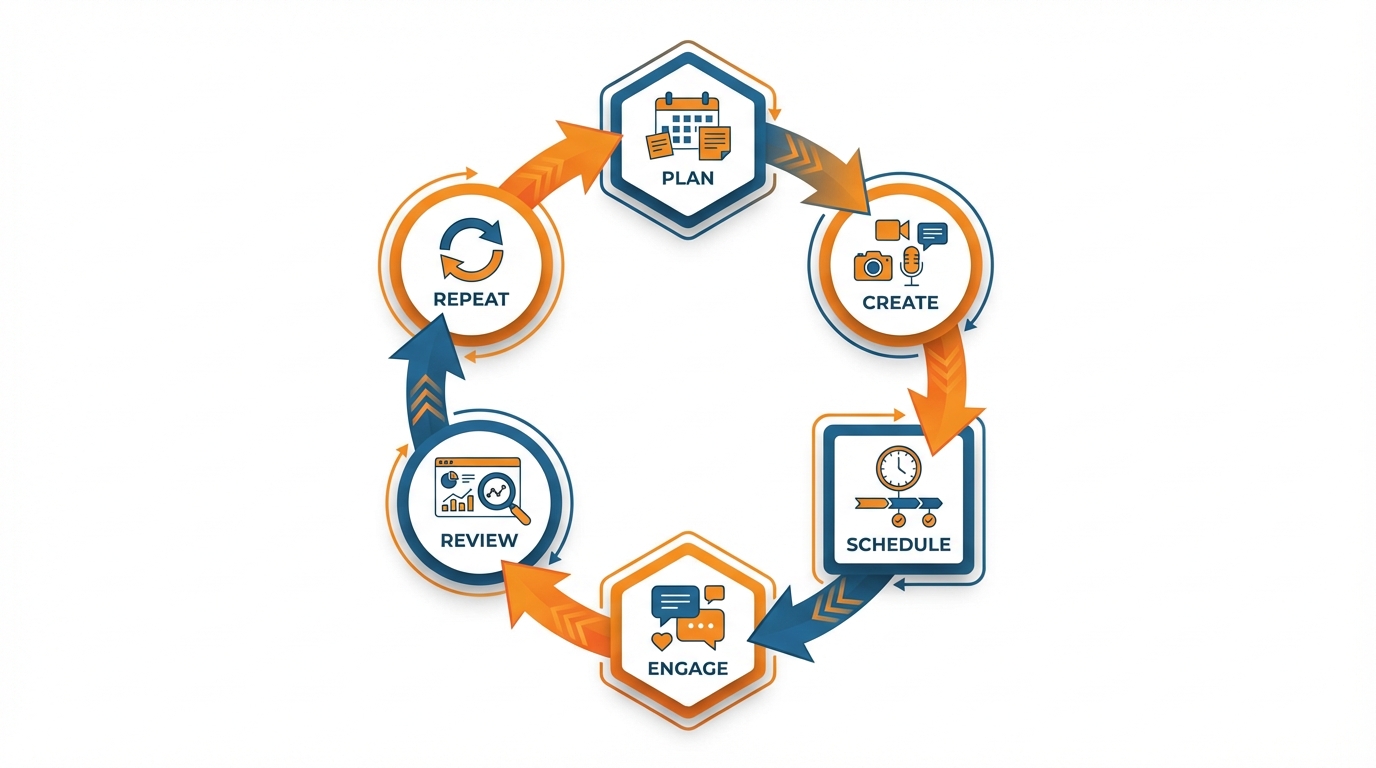
It looks like this: plan, create, schedule, engage, review, repeat.
Plan to your desired outcome (e.g. two posts designed to get in front of new people, one post designed to overcome a typical objection to purchasing from you).
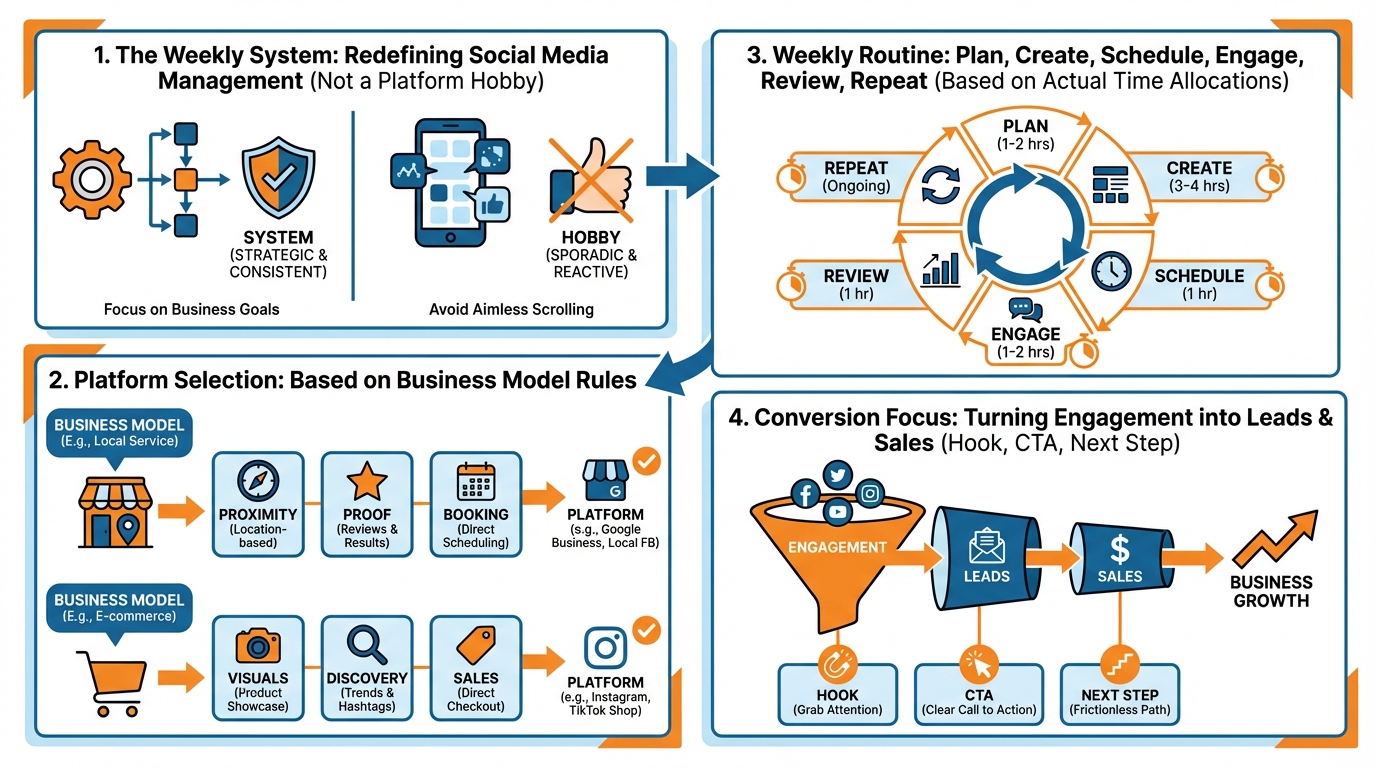
Create in a batch, rather than a little each day.
Schedule in a batch, so that you aren’t reliant on yourself feeling like posting every day. If you want to speed up the creation part without losing your voice, an AI social media post generator can help you get drafts fast so your weekly routine stays realistic.
Engage in short, timed increments, so you’re available without spending your day and your life in your notifications.
Review the metric that matters (e.g. how many convos/leads/bookings/store visits did you generate from the content you posted this week) so that the next week can be better, not just louder.
Even if you only have 2 hours a week: you’d use 30 minutes to plan (choose 3 topics out of your top customer questions), 60 minutes to batch (all recordings at once, or all captions at once), 20 minutes to schedule, and 10 minutes for 2-minute engagement times, dispersed across the week.
That’s enough to be consistent and cause action because as a small business, you don’t need volume to win: you need repetition and clarity.
Most owners don’t know that: accounts that post consistently get recorded in buyers’ memory, and buyers almost never buy on the first impression: so your goal is to show up consistently, not consistently well.
That is why batching is key!
However, if you’re going to batch by energy levels and not by media, you need to condense it down to three batches:
- one for filming (where you film all of your shorts and stories at once)
- one for designing (where you create the graphics for the week)
- one for scheduling (where you load all the content for the week)
And in order to quit overthinking every single caption, establish these guardrails for your brand that enable you to do so: a tone indicator you can follow even when stressed, a list of do’s and don’ts to keep you from going off-brand, design elements such as fonts and brand colors that default to 2, and 3 content buckets that you cycle every week (mine are proof, process, and offers)…because when I can choose from the “rules”, I no longer have to recreate my voice on every post (caption used to take 20 min to complete, now takes 3).
Third and last, establish an approval process that will not slow you down even if your team is one person and their intern.
Figure out what has to be approved and what doesn’t.
Basically anything that has to do with price, promise, or customer story is an approval but generally educational and behind-the-scenes is not.
Even set an approval deadline like 24 hours, then whatever the text is, publish it.
Social media rewards output more than perfection.
If you still want to have your personal tone but also want to be fast, you can generate 30 days’ worth of text post ideas in WoopSocial and reserve the time you can dedicate per week to grammar, tone, and engagement.
How to turn social media engagement into leads and sales (the missing piece)
If you’re looking for the ideal way to handle social media for small business, then you need to stop approaching the week as a content contest, and start approaching it as a conversion contest.
Every single week, you HAVE to have in your content a hook, a call to action, and a next step that a human can take in less than 10 seconds that involves money moving closer to changing hands, like “reply with the word X”, or “DM me your X”, or “book a time slot”, or “buy the thing”, or “get on my list.”
And that next step has to be singular.
When I review small business social media accounts, the biggest ‘money leak’ isn’t the quality of the content, it’s the ‘now what?’ that comes after. This is also why social search matters: The 2024 Social Trends Report notes that about 25% of consumers use social media as their go-to channel for brand discovery, and 87% of social media marketers say social search is important to their overall social strategy.
Imagine a simple funnel that mirrors how people interact with you on social media - post to profile to proof to contact path.
The post generates curiosity, the profile tells them you’re for them, the proof eliminates risk, and the contact path makes it easy to take action.
Define your profile with one promise, one audience, and one primary outcome.
Place your proof at the point of highest intent - think pinned posts, highlights, or featured content - so that prospects see the results before they see more opinions.
And eliminate friction in the contact path based on what you offer - DM for custom work, booking link for scheduling, product page for ecommerce, email sign-up for longer funnels.
Make sure you’re able to track it, without turning your entire business into a spreadsheet nightmare.
Just make sure you use UTM links for every bio and story link you control. A simple UTM generator helps keep this clean so you can actually tell what’s working.
Organize your link-in-bio by priority, not by exhaustiveness, because excessive options lead to fewer clicks.
Just add 1 required field to every form, where you ask how did you hear about us, and make sure social is a trackable option so you can keep it clean.
Then tag the lead as soon as it hits your inbox, even if it’s just a manual note in your CRM or inbox label, like “IG DM, LinkedIn, TikTok” because the attribution almost always breaks at the handoff between attention and conversation.
I’ve seen tiny teams be able to move faster by realizing that one platform gave them fewer leads, but 2x higher close rate, and you can only see that by tagging and measuring.
It all starts with posts that generate leads: publish proof to show you can achieve the result, process to show it’s easy to buy, and so on.
Then do engagement that closes leads: respond to comments with DM funnels and respond to DMs with one next step, and so on.
And track the leading indicators of sales: saves and shares are stronger than profile visits, which are stronger than clicks, which are stronger than bookings.
If profile visits are up but clicks are flat, your bio or proof is the problem; if clicks are up but bookings are flat, your offer or landing page is the problem.
If nothing is up, your content is irrelevant to any real-world problems.
Grab WoopSocial to make the endless content needed to generate leads, so you can focus your precious time on converting them. If you want an example of how a niche business can put this into practice, see this guide on bakery Instagram promotion.
Widen distribution through partnership, automation (where it doesn’t sacrifice authenticity)
While posting more is an option, it isn’t the best option for small businesses.
The best way to scale your efforts is to amplify the effect of your posts through collaborations.
This is because, when you appear in a place your audience trusts, you inherit trust and credibility.
Sometimes a single partner mention can yield more results than ten more posts you could make, assuming that it solves a pain point for your target audience.
That’s why we say the best way to approach social media for small business is to think of distribution as a flywheel: Your posts get you views, but your partnerships get you mileage.
Implement a basic content-trading partnership strategy: identify 20-50 non-competitive yet relevant companies in the niche that my ideal customers frequent and do not start with large influencers.
Consider neighboring businesses, local service providers, up and coming content creators, associations, newsletters, small to medium sized podcasts, and even vendors.
The objective is to create a piece of content that makes them look good and provides value to their customers.
Then, have them share it, adding their insights, and repeat the process.
When I successfully employed this strategy, the benefit wasn’t necessarily the share itself, it was the implied credibility: the new audience was more likely to trust me because I was shared by someone they already trusted. And since reviews often act as proof, it’s worth remembering that BrightLocal’s Local Consumer Review Survey 2024 found 88% of consumers would use a business that replies to all reviews vs. 47% who would use a business that doesn’t respond to reviews at all.
Don’t try to manage partnerships from memory.
Create a quick and dirty partner list asset that you can maintain for 10 minutes per week: who they are, what you pitched, what they posted, how it did, and when to reactivate.
Monitor basic engagement metrics like profile views, profile saves, and DMs within 48 hours of a collab, and then concentrate on the content formats and partner categories that generate comments - not just likes.
That’s how you make partnerships become flywheel distribution, because you no longer have to start from scratch and because you’ve built a repeatable pipeline of supporters you can re-engage for product rollouts, seasonal sales, or for slower months.
This is where automation comes in for small businesses to regain time. However, you need to automate the correct things.
You want to automate the scheduling and content creation process to save time, but you want to leave comments, direct messages, responses to objections and customer testimonials still coming from a real person because this is where the relationship and trust is built and sales are made.
Consolidating all your efforts into a dashboard, quick content creation and automatic branding streamline the process into one time block, which is why I rely on WoopSocial: in one sitting I can create 30 days’ worth of on-brand content ideas, apply my branding and schedule it across multiple channels so that you’re optimizing the limited amount of time you have on sales and customer service, not writing and formatting posts. If you want a broader walkthrough on building repeatable processes, this is useful context on smart social media automation.
The best one is the one you can do weekly
If you’re looking for a simple way to handle social media marketing for your small business, you need a system that will stand the test of your craziest weeks.
This requires building a boring system on purpose: Choosing the right social media channels based on how your customers consume your services or products, committing to a weekly social media post schedule you can maintain, ensuring each social post is designed to move your customer through a specific sales funnel stage, and amplifying your reach with collaborations and minimal automation.
This way you’re no longer focused on a social post as a task, you’re focused on what results from the post - more qualified leads, more scheduled consultations, more foot traffic, more purchases.
The secret here is to remember that consistency is a targeting strength, not a content battle.
The last point is that before you decide if this system is successful for you, pick one system and go with it for at least 30 days before you evaluate and pivot.
Most small businesses won’t see success with social media because they don’t give themselves enough time to have pure data.
Week one, they post five days in a row. Week two, they take a break. Week three, they post over on another platform. Week four, they offer something different.
Give yourself four full cycles where you can see patterns like which topics trigger DMs within 48 hours, which proof posts increase saves, and which calls to action produce real leads.
I have seen three posts perform better than higher-volume accounts because they kept at it long enough to condition their audience and the algorithm.
So here is your actionable tip: Pick the platform that is your true discoverability and trust builder for your customer.
Decide how much time you will devote to it each week and treat it like a client meeting.
Then plan a month of content all at once so that your weekly time is spent engaging and converting, not writing captions.
If you need to speed up and still maintain your voice, WoopSocial can get you a month of pre-made post ideas in just minutes and help you keep your branding consistent so that your flow is still good even if your day isn’t!
Last, make the benchmark ruthlessly simple: if you can run it every week, it’s the best.
If you can’t, it’s too complicated, no matter how sexy.
Social rewards consistency, transparency, and execution so make it sustainable in your actual life, not your fantasy life, and you’ll stack benefits while other companies continue to start from scratch.
Related reads
4/27/2026
B2B SaaS social media benchmarks: Set the right targets.
B2B SaaS social media benchmarks: Set the right targets. The trouble with defining B2B SaaS social media benchmarks is that it's an inherently impe...
4/25/2026
Building a personal brand as a technical founder (without becoming a creator)
Building a personal brand as a technical founder (without becoming a creator) Creating a personal brand as a tech founder should feel less about ma...
4/20/2026
Creative Post Ideas for Sustainable Brands (That Don’t Sound Greenwashy)
Creative Post Ideas for Sustainable Brands (That Don’t Sound Greenwashy) That’s not what creative post ideas for sustainable brands should look lik...