Social media ROI for Seed-Stage Startups
For seed-stage startups, redefine social media ROI beyond revenue. Focus on distribution, trust, and pipeline to operationalize a repeatable system for growth.
Social media ROI for seed-stage startups
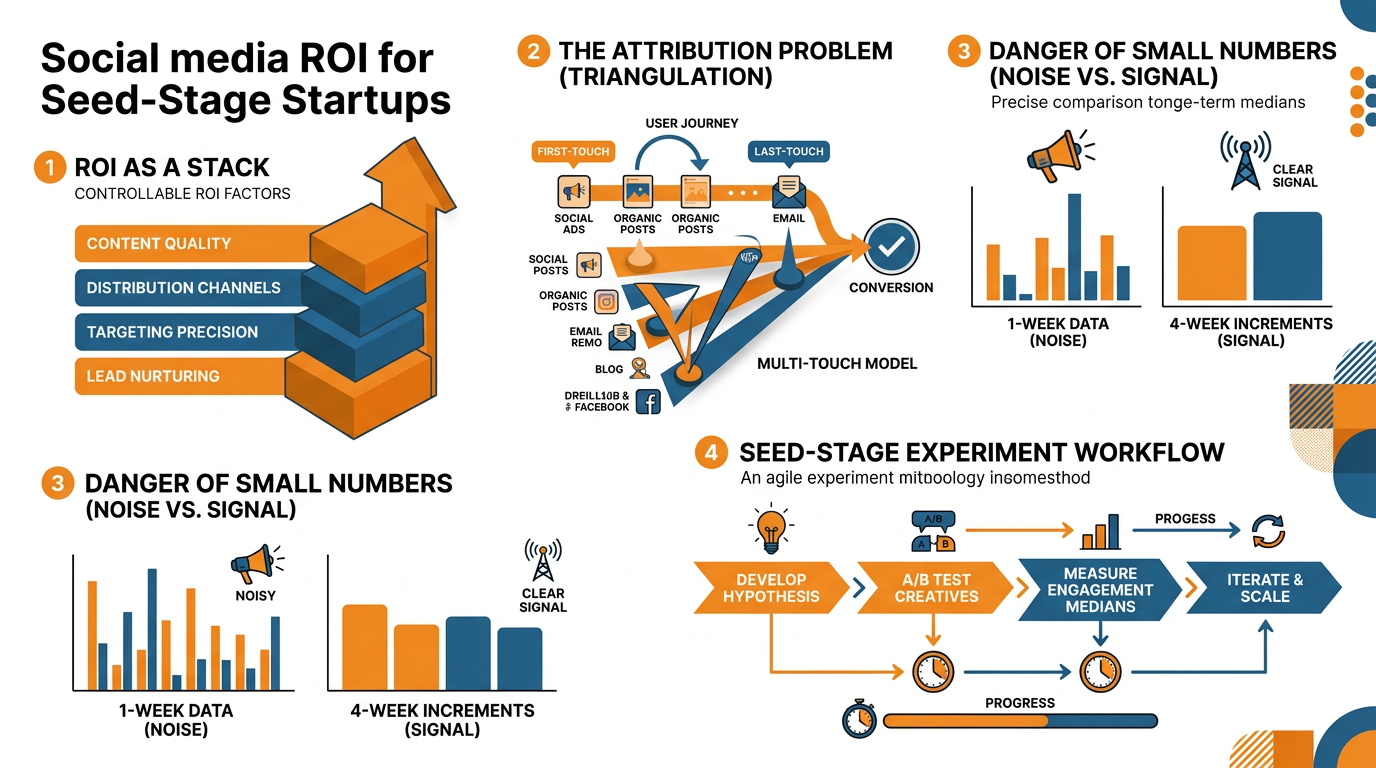
For seed-stage startups, the secret to social media ROI is to abandon the effort of trying to squeeze a purely revenue framework into an environment where there is less volume, where sales cycles are noisy, and where many of the biggest wins are proxies. For seed, I think of ROI as a stack of things you can actually control and stack: distribution, trust, and pipeline or activation. Distribution is when the right people are seeing you, not just more people. Trust is when those people are beginning to trust you through steady problem framing, proof, and clear perspectives. Pipeline or activation is when those signals are turning into conversations, demos, referrals, waitlist movement, or actual product usage. If you want to operationalize this into a repeatable system, you can pair it with a social media content calendar that keeps distribution, trust, and pipeline outputs visible week to week.
This also makes it clear when you should double down on social, and when you should prioritize other channels. Double down when your go-to-market motion demands frequency and storytelling, when you require speed of information and positioning, and when the founder has the bandwidth to serve as the channel because at this point in time founder content is more believable than a brand account. Prioritize other channels when there is a faster, more direct route to revenue at the moment, when the situation requires the immediacy of outbound or channel partners, or when there is no one on the team with the necessary authority and expertise to regularly create content. Social is not a check-box channel at seed. It is a leverage channel, if you can sustain it.
High early stage ROI won’t look like “big” metrics; it will look like directional signal from high-quality activity. Instead of overall impressions, you should track ICP reach. Instead of likes, you should track replies from target job titles and companies. Instead of signups, you should track meetings scheduled, sales cycles shortened by prospects citing your content or coming in pre-sold, and activated signups where the user took a meaningful first step. When I run seed-stage social experiments, I’m much more interested in whether the right 50 people responded to something rather than 5,000 of the wrong ones. If you need a sharper mental model for what to ignore, revisit the idea of vanity metrics so you don’t confuse attention with traction.
Your lens on ROI changes based on go-to-market motion from day one. If you’re sales-led B2B, social ROI is qualified conversations and pipeline velocity. If you’re PLG, social ROI is activated signups and early retention signals, not raw installs. If you’re B2C, social ROI has to map to CAC payback and cohort behavior much earlier, because attention is easier to buy than retention. Once you define ROI the way your stage and motion actually work, social stops being a guessing game and starts becoming a repeatable system you can improve every week.
The attribution problem at seed
When measuring social media ROI, seed-stage startups face an attribution problem: there just aren’t that many data points.
Last-click attribution for seed-stage startups breaks when you have a single point of failure, so you need a simple, easily defensible source of truth you can generate weekly.
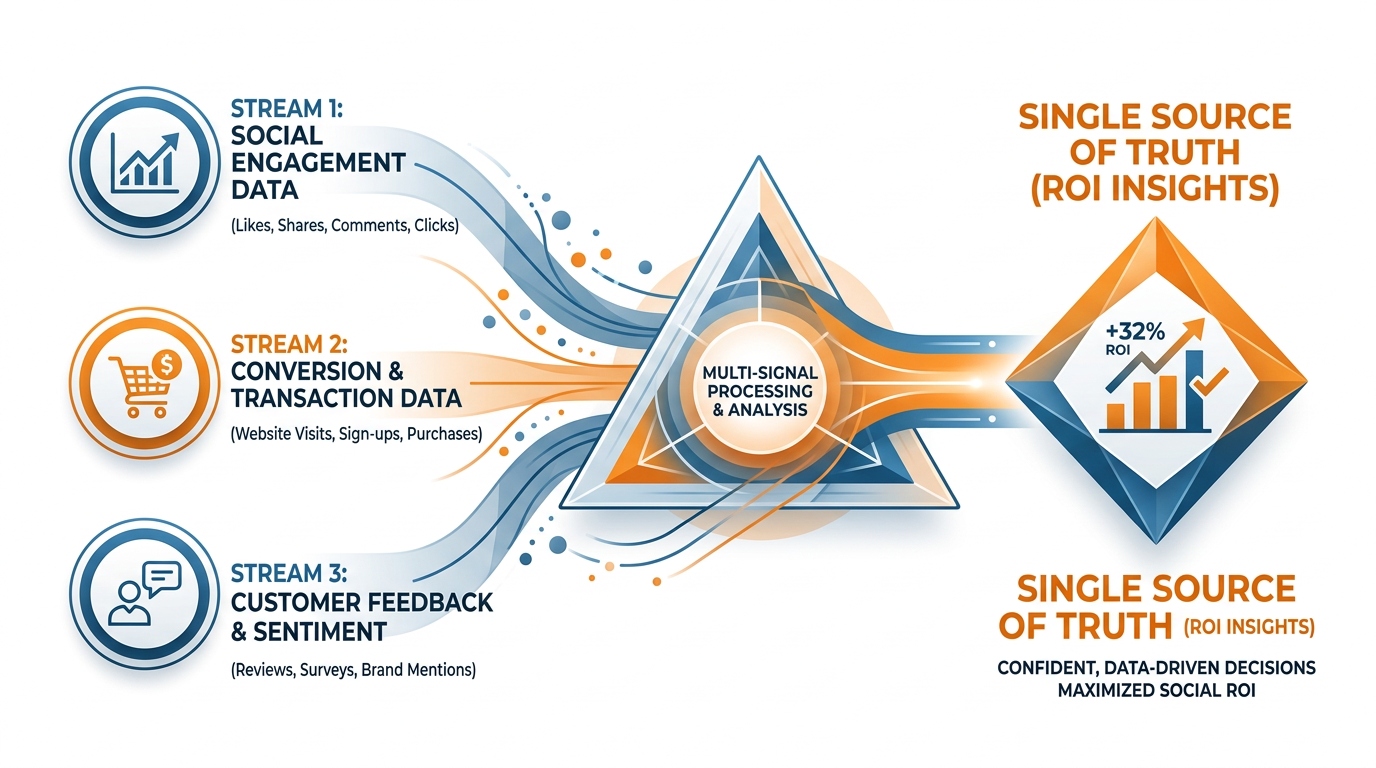
You do this by triangulating three different signals into one view:
- UTMs on anything you can tag
- A required “How did you hear about us” on every inbound and demo request
- Stable, never-mid-quarter-changing CRM rules
Your UTMs give you what happened at the click level, your self-reported attribution tells you what actually drove the decision, and your CRM rules prevent your team from overwriting reality to match the narrative. If you want a clean way to tag consistently, use a UTM generator so the data stays readable across weeks.
I embrace the mismatch between these three signals as a feature, not a bug: if your UTMs say direct but your form says LinkedIn, you just proved influence without last-click credit, and that’s exactly how seed-stage social typically works.
The danger of small numbers
The danger of small numbers: week-over-week changes are “signal” that’s actually just “noise”.
If you get just 5-20 conversions a week, a single demo request represents a 20-50% week-over-week change that could look like a signal and then fade away.
To avoid false positives and false negatives, you want to look at social in 4-week increments, and use medians whenever possible.
You also want to normalize for volume: try to measure per 10 posts or per 1k ICP profile visits rather than just total, to know if the change was “real” or if you simply posted more stuff.
I also look for correlation across metrics: if ICP comments, target-title profile visits, and self-reported social mentions all increase, that’s a move, even if closed-won still remains 0.
Seed-stage experiments that don’t lie to you
You can still run experiments at seed, but you need to keep them small and short.
Choose one thing to test and freeze it for 14-21 days, e.g., I believe that founder POV posts will drive more qualified demos than product videos, and freeze everything else.
Where you can, create a holdout: if you’re testing two channels, turn off one of them while leaving the other constant, or leave a portion of an audience untouched (by not posting or re-posting in that community), and compare.
If you can’t create a holdout, try before-after testing with some caveats: only compare equivalent time periods, normalize for frequency of posting, and measure lead quality rather than lead volume (i.e., lots of low-intent signups can make a test “successful” while actually screwing your funnel).
If you don’t have a closed-won, don’t say you can’t measure ROI, just measure the right pre-revenue leading indicators.
I measure pipeline created with a clear definition, influenced opps where social shows up in self-reported attribution or sales notes, demo-to-close lift signals like prospects mentioning posts or coming pre-educated, and activation or retention cohorts for PLG or B2C like day-1 activation rate and week-4 retention for users who first came from social.
I also try to capture qualitative signal as data: repeated objections, recurring use cases, and exact phrases prospects use right before they convert, because that language becomes copy you can reuse across ads, landing pages, outbound, and even product onboarding.
tl;dr: the seed-stage win isn’t a perfect dashboard, it is a model you can defend, iterate, and use to make better decisions with low volume.
Organic and paid are two different funnels
Let's look at the case for seed-stage startups first.
The tl;dr on seed stage social media is that there are two components: organic led by the founder, and paid led by hypothesis testing.
Measuring the effectiveness of social media for a seed-stage company becomes a lot easier when you treat it as two different funnels: top-down (founder-led) organic and bottom-up paid tests.
You want to isolate them because they offer different benefits and should be measured on different metrics.
Organic compounds trust & reach (with attribution challenges), whereas paid is a dial that can be switched on/off to test a hypothesis.
When conflated, you'll either under-estimate the impact of organic (it isn't last-click) or over-estimate the impact of paid (it can generate 'fake' clicks). For a broader look at the mechanics, this aligns with social media automation thinking: separate systems, separate measurements.
Founder-led organic ROI
On the founder-led organic front, you aren’t buying conversions, you are creating narrative, authority, partnership surface area, and hiring gravity.
It’s your responsibility to attach it to business outcomes without treating it like a last-click channel: track ICP profile visits, inbound from target titles, meetings where prospects mention your writing, referral intros that begin with I have been following your writing, and candidates that tell you it’s because of your writing that they applied.
I even view partnership as an organic ROI output: if I keep publishing strong points of view and proof, partners will be more likely to co-market with me because I’ve made it easy for them to trust my positioning and borrow my credibility.
Also, you should tune yourself to seeing organic fluctuate in 4-week chunks rather than daily, and a small number (e.g., 3 high-quality convos) can be a better signal of ROI than 300 likes.
Paid at seed: optimize for speed to insight
When it comes to paid at seed, ROI should be viewed as a small, contained test. It’s intended to be optimized for speed to insight and maximum leverage, not for scale.
Use paid to shorten the gap between awareness and decision by targeting a warm audience segment or ICP pocket:
- Retarget site visitors or people who have read your founder’s writing
- Amplify a risk-reducing proof point
- Sponsor an event or webinar where you can qualify someone in real time
- Target a list-based ad to a small number of accounts you’d like to see in your pipeline anyway
These budgets should remain modest, because at such a low scale, the outcome you are looking for is not a majestic ROAS, but rather insight into which positioning and proof point and ask can improve conversion rates or reply rates by sufficient magnitude that the next email you send and the next landing page you build and the next sales call you have just got a little bit easier. This is especially relevant given that a 2025 benchmark recap noted LinkedIn Ads delivered 113% ROAS; see this accessible write-up of the benchmark in this LinkedIn Marketing Solutions summary of Dreamdata’s findings.
To avoid paid covering up for product-market fit, you require hypotheses, short cycles, and kill or scale rules before you start anything.
You write the hypothesis in a sentence, choose one leading indicator of progress like cost per qualified meeting or activation rate, and time-box the test to 7 to 14 days so you don’t confuse novelty with traction.
If you don’t outperform your baseline by a decent amount, you kill the test and record what you learned about messaging, audience, or proof.
If you do outperform baseline, you scale one variable at a time because the fastest way to generate fake ROI is to change creative, audience, offer, and landing page all at once and then attribute the win to the channel instead of the insight.
Why posting isn’t the value
I was talking to a seed-stage entrepreneur the other day, and he told me that he was spending a lot of time trying to figure out the ROI of his social media efforts.
I told him that the ROI was zero, or close to it, and that he should stop.
It’s not that social media doesn’t have any value to a seed-stage startup. In fact, it’s very important.
The problem is that the value of social media isn’t in the posting. It’s in the distribution.
For seed-stage companies, social media ROI is almost never about frequency. It’s about distribution.
The compounding effect is realized from loops that bring proof and clarity in front of the ICP again and again until they are ready to buy, partner, or refer.
That comes from designing for repeat exposure: every post should create a second and third touchpoint through comments, reshares, communities, and mentions, not just a single spike of impressions.
One useful barometer for this is to ensure at least 30 to 50 percent of your value conversations are from people who’ve already seen you before, since first-touch social is unreliable and repeat-touch social is where trust converts. Channel effectiveness benchmarks can help contextualize this: in 2025 research, 85% of B2B marketers said LinkedIn delivers the best value; see the stat in Content Marketing Institute’s 2025 benchmarks and trends research.
Partnership as leverage
The simplest way to create leverage without increasing ad spend is to create a small selective partnership channel.
You select 20-50 adjacent brands, creators, specialized media outlets, and tooling that already have your buyers attention, and you turn content into a co-creation not a solo one.
I do this by doing co-written articles, partner analyses, and mutual promotion where both sides get something tangible: I deliver a clear perspective and evidence, and they deliver reach and social credibility.
If done correctly, it acts like a flywheel for referrals: a single partnership can get you weeks of subsequent engagement because it propagates through two networks, not one, and the credibility boost often increases response rates even if the base visibility doesn’t change.
Assign content types to the ROI you actually want
To make it measurable, you can assign each content type to an ROI that you are actually targeting.
Case and proof signals help you build credibility fast since you are lowering perceived risk when you talk in terms of actual time savings, conversion rate improvement, cycle time reduction, payback period, etc.
Teardown and strong point-of-view pieces drive demand and differentiation since you are defining the problem better than your competition and showing the buyer what to value.
Product demos drive activation if you show off the first meaningful win in under two minutes, not the full feature set.
Founder story isn’t vanity, it is credibility and recruiting gravity and you will feel it when candidates and partners talk about specific moments or decisions you shared, not just that you’re awesome. This matches what many small teams report more broadly: in a 2025 survey, 30% of small businesses identified social media marketing as delivering the highest ROI in advertising; see the figure in the Small Business & Entrepreneurship Council’s 2025 technology use survey PDF.
Consistency without burnout
Consistency isn’t draining if you treat one strong asset as a source, then adapt it into a short sequence that spans different funnel stages, all while keeping it personal.
You create one sharp insight or customer win, then you pivot it into a proof post, a teardown angle, a quick demo clip, and a community touchpoint where you ask a legit question and actually answer, like a human, then repeat.
You can standardize how you deliver value, how you label posts based on intent, and how you personalize your responses to those who like, without relying on uniform templates or “blast-from-the-ship” messaging. If you want a structured way to avoid the weekly scramble, pair this with a weekly social media system so the repeatable framework stays consistent.
That’s how social becomes a repeatable framework instead of a weekly scramble.
Also, if you want the original benchmark source behind the 113% figure (and the note that LinkedIn Ads’ share of B2B budgets grew to 39% by end of 2024), see Dreamdata’s 2025 LinkedIn Ads benchmarks highlights within the context of evaluating paid social ROI.
Related reads
4/27/2026
B2B SaaS social media benchmarks: Set the right targets.
B2B SaaS social media benchmarks: Set the right targets. The trouble with defining B2B SaaS social media benchmarks is that it's an inherently impe...
4/25/2026
Building a personal brand as a technical founder (without becoming a creator)
Building a personal brand as a technical founder (without becoming a creator) Creating a personal brand as a tech founder should feel less about ma...
4/20/2026
Creative Post Ideas for Sustainable Brands (That Don’t Sound Greenwashy)
Creative Post Ideas for Sustainable Brands (That Don’t Sound Greenwashy) That’s not what creative post ideas for sustainable brands should look lik...