Building a personal brand as a technical founder (without becoming a creator)
Building a personal brand as a technical founder (without becoming a creator) Creating a personal brand as a tech founder should feel less about ma...
Building a personal brand as a technical founder (without becoming a creator)
Creating a personal brand as a tech founder should feel less about marketing and more about shipping a credibility layer that compounds. If you are starting a small company with little time, you should NOT be posting every day, nor should you have to invent hot takes. You need a system to convert engineering judgment to business results: trust from buyers, shorter sales, better hiring, stronger partnerships, and greater investor confidence.
The reason I care about personal branding is because it turns the things you already do, and have done in the past, into something that someone who you’ve never met before can easily assess. The wrong thing that founders tend to do is to go for the wrong metrics: things like likes, comments, shares, and reach. They’re vanity metrics and don’t help. If you care about trust and authority, what people need is to be able to see proof. Not just opinions, but proof that you have thought about tradeoffs, reliability, security, and the real-world implementation of the ideas you talk about. This proof can then be used by a prospective client in the moment they’ve met you, a prospective customer in the process of making their final decision to say ‘yes’, a job candidate in deciding to put their career in your hands, and a potential partner in assessing how serious you are.
This article will show you how to create a technical founder brand without being a full-time content creator or faking an engineering persona. It'll explain how to pick the best channels for your go-to-market motion, how to talk technical without boring buyers, how to create 'proof' assets sales can leverage, and how to put simple guardrails in place so that your credibility doesn't leak out into your roadmap, security, or customer data.
Demonstrate engineering judgment, not self promotion
As a technical founder, start building your personal brand by demonstrating engineering judgment, not by engaging in self promotion. Technical founders build their personal brand by identifying the specific engineering judgment they want the market to link with their name.
Instead of trying to prove yourself generally competent, zero in on a specific area that you can demonstrate time and time again when you are operating with limitations.
Examples of this could be things like:
- robust systems under complex integrations
- a security posture that survives a procurement audit
- a superior developer experience that cuts onboarding in half
- a scaling strategy that avoids runaway cloud costs
- cost management practices that preserve healthy gross margins
- rigorous evaluation practices that guard against hallucinating systems
Be specific with the judgments you focus on.
Select one or two and articulate in measurable terms what success in that area looks like, then put that judgment to the test against practical situations that involve tight engineering team resources, legacy systems, or compliance obligations or demand spikes.
Then you translate that technical advantage into outcomes that a buyer cares about.
But that isn’t dumbing it down; that’s just changing the unit of measure.
The buyer doesn’t necessarily need to be shown the architecture diagrams; the buyer wants to know that incidents go down, so downtime anxiety is eliminated.
The buyer wants to know risk is reduced, so the chance of a breach or failed audit is lower.
The buyer wants to be able to see results, so you don’t have to wait six weeks for an implementation.
The buyer wants to know support tickets go down, and that you have a predictable spend so the small business isn’t going to get hit with a cloud bill in the middle of the month.
I typically will write the same point twice: once in engineer speak to make sure I don’t get the underlying mechanism wrong; and again in operator speak to make sure the non-technical operator knows why that’s important.
You sharpen your brand by taking a position that you can defend publicly with tradeoffs, rather than reciting generic best practices.
Ask yourself: What do I recommend? When does that recommendation fail? And what do I do instead if circumstances shift?
For example, I may advocate for boring reliability over feature velocity for early-stage startups that can't afford churn from broken workflows.
But I also have to explain what the cost of that is in terms of roadmap speed and how I mitigate that with targeted experiments and rigorous rollback protocols.
This is the gap between sounding like a content creator and sounding like a founder who has actually paid the price for their decisions.
Ultimately, align your efforts of Building a personal brand as a technical founder to your go-to-market motion so visibility converts into revenue, not applause.
If you are DevTools or open source, you earn trust by creating artifacts others can review: repositories, performance benchmarks, docs, and the thoughtful issues and threads where you reveal how you think.
If you are PLG, you build credibility by sharing what’s actually happening inside the app: the activation friction you eliminated, the integration pitfalls you keep coming back to, and the few settings you’ve seen reliably help customers reach their first value, fast.
If you are enterprise or sales-led, your insight must convey risk reduction: transparent security and compliance stances; reliability guarantees that make procurement easier and long-term support commitments that tell customers you’ll be there long after the contract is done.
Ship proof assets, not just posts
Establishing a personal brand is critical for technical founders, but that means shipping proof assets, not just posts.
One way to build a personal brand as a technical founder is to publish content that you can use as evidence, a portfolio of proof, which compounds over time.
Rather than write about opinions, show your artifacts.
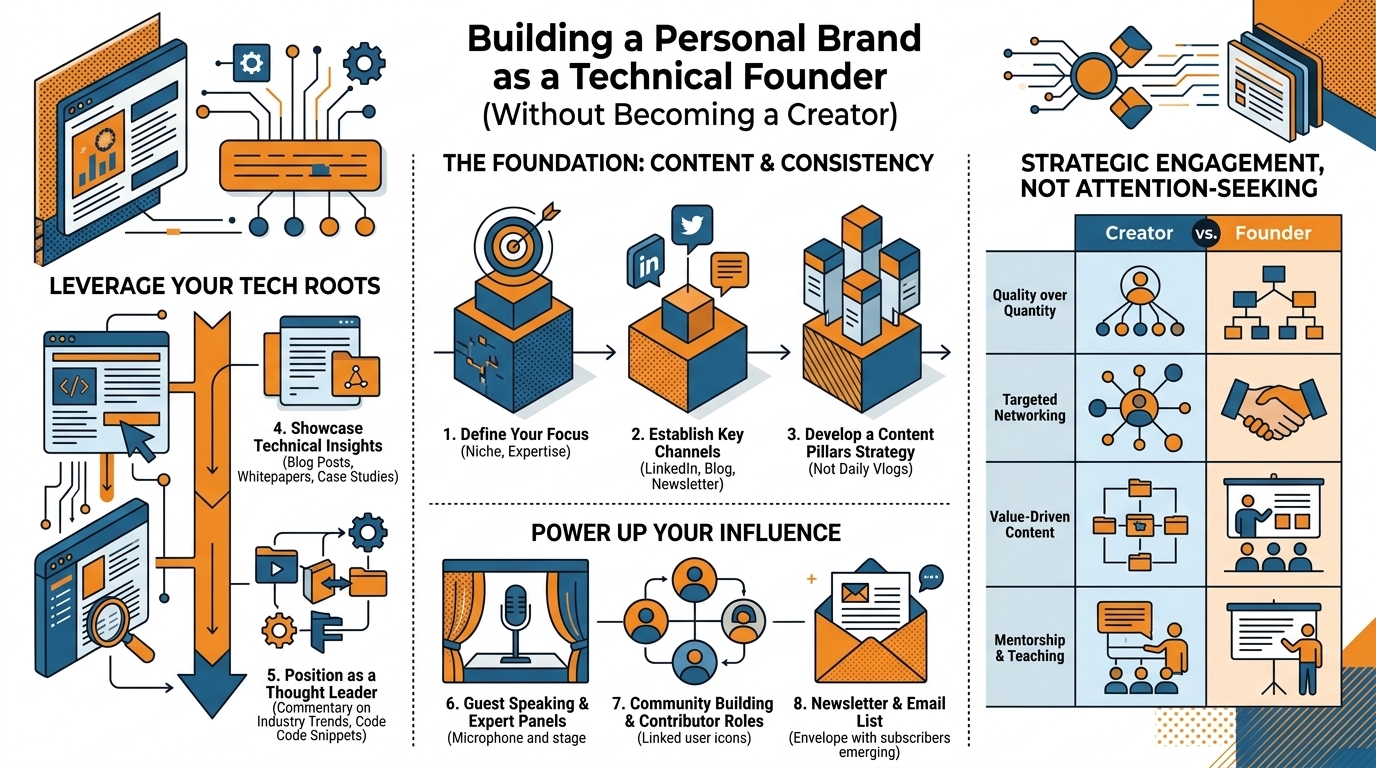
Let the buyer, candidate, or partner verify for themselves how you think.
Share how you design and why.
Document your architecture decisions, explain the goals you are optimizing for and what you are intentionally NOT optimizing for, and the trade-offs you make.
To me, one good decision story can be more valuable than ten general posts because it answers one question that is often left unsaid: is this person to be trusted for production, cost, and risk?
Make your proof measurable by default, even with non-technical audiences.
Share benchmarks and explain what you benchmarked: exactly what you measured, what you controlled for, what your baseline is, what you compared against, what would change the measurement, and so on.
This is where most founders unintentionally fail, as unqualified performance assertions come off as marketing.
To separate yourself, present your approach the way you would in an engineering deep dive, then reframe the conclusion in user-facing language: less timeout, consistent cloud cost, faster time to productivity, reduced support calls, and so on.
The operational maturity of a brand is also an asset, especially for smaller businesses which cannot afford chaos.
Rapid trust can be generated through sanitized postmortems or incident learnings which focus on how you prevent: what broke, how it was identified, what guardrails were put in place, and what you are monitoring going forward to make sure it doesn't happen again.
The same approach should be applied for building logs and decision memos: what was the decision behind choice A vs choice B, what broke during the build and what did you learn about reality (for example, third-party integration dependencies, legacy integration issues, flaky API access patterns, or human errors).
Don't ignore security or reliability stories; talk about your threat model or your approach to backups, recovery or recovery time objective or recovery point objective, how do you approach user access, what does it mean to be ready for an audit, without giving away the secrets.
So treat your proofs like a distribution channel.
Don't distribute them in the same way you'd distribute a blog post.
Where in your niche do people already go?
Who is talking about these problems?
Who are the people talking to the people you want to hire?
You've identified your networks, right?
So you're like, 'Okay. Let me think about how you can use a partnership to get this thing out to where those networks are.'
Finally, think about how this content can become credibility elsewhere in your funnel.
This benchmark is useful for this part of our sales calls.
This postmortem is useful in a hiring conversation.
This architecture doc is a useful way to get people to know me for a partner discussion.
This reliability thing is useful when talking to an investor.
This is how personal branding for a technical founder is more than just content.
It's leverage.
Align channel strategy with how buyers decide
As a technical founder, your channel strategy must align with how customers make purchasing decisions in order to build your personal brand.
To build a personal brand, first ask: where does trust form before the deal closes in my niche?
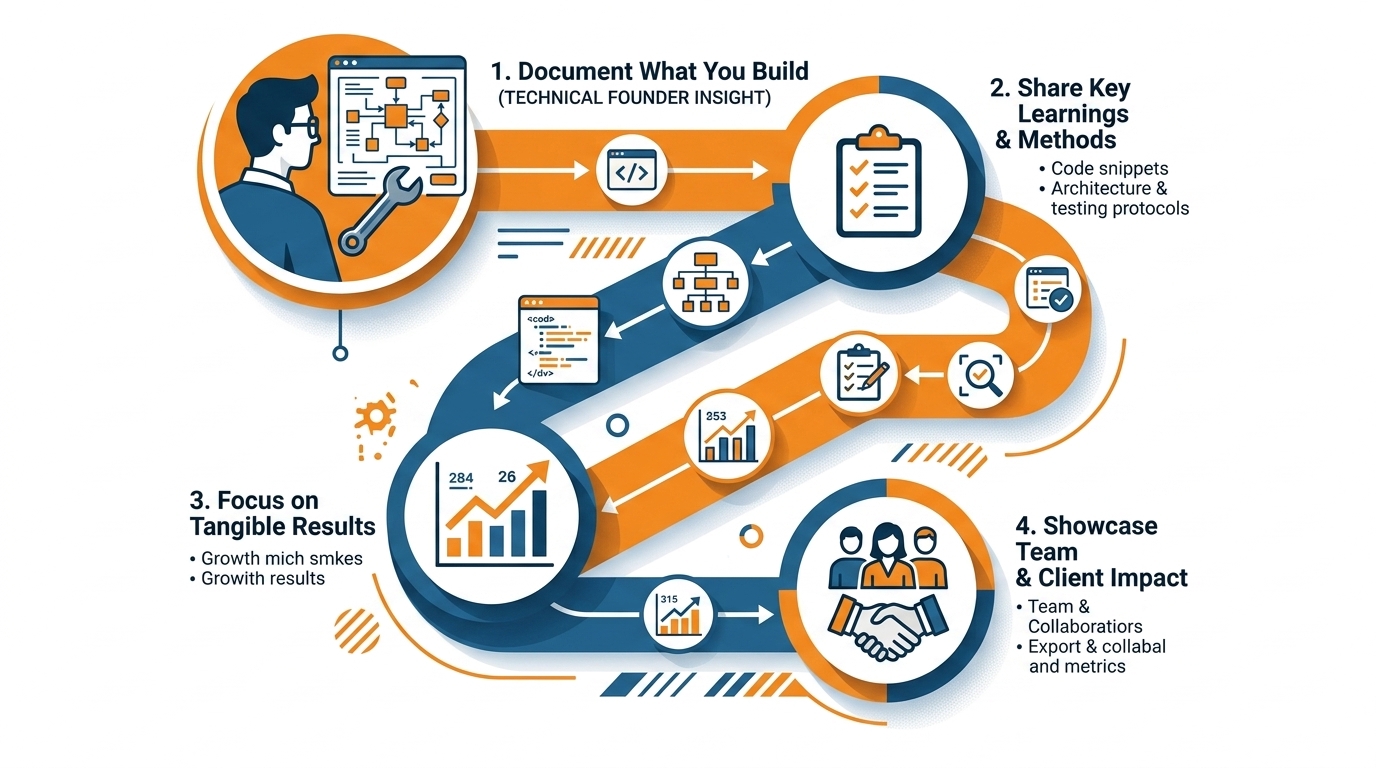
If the buyer or the biggest influencer is a developer, your winning channel is GitHub, your docs, your engineering blog, and the communities where technical choices are debated.
If the dealmaker is a manager, an exec, security, or procurement, trust forms via reputation and risk signals, so your winning channel is LinkedIn and a few curated one-to-many relationships where your risk stance, security posture, and decision-making is clear. This matches what the 2022 Edelman + LinkedIn report found-based on insights gathered from nearly 3,500 management-level professionals, 61% of decision-makers say thought leadership can be moderately/a lot more effective at demonstrating potential value than traditional product-oriented marketing during an economic downturn (see the Edelman + LinkedIn thought leadership impact findings).
If you want your personal brand to be authoritative right when a prospect is evaluating you, you build it with long-form writing that becomes the page people pass along internally when they say let's talk to them, because they understand their thinking.
For your tiny company that doesn’t have an Internet-based lifestyle, you’ll need to create a lean distribution engine that’s built for reuse, not viral spread.
You’ll find the few communities, content creators, newsletters, and collaborators who already have the attention of your sector, and then you’ll make an appearance to them with assets they can leverage: a framework for a performance benchmark, an analysis of a typical failure mode, an integration pitfall you’ve successfully resolved, or a straightforward clarification of a muddled tradeoff.
Rather than a one-sided endorsement, you’ll drive mutual benefit by consistently promoting their top articles, enriching them with industry-specific context, and sporadically providing them with an immediate asset that will increase the likelihood that your brand will gain the trust of their audience.
And then there’s the relationship list.
It transforms your distribution strategy from a hope to a process.
I try to be very deliberate with each proof I publish: who am I trying to reach, and who’s most likely to share it?
Maybe it’s the person who runs the project, because they appreciate what I’ve tried to do.
Maybe it’s a consultant, because they’ve seen this exact same problem for thousands of users.
Maybe it’s an information security person who needs to convince the rest of their organization to turn on my default.
Or maybe it’s the founder who happens to work on another project with an audience I’ve already gained access to.
I think that’s the reason it works so well; because you turn a single article into a number of trust-building actions, which is basically how a sale actually works: many people, all with their own reasons.
Safeguard your engineering voice with the right formats
The most efficient path to consistency lies in safeguarding your natural engineering voice.
Opt for formats that align with your thinking patterns.
Write your articles like RFCs, making all your tradeoffs out in the open.
Publish short essays and field notes from actual debugging and building sessions.
Record quick videos or demos that can demonstrate your claims in under two minutes.
Draw and annotate diagrams that can describe an architecture and its tradeoffs at a glance.
Run AMA (or FAQ) threads that provide solutions to all the objections your customers always raise in the sales or support channels.
If you do it well enough, then you no longer worry about 'how am I going to build a personal brand as a technical founder?' but more about 'how can I ship my technical brand as small credible units across channels where my buyers hang out?'
This aligns with buyer behavior research: in the Demand Gen Report + Demandbase survey, 84% said the winning vendor’s content had a significant impact on their buying decision (see the B2B buyer behavior survey PDF).
Make it measurable and keep it secure
Creating a personal brand for a technical founder is quantifiable, and more secure when boundaries are in place.
The day that you stop treating personal branding as some kind of foggy, visibility exercise and turn it into an actual pipeline input is the day that you can finally start measuring it.
So, how do you know your brand is actually working?
It’s in the inbound notes that call back to a specific project you put out, in demo requests that cite an idea or benchmark from a decision memo, in introductions from partners who include a little background on your expertise, and in search trends for your name or the name of your company.
I also look at how things change when we put a proof asset into cold outbound: if we get higher reply rates or people have more informed, relevant questions, I know the work is landing.
That is the real benefit of a personal brand for small businesses; we now know exactly which assets are lowering our sales friction and we no longer have to just post and hope.
A more efficient method to preserve credibility and remain measurable is to make CTAs that align with how technical stakeholders assess risk.
You can anchor the next action with an actual point of evaluation rather than a typical selling point: provide the opportunity to review the methodology, test harness, migration checklist, or qualifying questions used to determine whether a system is right for you.
I do this because it anchors the conversation in substance, and it ensures clean attribution: when prospects recall the name of your artifact, you can attribute your branding efforts to the growth in your funnel, all without compromising your feed to ad-hoc marketing.
Embed risk management right from day one, as a single careless post can undo months of trust, particularly when you're navigating enterprise buyers or heavily regulated clients.
Write down your never-share zones explicitly: security-sensitive information, customer-identifying signals, roadmap commitments that generate procurement headaches down the line, and implementation details that hand attackers a roadmap.
I use a simple review checklist for anything related to security posture, compliance claims, or performance, and I sanitize examples with standard practices: alter account identifiers, aggregate out-of-scope figures into ranges, and steer clear of exposing internals that invite scrutiny.
Stay clear of inflammatory opinions unless they directly reflect product reality; the gain is often empty buzz while the cost can be a fractured relationship during due diligence. This emphasis on trust matches the 2024 Edelman Trust Barometer Special Report, where 79% of employees surveyed globally say they trust “my employer” (see the Edelman Trust at Work top findings).
And lastly, automate the grind so you can reserve your time for what you can’t offload: judgment and content. If you need help making the grind lighter, you can use a tool like an AI marketing assistant to quickly slice what you’ve built into lower-friction units while you keep the judgment.
Establish a lightweight process that tracks inbound links to your work, nags you at follow-ups to high-intent signals, and lets you quickly slice what you’ve built into lower-friction units.
I’ve treated it like a software project: minimize effort, minimize variance, maximize signals.
That’s how you make Building a personal brand as a technical founder measurable and safe to compound.
Fim
Prove competence in public
As a technical founder, you don’t need to build a personal brand by publishing everything. You need to prove your competence in public.
Your differentiator? You’re able to produce verifiable, long-term content that others can’t: benchmarks that explain how you arrived at your conclusions; memos that show the thinking behind decisions you made; sanitized incident postmortems; implementation documentation that will help a business that’s going to get acquired.
Once you start building that kind of content, you’ll shift from competing on content creation to competing on the creation of assets that build confidence for a customer, prospective hire, or partner. This is reinforced by personal brand research: 67% of ALL Americans say they “would be willing to spend more money on products and services from the companies of founders whose personal brand aligns with their own personal values.” (see the personal branding national research key findings).
In practical terms, think of your brand as a product surface area.
You launch a single proof-of-work asset and deliberately seed it wherever credibility already exists in your niche, leveraging the select channels and relationships that close deals.
You track results using trust signals that drive conversions: the volume of inbound conversations citing that specific artifact, the drop in call prep time to walk prospects through core concepts, the jump in response rates when you attach that proof piece, and the uptick in warm intros that zero in on your competencies.
These are the real indicators that you’re becoming an expert people can point to, not just an expert they can see. This matches what research on LinkedIn discussion patterns found: only about half of posts receive at least one comment (see the arXiv study on how software engineering research is discussed on LinkedIn), so proof that travels in deals matters more than just visible engagement.
The biggest mindset shift to make is from trying to become a creator to trying to become a reference.
You win when there's a reference that, when an email goes around in a small company, saying here's why this is safe, here's how much this costs, here's what can go wrong, and here's how they handle it.
This way you can turn engineering rigor into commercial momentum instead of getting louder: your work starts traveling on its own as a decision aid.
If you’re looking for a simple bar for yourself to meet, make sure each public write-up answers three questions your buyer, candidate, or partner is already asking.
- Would you trust them with production? 2) Do they get tradeoffs under constraints? 3) Can they talk about the impact in business units?
You will not just grow an audience, you’ll grow a reputation that gets you customers, hiring, partnerships that fit, because you become memorable and useful before your first call.
Related reads
4/27/2026
B2B SaaS social media benchmarks: Set the right targets.
B2B SaaS social media benchmarks: Set the right targets. The trouble with defining B2B SaaS social media benchmarks is that it's an inherently impe...
4/7/2026
Free Google Spreadsheets For Social Media (Calendars, Analytics, Content Plans)
Use these free Google Spreadsheets to plan, schedule, and analyze your social media posts with more structure and consistency.