Creative Post Ideas for Sustainable Brands (That Don’t Sound Greenwashy)
Creative Post Ideas for Sustainable Brands (That Don’t Sound Greenwashy) That’s not what creative post ideas for sustainable brands should look lik...
Creative Post Ideas for Sustainable Brands (That Don’t Sound Greenwashy)
That’s not what creative post ideas for sustainable brands should look like. You can’t just post a leafy graphic on Earth Day, go on sale for a week, and then lapse into a series of generic, mission-based posts until next year. That’s exactly why small sustainable businesses struggle with content: Sure, your product is better, but your voice sounds like everyone else’s, and your audience has become jaded. It’s not surprising; consumers are widely skeptical of eco-claims, and regulators in the EU and US are providing increasingly stringent guidelines on the scope of claims that are allowed as well as proof that needs to back them up. So, what does that mean for you? You need to get your act together if you don’t want to waste money on ineffective and expensive social channels.
I want to write this piece to help you come up with creative post ideas for sustainable brands every single week that are not just for awareness days. So I am going to give you ideas throughout the whole year, platform-native (meaning they fit and feel like content that is consumed on Instagram, TikTok, LinkedIn, and beyond) and conversion-aware (meaning they will do more than just get likes but will overcome price resistance, help communicate trade-offs, give examples of proof, and inspire your consumers to make a first purchase, or refill, a subscription, or a repeat order) without sounding greenwashy (because they give you specific examples that communicate your boundaries and proof points in an entertaining way). If you want help building a repeatable system around this, see a social media content calendar.
Making authentic content is not about leading with inspiration. It’s about focusing on where you have credibility and how you can validate the answers that your customer is searching for, and then creating stories, demos, receipts, and moments from your community to use consistently and continuously in your marketing campaigns. If you want to make people think “OK, that’s a legit company” and click buy, you’re in the right place.
Also, remember the audience is there: a 2024 study of 4,400 consumers found 48% reported interacting with brands on social at a higher rate than previously in the report described as new numbers on how consumers connect with brands on social.
Fresh social media ideas for eco-friendly businesses to earn consumer confidence (without engaging in greenwashing)
The quickest way to build credibility is presenting the data in an accessible format; it should take the average reader 10 seconds to comprehend your impact by creating summary sheets that name the metric, define the boundaries, and identify the sources: you might say, “We provide a per-unit footprint range, list what is included and excluded, and share where the data comes from (e.g. LCA, utility bills, shipping invoices, and third-party auditor summaries),” then highlight supplier spotlights that validate the assertion through a person rather than a slogan: identify the factory or farm partner, explain their operating standards, describe how you assess them, and detail the process you use when they are out of compliance; for certifications, turn the post into a fact sheet instead of sharing your logos, noting what the certification confirms, what the certification omits, and what you independently audit: in my experience, skepticism plummets if you point out the label’s weaknesses before a reader brings it up in the comments section.
This is an area where smaller businesses can thrive over larger brands, as you're allowed to be more specific and to be more human.
A useful context check: a 2025 survey of 5,000+ consumers found only 20% believe brands accurately communicate their sustainability initiatives in ads/marketing, which is highlighted in the 2025 consumer sustainability survey infographic.
Tell your stories of trade-offs
Why are you using a more durable material that is difficult to recycle? Why do you choose to produce local with higher energy prices? Why aren't you adding ingredients that will increase shelf life?
Tell a series story on a metric you're improving over time, and then state your current baseline and next target every quarter so people know how it's progressing and aren't just promised that it's a priority.
Whenever you measure anything over time, show the trend line, not just the final number:
- how much is coming back
- how long the product lasts
- what percentage of people refill
- how many people send it back in for repair
- how heavy is the packaging for each unit that ships out
- what percentage of your suppliers have been verified
The data about progress establishes credibility because people recognize that it's about the process, not the promise. To keep your claims safe, write like a scientist, not a salesperson.
You can still be exciting by incorporating qualifiers and qualifiers to keep yourself safe and improve believability, like on our packaging, it is reduced compared to our prior version based on supplier data or applies to shipments to select states.
Steer clear of perfectly sustainable language and share best available option thinking: what your options were, what criteria you considered, and why your selection wins on the largest drivers of impact despite imperfections.
I tend to frame it this way as decision math a consumer can understand: we prioritized durability first as product replacement frequency causes more emissions than the difference in a few grams of packaging and we are iterating on the rest. If you want to build a consistent cadence for this kind of posting, this pairs well with social media calendar automation.
Leverage proof formats people actually want to consume
Ultimately, leverage proof formats that people actually want to consume, because trust is built in bite-sized, consumption-friendly chunks.
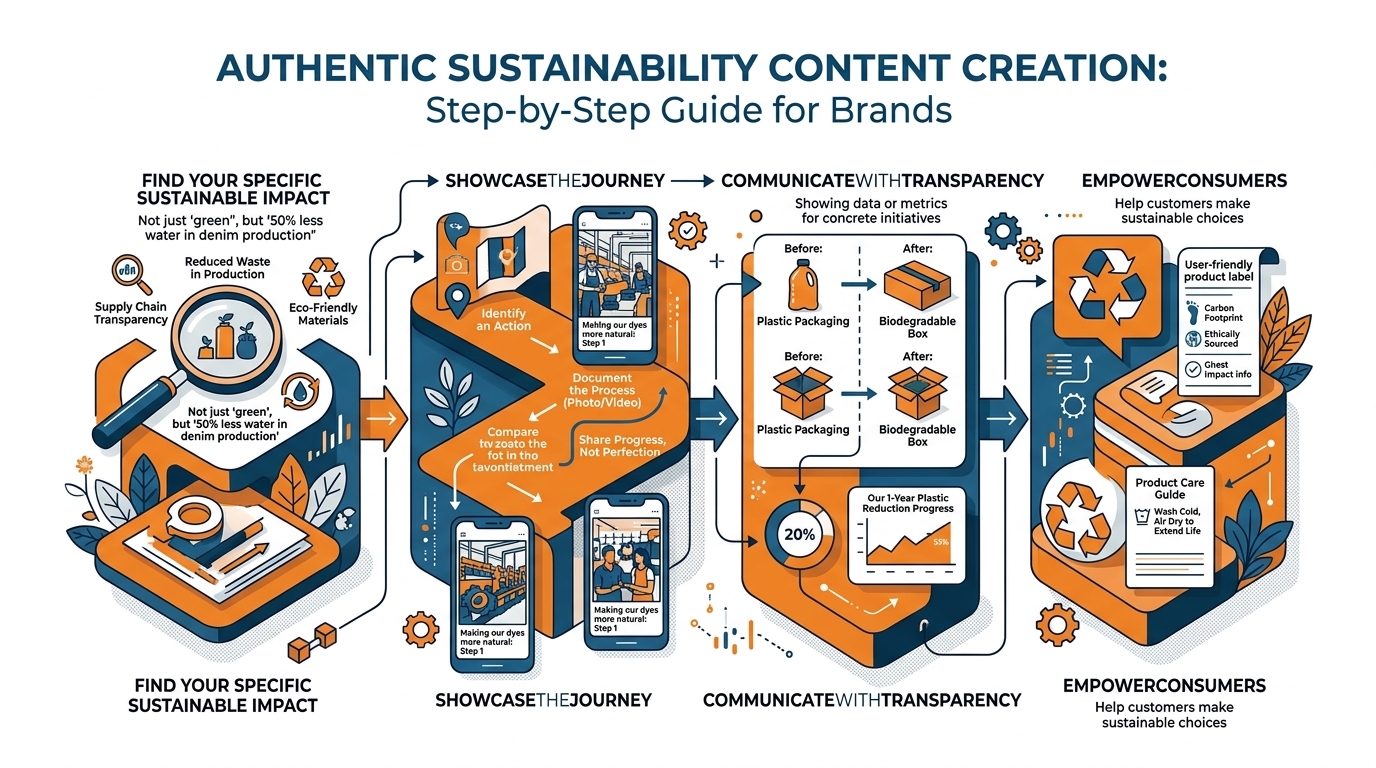
Before-and-after comparisons are compelling when you control for a single variable, such as old vs. new packaging featuring weight and composition callouts, or single-use vs. refill over a 3-month period paired with an authentic usage scenario.
Myth-versus-fact rounds and 'What this label means' quick lessons are tailor-made additions to your perpetual content schedule as they directly tackle the doubts stalling sales, whether that’s recycled means recyclable, vegan means low-impact, or carbon neutral means net-zero emissions.
Wrap the cycle up with an FAQ rebuttal, restating the tough question with grace, answering with supporting evidence, and acknowledging any limitation in context; you’ll see the same queries return again and again, and each one represents a turnkey post opportunity that eases the path for prospective buyers.
Influencers matter in this space: a Unilever-backed study using a simulated social platform with 6,000 consumers reported 78% look to influencers for sustainability choices, as reported in how influencer content shapes sustainability choices.
Creative post ideas for sustainable brands that tackle objections and convert
If you are selling a more expensive sustainable product, you have to make that premium worth it.
Create posts that justify the price premium by showing the math.
Start with the obvious, e.g. cost per use by calculating how many times that item would be worn (120 wears vs 30, for example).
Support this with receipts of durability by conducting a quick test in video, e.g. 30 days of abrasion or stain or seam stress test.
Then, go beyond price-per-use and calculate price-per-wash or repair-by-throwing away.
The key is to figure out how many refills it takes to break even with the initial investment (or if just the one repair would make it cheaper than buying a new one).
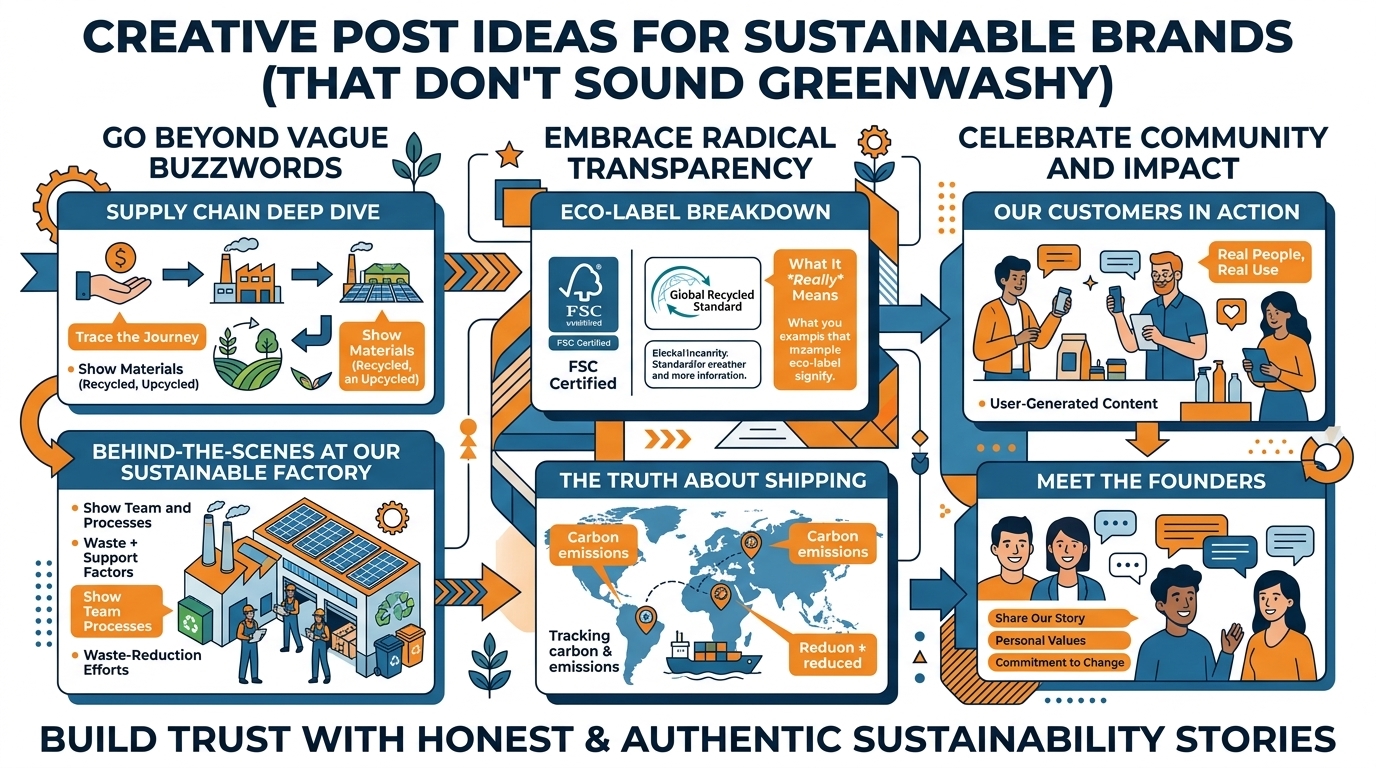
I like showing life cycle assessment numbers across the product lifetime (e.g. emissions per use or total waste avoided) as the value proposition, as it resonates more with audiences than a single use number, as long as you can define the system boundaries (e.g. product + package + average shipping distance in year one of use).
It is performance anxiety that converts your customers into non-customers. Therefore, you need to make your proof fun.
You can do this by conducting side-by-side comparisons. In these comparisons, you change one variable while controlling the rest and you point them out. For example, same fabric weight, same wash cycle, different dye method. Or, same countertop, same amount of time, different formula.
You can also do stress tests that mimic everyday situations and not a lab. For instance, spill it, scrub it, toss it into a bag or put it in the heat and then show what happened.
The proof converts the best when it's attached to a specific scenario and not just a generic customer testimonial. Ask people to share their story, their context, what they were using it for.
Was it for their 16-hour shift as a nurse? Was it for when their child made a mess on their pants? Was it for your bike commute home from work on rainy days? Was it for hard water? Sensitive skin? Or for a high-sweat workout?
Finally, you should be transparent about this to make yourself more believable. Let them know who it's not for. What are the conditions that might affect the product's performance? What should they use instead?
When you're honest like this, this will lower returns and increase trust and brand loyalty.
Decision paralysis around sustainability stems from the fact that people aren't selecting products so much as they are selecting values.
So give them decision-making content that takes less than a minute to follow.
Create choose-your-own-priorities guides to make trade-offs explicit.
Is their priority low-waste, low-carbon, or ethical labor?
Show them which option wins on each priority and why.
You can turn that into a decision tree.
If you'll wash cold and line-dry, pick this.
If you need heavy-duty performance, pick that.
If you live in a refill-friendly area, choose this format; if you travel a lot, choose the concentrated version.
Sometimes, I'll have a quick and dirty scoring model that scores three things, with a clear note of what I included and excluded, because consumers aren't looking for perfection, they're looking for a defensible decision that they can feel good about.
Make every concept fit within the funnel
Make every concept fit within the funnel, turning your creativity into a driver of sales rather than just engagement.
During the awareness stage, utilize pattern interrupts to highlight a problem the audience already has, such as how the monthly cost of disposable products compounds or the cost of replacement items over time; ensure these visuals work quickly on platforms like TikTok and Instagram Stories.
At the consideration stage, use comparisons, demonstrations, receipts, and use case evidence to address the specific objections found in your comments and DMs.
Finally, for the conversion stage, use posts to eliminate friction: share details about how the trial works, refill frequency, the scope of your return policy, your repair process, and what happens in the unlikely event that the product underperforms, as clarity is conversion.
By strategically matching content to awareness, consideration, and conversion, post concepts for sustainability businesses become a systematic sales machine rather than random content. If you want to make this repeatable, it helps to adopt smart social media automation.
Platform- and format-specific post ideas from sustainable brands, so the algorithm can help!
Your Instagram reward structure means your format should align with the user’s job, so aim your Creative post concepts for eco-conscious brands towards rapid retention, saves, replies, and watch time.
On Reels, make a visual claim check in the first second, then show your proof in three parts: baseline, test, and takeaway with boundary. One simple trick is to begin with the product failing in the real world then rewind to what changed.
On carousels, make save-worthy educational content by packaging your sustainability proof points like a course: the first slide is a hard question, slides two to six offer proof and trade-offs, the final slide includes a decision rule your audience can take into a store.
Treat Stories like an intent signal: use polls to understand the key trade-off, use questions to gather objections, and link the next Story to the most common response so people feel like you are answering them personally.
On live video, adapt that B2B move where you invite a supplier, a repair company, or a skeptical customer question list and do a live walkthrough of what you can measure, what you can’t measure yet and how you’ll change.
Native on TikTok: write scripts that sound human, not corporate, and let the evidence be the drama.
The angles that drive completion and replays reliably are a surprising truth, I tried it, things I wouldn’t do as a sustainable brand, and behind the claim.
Make them work by isolating one input and one result: which product we changed and what changed; the ingredient swap and the impact it had; how much the breakage went up (and then went down) when we made this packaging change; which supplier we picked or didn’t pick and the effect it had on lead times and defect rate.
Strongest comments happen when you’re talking through the less-fun stuff: what we left out of the footprint number, why a recycled material can still be wrong in high-wear applications.
The trick is to be both educating and pre-qualifying, so the people who stick with you are the ones most likely to buy and least likely to return.
The ones that work on LinkedIn are the brands where you can hear the operations team behind the brand, not the PR team.
Founder POV is decision-making content because you describe the constraint, what alternatives you reviewed, what metrics you reviewed, the decision you chose, and the metric you are measuring next quarter.
Decision logs create trust that compounds, particularly for smaller companies, because you are essentially publishing your internal processes for others to see and understand how you will consistently execute on them over time.
Supplier and circularity partnerships are high signal posts when you are not posting about a hand-shake but rather you are sharing the take-back process, what percent you are recovering, what does not get recovered, and how you changed based on that first batch.
Stakeholder-first content identifies who is affected by the decision, the customer, the worker, the supplier, the community, and then explains how you reduced harm without pretending that nothing was lost.
Evergreen Pinterest and SEO social needs “utility” posts, without any holiday spike, they pull people back months later.
Build how-tos around what to Google before churn or replacing: removing stains without harsh chemicals, seam repair, how to store refills safely, how to maintain performance so the product lasts longer.
Lists work as a content strategy because they are saved and reshared, especially if they are category-specific: what to look for at a refill station, what cert does and doesn’t cover for your product type, how to recognize durability markers in a fabric blend.
Care and repair content is a quietly good growth loop for sustainability companies, reducing replacement rate, which is great for customers and great for impact, and it establishes your brand as the companion post-purchase.
Sustainable swaps can be evergreen when anchored in a situation, rather than a day: travel kit swap, new-apartment swap, baby-stage swap, back-to-gym swap.
Always include the trade-off so it reads as guidance, not virtue signaling.
One more reason to prioritize TikTok and Instagram: a 2025 report found Gen Z spent 5.1 hours/day on social media in Q1 2025, detailed in the survey on Gen Z’s daily social media time.
Engaging Post Ideas for Sustainable Brands Leveraging Partnerships, User-Generated Content, and Community (Not Just Giveaways!)
The quickest way to grow your audience without ads or giveaways is to treat partnerships as a distribution model rather than a single campaign.
You only need a handful of aligned companies and creators and can then rotate co-produced content with them each month.
It does not have to be famous creators, but partners with customers who share the same values as you do.
My preference is to make each partnership produce 3 assets, which you both can use: a proof clip, a how-to-use clip, and a customers use-clip clip.
I prefer to rotate the content so that it always feels fresh, but the same story is told: one month it may be a side-by-side durability test, next it’s a behind-the-scenes of you and a repair partner.
The next you might make a video comparing which products customers should buy when.
This will help you get Creative post ideas for sustainable brands from thinking random ideas that only help one post, into an ongoing distribution of consistent messaging that will always work, even when it’s too busy to focus on content creation.
Avoid making user-generated content (UGC) appear promotional; in skeptical categories, highly polished material undermines trust.
Instead, encourage UGC that addresses the mundane concerns customers have: a “day in the life” that respects usage limits, an unboxing that documents both how they got rid of (or returned) their old product, a refill/repair video captured in a single take, and wear and performance updates at 30/90/180 days.
Conversion will convert better with more context: where, how did they use it, what did they replace, what was better?
Don’t just ask them to say they like your product.
For this content to convert, require the following 3 elements in submissions: show the starting condition, show the process, and show the result with a boundary (what doesn’t work).
I’ve seen brands slash skepticism when content shows imperfections: scuffs, stains, real-life clutter, which signals your product is not just in the studio, but living with customers.
Your community-led content will scale when it is aligned with behaviors rather than with vanity metrics.
Feature customer success stories around a specific, measurable outcome tied to your values.
Why did they switch to refills instead of buying single-use? How many items did they repair before buying new ones? What did they discover while changing their habits and what did they find most unexpected?
These kinds of personal stories are perfect for small business because they are tangible, and you will have access to all the relevant metrics, locations and people: You can show the location of a local refilling station or a repair pop-up, or you can include the name of the supplier you sourced your goods from.
Host a habit-building challenge such as a 30-day refilling streak, a 'repair first' week, or a month to boost your return rate.
Then share advice that can help your audience avoid common mistakes.
And, to let the community have a say, run polls for co-creation and solicit their ideas for things they would like to see that you can actually build.
For example, which items do you think should have replaceable components? Which guide would be most useful to extend the lifespan of the item?
And, as always, which of these two trade-offs would you prefer to make when it is not possible to optimize for everything?
Authenticity at scale isn't about improvising; it's about having the right lightweight processes and guardrails to make sure credibility stays intact, even as you go big.
To do that effectively: establish one simple page of content guidelines for your partners and customers, use one checklist for verification, and implement a single approval flow so your claims don't drift over time.
Consistency is key: define what counts as 'evidence' (for example: showing a return label being used, a photo of a receipt from a refill station, or a tight shot of a repaired seam) and turn down vague 'impact' language, no matter how beautiful the wording is.
Make sure each post builds trust in the same way: the same evidence over and over again.
That's where your best Creative post ideas for sustainable brands belong, as a recognizable proof style your audience can pick out instantly.
Finalização
The easiest method I use to maintain a steady stream of year-round creative post ideas for sustainable brands is to cycle through four different lanes: proof, objection-handling, native platform posts, and community distribution.
Using a combination like this helps you avoid two of the largest traps that small businesses fall into when it comes to social media content: saying the same thing about your mission over and over again until it becomes background noise, and chasing the latest trend for one day and never building trust afterwards.
Rotating through your lanes intentionally allows you to stay interesting while not sacrificing any of your message and your customers know what to expect when they interact with you: proof, honesty, and education.
Here’s the framework I recommend you rely on: people will believe what they can verify, and they’ll share what they can apply.
Verification posts drive belief, posts that tackle objections drive purchases, native posts within each platform drive reach, and community-driven distribution drives scale.
From my experience, a low volume of frequent posts can even outperform sporadic large-scale campaigns because regular repetition drives memory and decreases perceived risk, particularly in the area of sustainability where skepticism runs high and the cost of purchasing a false positive feels personal. If you’re also fighting inconsistency, this connects directly to inconsistent social media posting.
Your next step is to decide on your top proof type, your biggest objection, and your top channel, and then adopt a repeatable schedule that emphasizes credibility rather than hype.
If your strongest asset is accreditation, create a regular series that covers what the seal means, what it doesn't mean, and what you're actually checking for.
If durability is your edge, you should do controlled experiments and check back in at 30, 90, and 180 days.
And if circularity is the proof you want to lean into, you show what you have to do with products that come back to you, show what you actually manage to repair or recycle, and share your recovery percentage.
And now you're going to pick your biggest objection, most often, it's price, or you know, performance or convenience or how to think about trade-offs, and you're going to answer that same way every time, with baseline, method, result, boundary.
Once you commit to these three content choices, you can finally move past the weekly struggle of coming up with new ideas.
You can have a system that works even in a week when you're too busy to think creatively.
You'll see that comments become more specific, that more DMs start arriving with real requests for help, and that your audience will help distribute your content because they recognize your proof style and are able to replicate it.
That is how creative post ideas for sustainable brands stop being ad hoc ideas and start becoming a trust-compounding system.
One more industry signal: Nielsen’s analysis of the German ad market found 18,000+ sustainability-centered campaign motifs from the beginning of 2022 to the end of May 2023, covered in Nielsen’s report on sustainability-themed advertising.
Related reads
4/27/2026
B2B SaaS social media benchmarks: Set the right targets.
B2B SaaS social media benchmarks: Set the right targets. The trouble with defining B2B SaaS social media benchmarks is that it's an inherently impe...
4/25/2026
Building a personal brand as a technical founder (without becoming a creator)
Building a personal brand as a technical founder (without becoming a creator) Creating a personal brand as a tech founder should feel less about ma...
4/18/2026
Can AI Replace a Social Media Manager in 2026?
Can AI Replace a Social Media Manager in 2026? By 2026, AI will become an imperative part of social media, not an accessory. It’s baked into cre...