B2B SaaS social media benchmarks: Set the right targets.
B2B SaaS social media benchmarks: Set the right targets. The trouble with defining B2B SaaS social media benchmarks is that it's an inherently impe...
B2B SaaS social media benchmarks: Set the right targets.
The trouble with defining B2B SaaS social media benchmarks is that it's an inherently imperfect science that comes with many more built-in limitations than any other social industry you could name. Your target audience is smaller, and your sales cycle is longer, while most of the effects of a post are not visible within the platform. A lot of time, the social post is seen by a prospect and nothing happens; they don't click on it, comment on it, or share it. But a week later they Google your name and start engaging in conversations about your product, in person or over Slack. They go on to read about you in an email or search ad and then ultimately engage with you during a sales call or through your website. If you only measure success by comments and shares, you will not account for all the work that's going on that you aren't seeing on social. In fact, you will likely overvalue your content that generates more engagement, but that has zero impact on your revenue.
That’s also why most benchmarks out there leave you frustrated, to say the least. They’re grouped under big tech or software averages, built around only engagement metrics, and based on data sources that aren’t even comparable to your situation. A seed-stage SaaS with 500 prospects isn’t meant to be measured by the same standard as a developer tool with millions of users, or a consumer app with unlimited reach. I’ve worked with companies that chased the generic average, reached it and made no pipeline because the benchmark wasn’t really tied to intent, clicks, or anything further down the funnel.
In this piece, I'm going to give you social benchmarks for B2B SaaS you can actually use for goal setting and diagnosis. I'll benchmark organic and paid separately so you can know when it's a content and positioning problem versus when it's a targeting and offer problem. But more importantly, I'll make every metric turn into a decision you can make this week: what to change if you're below the line, what to double down on if you're above it, and how to track movement without turning your reporting into a performance piece. If you have a small social team with a real revenue objective, you're going to walk away from this with figures that are meant to be acted on instead of numbers that are just here for the sake of a presentation.
(Don’t set yourself up to benchmark the wrong game.)
B2B SaaS social benchmarks are only useful when you benchmark the right game.
I distinguish benchmarks by goal because each objective has a different definition of a win: Awareness is about efficient reach and memory. Demand creation is about converting attention to site activity. Pipeline influence is about shortening the time-to-close for live pipeline. Community & Customer marketing is about retention and advocacy. And recruiting is about attracting the right candidates.
Using a single metric across all five goals, such as engagement rate, means you are driving the wrong outcomes: You will drive likes when you need qualified attention from a narrow ICP, or you will drive clicks when you need to build trust through repeated exposure.
The only way to keep this approachable for a small team is to have one minimum metric set regardless of the tool used:
- For awareness, mandatory metric: impression counts, reach, frequency per person, and follower growth rate. Optional metric: share rate, video completion rate (those help explain what is driving reach up/down).
- For demand creation, mandatory metrics: outbound clicks, CTR (link), landing page conversion rate (posts-to-landing page). Optional metrics: assisted conversions, branded search lift (those help explain dark social impact).
- For pipeline influence, mandatory metrics: influenced opportunities count, influenced pipeline value with a consistent attribution rule, stage velocity lift (optional, as that tells you if the social is actually speeding things up).
- For community and customer marketing, mandatory metrics: active member rate, repeat engagement rate. Optional metric: referral volume.
- For recruiting, mandatory metric: job page visits from social, applicants converted to applications. Optional metric: cost per qualified applicant (only required if you do paid).
Comparability is where most benchmark articles go off the rails, so establish rules prior to your own comparisons.
Pin down a consistent time frame that aligns with your actual output rather than your current feelings: for example, use 28 days for tactical iterations and 90 days when making strategic calls.
Define a standard attribution span as well, say, you’re tracking demo requests; a 7-day click window is too short for B2B SaaS and should extend to 30 days when your content is focused on consideration; either way, commit to that number and adhere to it.
Always distinguish between paid and organic, because paid will tend to exaggerate your reach and may even suppress your engagement while still feeding your pipeline.
And make sure you are comparing apples to apples in terms of measurement: per post is the metric for creative efficiency, per impression gauges attention quality at scale, and per follower measures your ability to rally your audience; when you mix these benchmarks up, you’re prone to thinking you’ve won the race when you’ve barely started running.
The biggest mistake in Social media benchmarks for B2B SaaS is optimizing for engagement rate since your bottleneck is actually qualified attention and downstream intent.
High engagement typically implies wide relatability, not buying intent, which means you could have a very good engagement rate and yet have poor demo intent, because you have the wrong audience, or the right audience, at the wrong time.
The right way to benchmark is to use engagement as a diagnostic, instead of a goal: if you see your impressions growing and the qualified clicks staying flat, then you need tighter positioning and offers; if you see qualified clicks growing but weak conversion, then you need better landing pages and better alignment between what you promised and what you delivered; and finally, if you see conversion growing, but the pipeline influence isn’t growing, then you need to look at attribution and your sales handoff.
And so on.
You stop chasing vanity averages when you start with the goal of turning attention to revenue.
LinkedIn B2B SaaS social media benchmarks (and what the real numbers are for company page vs personal)
For B2B SaaS companies, LinkedIn is where B2B social media benchmarks actually apply, since it’s the only channel where your buyer self-reports their company, title, and public participation.
But the reality on LinkedIn is that average engagement rate is a terrible benchmark in isolation, because it is influenced heavily by distribution luck, audience size, and content format.
If you have a niche CFO software that generates a bunch of buying conversations, but it’s compared to a productivity tool that’s just collecting likes, it is going to look like you underperform.
And that’s not going to do you any favors if you are looking for benchmarks to follow.
Instead, you need to tie those benchmarks to inputs you can repeat, such as impressions per post relative to followers, monthly follower growth, link clicks, or engagement quality (i.e. are your target audience actually engaging with your content?). To ground what “averages” look like in the wild, compare your numbers to the live tech/software social benchmarks published in Rival IQ’s industry benchmarks, which includes data points like 12.1 posts per company per week, 1.81k engagements per post (average), and a 0.11% engagement rate per post (average) in the past 30 days.
I evaluate company pages on different criteria than founder and executive profiles since they don't follow the same distribution dynamics.
A company page should be judged on its ability to earn impressions through consistent posting, content relevance, and employee sharing, and its ability to convert through website clicks, adding users to retargeting audiences, and brand awareness.
I judge a personal profile based on its ability to earn reach through perceived trust, opinion leadership, and proximity to a given relationship and convert through conversational channels like comments that drive profile visits, direct messages, intro requests, and sales calls.
This means you should stop expecting a company page to outperform a strong executive profile on engagement rate and instead evaluate it by its ability to deliver predictable impressions and follower growth at scale and to drive clicks from the desired job titles.
At the same time, you should evaluate a personal profile by its ability to consistently generate comments from ICPs and measurable sales calls, even if it doesn't deliver raw click volumes.

I break benchmarks down into a few groups before I even assess performance: follower tier/page size, the breadth of the ICP, category stage, and the go-to-market motion.
A page under 1,000 followers shouldn't be evaluated on the same metrics as one with 20,000; early growth is volatile and often employee-driven; a larger audience is dealing with distribution degradation and content fatigue.
The scope of the ICP has a large impact on how you can scale.
A broadly applicable SaaS can benchmark based on reach and interactions; a vertical SaaS will look to benchmark on the quality and intent of the CTA clicks.
The stage of the category will impact the benchmark numbers.
Categories with higher familiarity win on that; an up-and-coming category needs more impressions spent teaching the category before it begins to show results.
The sales motion also will change the numbers.
A PLG motion would look more at click-through and quicker on-site actions; a sales-led motion would look more at saves, profile views, and DM activity that could be attributed to pipeline influence.
A hybrid motion should track both and watch which side is lagging.
But the important metrics, aside from engagement, are: consistency, and efficiency.
The consistency is measured by how stable the impressions per post week over week are, as opposed to spikes and valleys, because that consistency is what compounds into memory and inbound demand.
The efficiency is measured by followers per impressions (or more specifically new followers per 1,000 impressions), because that tells you if you are attracting the right people, or just renting their attention.
I also look at behavior patterns, especially how link clicks per 1,000 impressions rise or fall when posts are about a problem as opposed to a product, because that tells you what is creating intent.
Finally, I look at qualified engagement (comments from ICP titles, saves, indicating that someone wants to remember your content in the future, and shares that trigger conversation (including shares that result in DMs)) as the one metric on LinkedIn that really indicates success. If you want a consistent way to calculate engagement alongside these diagnostics, use an engagement calculator.
The point is: if your engagement is better than benchmark, and you are still below benchmark on pipeline influence, then you are probably too broad, too entertaining, or too safe (and you need more focused positioning and more compelling offers to get a decision).
And if your engagement is below benchmark, but you are above benchmark on pipeline influence, that means you are doing things right: you are becoming polarizing, specific, and attracting the right buyers; the key now is to scale the consistency and not worry about the engagement.
Here are the social benchmarks B2B SaaS companies should be tracking at different points in the funnel: CTR, lead quality, and pipeline contribution, not just engagement/likes.
If you're looking for social media benchmarks for B2B SaaS that reliably predict revenue, first connect social to a funnel that actually matters: attention, site or asset engagement, high-intent actions, sales conversations, and pipeline.
With most small B2B SaaS companies, I benchmark each step by a ratio so you can see exactly where the leak is.
For LinkedIn, you're looking for, on average, a 0.6% to 1.5% CTR on organic posts (with a defined offer in hand), and a 0.2% to 0.6% CTR, and your post is probably too broad on both the hook and audience.
Then on site, you want click to engaged session >55% and a 0.3% to 1.2% demo or trial rate for the traffic from social.
1.5% to 3% is a strong achievable range if you're very tight on pain and persona between post and landing page.
Your social might be fine if the CTR is okay but conversions aren't; the problem might be promise to page continuity.
There's one more important benchmark that we're missing, and that's traffic quality, since social can send us a lot of tourist-like clicks.
We should benchmark bounce and engaged sessions by social source, but also return visitors and time-to-second-session, since B2B SaaS buying rarely happens on the first visit.
Social should have fewer pages per session than search, but a better new-to-returning visitor progression over 30-60 days if it's doing its job.
I also keep a close eye on source-level tendencies, like when LinkedIn traffic doesn't return, meaning I'm probably just attracting curiosity, not need; or when LinkedIn traffic comes back, converts on a later session, and my content is helping build memory and trust.
If I'm going to test something here, I'll segment it by landing destination, since a post that sends us all to a product page is almost always going to underperform one that sends us to a razor-sharp problem page or a one-topic guide, even if the CTR is worse on the product post.
The place where most teams give up on social, or fake that social is a last click attribution, is pipeline influence. And both are wrong.
The pipeline influence numbers that can be trusted can be benchmarked without self-delusion with just four signals:
- Self-reported attribution on forms and on sales calls.
- Branded search lift.
- Direct traffic trends.
- CRM influence on campaigns that you know touched the prospect.
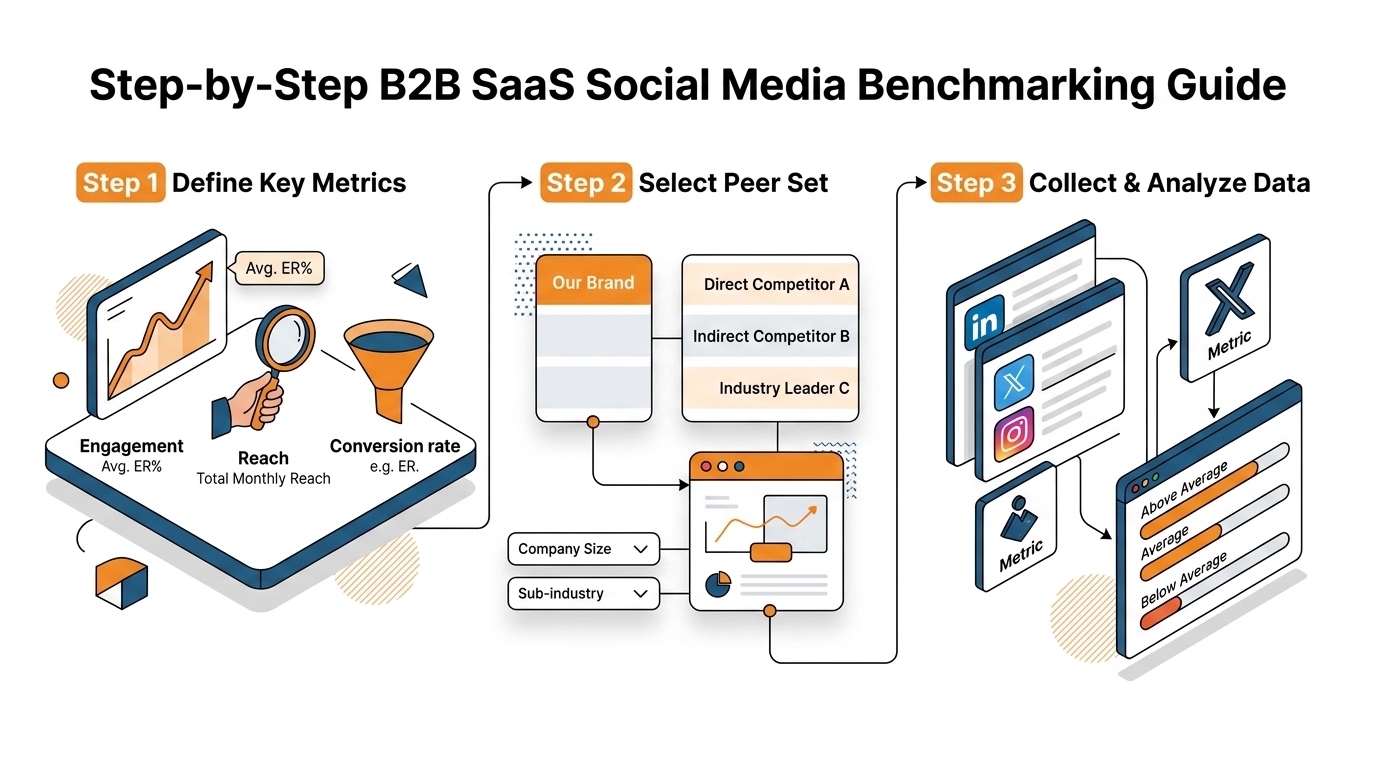
You should see a minimum of 20 to 30 percent of new inbound demos to have social self-reported attribution once you have a consistent, say, weekly posting cadence, and a point of view that is crystal clear. Even if it's reporting as last-click zero.
Also, pipeline influence can easily be measured by pipeline itself. Just compare close rates and close velocity for deals that have a single social touch in the last 90 days versus deals that don't, and even a 10 to 20 percent faster velocity from first meeting to next stage is a meaningful number when your deal cycles are long and your team is small.
You should see different benchmarks between demand gen and brand-led programs, and have guardrails that prevent benchmarking poor data.
For demand gen, good is efficient clicks, clean UTMs, stable landing conversion and lead quality like 25-40% sales-accepted rate and demo-to-opportunity rates that don't move as volume scales.
For brand-led, good is increasing branded search, increasing direct and returning traffic, increasing inbound mentions in sales calls, and winning a higher percentage of deals against competitors even if CTR is lower.
You can immediately mistrust any of these benchmarks if your UTMs vary in quality, your analytics is classifying paid social as referral or direct, LinkedIn referrers are lost to in-app browsers or your model window does not account for your sales cycle.
In all these cases you're not failing, you're measuring noise.
What are good social media goals and benchmarks for B2B SaaS companies for paid and organic combined (and how to set your own)?
I like to keep organic vs. paid separate and distinct because I need different criteria for each.
Organic needs to prove it can drive engagement, with the correct job titles, without needing to pay for it.
This means stable impressions per post, steady recurring reach, consistent comments that include the right job titles, and clicking behavior that is repeatable even when we post infrequently.
Paid needs to prove it can consistently drive intent, even at scale.
This means consistent CTR, consistent cost per landing page view, and a predictable and stable conversion rate even if we're willing to spend more.
If I blend paid and organic together into a single blended CTR or blended CPL, I can be lulled into a false sense of satisfaction, believing my organic performance is good when all my leads come from paid.
Or I might think I have an organic problem when in fact my real problem is paid targeting.
I use paid benchmarks primarily for diagnostic purposes, rather than to drive growth.
Start by allocating a minimal budget for message testing to accelerate insights.
On LinkedIn cold audiences, a compelling problem-solution message should yield between 0.45% and 0.90% CTR. This range aligns with broader references like Brafton’s social advertising benchmarks PDF, which lists LinkedIn ads CTR across industries at 0.52% and software & technology LinkedIn ads CTR benchmark at ~0.40%-0.42%.
Anything below 0.35% indicates your hook, promise, or persona needs attention.
Next, monitor the percentage of landing page views relative to click-throughs.
If you're receiving clicks that don’t transition into page views, you’re likely encountering a friction issue, such as slow load times, in-app browser restrictions, or misaligned user expectations.
I typically test five to eight ad variations for each angle during these quick experiments.
When one angle outperforms the others in both CTR and conversion rate, use that winning angle to inform your organic content strategy, but avoid using the same creative asset.
Instead, evaluate the organic performance of that topic by measuring organic clicks per 1,000 impressions and the volume of returning visitors after 30 to 60 days.
If performance is lagging, here’s the logic we apply to isolate the issue rapidly.
If impressions are good but CTR is poor, you have a creative problem. Your hook is generic, your point of view is too bland, or your post doesn’t earn the click because it gives away the whole solution in one shot (leaving no cliffhanger for you to follow).
If CTR is good but conversions are poor, you have a landing page or offer problem. You promised the wrong outcome in the post or the landing page sells the wrong outcome for the CTA. Or the CTA is asking for too much commitment too soon.
If paid CTR is lagging across several different creatives, you have a targeting or ICP problem. Great creative can’t overcome an ICP that has no pain.
If paid CTR is lagging while organic is strong, you have a distribution problem. You’re not earning enough employee reposts or partner shares or conversational surface area to generate repeated impressions with the same buyers.
So don’t post more, fix the distribution systems.
Partnerships, as well as influencer-type distribution, change what your ceiling should be, hence some brands seem like outliers.
It is natural for companies that are constantly piggy-backing other people audiences to have inflated benchmarks across the board; organic impressions per post increase, organic follower growth is faster, even organic engagement rate can be higher as they have the benefit of their content reaching people with existing trust to them.
When you have network effects that influence the performance, it is important to differentiate between first party reach and reach that is influenced by partners.
In these instances, you would separate your first-party benchmarks from partner amplified reach.
When doing this, you need to compare each to its own baseline; a partner amplified post is really more of a distribution campaign compared to a standard organic post.
Another important thing to consider when setting organic benchmarks is stage.
By having appropriate targets for your current stage, benchmarks don't become irrelevant or too easy to hit.
For early-stage SaaS, the benchmarks should focus on proof that your message resonates and the ability to attract your ideal customer base, even if this looks like a lower volume target with 1-3 pieces of content per week that produce a few qualified website clicks and at least a few interactions from your ICP.
For a scale-up SaaS company, the focus should be on consistency and efficiency; for example, you should be producing the same number of impressions per week, with a CTR range that you're hitting consistently and a landing page conversion that remains similar, even as your traffic increases.
Finally, an enterprise SaaS company should be focused on impact metrics that will show that the impact of their social is actually increasing influence within the market; in this case, they would set a target to see brand search lift, self-reported attribution from organic social, or even measurable stage progression velocity increases.
The goal in enterprise is not to see a spike in the numbers, but rather to see an increase in the influence, trust that they're building. For additional context on distribution channel value, note that Content Marketing Institute’s 2024 B2B research reports 84% of B2B marketers said LinkedIn delivers the best value among organic social platforms, and 44% said organic social media platforms perform among the best content distribution channels.
Conclusão
B2B SaaS social media benchmarks only deliver value when viewed as layers and not a single data point.
You now have the four layers that help a small team work smarter: platform mechanics to understand the algorithm's incentives and disincentives, segmentation to find comparable peers, funnel impact to connect your social metrics to actual site activity and the pipeline, and diagnostics that tie every metric to a potential action.
Our unique contribution is in providing layers, which avoid the biggest mistake in SaaS benchmarking: having engagement scores soar while quality clicks, returning visitors, and influenced pipeline remain unchanged.
If you want to use the benchmarks in a report without getting lost in dashboards, start by creating a baseline before making changes.
Take one 28-day snapshot for tactical signals such as impressions per post, clicks per 1,000 impressions, and conversion rate from social traffic, plus one 90-day snapshot for slow-moving signals such as branded search lift, repeat visitors, and pipeline velocity deltas.
Select one main goal each quarter (not five), and pair it with one or two leading metrics and one lagging one.
For instance, if your goal is demand creation, you can look at organic CTR and click-to-engaged-session-rate of more than 55% from organic traffic (leading indicators), as well as demo/trial rate from social traffic (0.3%-1.2%, lagging indicator; 1.5%-3%, a strong target, if post-to-page promise is on-point).
So, what stops you from chasing vanity metrics and over-optimizing them?
You measure progress, not perfection.
If impressions are up, but you don't see an uptick in qualified clicks, you optimize your positioning and the offer rather than simply posting more.
If CTR is strong, but conversion isn't, you fix continuity between the post and landing page, rather than obsessing over what your content hook is.
If engagement rate is below average, and you've seen that you have faster deal velocity with opportunities that are touched by a social activity within the last 90 days, you stop worrying and scale that.
Because what looks bad in-platform often works best for revenue.
The key insight is that benchmarks serve as a compass rather than a report card.
Viewing social media benchmarks for B2B SaaS in this way, one stops inquiring whether I'm good and starts wondering where I can eliminate constraints this month.
That is how a small business competes when constrained for time and capital: one uses benchmarks to identify what to address next, what to emphasize, and what to disregard, so that each reporting period yields more granular decisions and more predictable growth.
If you need additional paid context beyond CTR, you can cross-check against Tamarind’s always up-to-date LinkedIn ad benchmarks, which includes benchmarks for LinkedIn ad engagement rate by industry, and Databox’s LinkedIn performance benchmarks by industry, which cites a median number of LinkedIn Ads engagement actions across industries of 646.5 (October 2023).
Related reads
4/25/2026
Building a personal brand as a technical founder (without becoming a creator)
Building a personal brand as a technical founder (without becoming a creator) Creating a personal brand as a tech founder should feel less about ma...
4/7/2026
Free Google Spreadsheets For Social Media (Calendars, Analytics, Content Plans)
Use these free Google Spreadsheets to plan, schedule, and analyze your social media posts with more structure and consistency.