Can AI Replace a Social Media Manager in 2026?
Can AI Replace a Social Media Manager in 2026? By 2026, AI will become an imperative part of social media, not an accessory. It’s baked into cre...
Can AI Replace a Social Media Manager in 2026?
By 2026, AI will become an imperative part of social media, not an accessory.
It’s baked into creation, publishing flows, social listening, and reporting, so the question is different now.
In 2026, will AI take over the position of a social media manager? That’s a different question entirely from, “Can it post content?” As a small business owner, you want to answer the much more difficult question that’s also much more financially rewarding: can it hold down the kind of results you need, on a week-in, week-out basis, without you stepping in to take ownership if something fails?
The answer to that question depends on how you and I define the term replace.
The term “replace” here refers to replacing tasks, things like coming up with some captions, recycling a piece of content, gathering low-hanging insights, or responding to some low-level comments, and so forth.
Or it could be the kind of outcome that you can replace, such as delivering consistently-qualified audiences, leading to leads, and safeguarding your brand’s voice throughout each touchpoint.
And then there’s the level that most articles avoid: Accountability replacement, meaning who sets direction, who approves risks, who manages a messy customer situation in public, and who’s on the hook when performance dips or a post gets blown up.
AI is really good at doing things now.
The results are context-dependent.
Accountability is still the place where most businesses need a human, even if that human is you.
Our guide provides a practical, 2026-compliant answer to the question: Where can AI do the work? Where can it not? And what is an example of a reasonable operational structure to get speed and cost savings without risking your reputation?
Then I’ll show you what I’d do, what I’d automate, what would still require my personal touch, how I’d run social in a way that is measurable, repeatable, winnable.
The question isn’t “can a social media manager be replaced by AI in 2026?”
The question should be, and can only ever be, “can social media management be replaced by AI?”
The only honest answer to whether AI can replace a social media manager in 2026 requires you to break that word 'replace' down into three business-critical functions: execution, strategy, and accountability.
If you want a broader baseline on why this shift is accelerating, SurveyMonkey’s roundup of AI marketing stats notes that 56% of marketers say their company is taking an active role in implementing and using AI (AI marketing adoption data).
The 3 functions: execution, strategy, accountability
First, there's execution, that's the work of simply grinding out content, turning one long video into five posts, writing captions, formatting assets, and hitting deadlines consistently. If you’re leaning into drafting at scale, an AI social media post generator is built for that execution layer.
Next, there's strategy, that's deciding what to push this month, which segment to court, what creative angles to try, and which metrics matter beyond vanity counts. If your biggest gap is planning, a social media content calendar can anchor what “strategy” means in practice.
Finally, and most importantly, there's accountability, that's the role of the person who takes the heat when a post lands wrong, a customer complaint goes public, a claim crosses a legal line, or when performance tanks and you have to answer why and make it right.
A lot of the AI conversations stay at the level of execution because the demos seem really cool there. You see AI produce 30 post ideas in 30 seconds and go, well, now this work is done.
It's like evaluating the quality of a restaurant by the speed of their knife work. It's deciding what we're going to make, for whom, and what happens when someone gets food poisoning.
That's the bottleneck in 2026: the accountability gap.
Platforms reward speed but small businesses absorb the risk of broken trust, refunds, chargebacks, reviews, and the time needed to fix a blunder.
Using AI to manage social end-to-end doesn't make you a manager, it just makes you a manager of last resort.
How the core responsibilities map out in 2026
By 2026, this is how the core responsibilities will map out.
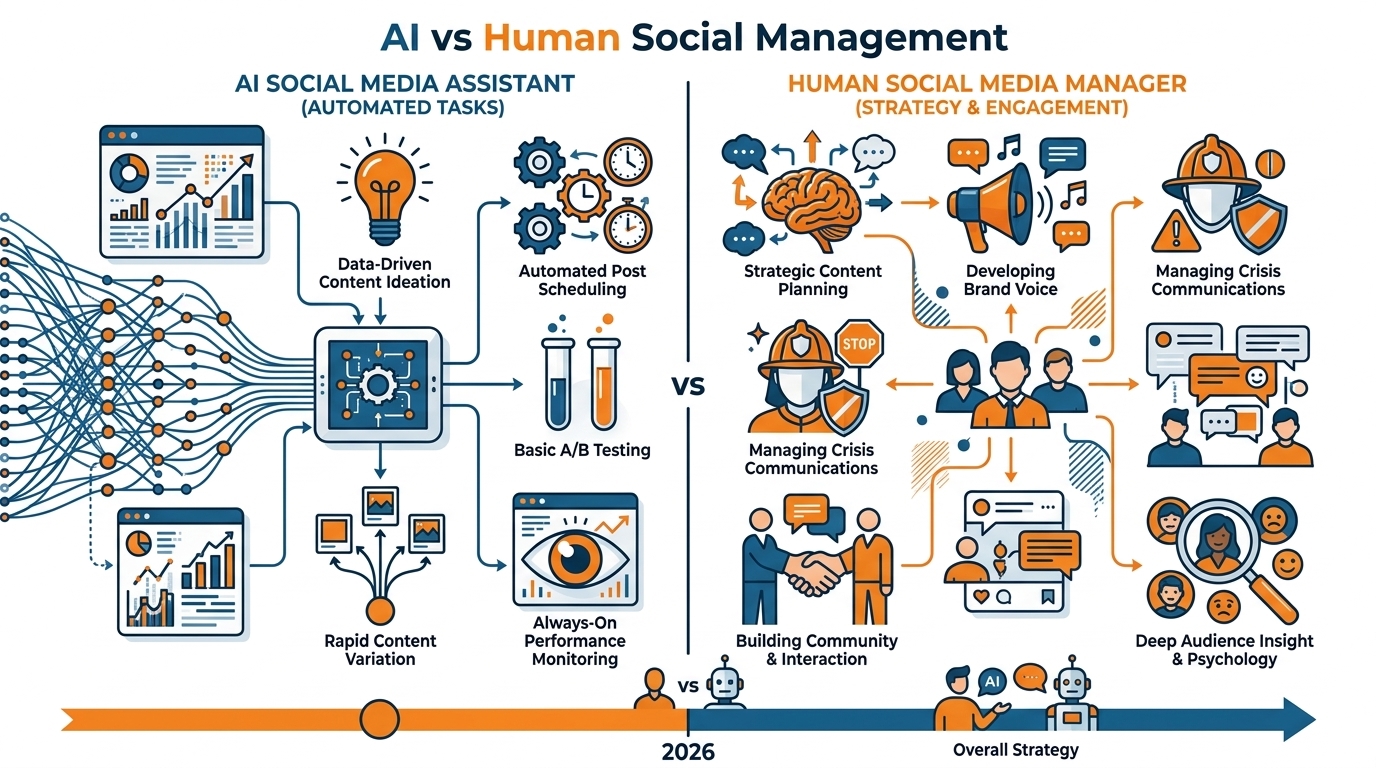
- AI-good: Content ideation and repurposing, when you give it the raw material, such as your FAQs, sales calls, before-and-afters, and customer testimonials.
- You can also get good outputs from scheduling logic, and basic analytics summaries like, which posts had above-average reach or which hooks kept people reading.
- AI-okay: First-draft community replies and simple reporting.
- Review any output involving price, guarantees, health, finance, or an unhappy customer.
- Human-required: Brand positioning, tone/voice judgment, and stakeholder alignment, as these require taste, context, and business-specific trade-offs.
- Human-required: Crisis calls, like, apologize now, stay silent, refund publicly, or escalate to law.
One bad reply thread can lose more in trust than a month of good posts can make up. AI doesn't feel the pain.
The key to using AI profitably is asking yourself if you are going for 'good enough' or competitive advantage.
Good enough looks like baseline presence: you show up consistently, your pages don't look abandoned, you respond to the simple questions quickly, and you gather basic data so you don't operate in the dark.
Competitive advantage looks like compounding growth: you differentiate with a clear point of view, you use it to create demand that converts to leads and sales, and you take deliberate risks on specific content, partnerships, and messaging strategies that competitors won't be able to replicate in a single night.
In 2026, AI can absolutely help you to 'good enough' far more quickly (and with fewer hours). However, competitive advantage will continue to depend on someone taking ownership of the strategy and standing by the results once the algorithm changes or market conditions shift, or when one post happens to matter an order of magnitude more than anticipated.
For a reality check on just how mainstream AI usage is becoming, HubSpot’s 2026 marketing trends dataset reports that 80% of marketers currently use AI for content creation (latest marketing benchmarks).
Can AI take over social media management in 2026?
A framework by business type, risk, and volume
Is it possible for AI to take over as a social media manager by 2026?
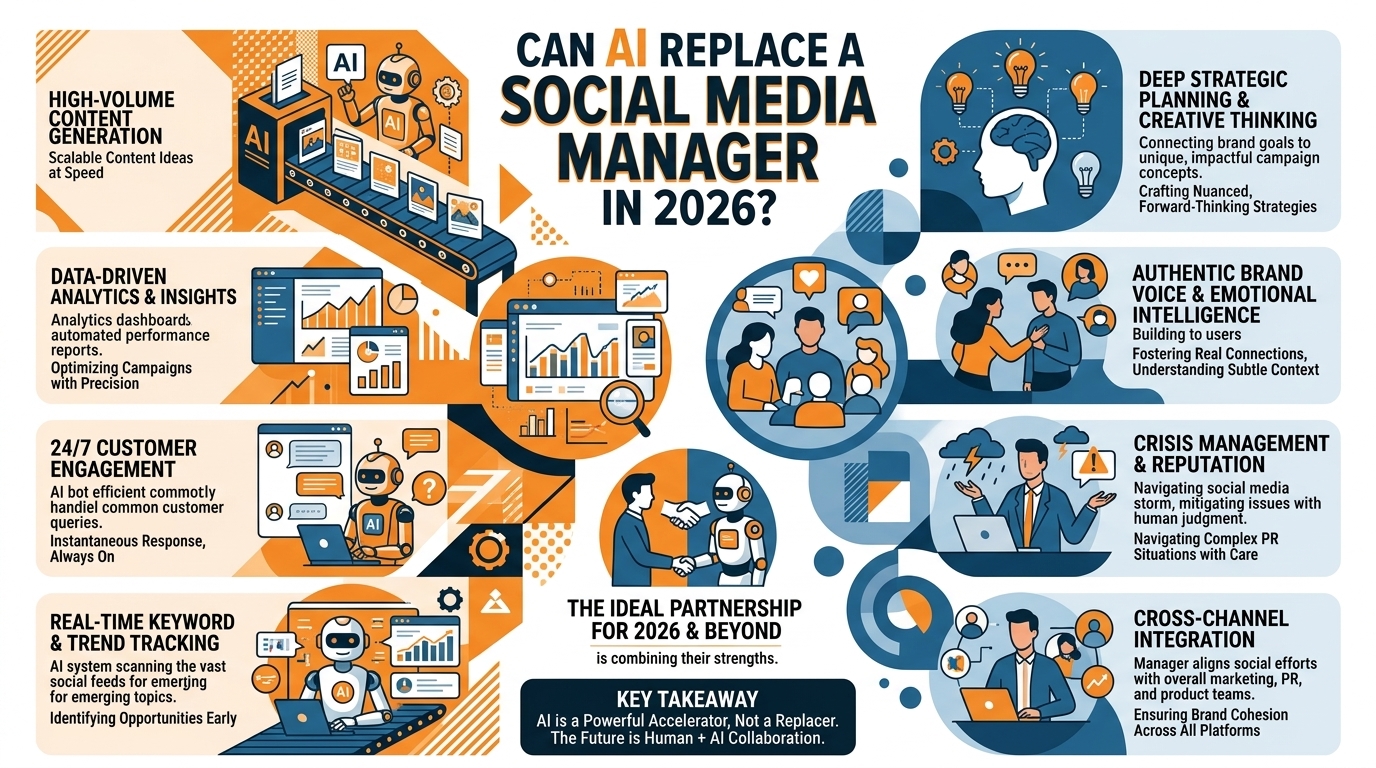
The short answer is yes, but only in parts, and the speed at which you can assess your circumstances depends on rating seven key factors: the acceptable level of brand risk, your sensitivity to regulations, dependency on your founder's individual personality, the degree of community engagement you're building, how many posts you make daily, how tightly social management intertwines with customer support, and how quickly an issue must be addressed.
The clearest rule of thumb is this: if a single misstep would reasonably cost more than the amount you'd pay your social media manager for an entire month, whether in customer refunds, payment processor chargebacks, negative reviews, or missed sales, then total replacement almost certainly isn't worth it.
Conversely, if your social media content is primarily factual, easily reused, and low-risk, and if most customers rarely anticipate prompt, personalized, public responses, then delegating nearly all your daily social operations to an AI tool is the smarter move.
Now, let's get specific.
For individual content creators, AI can easily crank out content on a daily basis, but it can't take the place of you. In this case, your replaceability by AI is highly dependent on whether or not your viewers care more about the person or the topic. For example, when I tested AI-written posts against founder-led posts, the AI copy consistently was able to hit all of the main structural beats, but missed the on-the-nose details that make people save or message you directly.
When I think of an SMB that offers a local service (plumber, dental clinic, gym, hair salon), AI can easily create an AI-generated presence or even answer most FAQs, but the biggest barrier you're trying to overcome is trust and/or how quickly you respond to leads in real time. So, you want a human in the loop when you need to handle escalations, complaints, pricing nuance, guarantees, and appointment failures, etc.
For ecom and DTC businesses, volume might push you toward automation, but customer support overlap and escalation speed pulls you toward a human. Think about it, the comment section is your return desk for public-facing customers.
For B2B companies, your risk is less about going viral and more about stakeholder complexity and credibility. AI can do a lot of the drafting, but a human needs to ensure posts align with sales stages, partner politics, and reality-checks against sales realities.
For heavily regulated industries like finance, health, legal, and any other industry based on claims, the stakes are much higher. Never allow an AI-generated post without a human hand on it, just in case you miss one tiny phrase and suddenly you're getting cited as an advertising violation.
Finally, for large corporations with multiple locations and/or a global audience, the risk for AI-generated copy is extremely high because the risk you care more about is brand trust and consistency (or brand 'governance' if you will). You're not paying for AI-generated copy, but rather the governance to ensure that copy is correct; so, in this case, AI replacement is almost 100% off the table unless you are okay with a material amount of brand risk.
The 3 approaches most use cases will follow
In 2026, the majority of real-world use cases will break down into three distinct approaches.
An AI-only social strategy works when the risk is low, your audience isn’t deeply engaged, and you just need regular updates, like a niche e-commerce brand that barely comments on anything, and there are no sensitive claims. For them, an AI-only plan might work fine because no matter what, nothing catastrophic happens when the posts aren’t the best.
AI-led social, with human oversight for quality checks, is best for small, growing businesses that are AI-generating a lot of content, at a much larger scale, but using quality checks to prevent AI content that deals with money, health, law, competitor mentions, angry people, or promises to show up. This is the sweet spot, and it will be the most common.
Finally, for large, high-stakes, high-reward social brands, AI can only help accelerate a human-led process. Human is still the driver of strategy, voice, and community management. AI can be deployed to help humans reduce time to execution, help identify patterns, and help produce more volume, but it can never remove the human accountability required whenever something goes really wrong.
This is actually a much clearer economic choice than many would acknowledge: don't pay for a manager if your social program is fundamentally an execution play, if your downside is capped, and you don't have exposure to regulation or the need for rapid escalation and founder-voice and a heavy community.
You create a false economy if you're buying speed and judgment and damage control, but only realize it on your worst day.
If you have high volume and low tolerance for escalation, moving from human to AI typically converts a direct cost to an indirect one and you will pay the price in time, ratings, and conversion rates.
The winning decision in 2026 is not about whether it's human or AI, it's about where you are safe to lose human time and where you actually move that loss to yourself. If you want to pressure-test whether your current setup is systemized enough for this, see smart social media automation.
How the operating models that work actually work (who’s supposed to do what and when)?
To run an AI social strategy without burning your trust, treat it like a factory and install quality controls.
Start with real data: pull your last 30 days of comments and DMs, call logs from sales calls, FAQs, reviews, product releases, and competitor messaging.
Once that data is in, let AI do the work: find audience questions and themes, create content angles based on intent, write posts and alternatives, and map each one to its purpose (lead-gen, retention, referral, review, or support deflection).
Then, force AI into your brand voice by feeding it examples of your best socials and requiring a rewrite in that style before posting.
After you approve posts, schedule them, and track results.
Small businesses should do it weekly like this: batch approve low-risk posts, hold off on promo posts with pricing until closer to going live, and review results and turn winners into variants and failures into learning opportunities.
The result in my experience? 40-70% less time spent executing and the right person making the calls.
If you want to turn the “factory” idea into an actual repeatable workflow, a weekly social media system helps lay out what to do week by week.
The four non-negotiable human-in-the-loop gates
In 2026, four human-in-the-loop gates, which are non-negotiable, ensure safety in AI-generated content, provided you value your brand.
- The first gate is final publish approval, requiring any post to be reviewed and approved by a human to ensure it aligns with your current offers, capacity, and tone.
- The second gate is a sensitive-topic filter, allowing you to customize what you consider sensitive, ranging from health claims and finances to politics, tragic news, legal claims, competitor calls, and employee matters, to enforce manual approval whenever posts engage with that material or show any indication of creativity.
- The third gate is claims verification: if a post implies results, promises, delivery dates, savings, before-and-after comparisons, or other factual comparisons, you verify the claim using a trusted source before posting it.
- The fourth gate requires you to establish escalation triggers for all posts with interactive components.
If a comment indicates frustration, intent to request a refund, legal threats, uses discriminatory or harassing language, or sounds like a reporter, you can request a draft reply from AI, but AI must not send a reply, and you must receive notification as soon as possible to prevent speed without judgment from leading to brand harm.
This “policy and training” angle is becoming standard in adjacent fields, too: a Muck Rack release summarized by GlobeNewswire says 51% of PR professionals report having a formal AI use case policy at work (up from 21% in 2024) (AI policy adoption in PR).
Community management is the hard moat
Community management is really the hard moat, and that's where the question of Can AI replace a social media manager in 2026? most often falls apart.
Today, most audiences expect near real time interactions.
For most small businesses, that means responding to typical inquiries within a few hours of business hours, and always within 24 hours since leads go cold quickly, and public exchanges build credibility.
AI can do a lot to help by sorting intent, determining whether you're dealing with a lead, a support ticket, a compliment, a complaint, or a troll, drafting a first response, and prompting you on what the next step should be.
Do they need to give you an order number?
Should we move this to a DM?
Does this need to go to an agent?
Should we give them a clear path forward?
However, humans need to still handle things that don't have a clear path forward:
- Harassment and bad faith actors: responding sometimes feeds those behaviors.
- Customer complaints: those need empathy, accountability, and resolution more than the most eloquent response to fix them.
- Crisis moments: one wrong word can live forever.
I use AI to try to keep the tone and quality of responses consistent at volume, but humans need to be in control of the calls that can result in refunds, reputation damage, or worse.
Axios, citing a Muck Rack survey, also breaks down how teams use AI in the real world: 82% use AI for brainstorming; 72% for writing first drafts; 70% for editing; 59% for research (communications workflow breakdown).
Authenticity, distribution, and relationships
It's not authenticity that's built by typing out every single word yourself; authenticity is built by showing up consistently with the same values, the same tone, and the same kind of relationships.
Let AI do the work on the things that are the same, over and over again: coming up with variations of the same post, summarizing conversations from a call, uncovering patterns in how you and your audience respond to content, and ensuring you stay on brand even on the days you're slammed.
Your job should be to show up where you matter: pick the values you stand for, add in the unique specifics only you know, and build your credibility in the open.
And remember that distribution is more than just posting: the part of your distribution you can't entirely automate is the part based on relationships.
It's great to use AI to do your research on possible partners and influencers, craft a draft of your outreach, keep tabs on who actually shared your post, but you still need your brain to get the 'yes,' your mouth to negotiate your partnership, and your presence to be a genuine person when you join someone else's community.
In 2026, algorithms come and go, but relationships add up, which is why the best strategy is AI-powered execution under human-led values, community stewardship, and partnership management.
Let’s calculate the numbers
Could an AI take on the role of social media manager by 2026? Let’s calculate the numbers.
The key questions are, “How many hours are being saved,” “How much are the tools costing,” and “How risky is that downside?”
Can AI do the job of a social media manager in 2026? The answer on the execution layer is yes and you will save time if you target the right work.
Most small businesses I work with see an easy 40-70% reduction of the time spent on drafting and production work by using AI: initial post drafts, turning one long-form post into multiple formats, creating multiple caption variations for different hooks, and converting messy notes into clean outlines.
You also will save time on light reporting tasks, such as identifying the top themes of the week and spotting repeatable patterns.
Where AI doesn't save you time is the work that creates leverage or prevents disaster: designing strategy that aligns with margins and capacity, setting approval workflows that align with the team member who owns the offer, and managing the edge cases in your community, including angry customers, sensitive topics, and context-heavy replies, where a single incorrect sentence could become a screenshot that defines your entire brand.
It’s easier to see the difference when you look at the overall system cost, rather than just an AI tool.
AI tools for small business, for example, average 50 to 250 per month, however you also pay in owner time, like three hours per week spent correcting the drafts, checking the content, or rewriting the pieces to sound like you.
That’s 12 hours per month of owner attention you must factor into the cost.
A part-time content contractor will run $600 to $2,000 per month depending on volume, plus replies on social media, while in-house managers average $4,000 to $7,000/month all-in (including taxes, software costs, and time to manage and correct content).
Marketing agencies typically cost $2,000/month, which may grow, but you’re buying the system/process and the accountability.
You pay with owner time and approvals on human-generated content and a false sense of content being ready on AI-generated pieces, as it may be on-brand wrong, legally dangerous, or not feasible to deliver.
You won't make the right choice in 2026 based on how much time AI saves you but on what that time translates to in terms of your risk-adjusted return on investment.
If AI saves you twenty hours a month at fifty per hour, you're looking at saving a thousand per month, sure, now think about what it would cost you if you had one brand-safety incident, one claim about outcomes, one botched community situation, one cringeworthy answer to a trending news item: all it would take is a refund, chargeback, poor review, or lost lead to erase multiple months of savings in a week.
I evaluate AI replacement by asking you to attach a realistic cost to the worst plausible incident for your business, then multiplying it by the probability of it happening when you remove human judgment from the loop; if the number is bigger, then it's done.
What to automate first (and what to keep human-only)
At the end of the day, measure success as an operator would. Lead quality, contribution to the sales pipeline, customer retention, and engagement with your community, and let’s not forget the cumulative effect of building your brand’s equity, matter more than the number of posts you crank out.
During the first 30 to 90 days, automate things like content drafting, reusing content, and caption variations first. Why? Because they are lower risk and easier to handle at scale with guardrails.
Keep content approval, offer alignment, and any social media responses that relate to complaints, pricing, refunds, health, finance, legal, or competitor mentions in humans only.
Measure what matters, too. How long does it take to respond to actual leads? How many social media conversations convert to booked calls and checkouts? Are more people finding the answers they need, which means that your support team is getting fewer questions? Is the number of repeat commenters growing, which means trust is compounding?
If your results are increasing while your time expenditure is decreasing, you didn’t just replace some tasks; you actually improved your business.
Para encerrar.
Could an AI take the place of a social media manager by 2026?
While it can handle a significant portion of the work, it will likely not take ownership of your social accounts and that, my friends, makes a huge difference for small businesses!
If you're working with low-risk, primarily factual content, and you're OK with the idea of being 'good enough', an AI-driven approach can cover idea generation, first-drafting, repurposing, and even basic responses at a level that will keep your pages lively and your inbox flowing.
Once your social account starts affecting or getting affected by your refund policies, brand reputation, claims, sensitive matters, or anything that can escalate to a public conversation, an end-to-end replacement is no longer a decision on efficiency, but instead a decision on liability.
For 2026, the most realistic strategy for most teams will be: Use AI as the production engine and people as the curators, strategists, and ultimately people responsible for handling the issues.
AI enables speed, volume, and consistency.
We, as people, bring taste, truth, and trade-offs, like what to say, what not to say, and what to do when reality does not match the script.
When I work with this model, I consider AI-generated content like the first draft of a very fast junior teammate who does the job incredibly fast but cannot be relied upon when things go weird and definitely shouldn’t get the last say in the comments.
If you're going to try this at all, tie what you're doing to reality, not buzzwords: your exposure, your scale, the outcome you want.
Make your move based on where mistakes don't matter and where they do, and structure your systems so AI has free range only where that freedom is low risk.
So you let AI drive the easy stuff, and save people time for final sign-offs, aligning offers, closing claims, and everything that could lead to chargebacks, bad Yelp reviews, or class action lawsuits.
The next piece of the puzzle is to evaluate your risk and volume context, select the appropriate operating model, and architect workflows that ensure AI outputs are safe, brand-compliant, and performance-oriented.
Get that right and you don't just buy time; you reinvest that time in sharpened strategy, quicker iteration, and tighter community stewardship, the very practices that enable a small business to expand, whether through algorithmic changes or when one post accidentally goes ten times more than you expected.
Related reads
4/27/2026
B2B SaaS social media benchmarks: Set the right targets.
B2B SaaS social media benchmarks: Set the right targets. The trouble with defining B2B SaaS social media benchmarks is that it's an inherently impe...
4/25/2026
Building a personal brand as a technical founder (without becoming a creator)
Building a personal brand as a technical founder (without becoming a creator) Creating a personal brand as a tech founder should feel less about ma...
4/20/2026
Creative Post Ideas for Sustainable Brands (That Don’t Sound Greenwashy)
Creative Post Ideas for Sustainable Brands (That Don’t Sound Greenwashy) That’s not what creative post ideas for sustainable brands should look lik...