Plan Social Media Content for a Month in One Sitting
Discover how to plan a month of social media content in one sitting. Beat decision fatigue and create consistent, platform-specific content aligned with your goals.
Plan Social Media Content for a Month in One Sitting
That's the thing that kills most social media strategies in real life. Not due to a lack of willpower, but because any strategy that demands you be inspired every single day, to context switch constantly, and to make a million teeny little decisions is going to die as soon as the phone rings, your supplier is late with the order, or you just don't have the mental bandwidth anymore. So I use this one sitting technique not to bang out 30 generic posts, but to complete that one sitting with an achievable, platform-specific content queue that aligns with your business objectives, your target market, and your real capability without killing you with decision fatigue.
Perhaps you’ve attempted to commit to a schedule, only to find yourself repeating the same theme, ditching days, or posting something that doesn’t feel like you at all. This article is for you.
I’m going to walk you through a planning process that begins with the right inputs, turns a single concept into multiple native formats, and leaves you with clear next actions.
You’ll come away knowing exactly what to say, why you’re saying it, and what each post is doing to earn its place in your week.
Structure the seating arrangement before you structure the presentation
What I’m saying is, if you want to learn how to plan social media content for a month in one sitting, you have to approach that sitting like a mini campaign, not like an empty calendar you’re filling to feel productive. If you’re also dealing with inconsistency, this pairs well with inconsistent social media posting.
So before you write a single post, decide what the minimum inputs are to prevent yourself from wandering off into random topics: one conversion goal for the upcoming period, which audience segments you’re speaking to, what the offer or next step is that you want them to take, what your non-negotiables are, and what point of view you want to be known for.
As a small business owner, you actually have an advantage here: in social media marketing, quality trumps quantity. A single, clear message can go a long way if you’re using every post to move toward the same objective.
You’ve got to select one conversion objective that you can track within the next 2-4 weeks, such as:
- consults booked
- quotes requested
- foot traffic to store
- email response
...and 1-3 target audiences, because trying to speak to everyone will result in content that speaks to no one.
I usually see companies try to cycle through 10 audiences and 5 conversion objectives, and the algorithm doesn’t know whom to serve content to, and therefore reach fragments and engagement decreases.
If you select one conversion objective and a few target audiences, it will inherently cause you to repeat key terms, pain points, and results enough for the algorithm to index you and for humans to remember you. This becomes even more important when 54% of U.S. adults say they at least sometimes get news from social media, according to Pew Research Center’s breakdown of social media as a news source.
Second, determine your hard and fast boundaries. What you actually have time for. Whose approval you actually need. What your production budget actually is. What regulatory hurdles will prevent this thing from happening in the long run.
Then define your viewpoint. In a single sentence. The opinion you are going to prove and illustrate and give examples for. The feeling is palpable.
For example, I choose to be the store that assists busy homeowners pick quality over band-aid, so every post leads back to that point, not a cheap trick. That sentence acts as a filter that makes decisions quickly. That’s the magic of batching.
Lastly, define scope boundaries such that the session concludes with actual results.
Determine what you will complete in one sitting (e.g., 12 posts outlined including hooks and next steps), what you will leave open for trending topics (e.g., 2 free spots per week), and how far out you actually need to plan according to your business situation. If you want a structure for that, the social media content calendar approach helps keep the scope tight without making the plan brittle.
Most small businesses tend to do their best with 2 to 3 weeks of planning plus a clear monthly theme since it is long enough to be consistent but short enough to remain topical.
If you need to expedite the development process but maintain your voice, I sometimes leverage WoopSocial to develop an initial list of ideas based on my website and brand, and then I further develop the ones I like to accurately reflect my view and specific offers I am promoting. This aligns with what HubSpot found: in their 2024 report on what’s changing in social, they surveyed 1,500+ social media marketers and reported that 71% of social media marketers use AI tools.
Develop a messaging system to avoid generic mass content
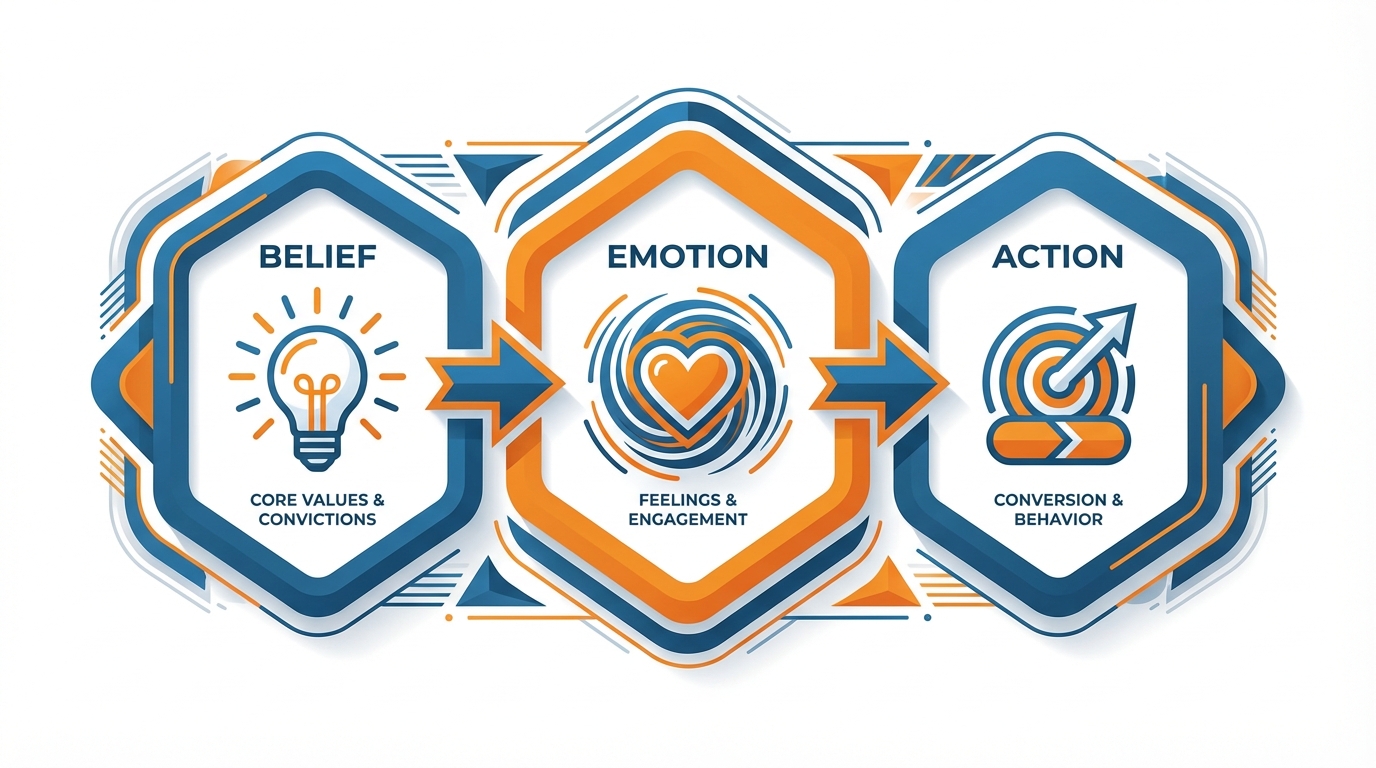
Want to learn how to batch social media content without sounding repetitive? Start with belief, emotion, and action, rather than content pillars.
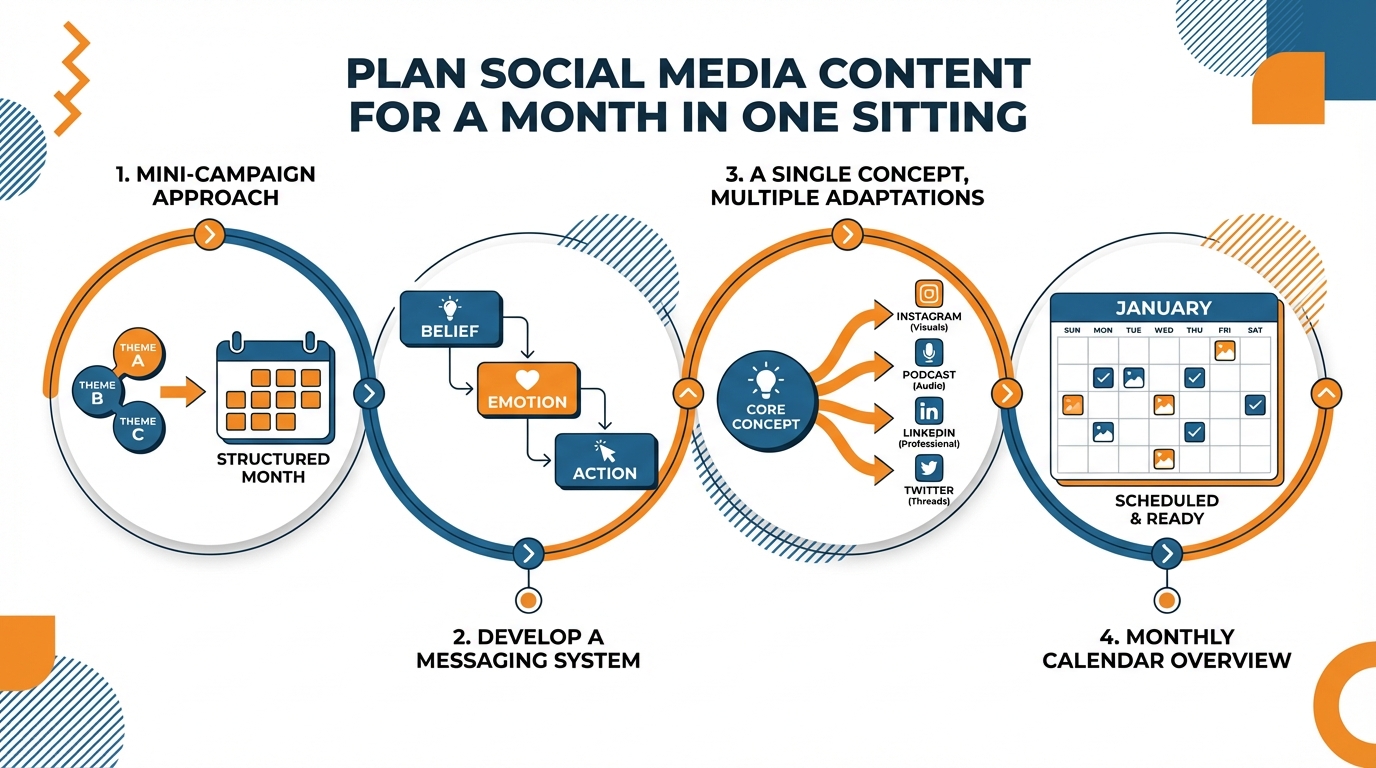
In your batching session, identify three things you want people to believe about your business, feel in their gut, and do next for the next 2 to 4 weeks.
Because the best content is not organized by topic, but by intent.
If every post is built around belief, emotion, and action, you can batch fast and still sound sharp, because you’re rotating intent, not just headlines.
Then associate that hierarchy with a rotating list of repeatable angle types so that each post gets a personality even if you are writing in volume.
Rotate through contrarian take, behind-the-scenes proof, mistake-to-lesson, teardown, myth vs reality, checklist, story with a turn, stakeholder objection, quick win, case mini-snapshot, etc., then insert your point into those. If you want more angle fuel, it pairs naturally with generate social media ideas.
You will experience a quality leap immediately: if you rotate the angle, then you also rotate the hook, structure, and proof.
I have a data-based observation on this: formats that deliver value in dense packages get reread and saved, and saves are one of the best signals that a post was actually useful, which enhances distribution and recall for a smaller company whose name is not as loud as a larger company. This matches what Bynder reported in their 2023 research on content operations: they surveyed 1,200+ marketing and creative professionals and found that 98% of marketers prioritize faster time to market and/or delivering content experiences across platforms.
Next, define a brand voice perimeter rail to ensure that when you’re in the middle of a batch, you don’t fall into the trap of speaking from a template.
Before you begin writing captions, make two tiny lists: what you ALWAYS do, and what you NEVER do.
ALWAYS might include specific, concrete, and mildly opinionated…
NEVER might include vague hype, generic motivation, or jargon without examples.
I do this because when I batch, I go fast, and when I go fast, I take shortcuts, so it helps to have a guardrail that serves as a quality filter.
It’s how you end up with consistency without sameness, which is exactly what your peeps require in order to find you in a crowded feed.
Last, you can use your messaging system as the engine for your batch: you choose one message, select 2-3 different angles, and suddenly you have 2-3 unique posts that still get the core idea across.
If you are short on time, I often use WoopSocial to create a seed set of on-brand angles from my blog, then go through and rewrite the best ones to sound like me, speak to my customers, and lead to the specific next step I want this week. (This connects with research showing metadata improvements can move outcomes: a 2024 large-scale field experiment on AI-generated titles provided ~1 million users access to AI-generated titles and reported that providing AI-generated titles increased valid watches by 1.6% and watch duration by 0.9%.)
You should come out of your session with posts that sound like they were written on your best day, not like you filled boxes on a calendar.
A single concept, multiple native-language posts: The platform translation pass
Want to know how to plan a month’s worth of social media content in one day? Don’t plan your posts. Plan your ideas.
Plan ideas -> adaptations, not post -> post, because the algorithms aren’t going to reward you for that.
For each idea, choose one primary platform where your customers are actually paying attention and you can move quickly, and treat every other platform as a translation exercise, not a copy-paste exercise, so each one feels naturalized and gets the engagement signals that platform puts out.
Now here’s how you make this actionable: you choose the content style based on the incentives of each platform and then adapt the same core idea into different formats.
For example, I might create a LinkedIn insight post that contains one valuable takeaway, then I could adapt this idea into an Instagram carousel that’s presented more as a linear narrative, a TikTok script where I try and front-load the hook and have one key reveal, and a Twitter thread where each line has to justify itself with shorter, punchier lines.
You don’t need more ideas, you need a greater ability to adapt one idea into different formats that the platform incentivizes its users to create.
Your best bang for the buck in this sprint is to write three to five opening lines for each platform before writing anything else because the hook determines whether the algorithm even lets you play.
Just changing the first line of copy has shown me a 2x difference in performance across my small business experiments, because one version will get stop and reads while the other version will get scrolled by.
So, in your one sit-down session, write three to five first-line options for each platform: curiosity hook, problem callout, contrarian belief, ultra-specific promise, proof-based opening.
Then select the one that fits the platform tone, not the one you like.
Don’t leave too much time between the steps: you come up with the central theme.
You translate it for each platform right there on the spot.
You narrow the following week’s posts down so that they line up to further your two to four week business objective.
If I’m in a big hurry, I’ll occasionally use WoopSocial to create a rough first draft for each platform.
And then I go through and rewrite the opening sentence and the proof points to make sure it sounds like me and addresses actual customer concerns.
When you do it correctly, one theme turns into a series of posts that looks custom-made for each channel.
And you walk away with a content queue that is consistent but not repetitive. This matters even more now that, according to Financial Times coverage of GWI analysis, adults (16+) in developed countries averaged 2 hours 20 minutes per day on social platforms at end of 2024, which was almost 10% less than in 2022.
Run the “Single Sitting” workflow
Batch, QA, Schedule and add smart buffer.
If you want to learn how to plan social media content in one session, you should structure that session as a production process, not a creative brainstorming process.
You should first create outlines for every post, then write hooks for all of them at once, then captions, then calls to action, then images or videos or audio scripts, and finally, you should schedule the posts.
You should do it in this order because it eliminates context switching, which is the cost of changing between tasks that is eating away at your time and turning a 2-hour content planning batch into an all-day marathon.
You will be faster and your content will sound more consistent because you are only focusing on one type of decision at a time.
The second gate is defining done before anything goes on the schedule. If you aren’t done, then don’t schedule.
Your Quality Assurance step should only take a few minutes per post, but it keeps you from errors like dead links, missing UTM parameters when you need attribution, undeliverable claims, and lazy brand drift between networks. If you want to go deeper on this workflow, the weekly social media system approach fits directly with this batching order.
I check accessibility basics on every post, as it is both good business and good distribution: captions on video, alt text on key images, readable contrast, and avoiding graphics-heavy designs that will be unreadable on mobile.
I also use standardized file names so I never have to deal with items getting lost in the Camera Roll, because the best way to waste time tomorrow is to force Future Me to go searching.
What I mean is that you should fill your calendar like you are filling a storeroom: put your most confident pieces up first.
My rule of thumb for SMBs is to fill 70-90% of the calendar and leave the remaining amount free: social is a real-time medium.
I leave 10-30% of the calendar open for reacting to customer service issues, covering local events, sharing relevant industry news, or playing off of a post that suddenly is performing well that week.
That open space is not a sign of weakness, it’s a sign of a plan that won’t fall apart after the 4th day.
To make those open spaces as painless as possible, prepare a quick-fire list of content ideas that you can convert to a post in 10-15 minutes when you’re already in production flow: a list of answers to frequently asked questions that you can give, a quick behind-the-scenes proof that you can share, or a common mistake you see your customers make that you can talk about.
And, if you want to shorten the sitting even more without letting the tool dictate your content strategy, sometimes I use WoopSocial to give me a batch of on-brand content ideas and consistent visual themes, and then I follow my usual quality assurance process and retain those “smart gaps” to keep the plan feeling flexible and human.
O Fim
If you’ve been searching for how to plan social media content in one sitting, here’s the win. It’s not treating that sitting like a brainstorming session, but treating it like an operations meeting.
You come in with defined inputs, pass them through a simple messaging framework, adapt them to platform-specific vehicles, then push them through a well-defined workflow that ends with a swift review step and a deliberately built-in adjustment step.
The result is predictability without sounding repetitive, because you’re repeating the method, not repeating the content.
To keep the process repeatable, there are a few process guidelines to follow: set a clear endpoint before starting, batch similar decisions together to eliminate context switching, and have a clear definition of done to ensure things don’t fall through the cracks.
Small businesses will feel the benefit of this very quickly, as you don’t have approval layers to catch errors later, and you can’t afford to throw a posting away on something that is unclear.
In practice, the process saves the most time by eliminating rework, and rework is usually a function of missing inputs, weak hooks, or bypassing QA.
Additionally, it’s nice to include a feedback mechanism to improve the following session automatically: Following each session, I’m only monitoring a few indicators to determine what changes are required.
If people are reading but not clicking or asking questions, you refine next-step copy. If people are commenting but not saving, you make the following set of posts more useful and referable.
And if reach is not consistent, you revisit opening lines first, because I’ve seen hook modifications alone move the needle by 2x without any content modifications.
Want to streamline even more?
Use WoopSocial to get an initial curation of on-brand options from your website, then follow the same operational process you just went through: select those that fit your goal, write the hooks in your voice, and give it a once-over for accuracy before it posts.
That keeps the strategy in your hands, but eliminates the blank page that turns 1 sitting into 5 sittings.
Related reads
4/27/2026
B2B SaaS social media benchmarks: Set the right targets.
B2B SaaS social media benchmarks: Set the right targets. The trouble with defining B2B SaaS social media benchmarks is that it's an inherently impe...
4/25/2026
Building a personal brand as a technical founder (without becoming a creator)
Building a personal brand as a technical founder (without becoming a creator) Creating a personal brand as a tech founder should feel less about ma...
4/20/2026
Creative Post Ideas for Sustainable Brands (That Don’t Sound Greenwashy)
Creative Post Ideas for Sustainable Brands (That Don’t Sound Greenwashy) That’s not what creative post ideas for sustainable brands should look lik...