Generate Unlimited Social Media Ideas (On-Brand Content)
Struggling with generic social media ideas? Learn to build a system that turns one customer insight into endless, on-brand content, avoiding common generator pitfalls.
Tool to Generate Unlimited Social Media Ideas (Without Sounding Generic)
If you are looking for a tool to generate unlimited social media ideas, chances are, you are not running out of creativity. You are running out of a repeatable engine. Most idea generators will give you a one-time shot of 10-12 generic prompts, and then you will be back at square one on Monday morning. Unlimited ideas is not a switch you flip. It is a system you build, where one concrete customer insight can be translated to dozens of unique posts across formats, audience, and funnel stages.
In this post, you’ll discover what makes ideas feel limitless in real life, how to find a tool that gives you on-brand angles instead of generic templates, and a simple way to turn a single idea into weeks of social media content that doesn’t make you sound like every other business owner. I’ll also share how I ‘acid test’ an idea so you can easily determine which topics are worth posting as-is, which ones need a better hook, and which ones can be developed into a series that will keep doing the heavy lifting for your small business weeks after you publish the first post. If you want a broader system around this, social media automation is part of the bigger picture—see social media automation.
The Truth About “Endless” (And Why Most Idea Generators Suck)
When I say endless, I don’t mean that you can literally click a button forever.
It means that you can consistently generate new, on-brand ideas week in and week out without ever having the feeling of re-sharing the same content with a new hashtag.
For a small business owner, that’s everything, because you don’t need more generic ideas, you need a system for repeating your core message in new ways that still sound like you and still serve your customer.
But that’s why most generators suck. They rely on surface-level variation.
They replace one keyword with another, change up tips and quotes and questions, and that’s it.
Which means you get a limited list, because you’re only pulling one knob at a time.
You can spot the pattern quickly. Your readers can spot it quickly.
And you end up with diminishing returns, because the posts start cannibalizing each other rather than building on each other.
The secret to true ideation infinity is permutation: hold your topics constant and pivot the factors that change the way the topic is received.
If you take one topic and pair it with a new target audience segment, a new awareness state, a new format, a new hook, a new objection, a new proof point, and a new call-to-action you don’t have 10 new topics; you have a matrix.
I can take one topic (like pricing) and pivot it into a myth-busting article for a beginner, a cost-explainer for a behind-the-scenes look, a comparison piece for a skeptical shopper, a case study for a proof-point piece for someone ready to buy, and a short story about the day a client realized that they wanted to pay for results instead of cheap, and I’m not off-brand.
So, when you assess a tool that offers to generate a list of infinite social media ideas, find a tool that can help you systematically cycle through those variations while maintaining the sanity of the results.
In the real world, that means learning the brand voice, actual sales environment, and generating content in groups that cover multiple types and phases, rather than the same variation 30 times.
That’s the difference between a list generator and an idea engine, and why a tool like WoopSocial can generate a month’s worth of ideas without them sounding like carbon copies. This matches what marketers report in research—according to HubSpot’s 2025 survey, generative AI adoption for brainstorming and content creation includes 27% using it for brainstorming and 43% using it for content creation.
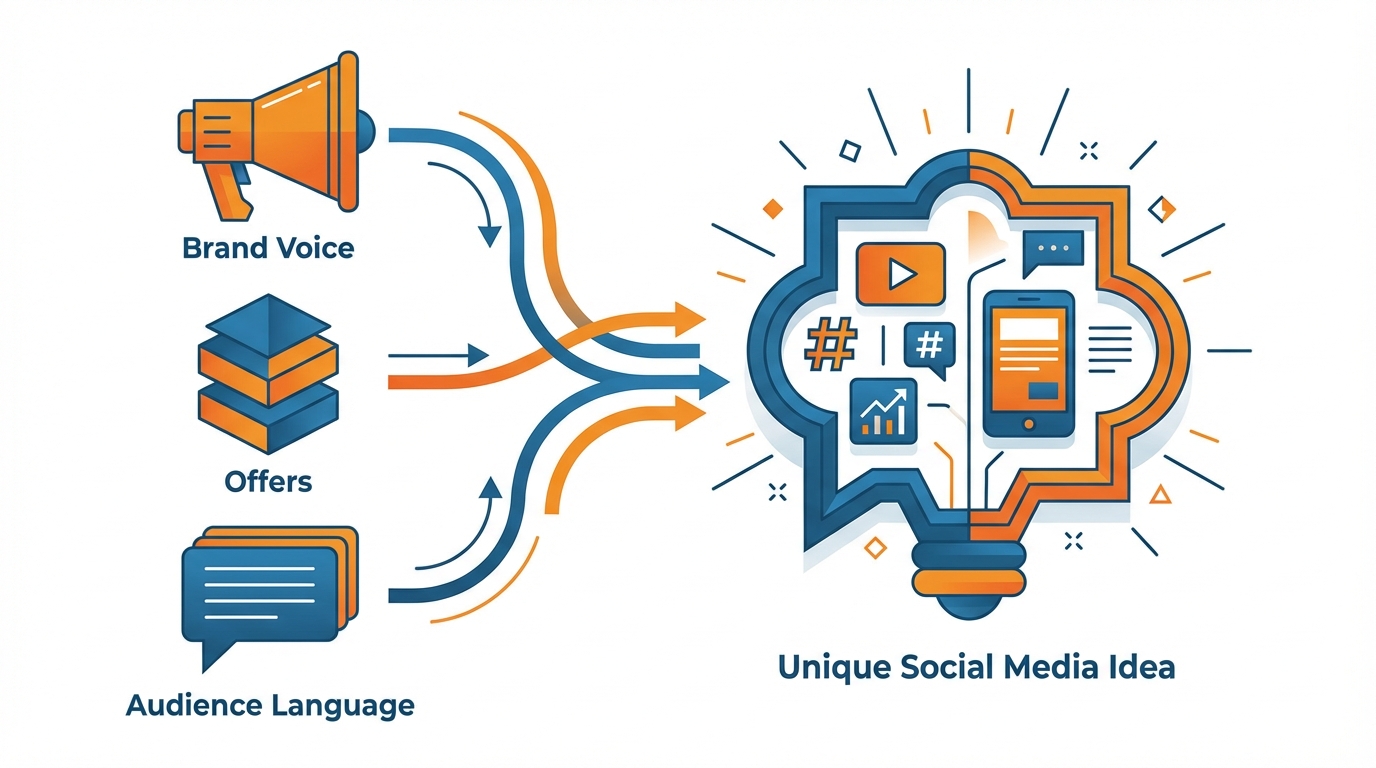
The variables that give concepts specificity (brand voice, offers, and actual audience language)
One of the quickest ways to tell if a tool is going to generate weak social media ideas is if it asks very few questions about your business.
If it asks for a niche and a keyword, it’s going to generate generic content that could apply to any business on your street.
You want a tool that incorporates:
- your differentiators
- your best use cases
- the objections you hear right before the sale
- the exact words and phrases your customers use in comments, reviews, DMs, and sales calls
That’s how ideas start to feel like lived experience, because they’re built on real buying context, not generic templates.
First, you’ve got to train your tool with how you sound.
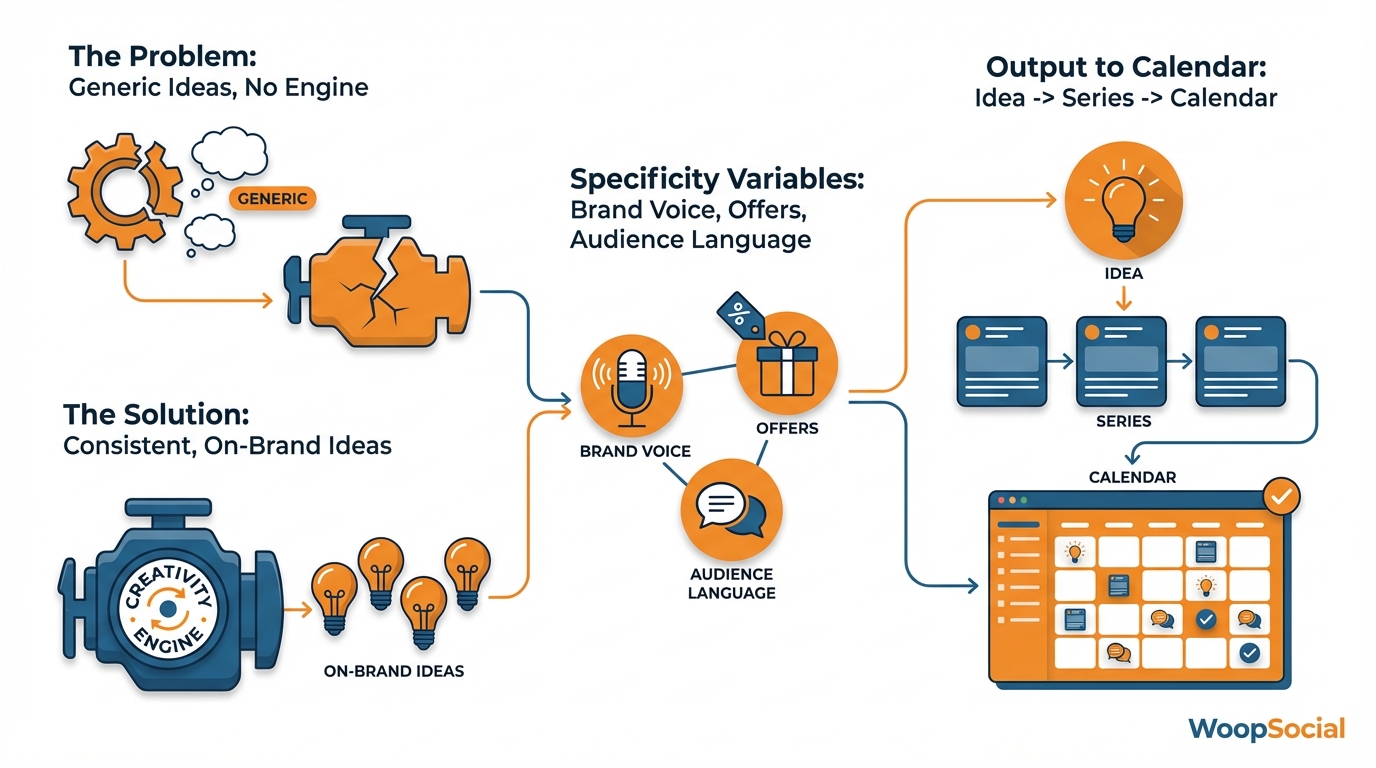
And to do that, you need to show it - not tell it.
Instead of typing in a string of adjectives, share 3 to 5 pieces of past content you’d publish tomorrow.
Include a list of words you never use.
Share 2 to 3 different ways you describe your offering to someone who’s never heard of it before.
One important stat to keep in mind: In several studies on consumer-facing language, we found that audiences overwhelmingly prefer content written in familiar and tangible terms.
And plain language descriptions always performed better than flowery language on readability tests.
If you can’t teach your tool to mimic how you communicate, you’ll end up re-writing AI-generated content into something human. This aligns with creator research too: Adobe reported that a large majority of creators use creative generative AI, with 86% saying they use it and 48% listing ideation/brainstorming as a top use.
Then, I want you to put your offer as the core.
The tool should know what you sell, who it’s for, what it gets them, what it costs, what the purchasing pathway looks like, and what’s at stake if they don’t purchase right now.
I may sell service packages, but you sell product bundles or service appointments, and the content direction should pivot appropriately: your post types should rotate between proof, process, comparisons, and objection-handling that aligns to how your money is actually made.
Once the tool knows how your offer functions, it can generate content ideas based on intent instead of just attention, which is how you get an infinite pipeline without posting pure gibberish. If you want to operationalize the “repeatable engine” part, a social media content calendar is the structure that keeps it from collapsing back into Monday-morning scrambling.
Lastly, make sure you are making the tool work with the words of a real audience, since that’s where the specificity comes from.
I typically copy out 20-50 customer sentences from my last month of emails and reviews to insert as a vocabulary to draw from, then ask the tool to re-use those as hooks/headlines.
I do this since a single powerful customer sentence can expand out to a series of ideas: the myth, the solution, the behind-the-scenes story, the case study, the outcome.
The tools like WoopSocial perform significantly better in this regard, since it can also draw on your website and existing content, meaning I don’t have to rewrite as much generic text, and can instead hit publish on ideas that already read like me. For platform-specific drafting, you can pair that with an AI social media post generator to speed up formatted variations.
Idea output -> calendar (make the infinite, finite)
The reason an “infinite social media post ideas” tool has any worth at all is that it gives you a content calendar that you can maintain.
If you just dump them into a list then you will be re-deciding everything each week and that’s where the reliability breaks down.
The key link in most people’s processes is missing the idea -> series -> scheduled month: you want the result to be chunked into repeatable themes rather than random prompts.
And for SMB this is important because reliability is a force multiplier: a small regular posting schedule will beat ad hoc posting for your SMB over time because your followers know what to expect and the algorithm sees a steady heartbeat. If you struggle with that “fits and starts” cycle, it connects directly to inconsistent social media posting.
Transform that idea machine into a calendar by funneling every idea through two gates: how does this feed my funnel and where does it go in my weekly rhythm?
Try to keep a balance between reach, trust, and conversion since most small businesses create too much of one and not enough of the other two.
A general rule of thumb is about 60% reach posts, 30% trust posts, and 10% conversion posts since it’s easy for people to get tired of hard sell content and insatiable for content that teaches and proves.
Finally, schedule into a weekly cycle where the types of content create a natural flow: educate to gain attention, prove to gain belief, opine to create separation, and lightly story tell to stay top of mind.
Now make the calendar feel easy by planning series instead of single posts.
Series are where the infinite becomes doable, because a single idea can create 4-8 posts that never feel redundant when you change the perspective, the objection, and the evidence with each one.
I might use the same idea about my premium pricing and run it as:
- a myth-busting,
- a behind-the-scenes process,
- a before-and-after client example,
- a comparison with the budget option, and
- a personal anecdote about the day a client stopped comparing on price.
You do the same thing by choosing 3-5 content pillars that you can talk about infinitely, then shaping each pillar into a monthly series with a beginning, middle, and end.
Lastly, you will have to adjust these daily slots to the format most suitable to each of these platforms; you can’t have a “copy-paste” kind of content on all of them.
Your content should remain the same but its form should differ; you need a hook-led text post for a quicker consumption, a script for a video, a carousel for a how-to and a single image post for social proof. This shows up in broader content trends too: Canva’s Visual Economy Report found that AI-powered visual content tools are widely used, with 82% having used AI-powered tools to produce visual content in the past year.
This is where tools such as WoopSocial come into play as they provide you with a month-long content ideas that are well-balanced and written in your tone, meaning you can fill your content planner for the entire month at once instead of doing it every Monday.
The true leverage for infinity: reuse + circulation (less AI-y)
The best “1,000 content ideas” generator is not a tool that generates 1,000 new ideas.
The ultimate “infinity” hack is derivatives: you begin with a single insight that you know is effective, and you find ways to intelligently create more versions that appeal to a different part of your target’s mind.
Derivatize a solid key point into a declaration, a tutorial, a list of common pitfalls, a tiny success story, a contrarian argument, a “quick tips” list, and a tiny video script.
Here, you’re not attempting to guess what will work next; you’re getting even more mileage from what you already know works, which is what a busy small business owner needs when time and bandwidth are precious. Video workflows are part of that reality as well—Wyzowl’s survey reports that AI use in video creation/editing is common, with 75% of video marketers saying they’ve used AI tools to help create or edit marketing videos.
To prevent re-purposing from devolving into 'AI-goo' you have to add constraints that ensure variety. Make me avoid the most cliched headlines (e.g. secret to, 10x, game-changer). Make me ask for fresh twists (e.g. most people get this wrong, when this advice fails, what I'd do on a 0 budget).
Make sure there's at least 1 example per article that includes at least a number/specific/constraint - because that's what makes content feel human. I also link every concept to a proof database: results, screenshots, customer push-backs, lessons learned and small anecdotes from real projects: because proof trumps cleverness, and prevents your content from sounding like it came from the same mold as everyone else.
Second, shift your mindset to thinking about distribution during the ideation process.
If you want it to spread, you have to design it to spread.
That means writing posts that are easy for a collaborator to co-sign, creating bite-sized wisdom that a partner can share without needing to re-report it, and wrapping up your content in share triggers like “this will save you time”, “this will help you avoid this mistake”, or “this will answer this contentious issue that your audience is already discussing”.
One rule of thumb I use is that a post should have at least one sentence that someone can send to a friend without any context and have it still make sense.
If it can’t travel on its own, it won’t get picked up and carried by other people.
That’s how you can stop throwing yourself at the whims of the algorithm and start establishing distribution flywheels through cross posting, co-signing and audience-to-audience relays.
This is where system trumps hustle.
Once you can extract ideas from your brand voice and offer context, then produce derivatives that sound like you, then adapt those into different media, that’s when you get to scale.
I use tools like WoopSocial to transform one round of content into 30 days of brand-worthy starting points, but the real magic happens with your content remix matrix and your content deployment wheel.
Get those two right, and more content means more noise and more media means more reach, more trust and more qualified attention, all from the same fundamental concepts.
Picking the correct tool (and using it properly)
The best tool to generate endless social media ideas is one that isn’t just a brainstorming tool, it’s an idea engine: it takes richer inputs about your product and audience, generates formatted variations (so your posts don’t all sound identical), returns batches of content shaped like a calendar, and treats recycling as a first class activity, not an afterthought.
For a small business, that matters because frequency > volume: accounts that post consistently see, on average, significantly more engagement than those that post in fits and starts, and a basic weekly schedule reduces the decision fatigue that suffocates motivation.
The aim here is to make social media ideas an act of routine, not a conjuring trick.
When you test tools, pay attention for signs that the results are going to get personal.
The tool should be able to get to know your real language, not just your vertical: your top 3 differentiators, the questions you get right before a deal is done, and the words customers actually use.
If you only give a tool a vertical and keyword, you’ll get generic content that could belong to any other competitor.
If you give it intent, you’ll get content that’s mapped to intent: a slice of articles that can get attention, another slice that can build trust, and a smaller slice that can convert.
I do a quick test by looking at the first 10 ideas and asking myself: would I be able to attach a real customer story, number, or proof point to each one in less than 60 seconds?
If not, the tool is generating fluff.
The secret to using the tool effectively is to treat it like an idea factory - not a set-it-and-forget-it button.
You’re still in control: You decide beforehand what content themes you’ll rinse and repeat all year, what hooks you won’t allow yourself to use, and where you’ll gather evidence (e.g., results, screenshots, before-and-after examples, FAQs, lessons learned).
Then you’ll turn your top results into series, because series is the key to “infinite content”: You can take one concept and generate 4 to 8 unique posts by changing up audience stage, objection, or evidence.
The reward is efficiency: fewer blank-page staring contests, fewer “random” posts, and more compounding brand recognition because people start to understand what they’re getting from you.
For a practical solution that is heavy on month-in-minutes content generation, cohesive brand voice, and automated brand visuals, a tool like WoopSocial can sit nicely in this stack as a production module.
The key is that your strategy remains modular: your pillars, your remix matrix, and your proof library, will function regardless of the tool you choose in the future.
Accomplish that, and the result is basic and quantifiable: you spend less time figuring out what to post, and more time posting content that really feels like you and get results.
Related reads
4/27/2026
B2B SaaS social media benchmarks: Set the right targets.
B2B SaaS social media benchmarks: Set the right targets. The trouble with defining B2B SaaS social media benchmarks is that it's an inherently impe...
4/25/2026
Building a personal brand as a technical founder (without becoming a creator)
Building a personal brand as a technical founder (without becoming a creator) Creating a personal brand as a tech founder should feel less about ma...
4/20/2026
Creative Post Ideas for Sustainable Brands (That Don’t Sound Greenwashy)
Creative Post Ideas for Sustainable Brands (That Don’t Sound Greenwashy) That’s not what creative post ideas for sustainable brands should look lik...