Grow a B2B audience on TikTok
Grow a B2B audience on TikTok In B2B, going viral on TikTok is a function of getting the right people to see your content. Not just any view is a g...
Grow a B2B audience on TikTok
In B2B, going viral on TikTok is a function of getting the right people to see your content. Not just any view is a good view. Actually, some views are worthless, or even negative, as they teach the algorithm to show your videos to users that won’t buy, refer, or influence a deal. We want repeatable, consistent reach to founders, operators, managers, buyers, and micro-influencers that influence purchasing decisions. Optimizing for saves, rewatches, profile taps, and high-intent comments is more important than maximizing 24-hour virality. If you want more context on what consistency really means, see consistent social media growth.
What I have found to be effective time and time again is to approach TikTok in a dual manner: as a distribution channel and as a research tool. As distribution because there is no other platform at the moment that allows you to reach beyond your immediate audience as quickly as TikTok does. As research because every time you scroll through the platform, you’re being given real-time information on what types of hooks will grab the attention of your ICP, what types of objections they have that they will tell you about, and how they will describe the problem when they are aware of it and motivated to solve it. If you can use this information to create simple repeatable video formats, you’re no longer guessing what will work. If you do this, you will start to see compounding effects. The thing that most small businesses fail to do is tie this attention back to an actual B2B lead generation funnel, which means they fail to generate actual demand for what they offer from the content they create. (For a broader system view, read social media content systems.)
In this piece, you’ll get a tactical framework to: Define your B2B audience Build discoverability Test your way into content-market fit (even with a small team) Turn attention into pipeline using next step templates, checklists, audits and other low-friction offers that feel useful, not salesy So you can scale on TikTok without morphing your brand into corporate cringe.
Step 1: Create an accurate ICP map
The first step to finding B2B customers on TikTok is to create an accurate ICP map (i.e. “not ‘business owners’”).
Your B2B following on TikTok begins when you quit trying to sell to business owners and start sketching out a buying universe.
In nearly every SMB B2B deal, there’s not a single buyer. It’s a collection of personas and a chain of impressions.
You need to reach people who will use your thing and who will take your pitch to someone else. You need to reach the one who can actually approve the purchase. You need to reach the other people who influence the shortlist, like contractors and industry publications and other content creators.
I consider a B2B audience to be a network of people who can initiate, clog, accelerate, or sink a deal. TikTok is valuable because it can target the entire network, not just the final signatory.
Once you have those, figure out what those look like in the form of TikTok interest clusters, because on TikTok, you can’t target job titles, you can only target behavior.
For each of those personas, what do they watch when they are procrastinating?
What do they search for when they are stuck?
What do they bitch about when a process fails?
What tools do they use all day every day?
What are they measured on?
You’ll start to see patterns pretty quickly: operators look at process hacks and dashboard tutorials, financially minded decision makers look at pricing explanations and risk analysis, practitioners look at troubleshooting and migration journeys.
And when you organize your content around those patterns, you’re teaching both the algorithm and the viewer at the same time; this is content for people who are facing this problem in this way.
Step 2: Build your pain-query content roadmap
Now, create a list of pain queries and use that as your content roadmap, not just a brainstorm.
This is how buyers talk when they try to figure out what’s wrong:
- compliance keywords and audit issues
- KPIs that seem to be broken
- reporting problems that make them look bad in a meeting
- pricing issues that won’t let them get an order approved
- migration issues that make them status quo biased
- vendor keywords that appear right before a shortlist decision
Each pain should be able to spawn multiple content topics: how do I know I have this problem, what are the root causes of this problem, why doesn’t [conventional wisdom] work to solve this problem, what does a good solution look like for this problem, and what should I ask vendors to avoid this problem?
I’m a fan of this strategy since it tends to create serialized content that will be saved and replayed later, which are the activities that drive the algorithm flywheel in B2B. If you want a structured way to plan series, this ties closely to a social media content calendar.
Step 3: Treat TikTok like a B2B search engine
Third, treat TikTok like a B2B search engine.
Use your keywords, early and often, displayed on screen, described in your captions, and phrased the way your ICP types when they’re on deadline.
Skip generic keywords in favor of specific, searching-for-a-solution questions that your ICP actually asks herself, such as “Why don’t my reports ever reconcile with accounting?” or “How to prepare for an audit when your records are a disaster.”
And lastly, define your one-sentence positioning statement that is both your category and your differentiator, so that both humans and the algorithm can find you fast, and keep sending you the right people, over and over and over.
One reason this matters in practice: in Content Marketing Institute’s 2024 benchmarks and trends research, 19% of B2B marketers say they use TikTok (more than double vs. the prior year), and 10% increased their use of X and TikTok over the last 12 months-see the 2024 B2B content benchmarks research summary.
Content-Market Fit: A systematic approach
Content-Market Fit is a systematic approach to growing a B2B audience on TikTok.
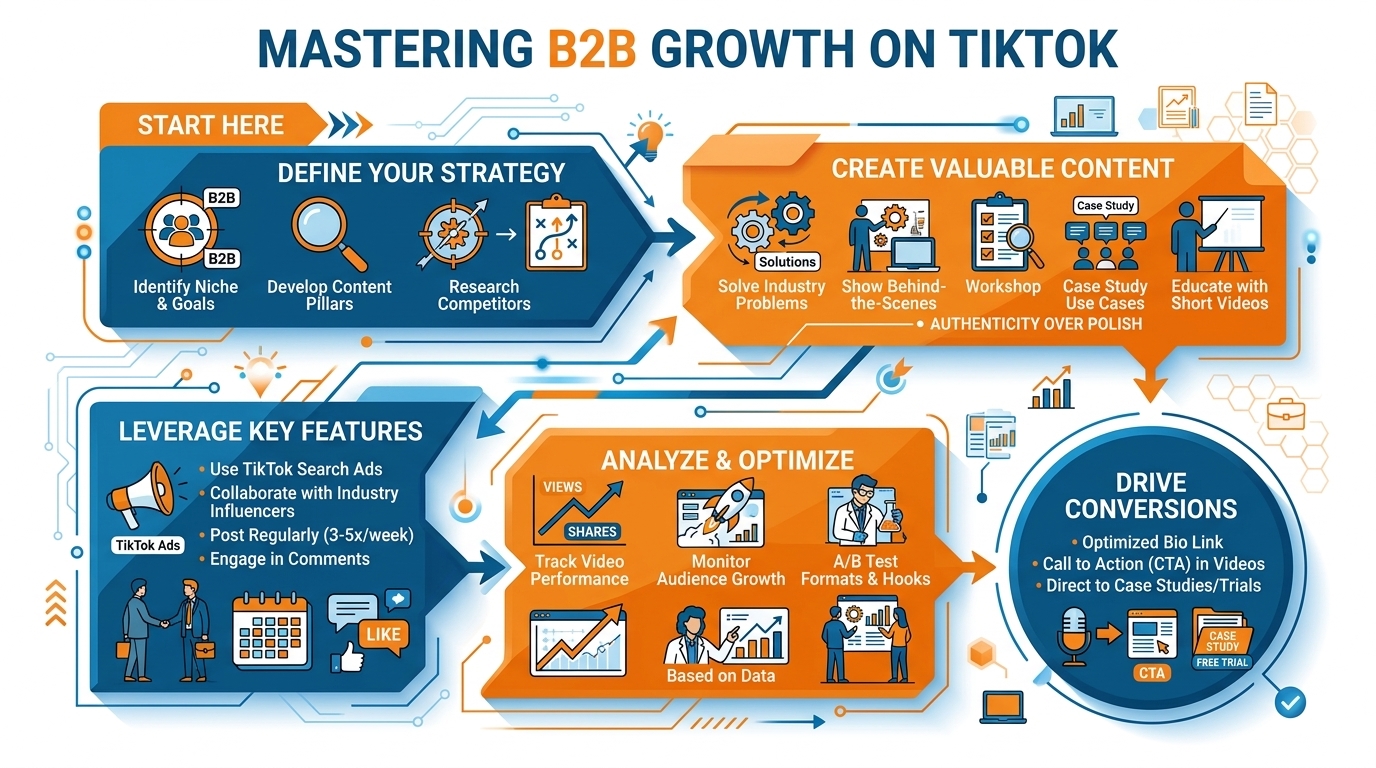
When you approach B2B on TikTok like a battle for continuity, it is hard. When you approach it as a testing flywheel, it becomes easy.
There is not much that is continuous about TikTok, but there is a lot of signal to test.
The best way for me to test is in small sprints. One persona. One format. One hook. One CTA.
Then produce a few variants to determine that what I am seeing is a trend, not a one-off.
This is feasible as a small business without a team, because I keep the production the same and only change one thing, because when you change everything, you learn nothing, and you end up blaming the platform for your own shortcomings. If this is an ongoing challenge, it often shows up as inconsistent social media posting.
In B2B, the levers that influence results are targeting and intent.
Test persona focus first, because it dictates who TikTok will send you: a founder, an ops manager, a finance lead, an IT admin, or a practitioner will respond completely differently to the same content.
Then test formats designed to solve work problems: teardowns where you break down a process that doesn’t work, myth vs reality where you debunk terrible advice and give a clear explanation why, walkthroughs where you demonstrate how to do the work, objection-handling where you address the real concerns: cost, switching pain, risk, and internal politics.
Then test hook types that mirror how buyers think under deadline, like “Why your pipeline is healthy but revenue is stalled” or “Why your reports never reconcile with finance.”
Finally, test CTA types that indicate intent, like “Leave a scenario in the comments below” versus “Visit my profile to see a step-by-step example,” because different CTAs draw different levels of intent.
To make Growing a B2B audience on TikTok repeatable, you need early B2B good signals that are stronger than likes.
You want saves because people save what they will use in a meeting later.
You want shares to coworkers because internal forwarding is basically pre-qualification.
You want profile visits because that is the moment they decide if you are for them or just entertainment.
You want repeat commenters because buying committees show up as familiar names over time.
You want high-intent questions that include constraints, numbers, tools, or stakes, like we are on HubSpot and the handoff is broken, or our CAC is up 30 percent and the board is asking why.
The more specific the comments get, the closer you are to content-market fit, because specificity is the tax people only pay when they actually care.
When a test succeeds, instead of constantly reinventing the wheel and doing one-offs, create an evergreen series that will scale with time.
You should have a format that your listeners can rely on, for instance, where every week you’ll dissect a particular process breakdown, or tackle one sales objection at a time in a series, or present 5-minute solutions to improve a key KPI that someone is being measured against in a meeting.
This is also a way to establish thought leadership that doesn’t sound like a sales pitch: you need to take a stand, justify your position, and discuss practical considerations and trade-offs, not just “thoughts.”
If you add a segment at the end of each review about what I would do differently, then you’ll appeal to professionals who seek out judgment, not just platitudes, and those are the types of fans that will reward you with business, introductions, and reputation.
Example: Bambooee and “boring” products
Let’s start with an example of a company that likely thought of themselves as having a “boring” product. Bambooee was selling bamboo paper towels. Yes, you read that right: bamboo paper towels.
But they didn’t just sell them, they turned the product into a viral sensation by showcasing creative ways to use them. The videos included everything from wiping up spills and messes to using the bamboo paper towels as a canvas for art. The results were astounding, with some of their videos garnering millions of views.
Here are a few key takeaways from Bambooee’s experience:
- The average cost of a lead decreased by 75% compared to other platforms.
- Bambooee saw a 32% increase in conversions.
- Their Return on Ad Spend (ROAS) was 3.6 times higher than their target.
- The company was able to successfully target and reach their ideal customer on TikTok.
Now, if bamboo paper towels can be made exciting and gain traction on TikTok, there’s no reason your seemingly “boring” B2B product can’t do the same. It’s all about finding a way to make your product relevant and interesting to your target audience.
So how can you make your B2B product more TikTok-friendly and appealing to potential customers?
- Highlight what makes your product unique. Just like Bambooee did with their bamboo paper towels, find a way to emphasize the unique qualities of your product. This could be a special feature, an innovative use, or something else entirely. The goal is to make your product stand out from the competition and grab the attention of your target audience.
- Showcase customer testimonials. One of the most powerful marketing tools is social proof. When potential customers see that others have had success with your product, they’re more likely to give it a try themselves. Use real customer testimonials in your marketing efforts to build credibility and trust with your target audience.
- Leverage humor and entertainment. Let’s face it: people enjoy laughing and being entertained. If you can find a way to make your product humorous or entertaining, you’ll be more likely to capture the attention of your target audience. Don’t be afraid to think outside the box and come up with creative ideas that might not have been tried before.
- Use popular culture references. Making references to popular culture can be an effective way to make your product more relatable and interesting to your target audience. This could include referencing trending topics, using memes, or incorporating popular music into your marketing efforts.
- Run a contest or giveaway. Who doesn’t love the chance to win something? Running a contest or giveaway can be a great way to generate interest in your product and encourage people to engage with your brand. Just make sure to follow TikTok’s guidelines and rules for contests and giveaways.

By implementing these strategies, you can make your B2B product more appealing and interesting to your target audience on TikTok. Remember to always keep your marketing efforts focused on your target audience and the unique qualities of your product. With a little creativity, you can successfully market even the most seemingly “boring” B2B product on TikTok.
Make the buyer’s messy moment obvious
The sooner you stop trying to make your product interesting and start making the buyer’s messy moment obvious, the sooner you will find it easy to build a B2B audience on TikTok.
Start with the scene they know in their gut: the spreadsheet that served as the single source of truth until it didn’t; the KPI meeting where marketing and finance can’t agree on whose data is accurate; the security review frenzy the week before the contract is up for renewal; the transition from sales to ops that quietly fails and later manifests as churn.
This approach works for a very straightforward reason: TikTok is optimized for pattern matching, and buyers will pause when you describe their problem using the terms they use on the inside like SLA, close date slippage, audit trail, rev rec, access controls, stakeholder alignment, and end of quarter timelines.
To make it TikTok-worthy, don’t describe benefits, but show them.
Rather than describe how you could add visibility, here is a redacted dashboard and I’m going to indicate the box that is the source of reporting conflicts.
Rather than describe how you could make operations more efficient, here is a three-step SOP that is possible for a small team to follow come Monday morning, and here is the before and after in one frame.
When I get it right, I go concrete.
A blurred workflow map, a list with two items circled, a screenshot of a reconciliation table with one column circled, and here is a quick walkthrough of what changed and why.
The videos get more saves because they serve as meeting ammo, and in B2B that is the metric that matters more than likes.
A big part of your most effective content can be your ugliest objection.
Objections are decision moments and decision moments create retention.
Wrap security, procurement, switching costs, implementation time, and internal politics into concise advice on how to avoid getting fired while navigating a buying committee.
Structure as “what I would ask a vendor in a 15-minute security call,” “how to explain ROI to a skeptical finance lead,” “actual migration time for a 5 person team”, or “where implementations fail when you have multiple data sources and no owner.”
The fastest way to self-qualify your audience is to answer the questions they’re too afraid to ask out loud.
Don’t rely on a trick to generate tension. Stakes and edge cases generate tension.
Educate by mistake: what they don’t tell you about handoffs falling apart at scale, how generic wisdom like just centralize your data might not work for a real business, the single setup step that will make the whole thing fall apart the first time they’re audited or the first time they have to present to the board.
When you speak to their KPIs and their timelines and their stakeholders’ fears, the right audience will identify and the wrong audience will scroll on by. Which is what you want when you want to Grow a B2B audience on TikTok.
Building a B2B following on TikTok that works (audience -> trust -> pipeline)
The only way you can get any B2B pipeline value out of an audience on TikTok is by building conversion flows that are optimized for the way that TikTok users consume video content: impulsive, curiosity-driven, and afraid of anything with too much surface area.
You need to make sure that what you’re asking them to do next feels like a seamless next step from the video, not like a weird conversational pivot.
Instead of trying to sell someone on a demo after watching 12 seconds of content, you’re looking for micro-yeses: tapping on your profile to see what else you post, leaving a comment with their situation, following your account to keep up with the rest of the series, sending you an in-app message with a single specific objection.
These should be the conversions that you optimize for in the early days, because they’re the ones that actually signal intent in B2B on the platform: the users who save for later and then come back, the users who ask specific questions, the users who come back several times.
I personally look at the comments to see if people are using tools, numbers, dates, and internal decision-makers in them when I’m trying to gauge whether something is pulling in B2B buyers or B2B tourists, because it’s easy to leave a generic comment, but it’s harder to leave a comment with context that signals you’re a decision-maker.
To convert attention into trust, create an offer ladder that follows the structure of your content, not your pricing ladder.
The first rung should be worth the follow, then the next should be worth the viewership and still feels like “help”, so if you’re doing a series on “how to repair broken reporting”, your next step should further explore the topic, like a live breakdown, a quick newsletter that continues with more fixes, a webinar that tackles one of the tricky boundary conditions, or even an audit type consult that begins from their status quo.
The important thing is that it “feels like the next thing”, not “ok now I’m going to sell you something” so you know it’s working when it feels like the next thing, and you’ll notice a huge difference in the quality of the “inbound” that comes out of it, because people who climb a ladder that follows the content come in precontexted, pre-vocabed, and pre-motivated, so it drastically reduces the length of the sales cycle for a small company that can’t afford the long-term nurture.
Measurement has to answer the real question: which topics and series generate qualified leads, not just views.
You need to instrument basic tracking of content topics against behavior: profile visits, DMs, website traffic, and sales calls.
And you have to do this at the series level, not the individual video level, because B2B trust is a cumulative effect, and TikTok distribution is inherently noisy.
A practical metric I use for this is ratio-based: profile visits per 1000 views tells you if the viewer finds you relevant, and DM rate per 1000 profile visits tells you if your positioning is compelling enough to generate leads.
Once you layer this against qualitative scoring of DMs, you have an actionable framework on which pain points attract qualified buyers, which attract students, and which attract competitors, so you can invest with confidence, not guess.
Want to get to the right B2B audiences more quickly without relying on paid traffic?
Systematically partner with and cross-promote other relevant micro-influencers, not just one time, but as a steady machine.
Seek out smaller, more targeted accounts that are already in your target customer’s feed: implementation consultants, industry teachers, analysts, template-sharing operators, and founders who journal.
Develop formats that are inherently TikTok-friendly, such as reply videos to one another’s content, stitched disagreements, and mini-series that approach the same issue from two different sides.
Then, implement whatever automation genuinely supports this without sacrificing character: bucket your incoming inquiries into a few categories, categorize your videos by ICP and pain point, and respond to them at a regular enough clip that the algorithm can keep figuring out your positioning for.
Your objective is to create a repository of responses to objections and real-world examples, while also letting your viewers do the preselling for you by sharing your videos inside their company before they’ve even spoken with you. (This approach aligns with content distribution automation.)
To keep expectations calibrated across channels, Demandbase’s 2024 report flags TikTok as having “significantly lower account-based sessions” vs. LinkedIn/Quora-see Demandbase’s 2024 State of B2B Advertising PDF.
O fim
Want to grow a B2B audience on TikTok?
There is one rule I play by 100% of the time: get uncomfortably specific about who you are for, then build series around pain queries, test until you see high-intent signals, and then (and only then) scale distribution and conversion.
Because if you don’t get specific? You get irrelevant views.
If you don’t build series? You get irrelevant spikes.
And if you don’t wait for signals? You scale the wrong audience and teach the algorithm to send you more people who are never going to buy from, refer to, or influence purchasing decisions.
You need to approach TikTok as a science experiment, not a game of chance.
Choose 1 ICP role, and 1 pain point that role is currently solving for, and play the wheel until you see that intent in their behavior.
In B2B, likes are a low-cost signal, but saves and re-watches are a high-cost signal because they indicate match bullets.
Profile visits per 1000 views is a rapid relevance test, and DM rate per 1000 profile visits measures whether your positioning and ask are strong.
If you get comments that mention things like team size, tech stack, timelines, compliance burden, or a KPI under attack, you know you’re getting buyers and buying committee members, not just looky-loos.
The truth is, once you have a clear intent, you expand the content that is working by making it more repeatable, not more complex.
You take that test video that is working and make it into an obvious series that delivers a promise to your audience of why they should follow and what they can expect to see next.
Then you refine the conversion process to every video being connected to a clear micro-yes based on the video, like a story comment, a bio click to watch the next video in the series, or a DM for a specific challenge.
This is how you keep the pace going and stay authentic, particularly if you’re a small business, you don’t have a content team.
If you invest in formats that repeat, positioning that’s clear, and conversion by design, then TikTok becomes a flywheel for B2B awareness that actually converts into something.
I’ve observed that the brands that win aren’t the loudest or shiniest, they’re the ones that consistently make the buyer’s messy moment obvious, earn saves and shares within teams, and build a library that answers objections before procurement even arrives.
If you do that, you’re not praying for virality anymore, you’re building a predictable acquisition engine.
In Content Marketing Institute’s 2025 research, 87% of B2B marketers say content marketing helped them create brand awareness in the last 12 months, and 9% increased their use of TikTok in the last 12 months-see the 2025 B2B content marketing benchmarks report. Marketing Week also notes a brand uplift study where 11% of marketers claimed TikTok helps them achieve their campaign goals, covered in Marketing Week’s piece on TikTok’s “professional mode”. Databox additionally surveyed 35+ B2B marketers on the topic in their TikTok ads for B2B demand generation Q&A.
Related reads
4/27/2026
B2B SaaS social media benchmarks: Set the right targets.
B2B SaaS social media benchmarks: Set the right targets. The trouble with defining B2B SaaS social media benchmarks is that it's an inherently impe...
4/25/2026
Building a personal brand as a technical founder (without becoming a creator)
Building a personal brand as a technical founder (without becoming a creator) Creating a personal brand as a tech founder should feel less about ma...
4/20/2026
Creative Post Ideas for Sustainable Brands (That Don’t Sound Greenwashy)
Creative Post Ideas for Sustainable Brands (That Don’t Sound Greenwashy) That’s not what creative post ideas for sustainable brands should look lik...