How to manage your social media in 1 hour a week
How to manage your social media in 1 hour a week Managing social media in 1 hour a week is achievable, if you quit thinking of social media as a co...
How to manage your social media in 1 hour a week
Managing social media in 1 hour a week is achievable, if you quit thinking of social media as a continuous stream that needs babysitting and start thinking of it as a tiny, repetitive operating system. The issue is that most how-tos quietly redefine manage to mean posting something and hoping for the best. True management includes three non-negotiables: Content that captures attention, metrics that tell you what to do next, and boundaries that prevent social from swiping time you don’t have.
This post shows you a simple 60 minute per week plan to keep your brand active that won't make you a 24/7 content machine. I turn to this whenever I need to be protective of my deep work hours but still want to show up consistently, and it works because it's made of specific choices, not quantity. You'll know what you're posting, why you're posting it, and what signal to look for after that so your next week is easier, not harder. If you want a broader system view, see social media time management.
Fast expectation adjustment for outcomes you can rely on: at one hour a week, you should expect consistency, greater definition, and multiplied effect from repetition. You should not expect overnight momentum if you’re directionless, scattered across multiple channels, or copycatting the flavor-of-the-month. What you want here is intentional consistency: one focused message, one focused group, and one small weekly feedback loop that increases the effectiveness of the next one. For a consistent baseline across months, this aligns with social media consistency build a system not.
Managing your social media presence in just one hour a week starts with focusing on the right networks and knowing what you want to achieve. Want to learn how to handle social media in 1 hour a week? Well you can’t be on every damn thing your competitor is on.
You pick your one platform by answering two brutal questions:
- Where is my audience already engaged?
- What is the fastest format I can create without going into total crap?
Number one is obvious. For most SMBs the answer is not, “Every. Single. Platform.” It’s one. It’s where your customers are already in purchase or browsing mode. This lines up with Americans’ platform usage, where Pew Research Center reports 83% of U.S. adults ever use YouTube, 68% use Facebook, 47% use Instagram, and 33% use TikTok (up from 21% in 2021), based on a survey of 5,733 U.S. adults; see Pew’s social media use report.
Number two is the real constraint: if you can write a text post in 12 minutes, but a video takes you 90, then video is not part of your one hour plan.
Personally I always play to the fastest format I can deliver weekly because that’s what I need to be consistent. And consistency is what teaches the algorithm, and your audience, to recognize you.
Establish success before you post
Second, establish success before you post, by setting a minimum viable objective.
If your objective is brand awareness, you post to be remembered: one clear idea, one strong point of view, and a simple hook that earns attention, then you measure reach and saves or shares as the signal that your message is sticking.
If your objective is lead gen, you post to be trusted enough for the next step: proof, a specific problem you solve, and a clear next action, then you measure profile visits and inbound messages or form clicks, not vanity engagement. If you want a more explicit breakdown of what to ignore, see vanity metrics.
If your objective is retention, you post to reduce churn and increase usage: tips, onboarding reminders, customer spotlights, common mistakes, then you measure replies, comments from existing customers, and repeat interactions.
The metric that most people fail to note is that different objectives change what success looks like: a retention post that doesn’t get as many likes, but gets 5 customer questions, may be doing more business work than a viral awareness post.
Constraints eliminate decision fatigue
The reason the 1-hour plan works is that it works within a set of constraints, and constraints eliminate decision fatigue.
- You choose one audience, not “anyone with a wallet.”
- You choose one offer or topic, not “here’s my entire menu of services that I have to explain from scratch every week.”
- You choose one content angle, such as “myths in my industry,” or “before-and-after outcomes,” or “behind-the-scenes decisions,” so you always know what to talk about.
- And you choose one call-to-action style so your audience recognizes the pattern and you stop having to reinvent the ending…for example, you might always ask for a reply with a certain keyword, or you might always point people to the same core page, but at least you keep it consistent.
I’ve seen solopreneurs double the results from the same amount of posting time, simply by eliminating these variables so that the pattern becomes more recognizable more quickly.
But sometimes 1hr/wk is not enough, and being in denial about that is how social media eats your whole week. If you need a lot of leads, or are building something new, or operate in a market where you need to educate buyers heavily, you’re going to hit that 1hr/wk wall hard.
When you do, the first thing to do is simplify. First cut platforms. Then cut formats. Then cut frequency. Then, and only then, cut ambition.
Going from 3 platforms to 1 frees up more time than cutting 1 weekly post because context switching is where the real time goes. If you’re still swamped, cut to the simplest format you can execute perfectly, even if you think it’s boring, because consistency always trumps perfection when you have 60 minutes a week to get the job done. As a benchmark, Valpak reports 43% of small businesses spend about six hours per week on social media; see the Valpak guide’s small business time-spend stat.
Social Media Management in 1 Hour a Week: The Weekly Batching Process (No Inspiration Required!)
Here’s how I do it.
It takes 1 hour per week, but it’s not 1 hour of brainstorming. It’s 1 hour of decisions and work.
It goes like this:
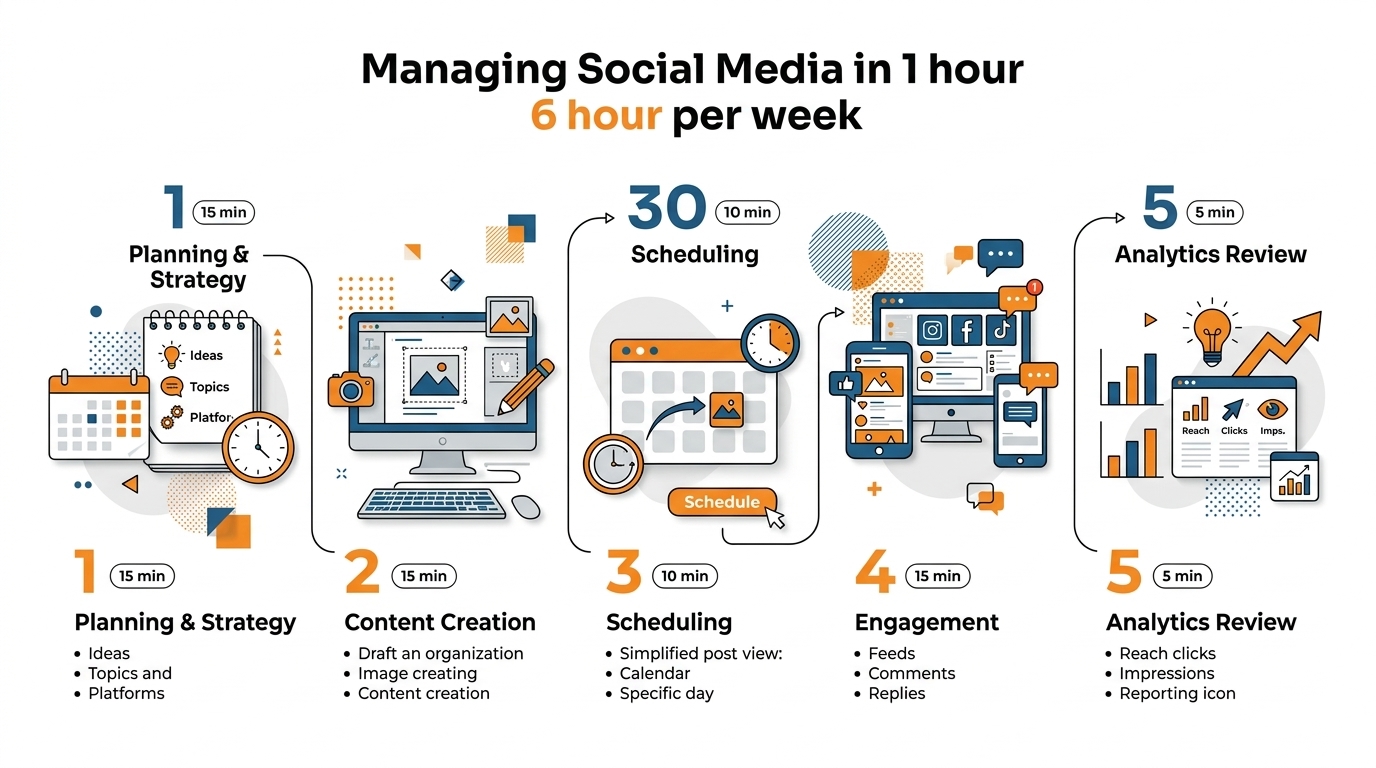
- 10 min, I review the week’s signals, and select one strong performer to repeat or refine.
Did you know that, for most small business accounts, a small number of posts generate a large proportion of the engagement? - 15 min, I pick a theme and a theme angle for the week, and make a mental commitment to a perspective. I don’t overthink it.
- 25 min, I write 3-5 posts, in the same format, so that I’m not switching contexts. I write the headline first, because that drives the initial stop-rate.
- 10 min, I do a speed edit, and I schedule two quick check-in windows during the week to respond to and filter messages.
Yes, you can create content in an hour a week, but you still have to commit to engaging with people in between. If you don’t, they will think you’re just an advert. Time-wise, this also matches how marketers actually spend time: MarketingProfs (citing a Sprout Social survey of 500 marketers in the US/UK) reports averages like 5 hours/week on content creation and approvals, 3.8 hours/week on data analysis and reporting, and 3.6 hours/week on strategic planning; see this breakdown of where social media time goes.
Take inspiration from demand, not vibes
The most significant change is what you’re taking inspiration from.
No longer are you trying to come up with conceptual content pillars, you’re taking inspiration from things that already have demand: customer questions, objections that you hear prior to a sale, sales calls, support tickets, reviews, community conversations, etc.
You should have an ongoing list of questions that people ask that you keep track of because the words themselves are prequalified hooks.
For example, if you offer accounting services, a support question of “Why did my VAT go up this quarter?” is a post that will likely attract the exact type of reader that is concerned and willing to pay for an explanation.
If you are a local gym, an objection of “I’m too busy to exercise” is not a content theme, it’s a weekly series of tactical tips that you can prove.
I like this because it means you never need to be inspired again.
You’re not writing content, you’re publishing answers, and answers have compounding value. This is also consistent with small business publishing habits: Service Direct’s 2022 survey reports 60.96% of small businesses publish content at least weekly on Facebook, 55.17% at least weekly on Instagram, and among B2B respondents 62.50% publish at least weekly on LinkedIn; see these small business content marketing statistics.
Slice one big idea into five posts
The secret to pulling off an hour is that you’re not starting from scratch. Instead, you’re slicing up the same big idea into five different posts that go up throughout the week.
So, if you’re talking about why cheaper isn’t really cheaper, you might have one post that’s the answer. One post that’s the big lie. One post that’s the quick example that’s an example with round numbers. One post that’s a framework, a simple framework.
One post that’s a short story. What happened afterwards.
When you slice that up like that, now it’s not about finding five ideas. Now it’s about slicing up one big idea into five different pieces, and that’s really how a smaller brand can actually get some good traction even if they’re not posting all the time.
Keep positioning guidelines simple
The quality is good, because the positioning guidelines are simple, so you can adhere to them when you are in a rush.
One message per post, one pain point, one proof point.
The proof point does not have to be elaborate, it can be a metric, a before and after, one step in a process, or a testimonial translated to your own language.
If you find yourself thinking that there is a second key point that you are going to include, cut it out and save it for the next week.
Because simple always trumps thorough.
This is why you can write a blog post in an hour that sounds authoritative: you are not trying to be thorough, you are trying to be actionable, concrete and consistent.
A step-by-step 1-hour workflow
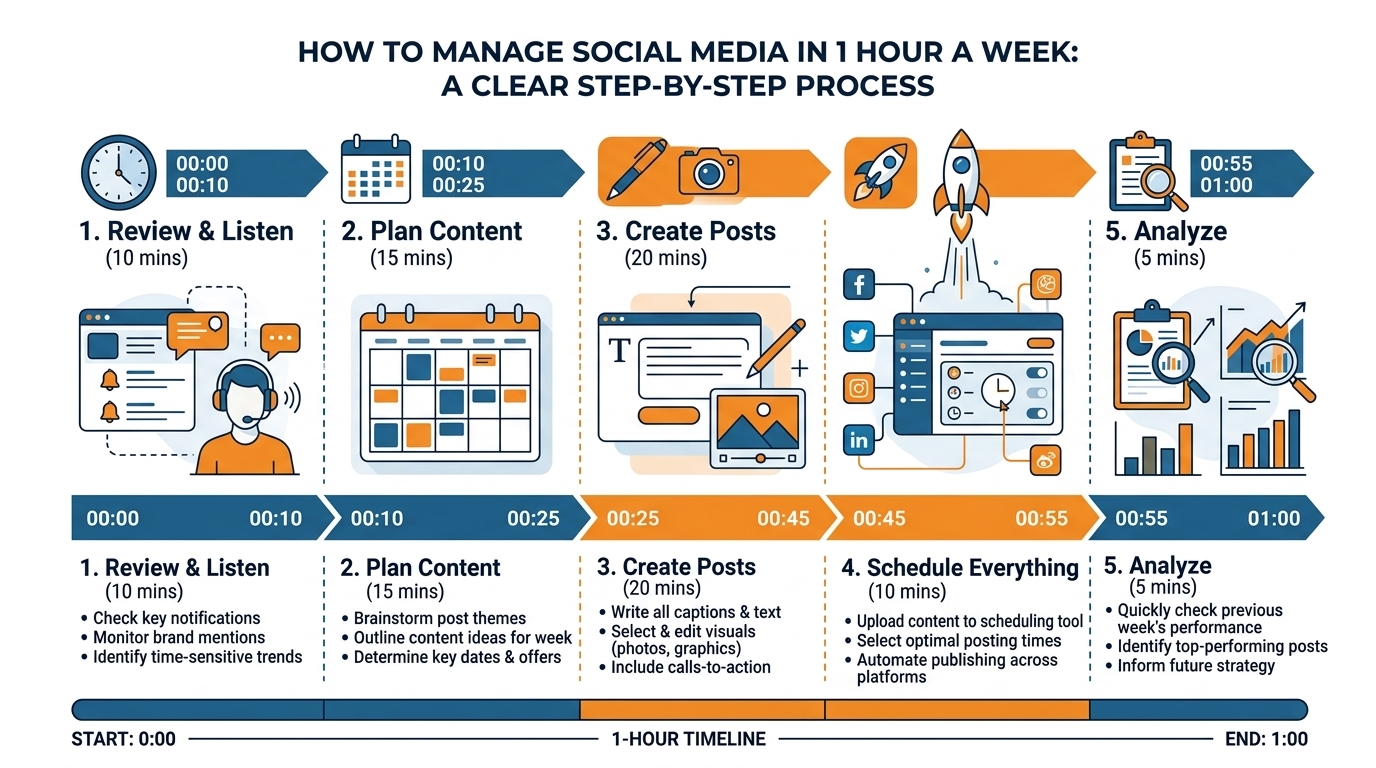
Managing social media in just one hour a week without compromising your engagement and community management can be achieved through a combination of planning, automation, and monitoring. Here's a step-by-step guide to help you do so effectively:
- 5 minutes, Week 1: Identify Your Objectives and Target Audience
Determine the primary purpose of your social media presence and the audience you aim to target. Establish clear, measurable goals for your social media activities. - 5 minutes, Week 1: Choose Your Platforms
Select the most appropriate social media platforms for your needs. Focus on the platforms where your target audience is most active. - 5 minutes, Week 2-4: Set Up Your Profiles
Complete your social media profiles by adding a profile picture, cover photo, and bio that accurately represent your brand. Ensure consistency across all platforms. - 5 minutes, Week 5-8: Develop Your Content Strategy
Plan the type of content you will post, including the mix of promotional, educational, and engaging content. Decide on the frequency of your posts. - 10 minutes, Week 9-52: Schedule Your Content
Use a social media scheduling tool like Hootsuite or Buffer to schedule your content in advance. Aim to schedule at least a week's worth of content at a time to save time. - 10 minutes, Week 9-52: Monitor and Respond
Monitor your social media accounts for comments, messages, and reviews. Respond promptly to all interactions to maintain engagement and build your community. - 10 minutes, Week 9-52: Engage with Your Audience
Like and comment on posts from other accounts, especially those within your niche or industry. This helps in expanding your reach and fostering your community. - 10 minutes, Week 9-52: Analyze Your Performance
Keep track of your social media analytics to understand what works and what doesn't. Adjust your strategy based on your analytics to optimize your social media performance.
By following these steps and dedicating just one hour a week, you can efficiently manage your social media presence, engage with your audience, and grow your community without feeling overwhelmed.
Comments and DMs are part of management
If you’re looking for advice on how to handle social media in 1 hour a week, you have to embrace a harsh reality that most answers overlook: social media management isn’t just about posting, it’s about comments and DMs, too.
Your small business page will suffer more from ignoring people than from not-so-great content.
In reality, the majority of the DMs and comments you receive will come within the first 24 hours after posting, and the pages that thrive aren’t the ones that respond all day, every day; they’re the ones that show up during that first 24 hours.
So you don’t handle this with discipline, you handle this with scheduling: you protect that 1 hour a week to create, and then you schedule in 2 tiny social media check-ins a week that are small enough to be maintainable but regular enough to be felt.
Make engagement rules-based
Your engagement system should be rules-based or it will consume your entire week.
You have to determine ahead of time what you respond to, what you ignore and what you escalate.
You respond to buy signals, legitimate questions and thoughtful comments that give additional context because they are conversion and community energy.
You ignore obvious spam, trolling and repetitive attention seeking because engaging trains the wrong behavior and clouds your mind.
You escalate anything sensitive, risky or reputationally threatening: allegations, legal, safety, medical, harassment, or a clearly angry customer.
When I see negativity, I treat it like a fork in the road: if it is confusion, I clarify once; if it is a legitimate issue, I take it offline; if it is performative hate, I starve it and report it.
Combine triage and canned responses
To avoid spending all day in your inbox, you combine triage and canned responses, which can be a good thing.
Here’s my triage system: scan quickly and mentally label each comment as money, momentum, or mess.
- Money: someone’s asking about price, availability, location, hours, etc.
Respond ASAP and make it easy to move forward. - Momentum: public comments that I can respond to with 1-2 sentences to keep the conversation flowing and show that my page is active.
- Mess: anything sensitive, complicated, or confusing.
Respond ASAP, with a brief reply and one clarifying question, and take the conversation off your page, or let them know when I’ll get back to them.
I keep my responses looking authentic by following one simple rule: one specific detail from their comment, one useful next step, and that’s it.
A long response looks like a customer service boilerplate, and it encourages users to treat your comment section like a helpdesk.
Use low-hanging collaboration to multiply impact
Lastly, maximize your reach through low-hanging collaborative opportunities, which enable you to create more than an hour of value from each hour.
You can do this by creating a small collaboration habit.
Take the time each week to engage with three to five other brands or individuals around you who target your audience without being a direct competitor.
Find a way to share each other’s content.
It might be writing a quality comment on their post, sharing one of their accomplishments, or using their advice and adding to it.
The algorithm likes to see value in the interaction, not just simply posting.
When I collaborate, I make it easy.
I share their advice, they share mine, and we both get more eyeballs on our profiles from a warm audience without using a dollar on advertising.
Within a month, those small cross-sharing habits will give me more value than if I simply posted more, because one quality share is going to give me more qualified profile views than a handful of cold impressions.
Managing Your Social Media in 1 Hour a Week with a Small Analytics Loop to Boost Your Results Week After Week
If you’re looking for advice on how to manage social media in 1 hour a week, you need a minimal measurement stack, not a dashboard full of numbers that make you feel busy.
Choose a single metric that aligns with your objective and ignore everything else.
For awareness, I use (shares + saves) / reach because it’s an indicator of whether the idea was worthy of spreading or holding onto.
For lead gen, I use profile visits per post because it tells me if the content created intent.
For retention, I use quality of comment from existing customers because it shows whether the post reduced friction.
In small business accounts, I typically see a power law distribution that tells me 20 percent of posts generate most of the value, which is why one metric is all you need.
It helps you find the posts that are doing the heavy lifting. If you want an optional way to quantify engagement, you can use an engagement calculator.
This can be a 10 minute weekly review: check your last 3 to 5 posts and just decide three things.
- What did best on your one metric?
- Why did that post do better (in terms of mechanics)?
- What one thing will you test next week?
What you can do next week is test one thing.
You should only test one thing.
If you do more than one thing you don’t know what worked.
Then your next week will be random.
Instead of it being repeatable.
So, why?
What were the mechanics?
Well it was a more specific hook.
Maybe that’s why.
Maybe the proof was more clear.
Maybe the first line was a customer’s question.
Maybe the post did a nice myth/reality.
Maybe it was the format reduced the effort for the reader.
You can and should learn from the signals the platform sends you, but only if you don’t sweat and hyperventilate through it.
One post is one data point, not a referendum on your entire positioning, and you can’t keep rewriting and restarting every time one doesn’t do well.
I look for distribution problems vs message problems, and if distribution is fine but engagement is terrible, the concept or messaging is bad, but if distribution just dies and engagement per person who saw the post is fine, distribution is the problem and you shouldn’t throw the baby out with the bathwater and redo all your positioning.
The most important thing is to preserve your consistency long enough for the algorithm and your audience to see that this is who you are, so you only look to adjust one variable at a time, you don’t mess with format, and you don’t check your results daily but instead see how they trend over 4 weeks.
The compounding comes from identifying repeatable winners and converting them into a series rather than just enjoying a success and moving on.
A repeatable winner is not your best post one time, it is a post type that is above average at least twice with different examples, because that proves the structure is the winner not the topic.
When you find one, you turn it into a recurring weekly slot, e.g., one customer question, one myth I hear on sales calls, one behind-the-scenes decision, one before-and-after analysis, so you are building an engine rather than starting from scratch every week.
I do this because series set expectation, decrease creation time, and increase your baseline over time, which is the real key to getting better results while keeping the time commitment fixed at one hour.
O Fim
Managing social media in 1 hour a week isn’t a hack, it’s a system.
Stop losing hours by limiting your scope, stop scrambling by batching an entire week at a time, stop letting it consume your life by setting a firm engagement boundary, and make next week a little easier by running a tiny analytics feedback loop.
If you keep the loop small, you’ll discover a truth that most small businesses learn the hard way: a small percentage of your content is responsible for most of the impact, so your goal shouldn’t be to create more content, it should be to find the few types of posts that reliably get saves, shares, comments, profile clicks, or lead-gen DMs.
Expect to match the consistency of an operator, not the frequency of a producer: when you don’t have much time, volume trumps magnitude.
A week of intense output, followed by three weeks of no output, will condition your audience to not respond, and will also not give the algorithm anything to learn about.
A consistent rhythm is going to increase your reach, because you’re saying the same thing over and over, your examples are getting more clear, and your audience will start to develop a feel for what you’re going to post; after three months or so, that feel will begin to translate into consistent responses.
The easiest way to make this system provable, over the next 4 weeks, is to choose a single platform to show up on, and a single success metric each week you will commit to measuring.
If you’re doing lead gen, commit to measuring profile visits per post.
If you’re doing awareness, commit to measuring saves + shares / reach.
If you’re doing retention, commit to measuring # of high-intent customer questions or repeat commenters.
Then commit to running the same weekly cycle, without adding new platforms or formats or posting days, because you need to prove that it works before you double down. If you need a companion system for planning, use a social media content calendar.
I approach these 4 weeks as a science experiment: same amount of time, same format, same frequency, one thing improved at a time according to the metric.
Do that and you will not only manage your social media in 1 hour a week, you will do it with confidence, knowing what you are trying to build, what the signal is that it’s working, and what you can improve for next Monday. If you want help generating posts quickly in the same format, try an AI social media post generator.
Related reads
4/27/2026
B2B SaaS social media benchmarks: Set the right targets.
B2B SaaS social media benchmarks: Set the right targets. The trouble with defining B2B SaaS social media benchmarks is that it's an inherently impe...
4/25/2026
Building a personal brand as a technical founder (without becoming a creator)
Building a personal brand as a technical founder (without becoming a creator) Creating a personal brand as a tech founder should feel less about ma...
4/20/2026
Creative Post Ideas for Sustainable Brands (That Don’t Sound Greenwashy)
Creative Post Ideas for Sustainable Brands (That Don’t Sound Greenwashy) That’s not what creative post ideas for sustainable brands should look lik...