The Secret to Overcoming Social Media Burnout for Founders
Founders, tired of social media burnout? Discover the real reason for exhaustion: it's rarely about posting, but the draining 'attention work'. Learn to distinguish and overcome it.
The secret to overcoming social media burnout as a founder is this: it's almost never about posting.
You are exhausted by the founder-specific cycle of creating content, the audience expectation, the fear that if you don’t keep the lights on everything will die, and by the fact that your brain interprets your reach, engagement, and incoming activity as a proxy for your value as a human being.
It’s even harder for a small business because social can feel like your lowest-cost sales funnel and your reputation machine rolled into one.
That’s why the key insight is this: distinguish between content work and attention work.
Content is building and publishing.
The attention labour is the monitoring, refreshing, responding, deciding whether to respond, and the emotional work of every like, view, and comment.
The problem with attention work is that it’s disguised as “responsibility” but chokes up your time into little pieces and exhausts your nervous system even if you hardly post at all. (The research-backed reality of social media strain is well captured in this meta-analysis of social media fatigue (64 empirical studies; N = 28,357 participants): a meta-analysis of social media fatigue drivers and consequences.)
Sometimes I feel drained and I didn't even ship anything, and almost always it's because of the background process in my brain constantly checking whether 'the market' saw me.
Before burnout bites you in the butt, you might notice that you are hesitant to post even when you know what you want to say, you are checking your analytics on autopilot, your emotions are tied to your results, you dread getting DMs and you even start to feel resentful of your readers for relying on you.
That’s not a motivation issue.
That's a system design issue. If you want a deeper look at fixing the system side, see smart social media automation.
A simple triage tool
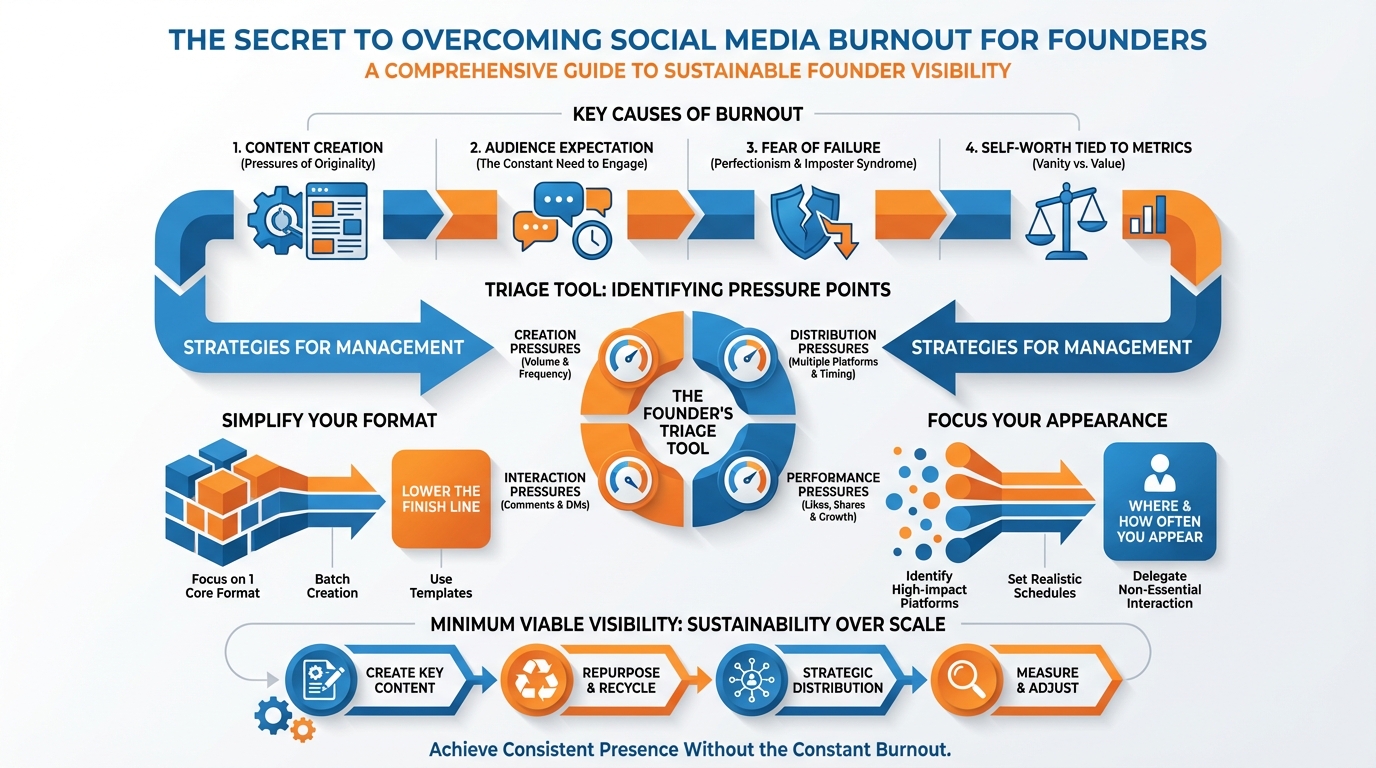
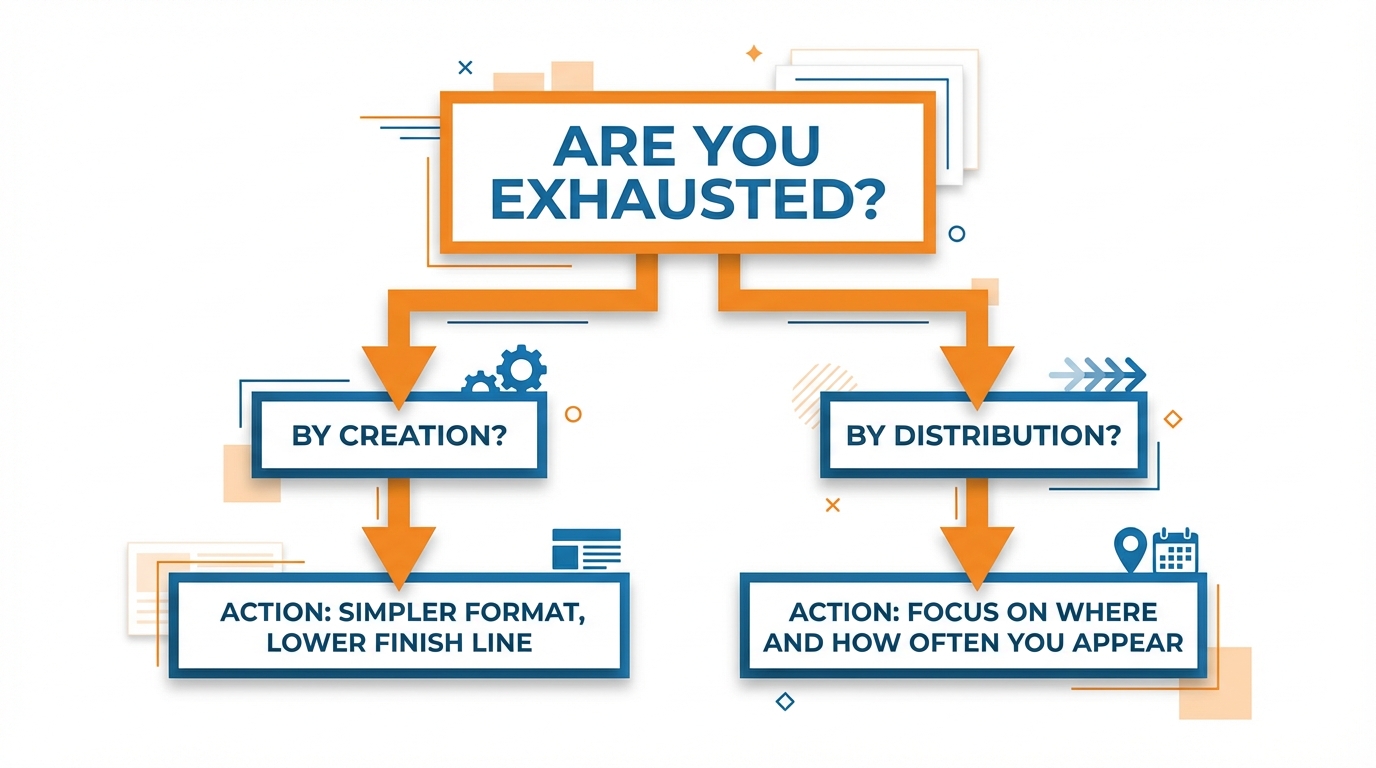
Here’s a simple triage tool for you in this moment: are you exhausted by creation, distribution, interaction, or performance pressures?
If you’re experiencing creation burnout, you require a simpler format and a lower finish line.
With distribution burnout, you need to start focusing on where and how often you appear.
If you have interaction burnout, you’ll probably need to set more boundaries on your commenting and DMs.
When you’re suffering from expectation burnout, you may have to redefine what success looks like this month.
First identify which class of problem you have, then pull the first lever that reduces the load, because solving the wrong problem is how founders keep spinning in the loop while telling themselves they just need to be more disciplined.
Minimum viable visibility (i.e. not going dark)
As a founder, social media burnout is managing a minimum viable visibility (i.e. not going dark)
Managing founder burnout when it comes to social media becomes a lot more manageable once you start to see social as a growth channel that you need to maintain to a certain minimum, rather than an endless exercise in social proof.
You don’t need to be posting as much as you can; you need to post as much as you need to maintain the perception that you’re still in business, still providing value to your audience, and still worth talking to.
For most of us in small businesses, that’s a relatively low bar because our potential customers don’t need to see fresh content every day, they just need to see that we’re still a going concern, that we’re consistent, and that we know what we’re doing.
When I’m determining my minimum effective dose, I try to ask myself this: If a prospective customer or client goes to look at my profiles this week, will it be immediately clear what I do, who I do it for, and that other humans still like me?
When you are full, you win by reducing surface area, not by working harder.
You select the one key platform where your customers are already listening and you stop trying to be everywhere. (If your “everywhere” is becoming too much, this pairs well with social media time management.)
You reduce the content formats that take up too much fresh energy and you focus on the ones that build the most trust per minute; in practice, that usually means you focus on simple content that educates, explains or proves, and you suspend intensive content production that exhausts you.
You also reduce the scope of engagement: you engage where it advances relationships and you step off the limitless content-creation conveyor belt.
You define a DM policy: you establish what constitutes a legitimate connection, what warrants a brief reply with a clear boundary, and what you don’t respond to, because the expectation of limitless availability is the fastest way to get back to exhaustion. (This is not just a founder thing; the STADA Health Report 2024 found 60% of Europeans say they have already suffered from or experienced temporary feelings of burnout, and it also reports that people who spend long hours on social media are more susceptible to burnout (68%) vs those spending little time online (53%): STADA’s 2024 mental health and ageing findings.)
To monitor whether a lower frequency is doing damage, you can’t just look at superficial engagement metrics, you have to track the things that matter most:
- Are qualified leads still coming in?
- Are your pitches still getting initial responses, did you still have a good call?
- Are you still getting similar objections, or are they now about trusting you?
And on the side of your audience, monitor for intent signals, not vanity:
- Are the right people looking at your profile?
- Are people responding to something specific you said?
- Are people who fit your customer avatar engaging with your content more than once?
- Are people referring you, saying they’ve followed you for months?
I’ve seen accounts that lost likes, but gained more valuable leads, because the posts got less views, but also, more views from the right people, which is exactly what you need with less bandwidth.
It’s a matter of messaging, not just an explanation.
You can’t just drop off the radar and hope that nobody will notice and you can’t just start posting a lot of stuff.
You need to just put out one straightforward message that says: Hey, I’m going to try to focus on a few things for a little while and I’m not going to post as much stuff as I normally do, and if you need something from me professionally, this is the way that you should reach me and this is how long it’s going to take me to get back to you.
Because that’s what your clients and partners and investors care about.
They don’t care about frequency of messaging.
They care about that you’re being stable and that you’re prioritizing the right things.
When you do it in that way you avoid the whole trap of, “Oh, you’re either going to be completely silent or you’re going to be just spamming a lot of stuff.”
Dealing with social media burnout as a founder is not something that has to be a negative brand thing.
It can be a positive one.
Here’s how you can avoid social media burnout
If you’re a founder, here’s how you can avoid social media burnout:
Build a content creation framework that reduces mental fatigue
When you’re a founder, social media burnout is a lot easier to manage if you treat content as an operating model instead of a daily willpower exercise.
I do capture → shape → publish → recycle because it reduces context switching and removes micro-decisions.
You capture raw material when you’re already doing founder work: customer calls, sales objections, product lessons, hiring mistakes, wins you can explain.
Then you shape in one focused block by turning that raw material into a single clear point, one example, one takeaway.
You publish with a defined finish line so you’re not endlessly tweaking.
And you recycle on purpose, because the fastest path back to burnout is believing every post must be brand new.
So, to make it sustainable, instead of trying to maintain an infinite stream, you create a small portfolio of evergreen content.
You identify 4-6 key messages that your company must be known for, and then you can use each one as an evergreen that can be formatted in various ways: a micro-message, a macro-message, an infographic, a case study, a value lesson.
When I craft one good idea, I can create a native format for each platform without altering the substance, so I’m not starting from scratch, I’m just re-skinning it.
The value of this in terms of data is that you can stack it: frequency drives retention, and most customers need to see your message several times before they believe you, so re-expression tends to beat out pure innovation in terms of performance at a much lower cognitive cost.
Design distribution leverage so you don’t have to be online all day
You prevent burnout by designing distribution leverage so you don’t have to be online all day to get results.
Rather than attempting to single-handedly promote every post, you engage partners, colleagues, and networks in ways that are natural and beneficial to all parties.
You collaborate on a small piece with a fellow business, you synthesise a partner’s wisdom and give them a shout out, you share a customer’s success story in a way that makes them shine, and you develop a small list of people who serve the same audience so your best ideas will extend beyond your own audience.
I have seen this one thing completely flip the output to effort ratio because one well-targeted share can achieve what hours of scrolling and responding cannot. (This is also where teen pressure and overwhelm mirrors the broader dynamic; Pew Research Center reports 38% of teens say they feel overwhelmed by all the drama they see on social media, and 29% of teens say they feel pressure to post content that will get lots of likes or comments: Pew’s report on teen life on social media.)
Protect your neurons by decoupling experiments from baseline content
Last but not least, protect your neurons by decoupling experiments from baseline content.
Baseline content is your minimum viable visibility: the stuff you can count on, the formats you can count on, the time it takes to produce them, the way they make you feel, so your week is roughly the same even when the algorithm decides to go nuts.
Experiments are voluntary, and time-limited: you want to try out a new hook, or a new format, or a more provocative thesis, but you’ve defined beforehand what “success” looks like, and when you’re going to stop doing it.
The distinction between the two is useful, because algorithmic uncertainty can produce emotional uncertainty, and founders have enough to worry about without their posting schedule (or their emotional state) being dictated by their engagement graph.
When the baseline is taken care of, you can experiment like a mad scientist rather than publish like a fireman.
How I combat founder social media exhaustion
I solve social media burnout by delegating what I can, without delegating my personality.
But social media burnout as a founder is no longer a willpower issue once you reach the delegation threshold: the threshold beyond which it makes more sense for you to spend your hours in high-context, rather than production.
A simple way to determine this is to time your last 10 sessions of creating content.
How many of those minutes were spent on founder-level work vs production-level work.
If more than 50% of your time is spent in editing, formatting, resizing, writing captions, and the mechanics of posting and engaging, you are using some of the most valuable time on earth to do something that someone else can do 80-90% as well while you forgo 100% of the value only you can deliver in product decisions, sales language, and market messaging.
You’ll get out of burnout the fastest when you stop asking, “can I do this,” and start asking, “does it make sense for me to do this?”
To reduce the weight instantly, you outsource what is low-context but high-frequency: adapting one content into 3-4 posts, refining grammar and adjusting length, formatting raw text into a readable blog post, producing basic design elements, and managing the logistics of scheduling and publishing.
You also delegate the triaging the initial layer of engagement (sliding in comments and DMs): Label what is time-sensitive, Label what is sales, Label what is support, Label what is irrelevant, and Label what requires a personal response.
You keep what is high context, high risk, and competitive: your takes, your anecdotes, your specific actions, your rules, and any words that pivot.
I can outsource having someone re-write 3-4 clean versions of a narrative from my raw voice note, but I never outsource what I am actually saying.
Authenticity is not magic, it’s a system.
You protect it by creating a voice bank: 30-50 examples of past posts, emails, call transcripts, and short recordings, labelled by intent - e.g. teaching, disagreeing, lesson learned, behind the scenes, customer story.
And by creating clear guardrails: words you will never use, claims you will never make, how direct you can be, how you navigate nuance, and what topics you need to personally approve.
You keep approval loops lean: you approve approaches, not commas.
If you only ever read a brief and a final draft, you protect your time and still keep your voice consistent because the team is writing to your patterns, not creating a new personality.
Automation is how community and distribution don’t become a second job, but you’ve got to automate the operational pieces, not the human ones. (If you want to systematize this end-to-end, this connects directly with social media calendar automation.)
Auto-segmenting incoming messages into buckets, triaging support requests to the knowledge base, sending a clear first reply that sets expectations, and generating an internal alert for high-intent signals can scale your response without making you feel like a bot.
Where you want to be careful is anything that impersonates you: no auto-replies that impersonate warmth, and no fake scarcity or fake intimacy.
The result is that you’re still there for the important moments, but the computer can handle the noise, which is what makes dealing with social media burnout as a founder a loop instead of a spiral.
O Fim
When founders experience burnout on social media, that’s not a failing. That’s data.
In solo entrepreneurship, the “system” tacitly demands that you be a marketing manager, salesperson, customer service agent, and community manager all rolled into one, and then wants you to treat burnout as a “time management” issue. (In adjacent fields, the pattern is stark: Muck Rack reports about half of PR professionals said they had considered quitting in 2024 due to burnout, and 44% said they had previously left a job due to burnout: a 2024 work-life balance report in PR.)
Recognize what’s taking too much energy. It could be the amount of content, the distribution of it, the engagement in the comments, or the performance pressure.
Once you identify the true source of the burnout, you stop applying solutions to the wrong problem, and you end up commanding the platform rather than the platform commanding your nervous system.
To make that last, be a platform owner, not a content titan.
You keep your working showcase short enough that a prospect can triangulate you inside 30 seconds: what you do, who you do it for, and evidence of recent work.
That’s important because buyer trust is heavily influenced by recency, and multiple B2B studies say buyers prefer recent signs of life, and in real-world terms, that means weeks, not days.
I’ve reduced my posting frequency and still had stronger sales discussions because the output moved from more content to clearer content and cleaner intent signals.
Finally, you create a low-friction funnel that fits your real life.
You source content from work you’re already doing, edit it once with a clear deadline, release it non-perfectionistically, and re-use your most powerful ideas until your audience memorizes them.
This is how you sustain the flywheel effect: repetition creates recognition, and recognition drives open rates, shares, and sales conversations even when surface metrics drop.
I like to think of it like a car losing value versus an investment gaining interest: random posting reduces attention, whereas a few timeless themes increase authority.
Last, you preserve your founder energy by delegating and automating the right levels without giving away your brain.
You outsource production and triage, but retain the high-context and high-risk pieces: the perspective, the narrative, the non-negotiables, and the language of reframing.
When you do that, you become easily seen without needing to be constantly available, your enterprise remains trustworthy without having to constantly prove itself, and social becomes a long-term investment rather than a daily expense. (For a broader system view, compare with social media automation.)
Related reads
6/14/2026
YouTube API Alternatives in 2026: start developing right away
Skip the YouTube quota system caps and API calls. Compare the best YouTube API alternatives with code examples, pricing and understand recent changes.
6/12/2026
Best Facebook API Alternatives for Developers in 2026 for direct access
The Facebook Graph API review can take weeks. Compare the best Facebook alternatives for posting, scheduling and more.
6/12/2026
Best LinkedIn API Alternatives in 2026 - instant access for developers
See a list of all the LinkedIn API alternatives for all types of use cases so you can skip the waiting time and get right on automating your work on LinkedIn.