How to Spend Less Time on Social Media for Your Business
Struggling with social media time? This guide helps entrepreneurs work smarter, not harder, by hacking social habits to boost productivity and sales.

How to Spend Less Time on Social Media (Without Killing Your Business)
If you’ve ever said I just need more willpower, that is your answer. Willpower is a finite resource and social apps are designed to burn through it with infinite scrolling, variable rewards, and perfectly timed notifications. This is why most entrepreneurs find themselves in the same cycle: you open an app to send a single post or respond to a single comment, and 25 minutes later you’re still there, responding to whatever the algorithm sent your way. When I want to stop this cycle, I don’t work harder. I work smarter. I treat social media like a system I can hack by altering inputs, triggers, friction and rules to make the default result be fewer opens, shorter time and more deliberate decisions.
So in terms of reality, what does less time on social media look like? It doesn’t look like being off the radar or killing your business. It looks like maintaining that positive connection with customers, staying on top of what the market is concerned with, and driving sales, without the compulsive scrolling that takes over your day. For you, it’s about separating business activities from social habits: you still post, engage, and investigate with intention, but you cease filling the automatic habit of scrolling at the breaks, anxieties, and moments of dullness. I do this by making the useful activities very easy, and the automatic ones slightly inconvenient, so I don’t automatically go to them without thinking. If you want a deeper take on making this consistent, see inconsistent social media posting.
In this article, I will guide you through a diagnosis-first process so you understand why you scroll, not just that you scroll. You will receive a staged plan with guardrails that are difficult to circumvent, achievable goals that finally hold up for time-strapped founders, and a list of plug-and-play options for the precise moments you turn to your device. Afterward, you will have a repeatable framework for preserving your attention while still serving your professional aims.
Identify your scroll triggers (you shouldn’t fight the wrong battle)
Want to know how to stop wasting so much time on social media?
The first step is to find out how much time you are wasting, instead of just estimating.
For three days, you track your baseline behavior: what apps you use, when you use them, and when you get sucked in for the longest periods of time. I do this by taking a note when I notice myself doing it: when, where, how I feel, and why I grabbed my phone in the first place.
Most of the time, you will see your most common usage times right away, whether it’s at 3pm in the afternoon slump, late at night watching TV, or in those micro-moments of the day when your brain won’t stand the friction of switching tasks, or waiting, or quiet time.
You need your baseline because you need a different solution if you’re a founder who gets sucked into social media mostly late at night, vs. between calls.
Then you give it a name, because the same behavior can have completely different roots.
The four triggers I described above have distinct patterns that emerge.
For me, boredom or waiting manifests as just checking for a minute that turns into a half an hour session; stress relief or avoidance is scrolling to numb myself from something on my to-do list that I don’t want to do; loneliness or connection seeking is refreshing to see if anyone has commented/liked/DM’d me; and procrastination or perfectionism is scrolling because posting feels too important, and I’m afraid of fucking it up.
You can do the same thing by asking yourself the same question every time you catch yourself scrolling: What was the problem I was trying to solve in this moment?
The answer will tell you which lever to pull, because turning off notifications will not help your perfectionism, and setting a more rigid timer will not help your loneliness.
Next, identify your loops, because most time wasted isn’t one giant decision, it’s five little ones, stacked.
Mine is notification → quick check → feed → recommendations → 20 min later, and the frightening part is how autopilot it feels after the first tap.
You’ll find yours the same way: what’s the trigger? What keeps me here? What makes me say just one more?
For the small business owner, the danger is assuming you logged in to work, but the app hooked you into one of the endless browsing surfaces (explore, shorts, reels) where there’s no such thing as “done,” and the goal is to maximize time on site, not your bottom line.
This is the secret to actually making it work: you start by eliminating only 1-2 primary triggers.
You lose the most time by killing the largest loops, not by attempting to tackle 12 tiny tweaks all at once and getting exhausted by day three.
You determine which actions remain unlimited, such as those that directly drive your business or social connection, like messaging, groups, posting, and intentional content consumption, and which should be restricted, such as those not designed to have an ending, like endless scrolling feeds, explore pages, and short-form recommendation streams.
When you make producing and sharing the easier path and browsing the more difficult path, you no longer need willpower to sustain it; this is also why tools like WoopSocial can help decrease habitual sessions, because being able to produce a month’s worth of on-brand content in a flash shifts your default from browsing for ideas to planning and action. If you want more on this approach, read outsource social media to AI.
Also, the “finite willpower” problem shows up in real measurements: in a 2023 two-week detox study, objective social media use dropped from 129.81 min/day to 24.58 min/day during the detox-see this two-week digital detox study with objective screen-time drops (129.81 to 24.58 min/day) in Behavioral Sciences (Basel), 2023.
Create a ladder of friction: reminders, then constraints, then full blockers
If you want to figure out how to use social media for less time without relying on brute force, you have to create an enforcement trajectory that becomes increasingly severe only as you demonstrate the need for it.
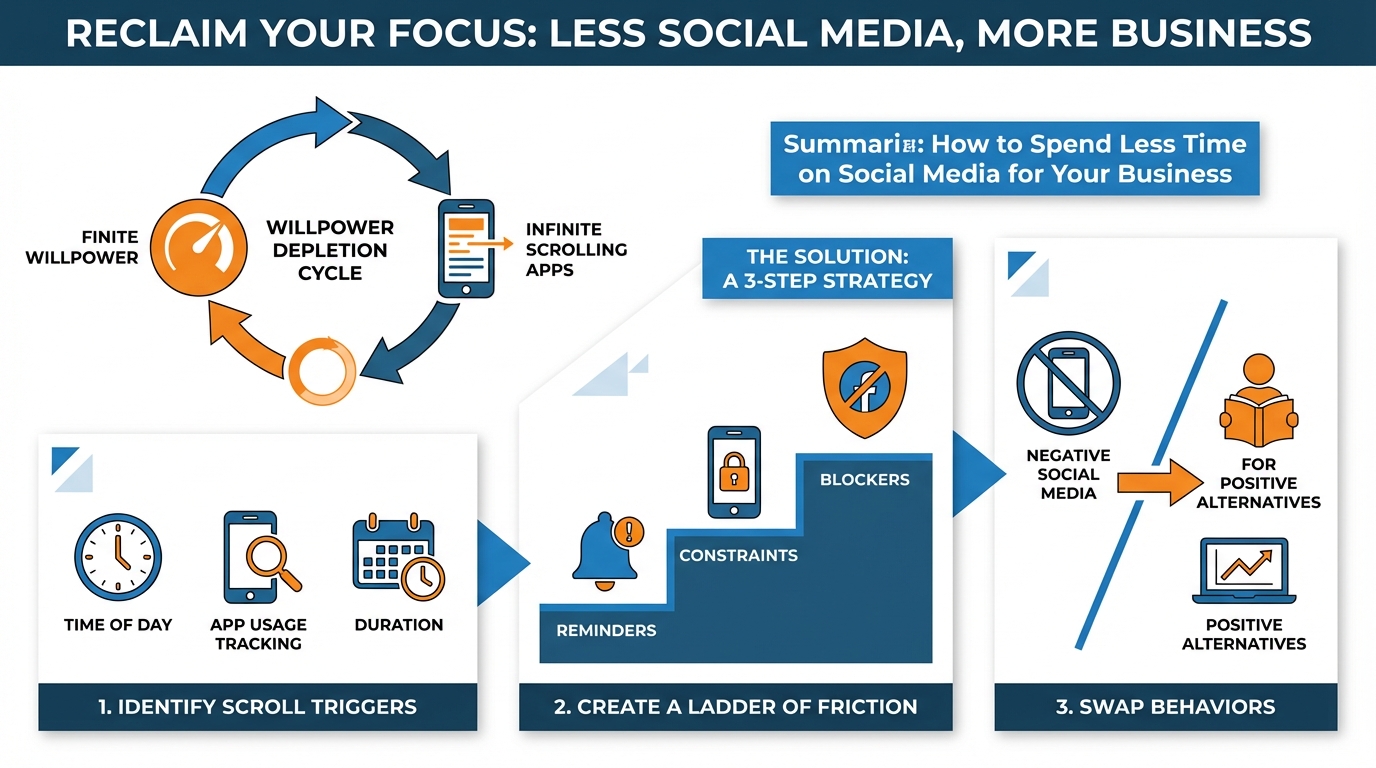
I arranged mine like a friction ladder so the default result is fewer opens and less time in the app, even on the most intense days as a founder.
The idea here is that much of the overuse is on autopilot, not deliberate.
Eliminate the various stimuli that prompt this sort of automated behavior, and you already reduce a good deal of the time it takes to even fire up the timer and block-based apps.
In real life, that’s the difference between using social media for work and social media using you for work.
You start with Level 1 soft friction, which attacks the auto-play loop at its core:
- You block the notifications which are most likely to cause you to endlessly refresh, most notably likes, new followers, suggested content, and anything which contains the word “recommended”.
- You take social media off your home screen, so that when you open the app it is a choice not a habituated reflex.
- You log out of your social media accounts, so that switching personas is enough of a pain that you cannot be boredly scrolling.
- You put your phone on grayscale or “do not disturb” for times of day when you’re most likely to get sucked in, because just as taking away reward decreases desire, so too does removing color and motion; those aren’t design defaults, they are engagement accelerants.
If you still overuse, move to level 2 structured limits that are based on your actual work hours, not a fantasy.
Also move to OS level timers with a limit that you can actually reach at first, since unrealistically low limits will simply teach you to always override the thing and click ignore limit as a matter of course.
Finally, add in times of forced downtime for your sleeping hours and the first hour of the day, since the time right before bed and the time right after you wake up are FAR more addictive than the rest of the day, and have a huge tendency to grow.
And lastly, restrict yourself during your actual peak hours.
If your vulnerability window is between 2-4 PM when you’re on the phone, then that’s when the limit should kick in, not as some abstract “2 hours a day” that you blow before noon, and then forget that you’ve reached.
When you continue to circumvent, Level 3 hard friction is where you preserve income-producing time and attention.
You block newsfeeds and newsfeed-like surfaces in core work hours, and use pinned tabs for learning and customer serving work, and block them on other devices, so you can’t just switch from your computer to your phone and trick yourself into thinking that it’s somehow different.
I also prevent workarounds by removing convenience: no saved logins, no quick login, no autoplay, and the app isn’t quick to open.
That added energy to initiate forces a decision, and that’s what automatic checking is trying to bypass.
My stack-the-deck rule is simple and harshly effective: when you blow a cap twice in a week, the app goes up a stack-the-deck level for the following week.
And for solopreneurs, this works beautifully in tandem with batching content creation: when you can create a month’s worth of on-brand social media content in mere minutes with WoopSocial, you remove the most frequent justification for content, “I need to find some content,” and you keep your social time contained to intentional posting and engaging, rather than mindlessly scrolling through your newsfeed. If you want to build that batching habit into a repeatable routine, this ties closely to a weekly social media system.
Research also shows “detox” adherence is hard: in a 2025 study, nonadherence was highest for Instagram at 67.8%-see the youth detox results including Instagram nonadherence (67.8%) in JAMA Network Open, 2025.
Swap the behavior in the same contexts where I usually mindlessly scroll
What I read most often as strategies to decrease social media use can be summed up in two words: Find a hobby.
That’s not specific enough to conquer a highly contextual addiction.
You do it in 30 seconds to 10 minutes chunks, you’re low on energy, a bit bored or anxious, and it needs to be something you can do everywhere.
The alternative needs to fit the occasion, not you in your prime.
If the alternative requires tools, a separate space, or an energy peak, your brain will always choose the feed because it is seamless and rewarding right away.

Rather than trying to find the one thing that will replace scrolling, create a handful of replacements for the scenarios when you most often scroll.
If you are lying in bed or on the couch, you’ll need something quiet and low-energy, with a defined conclusion: queue up a series of pre-selected articles to read, watch a single long-form video that you have saved to watch on purpose (not on autoplay), do a 3-minute stretch, write one paragraph in a journal, or write a tomorrow to-do list to clear your mind.
If you are waiting in line or driving, you’ll need something that productively uses the otherwise wasted time, and that doesn’t require your hands or attention: listen to a podcast, complete a few minutes of language lessons, read an article you’ve saved for offline reading, dictate a few notes for your business, or listen to a music playlist that you’ve created to produce a specific mindset.
You’re not trying to change who you are; you’re just trying to replace the behavior with something else that scratches the same itch, but with less downside.
For stress scrolling, we need to make this alternative physical and immediate, as this scrolling is more of a relief-seeking, rather than information-seeking.
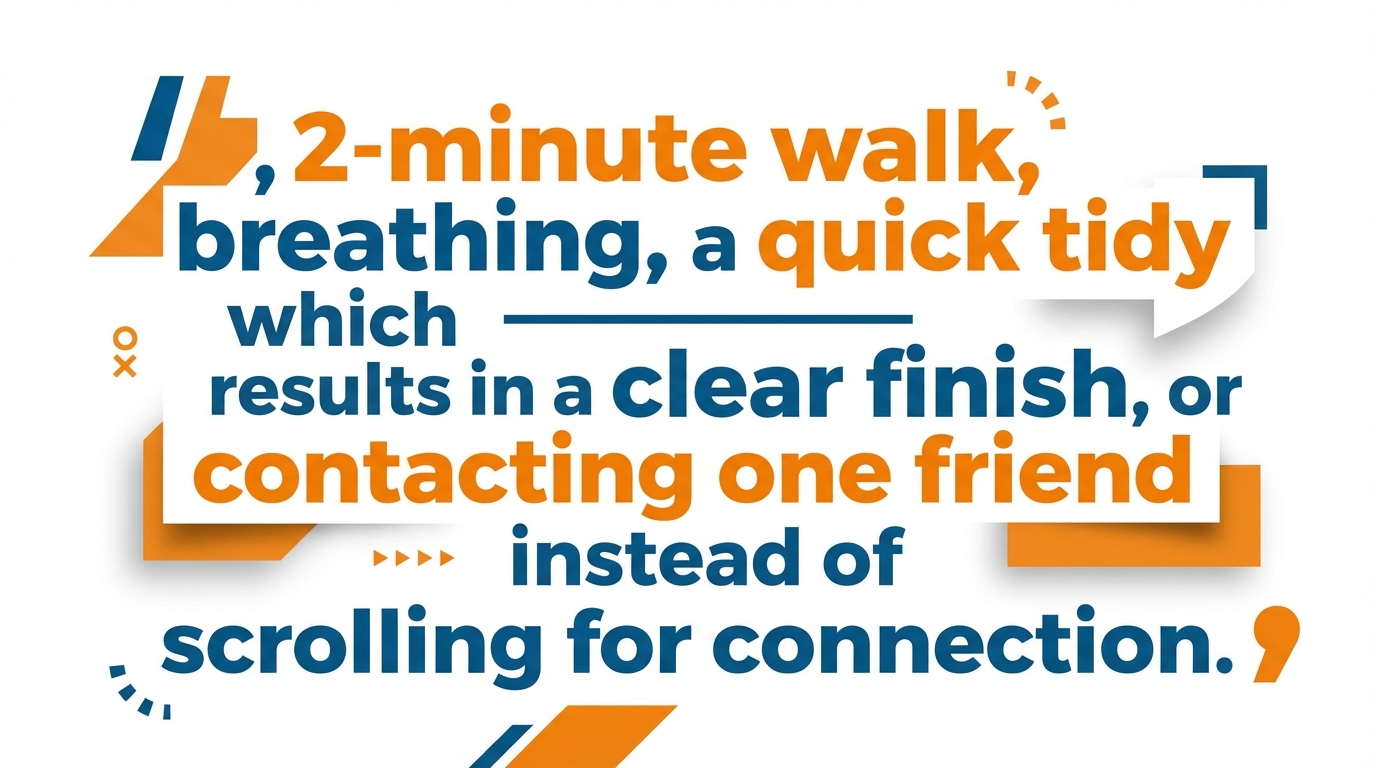
The best alternatives are tiny, and require a state change which can be achieved rapidly, e.g., 2-minute walk, breathing, a quick tidy which results in a clear finish, or contacting one friend instead of scrolling for connection.
Then, there is only one simple rule to overcome autopilot: If you open an app for no reason, then close it, and go through your alternative for 2 minutes.
This is because you are not removing the app completely, you are just putting a speed bump in the way which requires purpose, and most of the compulsive moments will dissipate after a couple of minutes if you do anything else.
Lastly, approach replacements like a business experiment, not a moral quest.
Keep a running list of which of the replacements do in fact provide what you are seeking: community, escape, learning, or closure.
If a replacement is not providing it, ditch it guilt-free and switch to another on your list.
I also minimize the frequency I need to open business apps by batching; the less often I need to open work apps, the less often I get trapped into scrolling; with WoopSocial, it takes me just a few minutes to create a month’s worth of content. If you want help on the “create quickly” side, you can use an AI social media content generator to reduce the “open app for inspiration” trap.
If you want a concrete view into how platforms keep you in the loop, one report showed least-active users’ TikTok watch time increased from 32 to 45 minutes after one week (40%+ increase)-see the report on watch-time increases among least-active users (32 to 45 minutes in a week) in The Washington Post, 2025.
Limit time without reducing results (even if I rely on social media for work)
If you are looking for ways to cut down on social media time without sacrificing your business, the first step is to distinguish between making and taking.
You do not have to be online all day to be consistent, you just need a regular production cadence.
You have to give yourself permission to treat content like a product: you make it when you’re offline, you share it intentionally, and you only consume when you have a specific question to answer, like what are people asking this week or which messaging is working.
I do this because the minute that making and taking happens in the same session, the algorithm has just assumed control and turned the work into scrolling.
Second, bound your social work into fixed times to give the work a finish.
You choose a couple small fixed times per week to create and publish, and a fixed bounded time each day to respond, and you don’t look outside that.
This is possible because infinite looking has an extreme attention cost: the literature on task-switching has shown that context changes can burn as much as around 40% of the productive time in a work day, and social media is essentially a context-switching API.
By batching, you preserve deep work, and you still remain persistently available in the place where customers notice it: consistent content and timely responses, not nebulous all-day availability.
Next, you optimize out the feed’s hooks.
You apply basic filters - if it doesn’t educate you, pay you, or otherwise serve you, it’s gone - and you eliminate recommended-content panels when the platform permits.
One good practice in this regard is a regular de-cluttering ritual: once a week, you “defollow” whatever lured you into a deep scroll in the last week, since the things that eat up most of your time are mostly offenders.
I do this the way I would scrub the window of a retail store: if the mannequin’s getting in the way of customer service, I replace the mannequin, not the service.
Lastly, track progress instead of being stuck on a schedule.
For example, I will post X times per week, spend Y number of minutes on social per day, and I will only engage during this specific time period so it does not add on without any limits.
If your problem is needing to come up with a month’s worth of content and getting the brand right, then that can be solved by using something like WoopSocial to quickly generate a month’s worth of content ideas, auto-brand the graphics, and schedule a month’s worth of posts in a single session, so you’re spending your time on social on what matters: customers and sales, not just tinkering with the content. If you want the scheduling piece to be more structured, use an AI social media calendar generator to keep the work bounded.
If you want evidence that many people “cave” under rigid rules, one study found 86.5% of participants did not fully stay off social media for the entire week-see the “Goldilocks rule” detox coverage noting 86.5% caved in Fortune, 2023.
Em conclusão,
The golden rule of how to spend less time on social media? Instead of trying harder, design your surroundings.
Social apps win at willpower, because they operate with triggers, variable rewards, and zero ending cues.
You win at altering the default mode: remove triggers to initiate the cycle, add resistance to make it a deliberate decision, and find alternatives that meet the same purpose with an end point.
I approach it like fixing a leaky funnel in my business; not that I’m aiming for zero leaks, but fewer leaks will stack into hours regained.
The quickest path forward is a 2-3 day baseline, followed by a single intervention.
You want to track what’s happening in reality, not what you think is happening, because the vast majority of founders under-report their hours and over-report the amount of time spent working.
Identify your #1 trigger that’s causing the longest unintentional sessions, and add just one layer of friction that breaks the first tap on that trigger.
And then select one alternative to the scroll of the day that’s costing you the most time, because you need to give your brain an alternative to jump to when the itch happens; if you don’t have an alternative, friction will simply become frustration and you will eventually bypass it.
The goal is gradual and sustained decreases, not a purge followed by a relapse.
You’ll find that you’ll have fewer instances where you’ll wonder why you opened it up, and a clearer distinction between when you’re doing work, and when you’re being guided by an algorithm.
A good goal is to aim to decrease your time by 15 to 30% the first week, and work your way down from there, as modest reductions tend to hold better than severe limits, which train you to override your own restrictions.
If you need the system to actually perform under business reality, limit the times you need to log in to the applications.
This is where WoopSocial comes in handy.
Being able to produce an entire month of ‘ready-to-post’ content in less than 2 minutes and having a consistent style helps you to eliminate the main reasons you’re mindlessly logging in and scrolling for inspiration; curating and publishing.
Social media should be a tool you are in control of, not one that controls your every moment.
Alongside personal rules, there are also intervention systems that show measurable effects: in an 8-week field experiment (N=71), one system reduced overuse by decreasing app visit frequency by about 7.0% to 8.9%-see the adaptive smartphone overuse intervention with ~7.0% to 8.9% fewer app visits in arXiv, 2024.
Related reads
4/27/2026
B2B SaaS social media benchmarks: Set the right targets.
B2B SaaS social media benchmarks: Set the right targets. The trouble with defining B2B SaaS social media benchmarks is that it's an inherently impe...
4/25/2026
Building a personal brand as a technical founder (without becoming a creator)
Building a personal brand as a technical founder (without becoming a creator) Creating a personal brand as a tech founder should feel less about ma...
4/20/2026
Creative Post Ideas for Sustainable Brands (That Don’t Sound Greenwashy)
Creative Post Ideas for Sustainable Brands (That Don’t Sound Greenwashy) That’s not what creative post ideas for sustainable brands should look lik...