Automation for Coaches: Content-to-Conversation Strategy
Discover how coaches can automate content to drive conversations and bookings, not just fill feeds. Learn to streamline your workflow and focus on your expertise.
Automation for Coaches: Content-to-Conversation, Not Content-for-Content
I’ll give you a secret that most people won’t. Coaches don’t have a content issue.
You have a timing issue, a regularity issue. Your most valuable content is likely the stuff you’re already creating in the daily context of your work: the patterns you see across clients, the models you develop, the insights you facilitate, and the perspective you gain as a function of doing the work.
Content comes as a second-order output from this thinking; it’s not a full-time gig you add to your plate after the sessions end.
So the real win here is automation for coaches that automates the mechanics, not the messaging.
Automation should make you sound less automated, not more. It should allow you to publish less, not more, and have that content actually get results for you in the form of opens, comments, and booked calls - all while you’re off living your life instead of attached to your phone. I call this a basic content-to-conversation platform:
record your ideas, repurpose into the formats that each platform incentivises, share regularly and monitor which types of content generate valuable leads. When you streamline your workflow to eliminate the grunt work, you are always the one taking care of the high touch elements: your expertise, your quality, and your connections.
A business process automation solution that really generates income
Want to automate social media as a coach and get a deposit to your bank account from it?
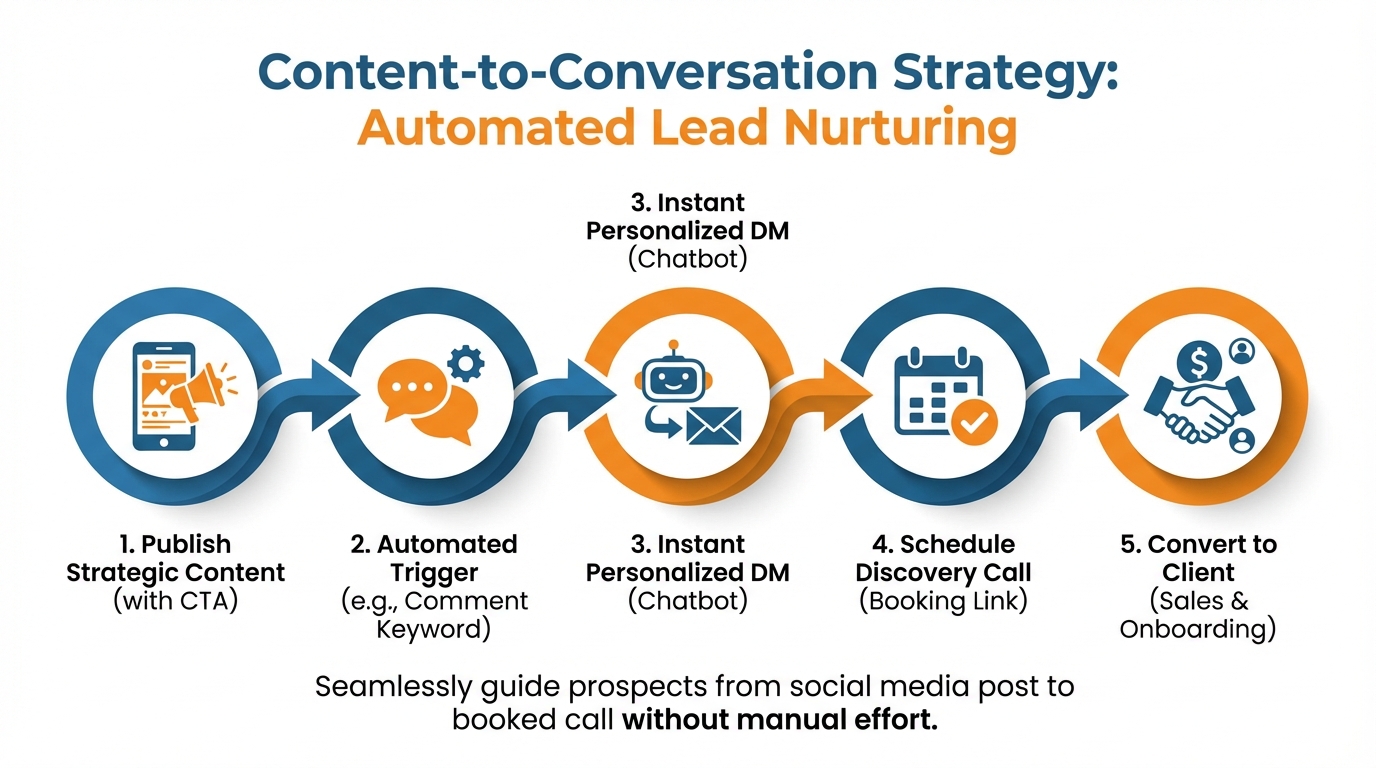
Quit thinking of it in terms of “tools” and start thinking of it as a pipeline: idea harvest → content production → distribution → lead generation → nurture → booking → follow-up.
Most coaches automate only distribution, which is why the result always looks the same but results always remain variable.
The magic is in the handoffs between the steps, where each post has one job beyond engagement: get the right person into a trackable next step such as a DM keyword, a quick application, or an email list. If you want more context on social media automation, this pairs well with social media automation.
1. It’s all about the math, not the feels.
As a small coaching practice, you don’t need to have THAT many eyes on you to fill a pipeline, especially if you set up a clear through-line: If you can get 1,000 relevant eyes on your content, and that can generate 10 profile views, and 3 DMs, and 1 of those people hops on a call, and 30% of those calls are conversions… you’re only a few good posts away from paid clients each month.
The way you get there is to create content that has a clear call to action, and a clear promise.
The call to action should move people to a point where you can filter them quickly.
I filter down to the bare minimum so you’re not spending time volleying back and forth with non-starters. And here’s what you automate versus what you keep human.
You automate the logistics: recording the ideas as they come up, converting one idea into three platform-specific drafts, and keeping your brand voice consistent so you don’t have to repeat the same descriptions week in and week out.
You keep the judgment and nuance human: your perspective, your boundaries, and the decision of what to publish and who to personally respond to.
Like, I’ll automate the process of converting a client pattern into three draft posts with different leads, but I’ll personally decide which one fits my audience’s needs that week.
I’ll personally send the first human connection message when someone expresses interest.
Ensure each stage lays the ground for the next.
Your distribution should lead to a trackable lead collection, your nurture should address the biggest questions before the conversation, and your follow-up should resurface the right evidence at the right time so that leads don’t get lost.
This is where a brand voice platform like WoopSocial quietly assists. It can produce a month of social post drafts in no time, and ensure the visual aesthetic and voice stay the same across networks, so you can focus on linking posts to results rather than pouring time into formatting.
When you link the pipeline, you stop following a metric for its own sake, and start creating a process whereby content leads to conversations which lead to conversions. If you want to sanity-check measurement, you can also reference vanity metrics, and cross-check broader benchmarks like the 2025 social media marketing report from 1,100+ global marketers in this data-backed HubSpot report (including that 50% of marketers use an automated response tool for customer service requests on social media).
Choose your automation method according to your coaching business model
For coaches, automation that doesn’t reduce your social media presence to static needs to match your sales. Your offer type, price, and the length of your sales process dictates the purpose of your content and what should come next.
A good benchmark to go from is: the more expensive and the more trust that is needed, the more your content needs to create conviction and filter before connecting with you; the less expensive and the quicker the sales decision, the more your content needs to create repetition and momentum.
I determine what should be automated by connecting three dots: your content messaging, the frequency of your posting, and your client journey, ensuring that each automated step serves your bottom line. If you want a practical system for keeping this consistent, see a weekly social media system.
If you're selling 1:1, high ticket
Automate the stuff that establishes your authority at scale, not the stuff that creates the illusion of proximity.
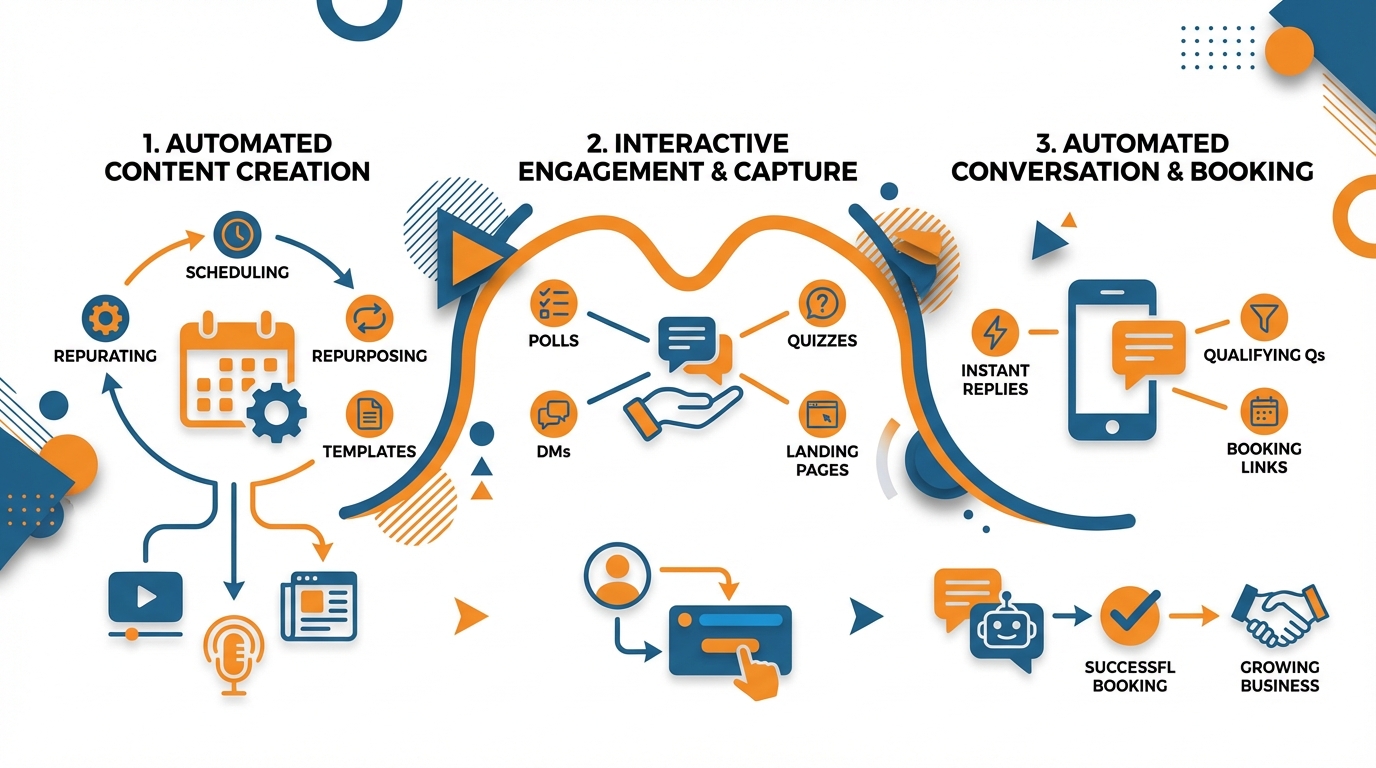
So you're looking for content ideas that come across as 'proof' of your ability to make decisions for your clients:
- Red flags you notice in your clients
- Mindset shifts you've seen in your clients
- Formulae or frameworks for why your methodology works
And you want to keep the frequency of posting somewhat controlled, because too much is diminishing returns; I've worked with some smaller coaching practices where their content is so much more effective when they publish less often, because focus is more impactful than frequency in a high ticket setting.
You're going to funnel all that to an application or a scheduling link, and you're going to automate wherever you can maintain your tone, and repurpose one idea into a few different posts, but you're probably not automating past that point, because you're likely still taking that first call.
When you have a group program
Automation should help you create urgency and social proof without being too pushy.
Your content should be centered around results, common pushbacks and what to expect in a community, which really means who is in the community, what do we do each week and how is the journey better with a group.
Frequency matters more here because people need time to catch the window so really, the number of days you have to go before a lead is likely to take some sort of action for the first time ranges from 7 to 14 so you should have a system that gives you multiple examples of the same messaging.
For this, use DMs to sell if you need a short sale but need to move through some pushbacks first and an application if you need to sell but you need to protect the community and keep refund rates low. If you want an outside benchmark for how widely AI and automation are being integrated, 900+ marketers were surveyed in this industry benchmark on social media marketing in 2025, where 60.4% reported integrating AI-driven personalization and automation into their social media strategies.
Offering a membership or lower-ticket service?
Maximize automation for consistency and retention.
Themes will be more about quick wins, identity, and community rituals since folks buy when they can see themselves using it every week, not when they know everything about it.
Cadence should be regular and predictable.
Frequency is the compound interest in a longer game.
The metric small businesses often miss is that engagement usually goes up when you post on a regular basis because the algorithm figures out who to serve you to and your audience figures out when to look for you.
Funnel conversions through a fast DM flow or simple link.
Use a tool like WoopSocial to create a month of on-brand drafts in a hurry so you can spend your human time on the welcome experiences and the few high-leverage comments that keep members on the plan. If you want a tighter process, this also fits with a social media content calendar.
Transform the coaching work you actually do into regular content - without sounding generic.
Want the simplest way to automate your social media as a coach without looking untrustworthy?
Instead of generating content, learn how to extract it.
Because your biggest untapped resources are: The recurring client questions The objections right before signing The mini-insights mid-call The voice note message you leave when the client is stuck The ideas you share at your workshop
So why not create a weekly recording routine: right after every session you share for five minutes one scenario with three copy-and-paste evergreen fields: What was the problem in the client’s words What was the choice you guided them toward What was the outcome or behavior change that occurred
Right there.
After ten calls you have ten social posts of value that’s proven to be relevant to your audience’s real pain - not a content trend.
To maintain consistency without losing the personal touch, you need a transformation pipeline that keeps the details.
You take one moment in the rough, and produce three platform-specific versions of it: as a short story that illustrates the pivot, as a lesson that calls out the micro-pattern, and as a boundary post that screens out incompatible clients.
I have a simple trick to prevent the output from becoming too gauzy: each version must contain one specific detail, one choice point, and one constraint (e.g., something that I would not recommend in that situation).
The constraint is the locus of authority, and also the point at which canned AI writing falls apart.
When I look at the data from most coaching accounts I work with, posts that include a constraint or tradeoff seem to generate significantly stronger intent signals, more saves, longer comments, and more qualified DMs, because they don’t feel like generic summaries. For a wider research angle on GenAI in coaching, this study surveying 205 coaching professionals reports its survey sample size explicitly.
Drift is a thing.
It happens when you’re giving your AI subjects instead of giving it facts.
You avoid it by drafting in your own voice.
Pasting in 3-5 sentences you’ve actually said on a call, then forcing the draft to preserve your cadence by locking in musts like sentence length, pet phrases and directness.
Then there’s an authenticity test before publication: if you take your name off it and it could have been written by any other coach in your niche, it’s a fail.
I always keep one deliberate imperfection in most posts, such as a direct sentence, a specific example or a mildly controversial view, because those are the markers that get you trusted.
That’s what makes you look consistent vs. recognizable.
I do believe there’s a way to use your clients’ stories, safely, and in a way that won’t cost you your integrity.
You can share principles, rather than a story that reads like a diary entry.
And you can approach consent as something ongoing rather than a box you tick once.
You can play safe with respect to what you share, making sure that details are anonymised and aggregated, that you never use time and date stamps, that you don’t ever talk about health, or money, or relationships in a way that could be traced back to someone in a small community.
You can talk about the kinds of results that you help your clients achieve, but do so in a way that foregrounds the method, the shift in attitude and approach, and that downplays the drama of the result.
You can talk about the results that your clients achieve, in a way that feels good to them, and that they would be proud of, if they were to read it.
And if you need to move fast, without sacrificing tone of voice, then there are tools like WoopSocial that can help you to create content based on the moments that you capture, but ultimately, it’s your curation, and your ethics that ensure it works.
Distribute, partner, and repurpose within the platform (this is the part that most coaches skip)
You’ve likely been taught how to automate your social media as a coach to hit that publish button.
Great.
Now let’s get strategic.
If you really want to automate social media, create content that multiplies.
Every time you publish something, you want that to earn you a second, and a third impression of your content, without you needing to show up.
And you do that by including things the platform will reward, not things that look pretty in your content calendar.
In most coach accounts that I review, the posts that get saved and shared (not just liked) are the posts that get resurfaced 24-72 hours later.
THAT is where your reach really piles up.
So you need to write for 2 primary actions, that will give you resurfacing later: Save (give it framework, or a decision rule to make it reference worthy), and Share (give it a strong point of view, so it’s identity worthy, that people will want their name attached to).
What if you could make distribution more reliable, and take it out of the one-and-done mindset?
For example, you can create a partner flywheel: 10-20 nearby but non-competing operators that already reach your target audience, and cycle through collaborations where everyone wins.
If you give them something easy to share, something where they can just add their logo and publish it (like a co-branded micro-framework, a micro-insight they can quickly respond to, or a client-safe pattern you both observe), I’ve found you can scale this with a partner rolodex and tracking of who is actually reaching, since in practice most of your secondary engagement is typically driven by a small few; for example, one time I ran a campaign where partner deal-making beat a simple “share with list” approach by an order of magnitude because the group of handpicked regular collaborators shared much faster and much more enthusiastically.
This is the key to in-platform repurposing: automation can amplify or destroy your content.
The principle is translate, don’t replicate: the essential insight should remain the same but it needs to be translated into the native language of each platform.
LinkedIn, you start with the business impact and the outline, because the reader skims deeply and is incentivized for clarity.
Instagram, you start with the problem and the swipe through, because saves are incentivized.
Shorts, you start with the controversial assertion and the proof, because watch time is incentivized.
When I repurpose a single insight, the content remains the same but the framing shifts: I do a list, a conditional story, a debunker, and I also include a caveat to keep it believable.
And then, for consistency, you create a distribution spec for each concept ahead of time that outlines the one-liner, the save-worthy takeaway, the share-worthy line, and the proof element that makes it feel earned - so you can then automagically generate platform-specific copy without sacrificing the nuance because you’re giving the platform choices, not impressions.
(We’re just starting to work with WoopSocial on this, but they enable you to keep your voice and branding right as they auto-generate a number of on-platform copy options that all pivot off the same idea, so you can focus on the most valuable decisions - which partner to pair it with, which proof to pick, and which version to go out with that will get pushed by each platform.) For broader numbers on automation adoption, this HubSpot marketing statistics page for 2026 cites that 47% of marketers report leveraging automation to make marketing processes more efficient, and 93% use automation for administrative tasks like scheduling, note-taking, and documentation.
How to automate realistically without compromising your tone
If you want to automate your social media as a coach but avoid sounding like a robot, you must automate the things that don’t matter and never automate the things that do.
You automate the recording, technical support, ensuring your branding stays congruent and scheduling, but you don’t automate the message, uniqueness or connection with your audience.
If there’s a faster way to spot that you’ve automated your content too far, it’s this: could this post be re-published by any other coach in your industry by simply changing their name at the top?
If so, you’re automating the exact thing your clients come to you for.
The real process that you actually have time for in a small business week is: gathering the ingredients throughout the week, and then batching creation, styling, and distribution together in one monthly session.
Most coaches burn time by scattering the process across too many tabs, prompts, and half-finished drafts, which creates decision fatigue and brand drift.
When you consolidate, you can often batch a month of content in one sitting, because you are reusing the same proven inputs, the same offer path, and the same distribution spec instead of reinventing your voice every time you post.
When you scale your writing, use analytics to maintain your tone: pay attention to intent signals over vanity metrics.
In practice, I’ve found a cluster of actions such as saves, long comments, and keyword-esque DMs tend to indicate people are trying to use your ideas rather than just read them.
One rough heuristic is that if you raise consistency and lower friction, you’ll see engagement rise materially over a few weeks as the platform learns who to serve you to and your audience learns when to anticipate you; the win is that your new consistency is achieved with fewer creation hours not more work.
If you need a tool to assist you in the consolidation process, WoopSocial’s interface is designed to help a coach do this very thing: rapidly create pre-drafted content posts, edit the text and image to match your tone, and post to the primary networks from one interface. If you want to go deeper on reducing inconsistency, see inconsistent social media posting.
It’s not about having someone else speak your voice; it’s about automating away the formatting, editing, and branding to help you focus on coaching, selling, and calling people to close deals.
Related reads
6/14/2026
YouTube API Alternatives in 2026: start developing right away
Skip the YouTube quota system caps and API calls. Compare the best YouTube API alternatives with code examples, pricing and understand recent changes.
6/12/2026
Best Facebook API Alternatives for Developers in 2026 for direct access
The Facebook Graph API review can take weeks. Compare the best Facebook alternatives for posting, scheduling and more.
6/12/2026
Best LinkedIn API Alternatives in 2026 - instant access for developers
See a list of all the LinkedIn API alternatives for all types of use cases so you can skip the waiting time and get right on automating your work on LinkedIn.