Relevant Social Media Content: A Framework for Small Businesses
Relevant Social Media Content: A Framework for Small Businesses Much of the guidance out there on how to come up with relevant social media content...
Relevant Social Media Content: A Framework for Small Businesses
Much of the guidance out there on how to come up with relevant social media content is leading you down the wrong path: new trends, new hooks, new prompts. But relevant and new aren’t the same thing. New can be fun for a day. Relevant is what gets the right people in front of your brand every day and converts that attention into leads, customers, and loyal patrons. As Gallup’s research on browsing vs posting behavior shows, “people are more inclined to browse than post”-for example, 49% of Facebook account holders say they post content at least occasionally-so relevance has to work even when most of your audience is passively consuming.
Here is the definition that I use because it keeps small businesses focused and profitable. A topic is relevant only when it hits three anchors at the same time:
-
Demande du public
They’re already asking for it, looking for it, or debating it. You’re not creating demand, you’re catching it. -
Business alignment
This, of course, relates back to what you sell, how you sell it and what you want to be known for. If it can’t lead to a next step with your business, it’s content debt. -
Platform behavior
The context aligns with how the platform delivers and how the audience is using the platform. Just because something performs well on LinkedIn doesn’t mean it will work on TikTok and just because it does well on Instagram doesn’t mean it will work on YouTube Shorts, even if it’s the same content. Pew Research also highlights how platform context shapes consumption: among U.S. adults who regularly get news on TikTok, 84% say they get news from other people they don’t know personally, which reinforces why how people get news on TikTok, X, Facebook and Instagram matters for “Platform behavior.”
For the rest of this guide, I’m going to walk you through a framework that you can use to create relevant social media topics that aren’t dictated by chance. This framework will teach you how to identify social media demand signals in the wild, how to use a simple score to qualify ideas, how to adapt topics to each social media platform’s native format so that it feels natural to your followers, and how to create a closed feedback loop so that you don’t need to play whack-a-mole with trending topics. If you want related help building repeatable workflows, see this guide on social media content systems.
1. Begin with a working idea of what “relevant” means (or else you’ll pursue trends you can never catch)
If you’re interested in using these principles to generate social media content that is relevant, you need to get even more particular about who it is supposed to be relevant to.
When you define your ICP, break it down into segments: business model and industry first, then target function, then maturity.
The solo owner of a small business has different needs and interests than a marketing employee in a mid-sized organization, even if both offer the same product or service.
Then add one last filter that many people don’t consider: daily life.
What does my audience do during their workday, what are they accountable for, what are they dealing with this month and this quarter, and what are they desperate to avoid?
If you can generate topics that your ICP relates to in that context, you will no longer be competing against generic social media creators, but dominating a niche that your buyers already value.
Second, attach everything to a business result by labeling it as awareness, consideration, or decision prior to creating it.
- Awareness gets attention by labeling the problem in your audience’s words.
- Consideration gets trust by laying out different approaches, highlighting trade-offs, and overcoming typical concerns.
- Decision gets revenue by showing proof, process, pricing logic, and what happens after yes.
A simple data point you can use as a guardrail: only about 3 to 5 percent of most small-business funnels is truly ready to buy at any given time, with the rest being earlier-stage, so you need a mix.
The mistake is producing 100 percent awareness content because it’s fun and gets likes, and then wondering why nothing is converting.
You solve that by making sure each week has at least one thing that nudges a curious person toward evaluation, and one that helps an almost-buyer feel safe in making that decision.
After that, add differentiation so that your relevance is not just popular, but defensible.
What can you say that others in your niche won’t say because it is too specific, too experienced, or too contrarian?
I like to stress test this by looking at the top articles in my niche and writing the opposite that is still true, then backing it up with evidence of what I’ve seen work across markets, offers, and channels.
That evidence could be results, but it could also be before-and-after processes, or even the specific constraints you work under, such as budget, time, or team size.
If you can’t show evidence, your content becomes a remix.
If you can, your content becomes a point of view that people remember and repeat.
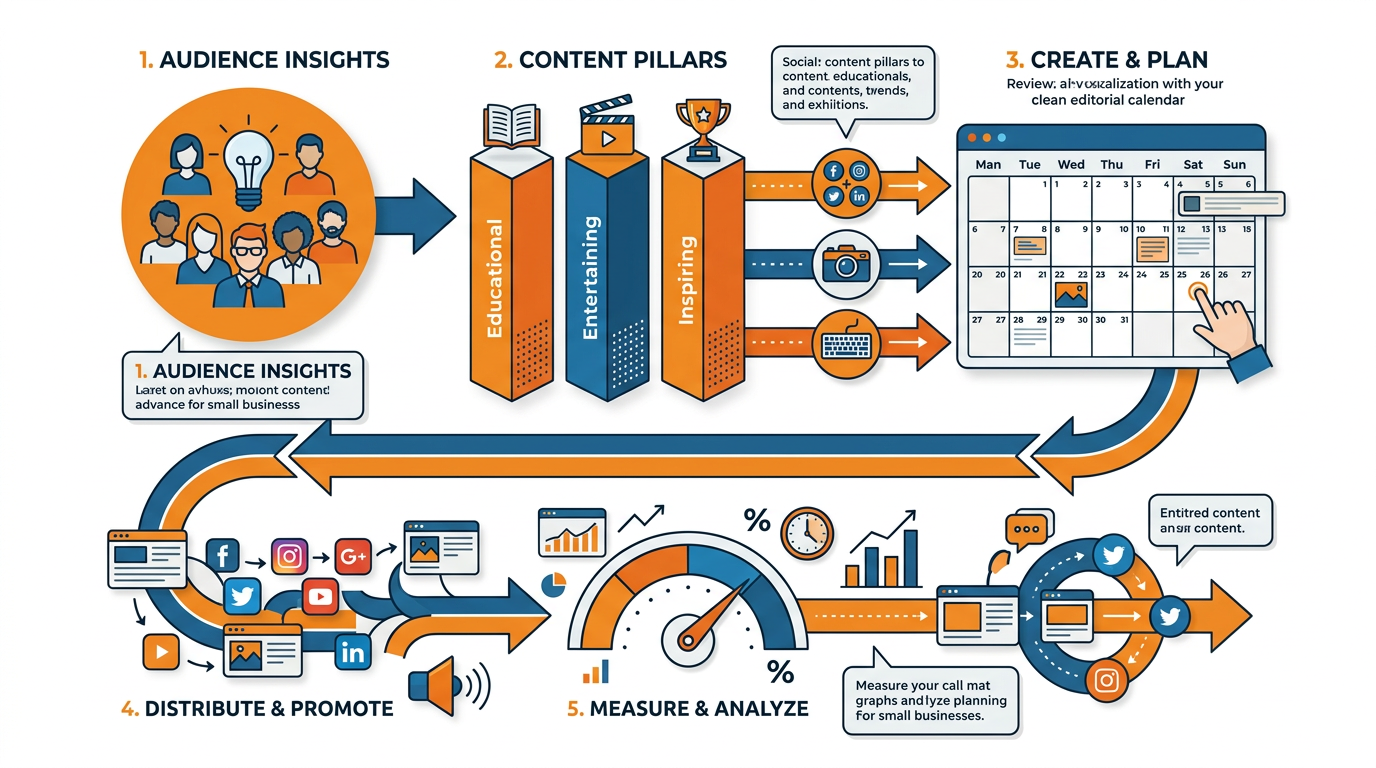
Last but not least, pin down relevance with 3-5 content pillars and a clear line in the sand.
Pillars should be specific enough that people can define you in a sentence, but broad enough that you can create content on them for at least 3 months.
So for me, I might choose customer acquisition for local businesses, conversion-focused content, and platform-specific distribution behaviors as my pillars, then find countless sub-angles within them.
It’s equally important to define what’s out of bounds, even if it’s trending.
Because every post you create that’s not relevant to your niche is training both the algorithm and your followers to perceive you as a generalist.
If you want to shortcut the process of moving fast while staying focused, you can input your pillars, ICP segments, and funnel stages into WoopSocial, which will use them to generate 30 days of brand-compliant topic ideas in 5 minutes flat. You can also pair that workflow with a social media content calendar to keep your publishing consistent.
But in either case, the key to the shortcut is the rigor you established here.
Your pillars define what you are and aren’t willing to talk about, which keeps every idea you come up with profitable.
The demand engine: where my best topic ideas really originate
If you want to learn how to create relevant social media content, quit thinking of it as content creation and think of it as demand harvesting.
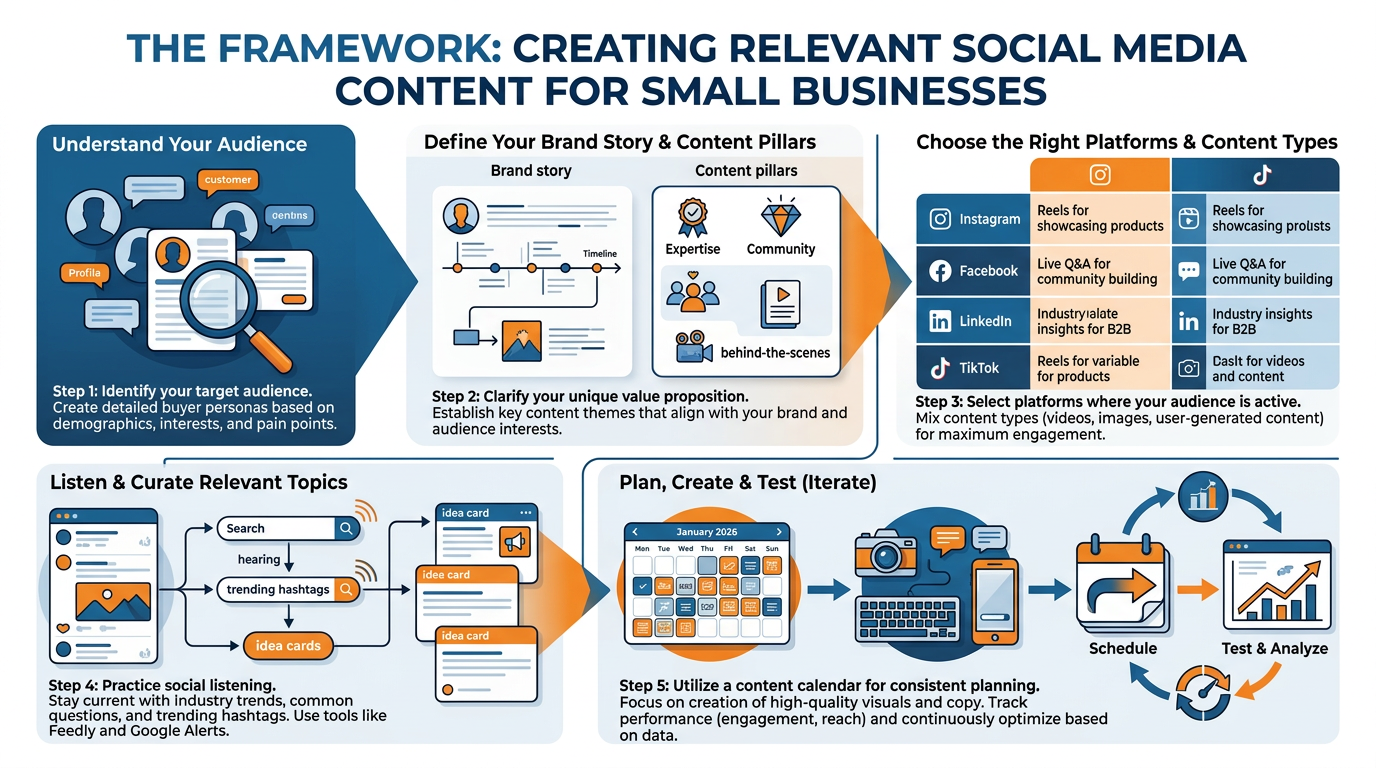
The most accurate signals you have are 1st party, because they come from people who are already in your orbit: customer calls, sales objections, support requests, onboarding questions, and reasons for churning.
Add in 3rd party as well, because it is pure intent: DMs, comments, and especially the things that people echo back to you, misquote, or disagree with.
If you have heard the same objection 3 times in a week, that is not noise, it is a topic with inherent demand.
If you have onsite analytics, use it like a polygraph: your onsite search keywords and most-viewed pages reveal what visitors were looking for next, which is exactly what your next pieces of content should cover.
Second, dig into the platform’s native discovery cues, as intent is platform-dependent.
On search-based platforms, you can start with searches that are already happening: autocomplete, People also ask, and related searches will deliver demand in the language of the user.
On TikTok, Instagram, YouTube, and Shorts, examine how the platform stimulates curiosity: query suggestions, hashtag ecosystems, and creator Q&As show you what’s expected to be found there, not what you hope people want.
Trending tools can be useful, but only if you use them as leading indicators: you are not chasing what’s trending, you are identifying what’s trending within your category so that you can get in early with a relevant angle. EMARKETER’s reporting (citing Nov 2024 M Booth research) notes that 25% want to see brands using popular phrases, expressions, and slang, which is a reminder that “brands participating in social media trends” is only valuable when it stays inside your category.
Next, model the influence ecosystem so you can align your content to the topics your market is already looking at.
Identify the authors, suppliers, and micro-influencers your clients are already listening to even if they are small.
Look for the stories that repeat, the arguments that appear again and again, and the questions that never seem to get answered.
This is where small businesses can gain ground fast; you don’t need more quantity, you just need to keep showing up where the conversation is, and be the person who delivers the answer.
When I do this right, I nearly always discover that most of the competition are offering advice, whereas the real opportunity is in talking about the trade-offs, the myths, and the fear that goes into making the decision.
Sure, you can use AI, but only to transform the source material, not act as the source itself.
Give it the raw data, call notes, screenshot of comments, snippet from a ticket, and ask it to classify themes, pull out recurring statements, uncover a common anxiety, organize the desired end results in the exact words that your target uses.
This results in an actionable topic queue, but we are not lost to generic guidance.
And if you have your ICP, Pillars, and funnel stages down, you can input those into WoopSocial and generate on-brand topic ideas even faster, still rooted in the signals. If you want a broader workflow view, this ties closely to automate social media strategy.
Strategic prioritization: a quick way to score your topics and focus on the most impactful ones.
So, once you’ve got a continuous flow of ideas, the other half of how to generate relevant social media topics is actually deciding which one should be the next topic.
I use a simple scoring framework, not a detailed spreadsheet.
It’s speed and predictability over absolute optimization for small businesses like us.
So, for any topic you might have, I’ll give it a 1 to 5 for 5 criteria, which is demand strength, problem proximity, business value, uniqueness, and effort vs payoff.
Demand strength is essentially does this seem like it comes up a lot in multiple places?
Like, you heard this on two customer calls, you saw this on three comments, you saw it in related searches.
Problem proximity is, how much of a pain point is this?
Is it a real pain point that has real implications, or is it just an interesting trend?
Business value is does it relate to what I sell?
Is it possible for someone to go from this topic to what I sell without feeling baited and switched?
Uniqueness is usually the one that kills most topics.
Is there any way I can make this unique?
Can I add proof?
Can I add some mini-framework?
Can I add some numbers?
Can I add some sort of contrarian tradeoff?
Can I add some sort of before-after?
And then effort vs payoff is what keeps you shipping consistently.
If something takes me 4 hours to explain one time, that’s probably a worse topic than something I can ship every week with one example.
For this scoring system to effectively generate revenue, you’ll also need to intentionally balance the funnel.
Awareness topics bring in the right people with problem-cost titles, but still filter out the wrong ones.
Consideration topics carry the weight with approach-tradeoff-objection pieces, which is where SMBs can thrive since you can be precise about budget, time, and team constraints.
Decision topics convert attention into action with your process/results/after-the-yes/why-not-them pieces.
If you need a rough rule to match the majority of industries, target about 60 awareness, 30 consideration, 10 decision, and then tweak to your sales pipeline.
I’ve found that this balance decreases “wasted” content since you’ll have at least one trust builder and one proof closer each week. This fits how modern buyers behave: HubSpot’s 2024 findings show 59% of consumers prefer to gather information themselves rather than speak to a human when researching a brand or product, which supports building a pipeline of self-serve research content across awareness through decision.
Here’s how you action this with a topic backlog workflow so you’re never starting from scratch:
Collect ideas daily in one location, but collect them as demand evidence, not perfected titles: the exact sentence the customer said, the objection you heard, the comparison they made, the keyword you keep seeing.
Then review weekly on a set schedule and score only topics that cleared the pillar and ICP filters, because scoring random ideas is how you get busy, but not relevant.
Select the top few by overall score, then choose at least one topic from each funnel stage so your feed doesn’t slip into awareness mode.
If you use WoopSocial to generate ideas fast, treat those outputs like candidates in the backlog and run the same scoring lens so the final queue remains aligned with demand, differentiation, and what your business actually sells.
To avoid sounding like a broken record without making sure you’re getting your most important points across, differentiate between a topic and a point of view.
You can come back to the same topic every few weeks or months as long as you look at it from a different perspective.
One week you might talk about the myth, the next week you might discuss the tradeoff, the next week you might offer a mini case study, the next week you might provide a checklist for evaluation.
I do this by assigning a single benefit and a single example to each idea before writing, because repetition without evidence is static, but repetition from a fresh perspective is how you establish authority.
Eventually, your topics list will form an atlas of what’s important to your market and your scoring system ensures that you’re publishing the most valuable information first, not just the trendiest.
Take one subject and flip it into multiple platform-specific ideas (and post them regularly)
Want to learn how to come up with relevant social media topics without going to brainstorm hell? Create a basic engine: topic -> angles -> formats.
Choose one topic that your audience already gives a damn about, and then you need to come up with 8 angles for that topic: myth, mistake, checklist, teardown, story, comparison, counterpoint, and case insight.
So if your topic is “why your bakery isn’t getting repeat customers”, your myth angle is “people only care about price”, your mistake angle is “posting pretty photos with no ordering path”, your checklist angle is “the 7 day follow up flow”, and your teardown angle is “how to review a menu board like a conversion page.”
Same topic, different entry point.
This keeps you consistent without being repetitive.
Then you translate the angles into formats based on what each platform consumes.
LinkedIn values clarity and organization, so you take your list and turn it into a mini-post with a solid hook, three paragraphs and one decisive takeaway.
TikTok values brevity and surprise, so you take that list and turn it into a rapid-fire clip with a graphic for each point and a single example on the screen.
Instagram is half about quick tips and half about expression, so you turn the myth into a carousel of slides that people can save, and you turn the anecdote into a Reel with a before and after reveal.
You are not generating more content, you are formatting the same content to match how people consume it, and this is where most small businesses avoid wasting time. This also maps to purchasing behavior: PwC reports 46% of consumers directly buying products through social media (up from 21% in 2019), so the formatting of your content can directly affect conversion paths when people “buy products through social media.”
To stack relevance, nail down the angles to series that can be repeated so people know what to expect.
Choose a few weekly theme staples, and repeat the format until it’s familiar.
Could be Mistake Monday, Teardown Wednesday and Checklist Friday, say, with the same name and same rhythm every week, so your readers know what they are getting and you don’t have to recreate the idea wheel.
This isn’t just a consistency trick, it’s a retention trick: a familiar format lowers the cognitive overhead for the reader and massively decreases your planning time because you’re only deciding on the topic, not the entire format from scratch.
Last but not least, validate regularly to keep your engine on track rather than just floating: use polls and single-question surveys to pin down what your audience wants to learn next, treat your comments as research notes, and turn any push-back into your next post outline.
When an idea does work, adhere to a simple doubling down rule: top up with 3 to 5 more related angles in the next 14 days before it drops out of relevance.
I practice this all the time, because it gets you one hit post that leads to a mini-series rather than one hit wonder.
And once you have your pillars, backlog and angle bank defined, WoopSocial can help you instantly transform that strategy into a month of on-brand post ideas and auto-branded visuals, so you can keep distribution ticking over without making content your full-time gig.
A reliable topic pipeline always trumps inspiration
Want to learn how to create relevant social media content?
Well, you need to stop waiting for inspiration and start listening for signals.
Relevance is not a feeling, it’s a math problem: demand signals + business alignment + platform-native packaging.
And when you’ve got a system for harvesting what’s already in demand, marrying it to what you offer, and delivering it in a way the algorithm actually favors… well, you’re no longer leaving it up to chance.
You’re stacking the deck.
So here's everything in one sentence you can repeat each week: find relevance, gather signals, score brutally, turn topics into angles, and use feedback to guide the next round.
I've seen small businesses spend months producing clever content that never relates to a purchasing decision while the bland-looking posts that address one real objection with one real example continue to generate leads.
The key difference is not creativity but curation and formatting. If you want to go deeper on consistency, this connects directly to inconsistent social media posting.
The next move is quick and easy.
Choose a single content pillar and gather 20 legitimate questions and objections verbatim from your customers, (e.g. DMs, calls, comments, questions at the counter, or wherever a lead may get hung up) and rank them with the same rubric, then release the top 6 to 10 as a condensed 2 week content series that covers the entire awareness through consideration through decision journey instead of optimizing just for impressions.
You’ll notice as you go that each piece of content practically writes itself as the natural follow up to the last.
Then you can iterate like a scientist, not an artist: amplify the posts that are getting saves, responses, and quality questions, and cull the ones that only get empty likes.
If you want to move even quicker without sacrificing the integrity, you can use WoopSocial to pour your pillar and audience questions into a generator that will spit back 30 days of on-brand content candidates in a few minutes.
You can then apply your scoring criteria so only the best, most relevant ideas get through.
That’s how you convert social media from a treadmill into a flywheel.
Related reads
4/27/2026
B2B SaaS social media benchmarks: Set the right targets.
B2B SaaS social media benchmarks: Set the right targets. The trouble with defining B2B SaaS social media benchmarks is that it's an inherently impe...
4/25/2026
Building a personal brand as a technical founder (without becoming a creator)
Building a personal brand as a technical founder (without becoming a creator) Creating a personal brand as a tech founder should feel less about ma...
4/20/2026
Creative Post Ideas for Sustainable Brands (That Don’t Sound Greenwashy)
Creative Post Ideas for Sustainable Brands (That Don’t Sound Greenwashy) That’s not what creative post ideas for sustainable brands should look lik...