Automate Social Media: OS-Level Strategy for Entrepreneurs
Learn to build an automated social media system that's predictable, on-brand, and revenue-generating. This guide helps entrepreneurs automate strategy, not just execution, to generate more leads and sales with less time.
The entrepreneur isn’t posting anything because you have an OS-level problem.
When we talk about automate social media strategy for entrepreneurs, we’re usually talking about automating tasks. When to post. How to repurpose content. How to generate a report. Helpful, but it does not solve the real issue: building a system that makes social predictable, on-brand, and tied to revenue, without you living inside your phone.
When we talk about automate social media strategy for entrepreneurs, we’re usually talking about automating tasks. When to post. How to repurpose content. How to generate a report. These are all useful things, but they don’t solve the big problem: creating a social media process that is consistent, on-brand, revenue-generating, and doesn’t require you to live on your phone.
What you really need is a low maintenance weekly process: choose channels that make sense for your business model, create content that aligns with your offer, post in a way that you can replicate, and convert eyeballs to leads that you can then follow up with. Tools should enable that process for you, not do the talking for you or your business.
In this article, I’m going to walk you through how I automate strategy, not just execution. You’re going to learn:
- How to select channels where buyers are already listening
- How to develop a content flywheel that compounds
- How automation can make you faster without sounding inhuman
- What you should keep human to continuously build trust
The objective is simple: Less time spent on social. More leads and sales generated from it.
Start by defining a strategy: what channels, what results, and what content engine you want for your offer.
Select one business metric your social media presence will deliver over the next 90 days, and hold all actions accountable to it.
Select something tangible (e.g., scheduled calls, product purchases, email list additions, community members, etc.) and outline what the target is, as well as how you will be able to track it. If you want a deeper measurement lens, see prove social media ROI to investors.
Reach and likes are diagnostic metrics, not business outcomes, and I find they are very often decoupled from business outcomes for small businesses; you can increase engagement by 100% but still have a completely empty calendar if none of the content has converted to a next step.
The rule of thumb should be this: each week, you should have a few activities that directly resulted from social media, not just eyeballs.
Second, commit to a minimum-viable platform stack so that your automated social media strategy for entrepreneurs doesn’t become too heavy to carry.
Select one primary platform where your customers are already consuming content, and where you can deliver legitimate authority, and then pick a secondary platform that is largely a repurpose.
This could be going all in on LinkedIn for B2B, and then repurposing that content into mini clips for Instagram or YouTube Shorts, or using TikTok as your primary prospecting vehicle and then repurposing winning content into LinkedIn posts for authority. If you want a platform-specific lens, LinkedIn algorithm 2026 pairs well with this approach.
If you cannot maintain a platform for 12 weeks without burning out, that isn’t a platform problem, that is a strategy problem.
Next, structure your offer into 3-5 content pillars that relate to the intent of buyers (so you’re not just posting whatever random thing comes to mind, and as a result getting random results).
You likely want a blend of:
- problem-aware content (which names the problem)
- solution-aware content (which helps people understand how to solve the problem)
- proof (which demonstrates that your solution works)
- inside-the-kitchen (which shows people what the cooking looks like)
- objection-removing content (which clears the decks of objections before the customer ever speaks with you)
I personally test each content pillar idea for my offers against a single criterion: Could someone read or watch this, and be able to logically go to the next step of buying the offer without having to be convinced by some sales-y communication?
If the answer is yes, that’s how your content stops feeling like a weekly tax on your creativity, and starts being an exponential engine that drives results.
Lastly, determine your hero format and establish guardrails that enable automation to amplify your voice, not dilute it.
Your hero format is the one that you can create the quickest with the highest quality (e.g., a 3-2-1 format text post, 60-second talking-head video, or simple 5-slide carousel) that everything else is derived from to decrease production time and increase consistency. For a broader system around this, weekly social media system for is a useful companion.
Then, establish brand guardrails that are clear enough to preserve positioning (e.g., what you stand for, what you stand against, who you are for, who you are not for, a few key phrases you always say, clichés you never say, and POV you will never sacrifice).
When you develop those inputs first, platforms like WoopSocial can produce on-brand, high volume content (text and visuals) that won’t slip into generic/off-brand content. This aligns with the broader reality that an AP-referenced survey found 98% of small businesses surveyed reported using AI-enabled tools, with 40% using generative AI, and 91% of AI users believing AI will drive future growth, as covered in an AP report on AI-enabled tools in small businesses.
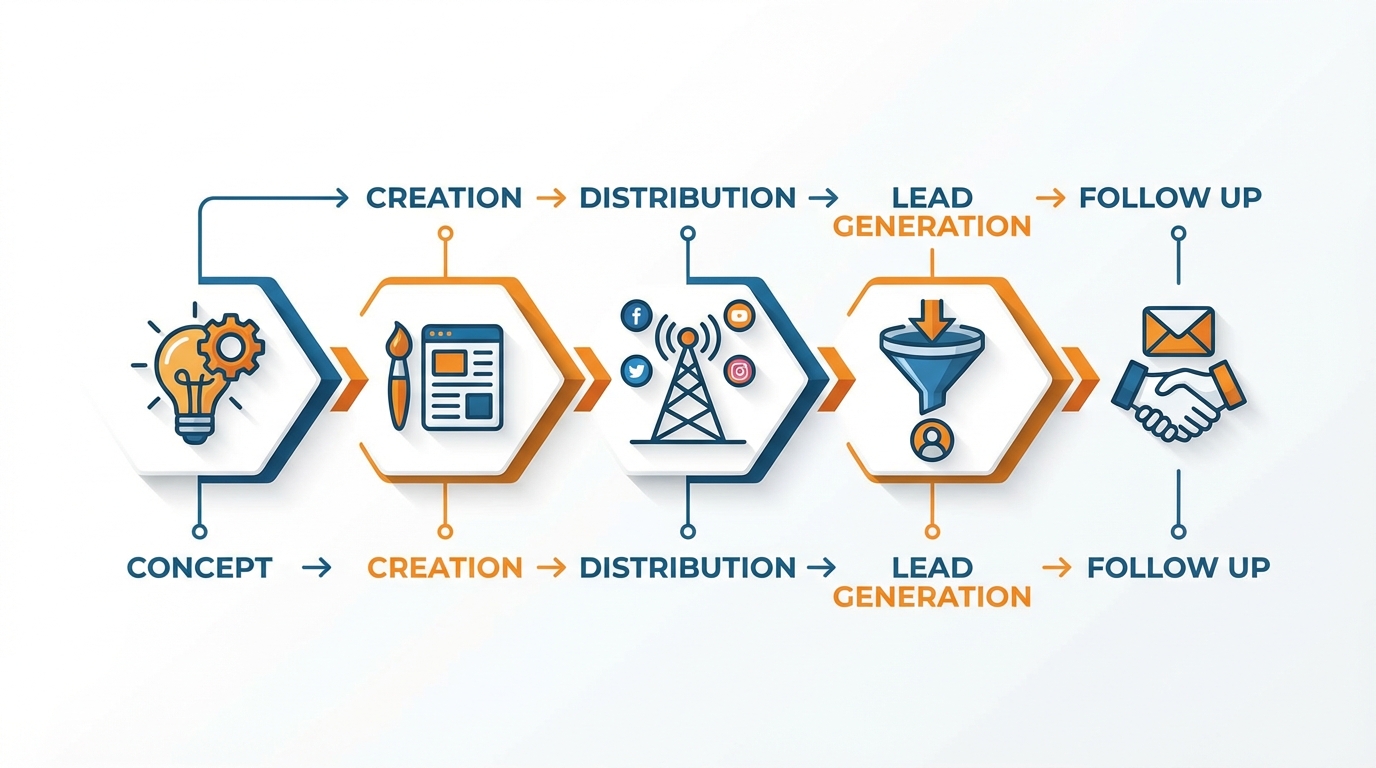
Take the whole process from: concept → creation → distribution → lead generation → follow up and automate it.
So if you want to have systems for a social media strategy for entrepreneurs that work for you, number one is you have to take this task that you're doing on a daily basis and you have to flip it to a weekly cycle.
You have to break up the creation time and the production time.
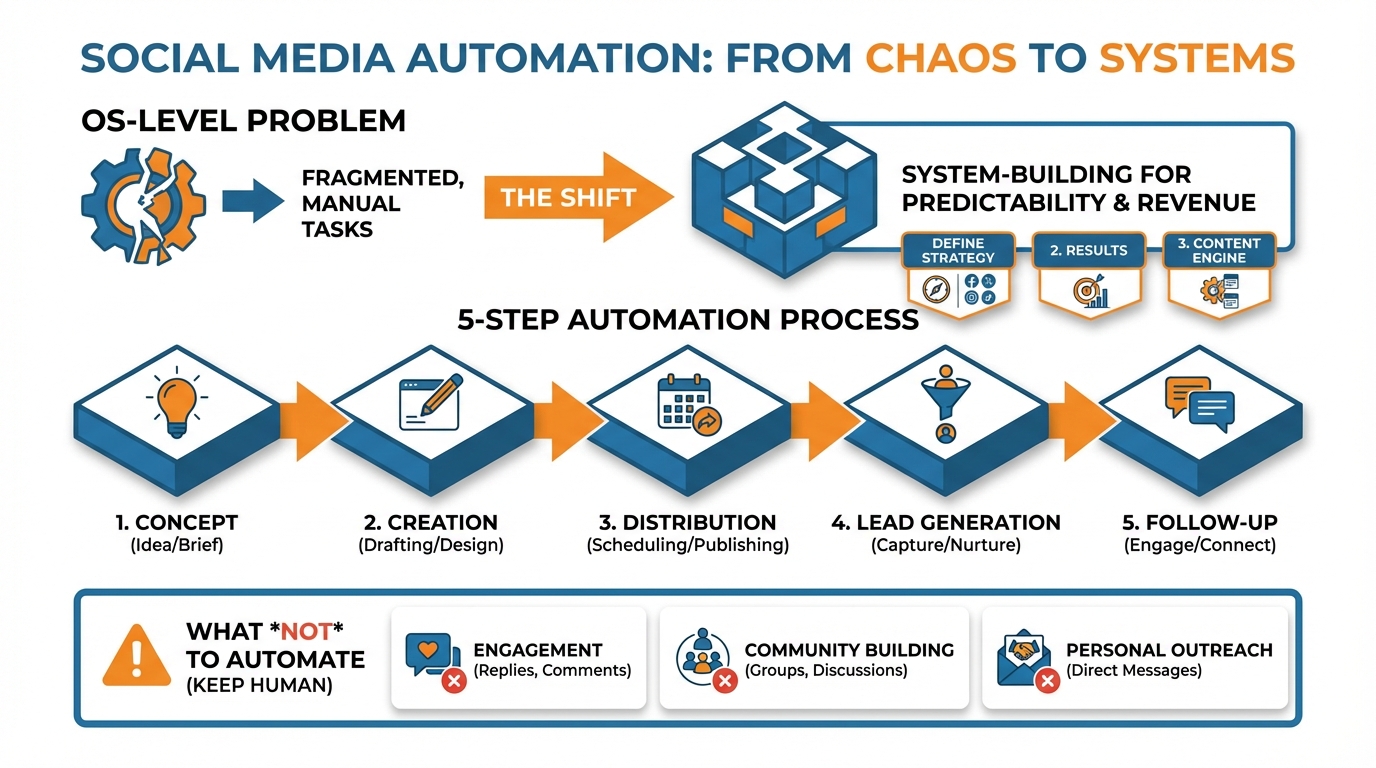
This is the one thing that will give you consistency versus not consistency.
Because when you create, you create.
When you produce, you produce.
You go into a flow state, you come up with all your ideas, you record all your talking points, you make all the little short video clips.
Then you come back and you have a production day where you go through and you edit, and you design, and you write your captions, and you schedule them, and you get them ready for the week.
This will give you the ability to create two to four pieces of content when you want to and love to.
Or you can create 12 to 20 pieces of content per week like clockwork, no matter how busy you are.
This is the one thing.
And again, I'm going to go back to it.
The reason is, is your brain cannot write and edit and design at the same time.
Second, systematize recycling, so you’re not starting from scratch each time.
You make one hero piece, then you extract elements that play well on the medium: a strongly-held belief gets turned into a text-only post, that belief gets turned into a 45-second vertically shot video with one key takeaway, the proof point gets turned into a simple visual post that leads with one statistic or a before-and-after. This approach is reinforced by a guide to content repurposing from Adobe Express, which notes 56% of small business owners who use AI to repurpose content save 1-5 hours per week.
The crucial key to unlock is to recycle by purpose, not by medium: the problem statement remains the same, but the medium changes, and you adapt the wrapper to fit the medium.
I almost never see small businesses fail at this because they have no ideas; I see them fail because they’re treating each medium like a blank page, rather than treating each medium like a new spin on a single revenue-generating point.
Second, tie each post to a lead funnel that follows how you sell. This does not have to be some fancy funnel.
Just ensure you have a single next step that you can measure - if you sell services, use a booking link, if you sell something higher consideration, use a lead magnet to capture email addresses, if you sell something where there is an advantage to talking quickly, use a DM intent capture.
The metric that most entrepreneurs are not aware of is that conversions on an organic post are usually in the 0.5-2% range for cold audiences, meaning you have to win the game on volume and consistency rather than on a single post going viral. This also matches what Gartner reports from marketing leaders: 48% say their organizations are already using generative AI somewhere in the funnel, and among those using GenAI, 52% selected drafting social media copy as a use case, as summarized in Gartner’s peer insight on generative AI in marketing.
If you are not giving people a clear next step, you can still generate reach and go to the end of the week with no conversations.
Lastly, ensure that no lead falls through by having the bare essentials integrated which funnel any sign-up or inquiries into one funnel and automatically initiates the next action.
The goal is to have a rule setup where any new lead added to your CRM or email tool is followed up with a nurture email or a follow up task in your email within minutes (not days).
And to keep your stack as simple as possible:
- 1 tool to create and brand content (for me, it’s WoopSocial which keeps my content on brand and production high).
- 1 tool to distribute on all platforms.
- And 1 destination for leads to come into and be actioned.
With this stack, social media stops being a content hamster wheel and starts being a lead gen machine.
And here’s what you shouldn’t automate: policies related to authenticity, risk, and anything that’s better handled by a human.
Want to streamline social media strategy for entrepreneurs without destroying your credibility?
First, divide the dialogue from the dark arts: dialogue that requires discretion, and the dark arts that require efficiency.
Anything that can alter income, image, or influence should be left to a human: an interesting DM that seems serious, a concerned objection that requires tact, a frustrated client that requires empathy, a collaborative opportunity that requires details.
Anything that requires efficiency can be partially automated: a first-response template that provides expectations, a question about the service desired and desired timeframe, a single link to a frequently asked question.
I have a simple philosophy: if it requires a response with emotion, diplomacy, or discernment, I personally respond to it.
If it simply requires information and instruction, a template will suffice.
The second thing you need to do is create a pause process that ensures your automation doesn’t get you into a PR disaster.
Timed content can come across as tone-deaf in the wake of an industry-wide tragedy, a product launch gone wrong, or a regional crisis, and this impacts SMBs more because we are the face of our brands.
This process should be detailed: the events that call for a pause (an industry crisis, a major news story in your target market, a social media storm, product glitches, delivery issues, the health of a team member), who can initiate a pause, and the amount of time you take to review the queue before content is posted again.
The day-to-day reality of this is that you develop a reflex of checking the news and your own social media conversations before your content posts, and double-check anything that could be construed as a celebration, offensive, or insensitive.
This is worth more in brand value than any growth hack.
Preserve your time but don’t sound like a robot: implement policies not platitudes.
You determine the frequency you can deal with your comments or DMs (e.g., twice a day) and let people know when you will respond, and what will happen.
Use a couple of escalation rules, so you don’t get stuck in a loop (e.g., if they are describing something in detail, or if they ask you for a quote that has a lot of moving pieces, or if they start to get irritated with you), then move the conversation to email or phone.
Even script the structure of the hand-off (you can vary the language):
- acknowledgement
- explanation of what happens next
- ease of continuance in the other medium
Last, keep your trust signals un-automated, because trust is the multiplier that makes consistency pay off.
People buy from proof and personality, not from perfect output, so bake in real stories, real results, and occasional imperfect human moments that remind people there is a person behind the brand.
Avoid vanity automation where you just post more without sharper positioning; volume without clarity often inflates impressions but not conversations. If you want a name for this trap, vanity metrics is the framing.
Aim automation at consistency, speed, and follow-through, then keep your credibility moments manual.
I like using something like WoopSocial to stay on-brand and consistent at scale, but I never outsource the parts that create belief: the specific story, the specific lesson, and the specific human response that turns attention into trust.
A real-world stack for founders: minimum viable stack + monthly execution done consistently
You’re trying to systematize your social media strategy as an entrepreneur, but you don’t want to build a house of cards that you’re going to ignore the minute things get crazy.
The only cadence I’ve ever seen truly hold up in actual entrepreneurship is this: Monthly, not daily.
- 1 planning session to choose your pillars and determine what you’re going to drive this month.
- 1 batching session to create your hero content in one sitting.
- 1 scheduling session to load it all up for the next month.
- And a 10-15 min weekly check-in to make sure you’re still on track.
Because it acknowledges how we function: in sprints, followed by cruise control.
I use AI to multiply the time I save, not displace my critical thinking.
So I produce a month’s worth of post ideas quickly, then I lock them in my guardrails so they don’t sound like the internet.
I do this by giving AI a few examples of my most popular posts, the words I like to use, the promises I won’t make, and the questions I want to answer, then I have AI produce permutations within those limits. LinkedIn’s own benchmark supports this direction: 54% plan to use AI to generate more content in less time and 49% plan to use AI to create optimized and engaging content, as shared in LinkedIn’s B2B benchmark on applying AI to marketing strategies.
The bonus here is that consistency of voice and visuals gets your audience to notice you in the feed, which leads to more repeat exposure, and repeat exposure is what creates conversations out of strangers.
- Then, streamline it so that you can batch content for a month in just a few hours and maintain consistency without having to constantly put in time and effort.
The reason this is important to small businesses is not about convenience, it is about derisking: if your content is being posted based on whether you feel like it or have time for it, it will never be consistent and inconsistency will prevent compounding.
One method that I use is create -> brand content -> brand imagery -> schedule across all of your major platforms from a single platform.
WoopSocial does just that, with a generate, brand and schedule a month in a few hours workflow, which is why it is a part of the smallest viable stack if you don’t have a team. This also echoes SMB adoption data: 74% of SMBs are interested in using AI or automation, 26% are already using it, and among those, social media is a top use case (52%), as summarized in Advertising Week’s AI stats for small business marketing.
Last but not least, decide what drives revenue, and optimize in a straightforward cycle.
Founders: I know you don’t have many KPIs, but you care about content cadence, conversations initiated, # of leads, and percent that flow from social into whatever is next on your funnel; you care about impressions only as a warning light on your dashboard, not as a scoreboard.
A good, brutal test for whether you’re on the right track here is that most cold social posts convert at something between 0.5% and 2%, so the real victory is in optimizing the content-offer match and playing the numbers game, not gunning for some viral anomaly.
At the end of each month, look for what worked best in terms of pillar and content type, either from a conversation or lead gen perspective, and do more of it the next month; ruthlessly cut anything that’s getting you eyeballs but no results.
Em conclusão:
When it comes to automating social media for solopreneurs, remember that automation is a tool, not a persona.
Your objective isn’t to spam people’s timelines but to create a lead-generating engine that safeguards your time and your voice.
Therefore, start with your offer, as you may get engagement but fail to drive leads without a clear call-to-action.
Next, automate your entire funnel, as this allows you to attribute each piece of content to lead generation and also sets up an automatic follow-up process, since response time is an often-underestimated growth hack for a cash-flow-dependent solopreneur business.
Intentionally leave the high-trust interactions human.
Cold audiences don’t convert well, typically in the 0.5-2% range for organic, so your secret sauce isn’t getting a single post exactly right, it’s consistency plus credibility at key junctures.
Standardize introductory data and expectations, but personally deal with any interaction involving emotion, nuance, or money: major objections, detailed requests, sensitive complaints, and collaborations.
That’s how you scale without coming across as bland, and how you prevent the automation trap of increased volume alongside reduced trust.
Implement a condensed monthly rhythm that you can maintain during busier periods: 1 plan, 1 build, 1 ship and distribute, followed by weekly check-ins to pivot based on leads and conversations instead of eyeballs.
I’ve witnessed small businesses thrive by shifting the way they think about impressions (the warning light) and leads and conversations (the scoreboard) and amplifying the tactics that motivate buyers to the next milestone.
If you can’t sustain your rhythm for 12 weeks, reduce the stack of platforms and better connect the dots between the content and the offer before scaling.
Last but not least, simplify execution.
By giving yourself guardrails and a process of just 1 sitting per month, you can end daily negotiations and start compounding.
I like to use a tool like WoopSocial to generate on-brand drafts and maintain visuals on different platforms, but I leave strategy, positioning, and trust moments to myself.
By doing that, automation ceases to be a shortcut and becomes an operating system for predictable attention, predictable leads, and predictable growth.
Related reads
4/27/2026
B2B SaaS social media benchmarks: Set the right targets.
B2B SaaS social media benchmarks: Set the right targets. The trouble with defining B2B SaaS social media benchmarks is that it's an inherently impe...
4/25/2026
Building a personal brand as a technical founder (without becoming a creator)
Building a personal brand as a technical founder (without becoming a creator) Creating a personal brand as a tech founder should feel less about ma...
4/20/2026
Creative Post Ideas for Sustainable Brands (That Don’t Sound Greenwashy)
Creative Post Ideas for Sustainable Brands (That Don’t Sound Greenwashy) That’s not what creative post ideas for sustainable brands should look lik...