Finding your first 1,000 followers on $0
Finding your first 1,000 followers on $0 There is a HUGE difference between growing your social media following and getting your first 1000 followe...
Finding your first 1,000 followers on $0
There is a HUGE difference between growing your social media following and getting your first 1000 followers on $0. All the growth advice in the world is for people who already have some followers, some data, and some kind of feedback loop going on. When you are a small business starting from scratch, you don’t need more content ideas, you need a system for getting your stuff in front of brand new people and turning the right ones into followers… for FREE.
Here are my 2 rules to do that.
- hard $0 guardrails: no ads, no paid tools, no giveaways. If it costs money to execute, it is not a strategy, it is a subsidy.
- real follower integrity: no engagement pods, no bought followers, no spammy mass comment games. If the follower wouldn't pay, refer, or respond, they aren't helping your business, they are harming your signal.
The metric I’m optimizing for is basic: 1,000 of the right people who are active, not a brag-worthy metric that performs terribly. This could be 1,000 local homeowners who apply for a quote for a local business, or 1,000 niche customers who save and click on an ecommerce brand. Your goal isn’t a metric, your goal is a group of concentrated individuals who share a pain you can alleviate.
This applies to any platform because it's not about posting more. It's about having a scalable content-and-commenting process: you intentionally position your content and comments in places where there's already demand, you make your profile immediately communicate who you serve and what you offer, and you use every interaction as an opportunity to follow. I'll teach you how to create that process to get your first 1,000 followers at no cost using tasks you can perform now, even if your profile seems to be going unnoticed. If you want a deeper system view, this aligns with what’s covered in smart social media automation.
An actionable guide to getting your first 1,000 followers on $0 begins with a one-sentence promise
Getting your first 1,000 followers on $0 becomes pretty straightforward once you stop trying to serve everyone and just describe your ideal follower.
Your ideal follower is someone you can actually serve in the next 30 days.
You know: who they are (local homeowners who are going to renovate, new Shopify store owners who can’t get past 1-2 sales per day, service-based businesses who live and die by referrals but don’t have leads pouring in), what they want (more bookings, higher margins, faster content that converts, fewer returns, simpler sales process, etc), and what’s holding them back (the pain points you can articulate better than they can: I post all the time but nothing happens, I get likes but no inquiries, I don’t know what to post, I get overshadowed by bigger brands).
Because, you know what?
Most small accounts aren’t dying from lack of reach, they’re dying from lack of relevance: wrong people are seeing the posts, not engaging, and the algorithm is learning not to show them anymore.
Now, pin down a one-sentence content promise that will make following feel like a fair trade.
A good promise has three pieces: 1) who it’s for, 2) what you’ll help them accomplish, and 3) the format and frequency they can count on.
Example I use: “I help local service businesses turn every day jobs into content that drives weekly inquiries, using simple before-after breakdowns and copy-and-paste scripts.”
Your promise should be so specific that anyone can immediately answer two questions: “Will this help me?” and “Will I get this on an ongoing basis?”
Useful data point to use as a gut-check: most profiles convert around 1% to 5% of profile visitors into followers when the offer is clear…if you can’t describe your promise in a single sentence, typically the conversion rate tanks because nobody knows what they’re getting themselves into. In a world where the creator economy reached 303 million creators globally (growing by 165+ million since 2020), per Adobe’s report on the creator economy surge in this Adobe creativity research PDF, clarity becomes a competitive advantage.
Take that promise and turn it into profile to follow essentials such that each view actually becomes a follow.
The bio should communicate who you serve and the transformation you deliver, and you should include at least 1 proof signal (e.g., years of experience, number of clients, a metric), because the less proof, the less risky the follow button is.
The pinned posts should serve as the 3-part airstrip:
- 1 Pinned post explaining the promise
- 1 Pinned post showing you as a solution to an actual problem
- 1 Pinned post showing a quick win that someone can achieve in <10 minutes
Finally, give them a clear place to start with a start here sign by making your newest viewer feel oriented: The 1st Pinned post should answer the questions: what do you post, who is it for, and what should I do next, so your profile looks like a mini-onboarding experience, not a business card.
Lastly, select 2 to 3 demand-driven content pillars that make you discoverable and bingeable.
For small businesses, the most intent-driven pillars are problems, comparisons, mistakes, and quick wins because they align with what people search, argue, and save.
You can rotate through: fixing a common problem in your niche, comparing 2 options your customer is already deciding between, revealing a costly mistake and how to avoid it, and offering a fast result with a simple checklist.
Then set the first milestone right: don’t chase reach, chase repeat engagers.
Your first real milestone is 10 to 20 people who return, comment again, and recognize you because repeat engagement is the first concrete signal that your promise is hitting; once you hit that, your reach becomes an outcome, not a risk.
Acquiring your first 1,000 followers with zero dollars requires loops of discovery, not posting.
This becomes manageable when you realize the vast majority of your first 1,000 followers won’t come directly from what you create.
They will come from three surfaces you can influence daily: search, social feeds, and other people’s audiences.
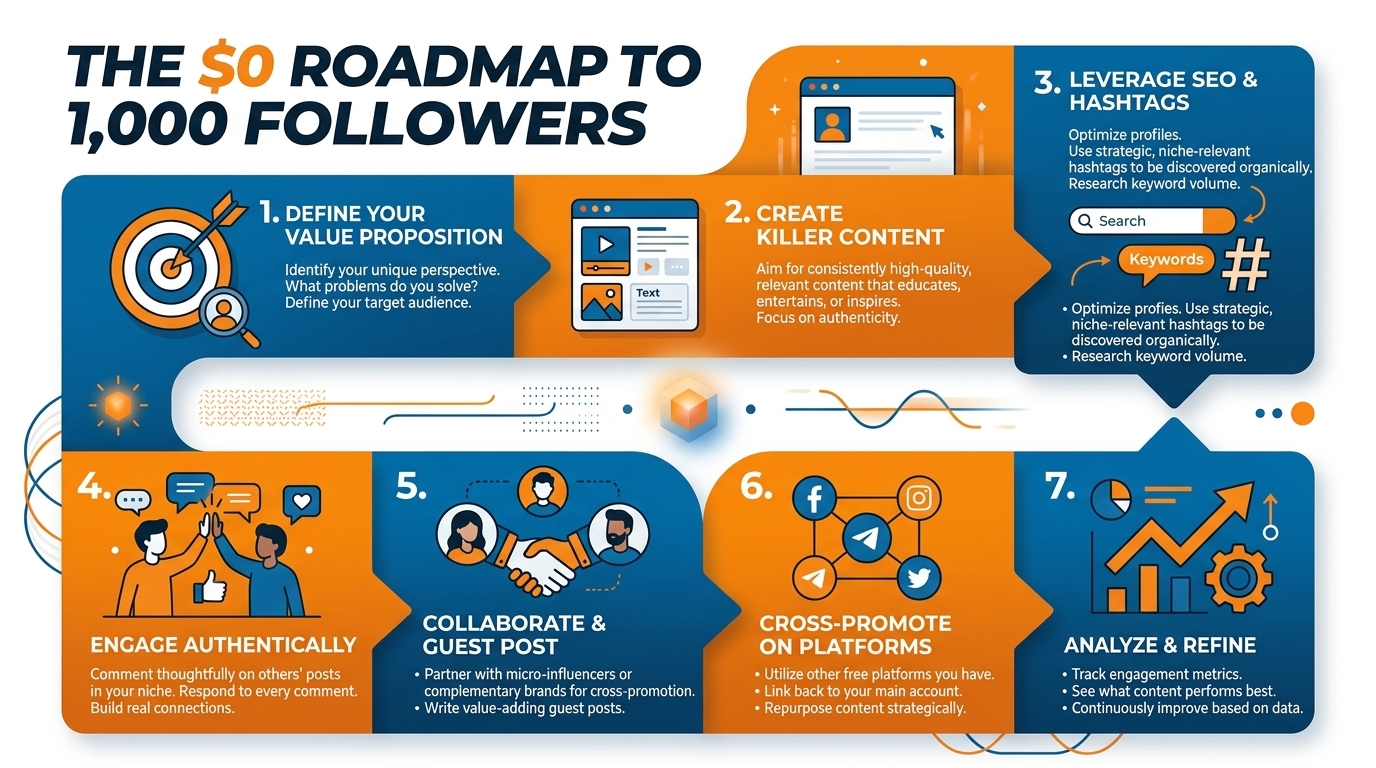
Search is where you find intent, so a single post can send people to your profile for weeks if it solves a specific problem.
Social feeds are where you piggyback on trending conversations.
Other people’s audiences are your early shortcut, because you are not starting from zero, you are being introduced within contexts they already believe in. This is the same compounding logic behind content distribution automation.
The $0 engine I can count on is a comment-to-follower funnel, because comments are essentially free ads that the algorithm and humans like if they are valuable.
I select posts to comment on based on two triggers: the post already has several comments in the last hour, and the audience problem in the post aligns with the one-sentence promise on my profile.
I write comments that generate profile clicks by accomplishing three tasks in a single condensed paragraph: agree with a single detail in the post, add a single step that the post missed, and close with a small anecdote that proves you’ve done it before.
I never comment in a way that even hints at being a sales pitch, as there is no trying to “start a conversation,” no vague claims of benefits, no saying “if you want to know more, DM me.”
The best way to avoid this is to make sure your comment offers some sort of mini-solution, because the curiosity about what you know is what will prompt the click.
To ride existing demand, use question capture: turn the exact questions customers ask you into posts built to rank in search and get saved.
I do this by opening platform search and typing the first 2-3 words of a question, then writing down the autocomplete suggestions.
Those aren’t content ideas; they’re demand data.
Then I structure my post to match how people search: a plain-language title that repeats the question, a direct answer in the first two lines, and a short checklist or pricing range that people will save.
I focus on questions like “how much does it cost to,” “how long does it take to,” “what is the difference between,” and “is it worth it for small businesses,” because those phrases consistently generate saves and shares, which keeps the post circulating even when my account is small. This is especially relevant where content creators average ~4,000 followers (niche-audience orientation vs. mass following), according to The Tilt’s creator benchmark research archive.
The final flywheel is collabs. This one works even if you have no influence, as long as you approach it as a stack.
Start with micro-influencers, who have a tiny but engaged following, and propose a one-post trade that’s hard to refuse: you handle the content, they handle the promotion, both sides get value for their audience.
Then graduate to peers.
Then move up to bigger accounts once you have proof that your content drives profile visits into follows.
I put together a quick partner map for my niche using free tools: just a list of accounts that already have my target audience, the type of content they share, which of their posts get the most saves, and how I can add value with a better explanation, a local spin, or a more actionable list.
Keep the outreach clean, to avoid hurting your account and your image: no mass DMs, no automation that can get you banned, no engagement baiting.
One personalized invite to one relevant creator is worth fifty generic attempts, and creates a discovery loop you can scale.
Acquiring initial 1,000 followers using $0 with a 30-day operational tempo (daily + weekly)
The cold-start truth is that consistency only matters when distribution is present.
When you create, you are hoping to be discovered by the algorithm; when you create and distribute daily, you are now causing your own discovery.
Finding your first 1,000 followers on $0 is not about becoming a content factory; it is about having a repeatable 30-day playbook in which every day has one creation moment, one distribution moment, and one trust moment.
When I execute it, I can already predict that the flywheel will spin by Week 2 because profile views always increase before follower counts do, and I can see the leading indicator that the flywheel is spinning even when the follower count is still small.
Your daily non-negotiables (with timeboxes so that you can actually do this as a small business owner): 1 publish action, 1 discovery action, 1 relationship action.
Publish: Ship one piece of content that aligns with your promise and pillars, even if it’s a short one, as frequency is what will increase the number of entry points to your profile.
Discovery: Show up where your customers are already by leaving a few high-signal comments on posts that are relevant, or by answering a question people are searching for in a reply (because comments and replies receive disproportionately high reach compared to account size).
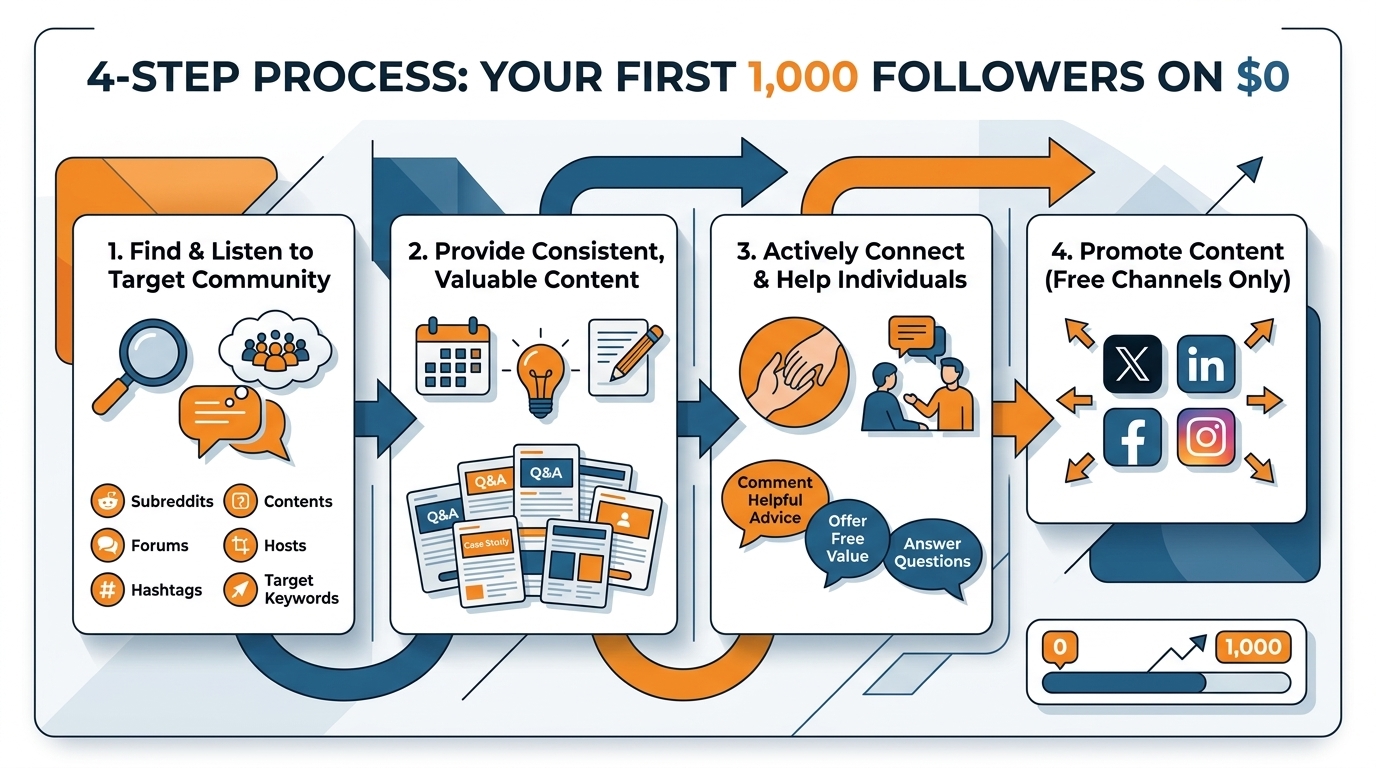
Relationship: Turn warm leads into repeated engagement by responding quickly to every comment you receive, circling back with the people who engaged with you yesterday, and starting an authentic conversation with one person who is an obvious ideal follower.
I do these in short blocks because the magic is in the touchpoints, not the marathons.
Your weekly actions are 4 stacked “step” activities instead of “linear” work: 1 collab reachout, 1 pillar content post, 1 research hour, and 1 profile refresh or pinned update based on performance.
The collab is a single highly relevant reachout and a simple content swap idea that’s a fit for the other account’s audience because collabs are the fastest $0 leverage once your positioning is on point.
Pillar content is your best, most saveable content that solves one of the problems you fix because saves and shares increase the content’s life and the chance it’s seen multiple times. (If you need to plan this cleanly, the structure maps well to a social media content calendar.)
Research is where you dig up the words your customers use, what’s holding them back from buying, and what they’re comparing, and then we turn those into next week’s hooks.
The refresh is where you treat your profile like a store: If a post sent traffic to it but didn’t convert to followers, your bio promise wasn’t strong enough or your pinned content wasn’t what people just proved they wanted.
Optimize your strategy based on what step you are on: don’t do the right thing at the wrong time.
At 0 to 50, your goal is to prove value to the audience, and you do that by showing up where your target audience is and mirroring the topics they’re already consuming so they know what they’re getting from you as soon as they hit your profile.
At 50 to 200, your goal is to start getting signals for repeat consumption and thematic consistency, and you do that by reusing concepts, grouping into sequences, and calling out continued engagement from the same people so the platform sees proof of a sustainable group.
At 200 to 1,000, your goal is to ride what’s working and scale with distribution, so you double down on formats that work, put out more collaborations, and tailor content for the engagement signals that you know get you distribution (saves, shares, replies).
The metrics you care about are: profile visits/follows (conversion), saves and shares (continued distribution), and repeat commenters (long-term survival). If you want to sanity-check what those engagement signals mean in practice, compare against your own numbers and the patterns discussed in vanity metrics.
If profile visits are flat, figure out how to get in front of more people and ensure your content is more tightly aligned to what they care about.
If profile visits are growing but follows aren’t, fix your bio and pinned post.
If you’re getting likes but not saves or shares, make the content more useful with a checklist, some price ranges, or a framework to help them decide something that they’ll save.
What if you could find your first 1,000 followers on $0 without attracting the wrong audience (or getting throttled)?
This is how you get your first 1,000 followers on $0.
You’re filtering for quality and the algorithm copies your audience.
The quickest way to signal is not with the follow. It’s what happens afterwards.
A quality follower goes to the pinned post and consumes more than one item. They save. They leave a comment that includes their location or budget or timeline or problem they’re trying to solve.
For small businesses, I use those as intent markers because they’re more closely related to inquiries and referrals than vanity engagement.
If you need 1,000 followers that can actually become customers, you should be measuring the last 30 followers manually.
How many are local or niche relevant? How many have a real name and posting history? How many have engaged at least twice in the last 7 days.
If that number is low, the solution isn’t to post more. It’s to tighten the promise and to shift distribution to wherever your buyer is already having a conversation.
The easiest way to get throttled or poison an audience is to pursue low-intent growth.
Low-intent content can drive views, but it teaches the algorithm to send your content to people looking for entertainment instead of answers, so your next value-packed post tanks and your reach decreases.
F4F and engagement groups are even worse: you grow your followers at the cost of tanking your engagement rate, which is one reason some accounts feel capped between 300-800 followers despite posting frequently.
I also sidestep bot behaviors that scream automation even if you’re doing it manually: like posting similar comments, like-spamming, or posting generic responses on semi-related posts; the algorithm picks up on these and reduces your distribution silently.
For compounding growth, make your behavior human and unique: comment less, but make each comment so good it feels like you wrote it just for that post and that specific audience problem.
Consistency is a system, not a hustle.
You want to create a weekly workflow that generates content in bulk, and then recycle ideas that have already shown they can get you saves, shares, or responses.
I use a mini-scoreboard of successful concepts and reuse the same essential lesson across a variety of formats: as a quick how-to, a customer story, a mistake-to-fix, and a comparison post to help someone choose.
This means you can be consistent without exhausting yourself, because you’re not constantly dreaming up new ideas; you’re multiplying the doors into the same room.
And that’s when your content starts to feel comfortingly repetitive, which is what ultimately convinces strangers to trust a small business account.
Lastly, you have to use your audience as a research group, so the more you post the more precise it is and the conversions remain the same.
You have to dig in the comments and DMs for the repeated words, concerns, and buying points, and use them as hooks and titles for your next post because that is what they are asking for.
I personally look out for three types of messages:
- Clarity This worked for me but this did not work for me.
- Either or Should I buy this or that?
- Deadline I want to achieve this by next month.
I would usually reply with a question that could disclose their intention, and then use the pattern to create a post within 48 hours to show them that you are really listening.
It’s a cycle where every engagement sharpens the precision of your posts, and that is how you can gain your first 1,000 followers with no budget and without the wrong crowd. And if you’re building on TikTok specifically, note that Pew Research Center surveyed 2,745 U.S. adult TikTok users in August 2023, as documented in this Pew TikTok usage study.
O Fim
And that’s it. That’s the entire system for Finding your first 1,000 followers on $0: a positioning promise that makes following seem like a fair trade, discovery loops that expose you to existing demand, an operating rhythm that’s realistic for a small business owner, and quality control that ensures the audience is buyer-aligned, not vanity-aligned.
Taken together, it’s how you stop relying on luck and start generating predictable profile visits, predictable follow conversion, and repeat engagement that the algorithm can confidently expand.
The only way this $0 growth model works is if you commit to the following non-negotiable.
You show up with the same repeatable process for 30 days and then you scale what is already converting.
That means your metric is not how you feel, it’s that profile visits have to go up before followers do and saves/shares have to go up before reach flattens out.
If you see a post driving profile clicks, you produce 2 more variations of that same idea targeting the same buyer problem.
If you see comments attracting the wrong people, you refine your promise and pivot your distribution back into higher intent conversations.
That’s the quality control people tend to miss, and why their growth seems unpredictable.
I want 1,000 followers who act like customers: they read more than one post, they ask “where, how much and when” questions, they save planning resources, they return within a week.
I police this by going through my last 30 followers and trying to gauge whether they’re a good fit in real life; if I find less than around 20 clearly applicable accounts, I don’t push harder, I tweak the promise and try adjusting where I’m promoting to make the next 30 cleaner.
The first 1,000 isn’t about going viral, it’s about being discoverable, followable, and regularly showing up in the spaces your audience is already inhabiting.
And if you keep up the daily and weekly cycle long enough to build enough jumping off points, your profile ceases to be a single item to be discovered and starts to become a whole collection that keeps reappearing at exactly the times people are hunting, scrolling, and choosing.
At that point, having $0 in the bank stops being a restriction and starts being a superpower, because at that point the only thing that still determines success is relevance.
Related reads
4/27/2026
B2B SaaS social media benchmarks: Set the right targets.
B2B SaaS social media benchmarks: Set the right targets. The trouble with defining B2B SaaS social media benchmarks is that it's an inherently impe...
4/25/2026
Building a personal brand as a technical founder (without becoming a creator)
Building a personal brand as a technical founder (without becoming a creator) Creating a personal brand as a tech founder should feel less about ma...
4/20/2026
Creative Post Ideas for Sustainable Brands (That Don’t Sound Greenwashy)
Creative Post Ideas for Sustainable Brands (That Don’t Sound Greenwashy) That’s not what creative post ideas for sustainable brands should look lik...