B2B Consulting Social Media Strategy: Authority, Trust, Pipeline
Develop a B2B consulting social media strategy that builds authority & trust, generates qualified conversations with decision-makers, and creates pipeline, not just noise.
B2B Consulting Social Media Strategy: Authority, Trust, and Pipeline (Not Noise)
When it comes to a B2B consulting social media strategy, it’s different from B2B marketing in general because your ideal clients aren’t making a purchase because of a post going viral.
They buy because they trust your judgment on the big things. In consulting, authority is the conversion engine. Trust is the funnel. And that changes what you post, how you distribute, and what you measure.
That’s also why I don’t optimise for followers. I optimise for ongoing, qualified conversations with actual decision-makers, even if your following remains tiny. If you want more on building systems around this, see social media automation.
Now, if you’re a solo consultant or a boutique firm you don’t need 50,000 followers. You need a repeatable way to get on the radar of the right people, establish authority quickly and create a logical flow from content to call without being promotional or having to share sensitive client information.
In this article you will have a consultant specific operating model which links positioning to content, content to distribution, distribution to conversion, and conversion to measurement.
You’ll construct a reputation and discretion system so that you can share evidence without over-sharing, generate leads without hyping, and convert interest to meetings that you’d actually want to take.
This is the framework you need if you need social to generate pipeline, not noise.
1) Positioning comes first (ICP, triggers, and committee dynamics)
Your B2B consulting business social media marketing strategy begins with the best positioning for selling.
With B2B consulting content for social media you need to nail the ICP or everything falls apart.
So don’t just go down to industry and job title.
Go all the way down to industry + trigger event + decision maker + roadblock then create content with the likely committee dynamics in mind.
The owner, CEO or department head signs the deal but the deal is blocked by a risk-averse CFO, an ops director fighting to preserve capacity or an evangelist who doesn’t want to be proven wrong.
At the point of publishing consider the trigger moment, such as when:
- a new VP starts
- a wave of churn hits
- an integration fails
- a compliance date looms
- the board demands better profitability
and address this moment, because it’s the moment buyers begin to search for authoritative guidance and a safe pair of hands.
The second thing to do is form a defensible point of view so you can stop reading like a Business Consultant 101 best practice list.
You can do that by first defining what the market thinks is true, then showing where that doesn’t hold up in practice, and finally show how you’re different and why that matters.
The old playbook vs new playbook format always outperforms fluffier thought leadership because it gives the target audience a clear choice: old playbook vs new playbook.
I use it to get constructive dissent without being a provocateur.
I want to make the target audience think, finally, someone understands our real world problems like politics, risk, time, and imperfect data, and the non-target audience decide to disqualify themselves.
2) Create a signature process people can recognize (and self-qualify against)
Next, transform your skills into a signature process that you share in front of a crowd, since teaching is the most efficient credibility trigger for consulting.
Distill your work into a handful of named, discrete steps with defined in’s and out’s, just like you would structure a client project.
If you can’t outline your process in 3-5 steps, prospects will either conclude that your work is ad hoc, or that it’s too complicated to safely purchase.
When you repeatedly communicate your process, you foster recognition and self-qualification: prospects can find their own problem on your map, know what they need help with, and know what to expect when they work with you, all before contacting you.
Lastly, organize your offer stack to mirror your social media to the consulting purchasing process.
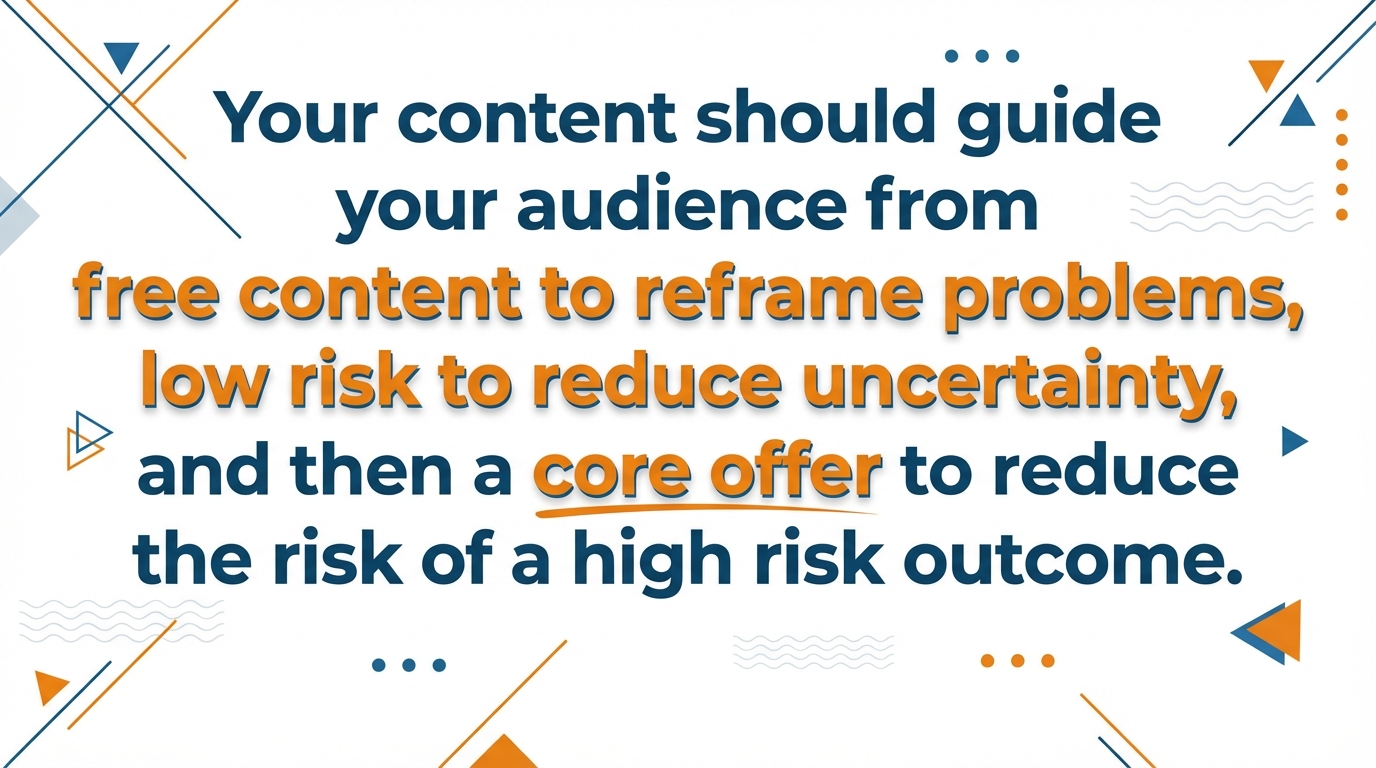
Your content should guide your audience from free content to reframe problems, low risk to reduce uncertainty, and then a core offer to reduce the risk of a high risk outcome.
This is important because people buy consulting to reduce risk, not to stack up features, so each offer should satisfy a different concern: do you understand my problem, can you get to diagnosis fast, can you get results without imploding my organization.
When you structure social media this way you’ll stop trying to get engagement, and instead, create a pipeline of buyers who are already aligned, already believe you’re qualified, and already know what to buy next.
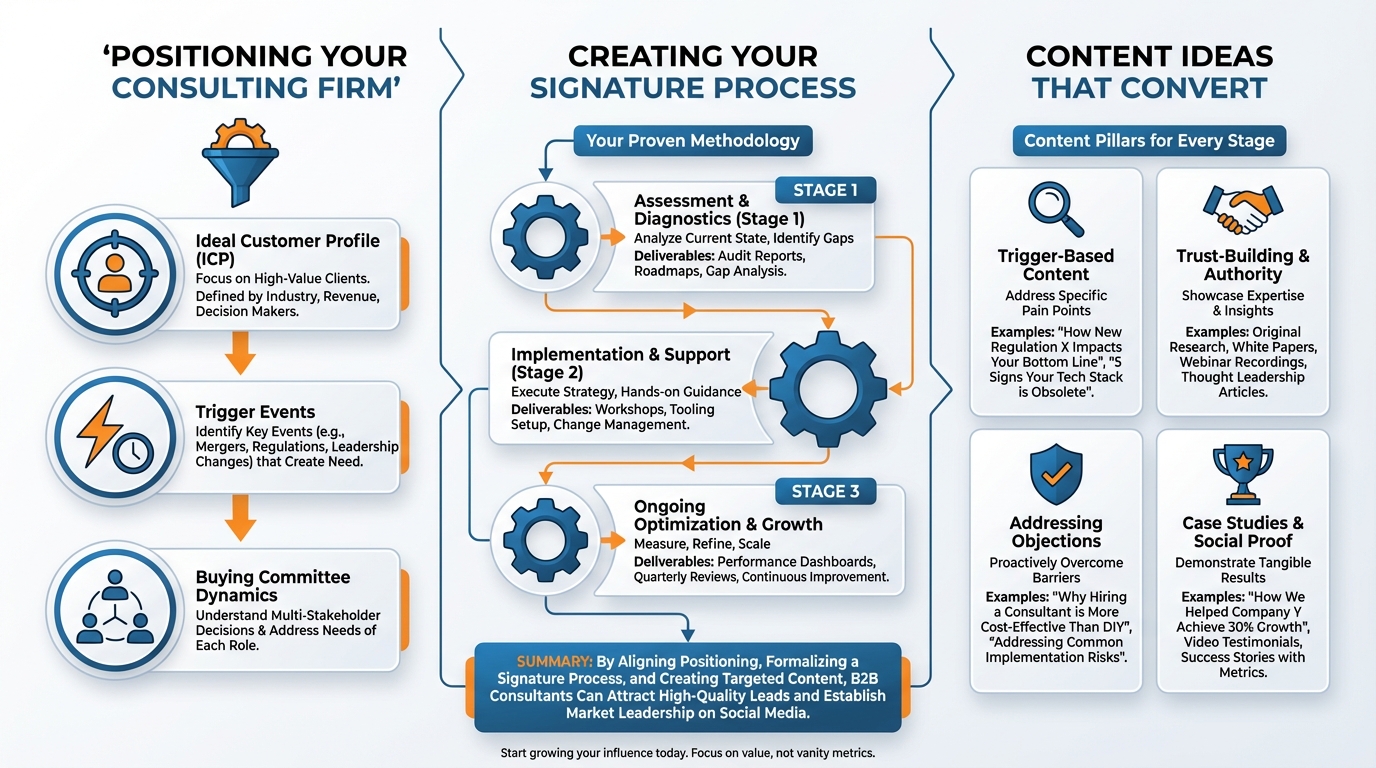
3) Content ideas that actually convert: triggers, trust stages, and objections
When it comes to social media, many B2B consultants struggle to come up with content ideas. If you want a structured way to expand your angles, this pairs well with generate social media ideas.
One approach is to publish content that’s connected to common buying triggers and/or typical objections.
The social media strategy for B2B consultants that I have found to be most effective is when you shift away from sharing generic advice, and begin to share based on buying triggers, because triggers are when budgets become unlocked and attention becomes heightened.
Create content based around new to role situations such as a new executive taking over a role in which they were left with a pile of disorganization, the target was missed this quarter, a compliance date was set, churn has reached an unacceptable level, an influx of new funds requires immediate action, or a recent reorganization led to broken processes and lost handoffs.
You can also take this approach and get tactical and write as if your reader has been on the job for two weeks in this new trigger role, in this case, what does their dashboard look like, what is now political suicide, what was the first thing to break, and what is a safe first move.
I have experienced that trigger-based content receives more valuable comments and DMs because they mirror the identical conversations that occur inside of a buying organization prior to reaching out to external partners.
Next, you use a consultant-specific content blend that progresses people through trust stages, not through topics.
Your job is to get them from problem definition, to diagnosis, to trade-offs, to decision criteria, to what good looks like, because that’s what a buyer needs to feel safe buying expertise.
You can rotate posts that name the real root cause patterns, how you would diagnose in the first 10 days, how to understand the non-obvious trade-offs a leader has to make like speed vs control, centralization vs autonomy, or short-term fixes vs durable systems.
I often write decision criteria posts that sound like a scoring model a buyer can reuse internally, because when your content becomes their internal language, you become the default reference point.
If there is one place consulting engagements go to die, it is in the objection phase, so you need to publish objection-handling content before you ever pitch.
You should handle consulting-specific risks around politics, switching costs, credibility, time-to-value, and implementation, and you need to do it in an operationally specific way.
For example, you can explain how you minimize politics by getting a sponsor, a blocker, and the operators aligned around a shared definition of success, or how you minimize switching costs by doing a limited scope diagnostic that delivers options instead of a full rollout.
I will often describe how I would sequence the work to get to an early, measurable win in 2 to 4 weeks, because the buyer isn’t afraid of the strategy, she is afraid of the drag, the blame, and the failed execution.
4) Share evidence without breaking NDAs
Here’s how you can do this without violating a non-disclosure agreement:
Instead of talking about logos, talk about artifacts.
Talk about masked results, bounded metrics, before-and-after trends, aggregated success stories, and any visual deliverables with identifying information obscured.
Publish decision briefs and rules of thumb for the buyer that help them evaluate solutions, even if it means deciding that they don’t need me, since authority is based on helping people to judge well, not just confidently.
A post that leaves the reader feeling better equipped to judge vendors and strategies has built the kind of authority that leads to a steady stream of discrete, probably anonymous leads.
5) Go beyond posting: partnerships, community, and amplification
How B2B consultants can use social media: go beyond content distribution (use partnerships, community, amplification)
The reason posting alone is a limited growth lever is that you are subject to the whims of two things that aren’t in your direct control: the algorithm and the size of your existing audience.
Organic reach is often in the low single digit % of your followers on most platforms, which is why sometimes even a good post doesn’t perform as well as it could because it didn’t gain immediate traction.
A real B2B consulting social media strategy incorporates a distribution component that establishes consistent engagement with the people who already own your buyers’ attention.
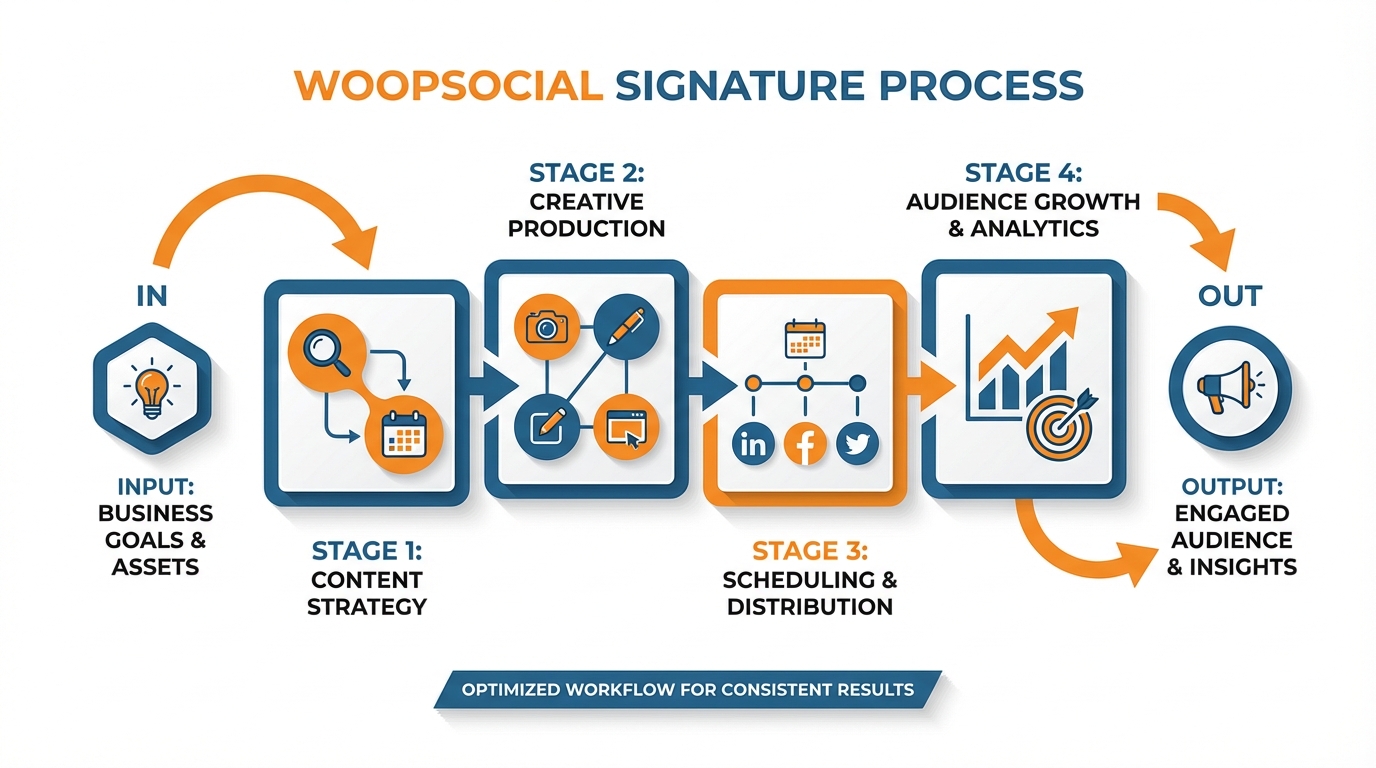
You establish this by designing the journey your content takes once you press publish: who will consume it, why they will share it, and how it will be echoed within the circles your target buyers already tune into.
Create a network of partners and influencers in your niche, but think of this as a funnel, not a game.
Find 30-50 accounts that are continually drawing your ICP and label them by shared audience, content theme, and the strength of your connection.
I maintain a few notes on each person’s interests, things they tend to engage with, and what their audience reacts to, and then build the relationship by providing value in public consistently.
When done correctly, you will observe that often the same few creators and operators are responsible for the comment threads in spaces where decision-makers congregate, and establishing yourself in those rooms can be more impactful than months of independent content creation.
Such mutual promotion is much more effective when it’s aligned with your perspective and not simply people playing dress-up as influencers.
An example could be exchanging best performing content where you add one paragraph of your analysis, or co-posting a comment on the same news article to attract a meaningful conversation, or hosting a live video for a single lead magnet, or co-announcing something where you each cover one part of an overall recipe.
The advantage of such tactics is that they permit repeated exposure across partially shared audiences, which is how one gains credibility in B2B.
You aren’t meant to piggyback off their credibility, but their distribution in which you prove yours.
You don’t have to lose a whole day to community building if you think of it as a cadence.
You decide which ones to invest in (comments, groups, threads, etc. where your customers hang out) and you set a time to do a little in each of them.
This is where you can leverage automation for things like filtering, labelling and follow-up, but avoid automated engagement where you can (it’s safer and more effective). For a deeper look at building this into a repeatable workflow, see smart social media automation.
One choice here is which platforms to use: I start with LinkedIn because it’s the natural home for many consultants and that’s where decision-makers hang out, and where you can leave a trail of authority through engagement and social proof. This lines up with the CMI research where LinkedIn leads organic B2B value, with 84% of B2B marketers saying LinkedIn delivers the best value among organic social platforms.
And then maybe use one more platform if that’s where you get traction, and you can reuse your effort easily (like turning a LinkedIn post into a quick video, or a text stream).
6) Convert “visibility” into private conversations (CTA ladder + DMs)
I was trying to explain to some B2B consultant friends the other day that the real goal of their social media strategy shouldn’t be “visibility” but rather getting those interested in talking to you privately.
For B2B consultants, you want that “social media visibility” to translate into potential new customers contacting you privately about working with you.
This is the pipeline that you want to generate from your social media activity.
Most “SERP hacking” content goes as far as engagement, but the rest of the Social media strategy for B2B consultants is a funnel of attention to trust to diagnostic to sale.
Attention is the match, not the flame.
Trust happens when your posts consistently deliver enough value that it helps a buyer make a safer decision under conditions of uncertainty, and the diagnostic is a transition point that converts public proof to private evidence. This is especially relevant when, as the Edelman-LinkedIn thought leadership study notes, we surveyed nearly 3,500 management-level professionals across seven countries and found 95% of business clients say they are not actively seeking goods or services at any given moment.
You do this by writing a post that naturally encourages a buyer to share some context - a trigger-based post that concludes with a very specific question about their situation, a decision-criteria post that encourages them to sanity-check their scoring model, or a teardown of a common failure mode that leads them to wonder if it is occurring in their own org. If you’re creating a repeatable planning rhythm for this, pair it with a social media content calendar.
If you execute on it properly, the right people don’t just like the post, they comment with specific details that flag themselves for followup, and that’s your cue to take the conversation off the socials.
To sell without coming across as pushy, we need to set up a CTA ladder that mirrors the degree of readiness: not everyone who reads or comments on a post is ready to work with a consultant.
We ask a low-friction CTA to create micro-commitments: you make them comment or like, then move them to a DM about the specific part they liked, then share a resource after they confirm it is what they need, then suggest a brief fit call, and only then invite them to a paid diagnostic.
This ladder works because each step is a lower perceived risk and a higher degree of specificity, and mirrors the process in which consulting services are bought: people pay us first to understand, then to act.
This also means that we should treat each step as a filter: if someone cannot answer one crisp scoping question in DM, they are not a good fit for a call, and you just avoided a calendar full of bad meetings.
This is where most consultants blow their branding, so let’s make sure your rules of engagement are good.
Only use engagement-based outreach, not random prospecting: if they leave a considered comment, if they react consistently to your diagnostic-style posts, if they make a statement that indicates an active pain point, fine.
Then your DMs need to be tight: you need to reference their action, you need to ask one contextualising question, and you need to propose the absolute minimum ask that aligns with their likely answer; if they don’t respond, you follow up once to clarify with value, then leave them alone. Speed matters too: in the LinkedIn + Edelman write-up, buyers decide quickly on thought leadership, with 55% saying they will move on if it doesn’t pique their interest within the first minute.
I ensure I always give value and protect my brand by making every follow up permission-based (I’ll ask if they want it before I send), and I always provide a graceful exit; that one trick alone will keep you out of the spam filter and make your outreach feel like pro-to-pro problem solving.
7) Measure what creates pipeline (not vanity metrics)
But social needs to be part of a system to create pipeline.
And when it is, your social content can serve as a market test for what to build out more comprehensively into SEO’d blog content, your newsletter can be the conversion mechanism to convert those anonymous visitors into monthly readers, your webinars can be the efficiency play to diagnose people en masse, and referrals get way simpler because now everyone in your network can explain what you do in your terms.
What I care about is the conversions that really matter for a small consulting business: I look at which posts drive meaningful conversation quality, not eyeballs, I track how many meetings I have, and how many of those turn into diagnostics.
I track how many diagnostics turn into actual engagements.
I track how long that deal flow takes, and which topics get reads from decision-makers with pain right now as opposed to just other people in the industry who think it’s interesting.
When I track those things every week, I don’t have to take a guess at what’s working anymore.
I just have to keep going back to what’s driving these private conversations with people that have the ability to write me a check. And to zoom out, social measurement increasingly depends on data discipline; the Harris Poll report published by Sprout Social notes in a study of 750+ leaders that 90% of leaders agree their company’s success will depend on how effectively it can use social media data and insights to inform business strategy.
O fim.
The formula for Social media success for B2B consultants is straightforward to communicate and brutal to apply: positioning-led, trigger-driven, distribution-backed, conversion-designed.
Positioning allows you to be understood at a glance, triggers get your work to reach people when budgets and attention actually shift, distribution breaks the algorithm curse, and conversion design pushes public perception into private contact and serious interest.
Combined, you stop looking like a just another valuable generalist and start looking like the person your target audience brings up in a meeting when they want to make a no-fuckups decision.
For the first 30 days, force yourself to stay tight: pick one ICP, and one signature method, and write for triggers and objections as if you were writing for a brand new hire in week two who’s under a gun.
You’ll know you nailed the triggers if the comments start getting specific about deadlines, budget, and other organizational landmines, because that’s the type of engagement that’s a buying signal, not a vanity metric.
I’ve found that when you routinely hang your method on the hook of a moment where a leader is held to account, the quality of responses improves even when the number of views doesn’t.
Meanwhile, create a few partnerships rather than just waiting for your content to go viral.
Look for a few other relevant voices your customers already listen to, offer value in their comments and engage in low-key joint activities that put your ideas in front of the same people multiple times.
Experience proves a few steady connections are worth more than 1000 fleeting followers: it is consistent, trusted exposure that drives B2B recognition, and it is recognition that gets you on the short list.
Last, use a Readiness Matching CTA ladder to avoid selling: micro-asks in public, a single contextual question in DM, a permission-based next step, and a short fit-check only when an active trigger is revealed.
Measure what is meaningful for small businesses: Qualified DM threads, meeting-to-diagnostic conversion, diagnostic-to-engagement conversion, and deal cycle duration… Because those are the things that tell you how much money you’ll make. This also echoes older findings from the 2022 Edelman B2B thought leadership report, where 50% of C-suite executives say high-quality thought leadership has more impact on purchase decision-making during economic downturns than when times are good.
You’re not looking for Followers, you’re looking for Predictable Authority that generates qualified conversations, repeatedly.
Related reads
4/27/2026
B2B SaaS social media benchmarks: Set the right targets.
B2B SaaS social media benchmarks: Set the right targets. The trouble with defining B2B SaaS social media benchmarks is that it's an inherently impe...
4/25/2026
Building a personal brand as a technical founder (without becoming a creator)
Building a personal brand as a technical founder (without becoming a creator) Creating a personal brand as a tech founder should feel less about ma...
4/20/2026
Creative Post Ideas for Sustainable Brands (That Don’t Sound Greenwashy)
Creative Post Ideas for Sustainable Brands (That Don’t Sound Greenwashy) That’s not what creative post ideas for sustainable brands should look lik...