Automate Brand Awareness on Social Media (For Real)
Automate Brand Awareness on Social Media (For Real) Everyone seems to think they automated brand awareness on social media if they schedule 7 days’...
Automate Brand Awareness on Social Media (For Real)
Everyone seems to think they automated brand awareness on social media if they schedule 7 days’ worth of posts and create a “system”. That’s not automation. Automation of brand awareness is when you create a repeatable system that amplifies qualified reach, recall, and recognition even on days you’re too busy running the business. The aim isn’t to post more. The aim is to show up consistently in front of the right people, in the right context, enough times that they remember you and trust you, without having to touch every step each day.
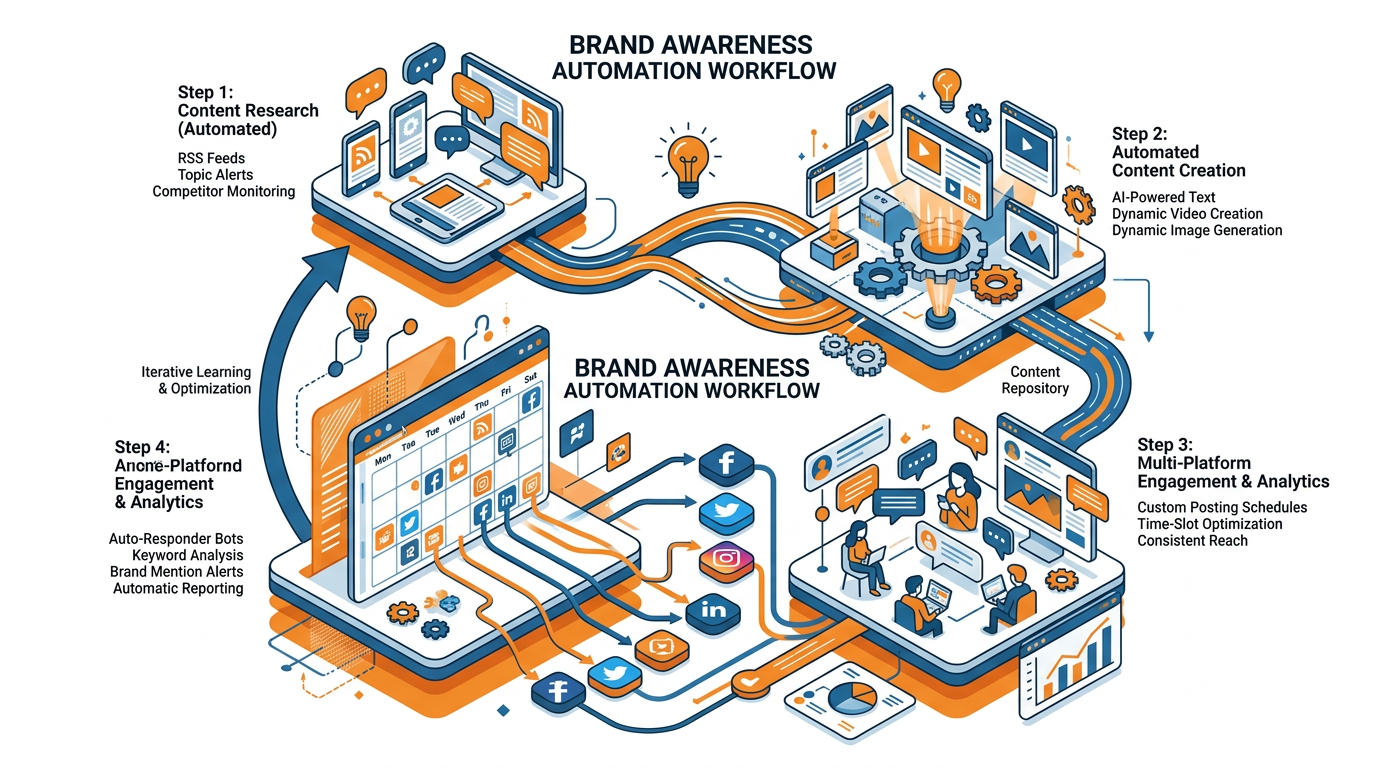
TRUE automation is the interplay between three gears: a content supply chain that converts your knowledge into publishable content, distribution circuits that then ensure that content is reformatted, repurposed, and then redistributed, and a lightweight feedback mechanism that helps you adjust the machine in terms of what works and what doesn’t. When I first discovered all of this, I learned that awareness isn’t a single post issue, it is a compounding exposure issue. And you get compounding exposure if your best content is constantly repurposed, reformatted, and re-distributed to different segments of the same audience, while you focus on higher-leverage decisions. If you want more on smart systems like this, see social media automation.
Set clear guidelines so you can do this responsibly. There are some things that you will want to reserve for human brand stewardship including: core purpose & positioning, core value articulation, final review & approval as needed, & partner/audience/community engagement. But there are many things you can automate without sacrificing your voice: idea gathering & grouping, outline drafting, formatting to platform-specific templates, long-form to short-form conversions, publication processes, & simple logic like spinning up sequels to top-performing themes. You will remain the captain. The tool will do the paddling.
Building an awareness engine: inputs -> content creation -> distribution -> feedback
If you’re interested in automating brand awareness on social, the first step is to identify the awareness inputs your business is already generating week-to-week, then document them in a simple running document to give automation some meat to chew on.
I’m talking about things like:
- Questions your audience is always asking
- Objections you always have to overcome
- Myths in the category that you can bust
- Outcomes from customers that are backed up by before/after detail
- Moments from your product experience where the light bulb goes on
- Industry trends that are shifting buyer behavior
What I find is that the best-performing awareness content is not born from an idea for content, but rather born from a conversation that keeps repeating.
If you’re building an engine that is powered by conversations that keep repeating, you eliminate the need for guessing, and you always wind up with content that is relevant. Now, convert those inputs to a few repeatable awareness pillars, designed for recall, not for conversion.
You want 1 second differentiability, 1 sentence recallability, shareability which makes the sharer look intelligent, and consistency to train both the algorithm and audience.
In reality, you use one input and apply it to the same pillar template each time so you build mental availability through repetition.
I’ve seen smaller brands beat larger competitors because they repeated the same few concepts with sharp edges until they became the go-to brand for that topic.
So, you need to create a content production process that can be automated, but not generic AI automation.
And you do that through batching: one short session for input gathering, one for drafting, one for editing, and one for formatting into simple formats like a myth vs. truth, a short story with a moral, a simple structure, or a POV that challenges the status quo. If you struggle with that consistency problem, read inconsistent social media posting.
Then add some content style guardrails: words you never use, level of bluntness, types of examples you do or don’t allow, and what POV you always revert back to.
Most automation fails here because automation happens before POV becomes standardized, and volume is created without identity.
Last, merge creation, branding, and publishing into one cycle so reinforcement becomes automatic: your best themes get repeated, your most effective hooks get repeated, and your audience experiences the same key concepts in different forms over time.
This is where a service like WoopSocial comes in, as we’ll create a month’s worth of on-message posts in a hurry, make sure the copy is on-tone and the imagery is on-brand (with your logo and color scheme), then publish it all via a single interface that spans all your networks.
That’s important because awareness is frequency plus consistency: most consumers need several impressions before your brand sticks, and your system should generate those impressions regardless of how busy you are with the rest of your business. Deloitte Digital reported that GenAI users saved an average of 11.4 hours per week, and that marketing content demand grew 1.5x in 2023 while teams said they could meet demand only 55% of the time, in their Deloitte Digital generative AI content marketing research.
Automation (not just publication) of content repurposing, variation, and amplification
If you’re going to automate social media branding, think of distribution as a system rather than an afterthought. For a deeper operational view, see content distribution automation.
This typically begins with a repurposing funnel, where one idea can be turned into 6-12 platform-native variants.
You retain the same core content, but you’re intentionally changing the form it takes.
That means creating hook variants that can serve as different attention levers.
Creating length variants that can serve as different content vehicles.
Creating format variants where the same essential content can be a winner as a visual-led piece of content on one platform, and a text-led piece of content on another.
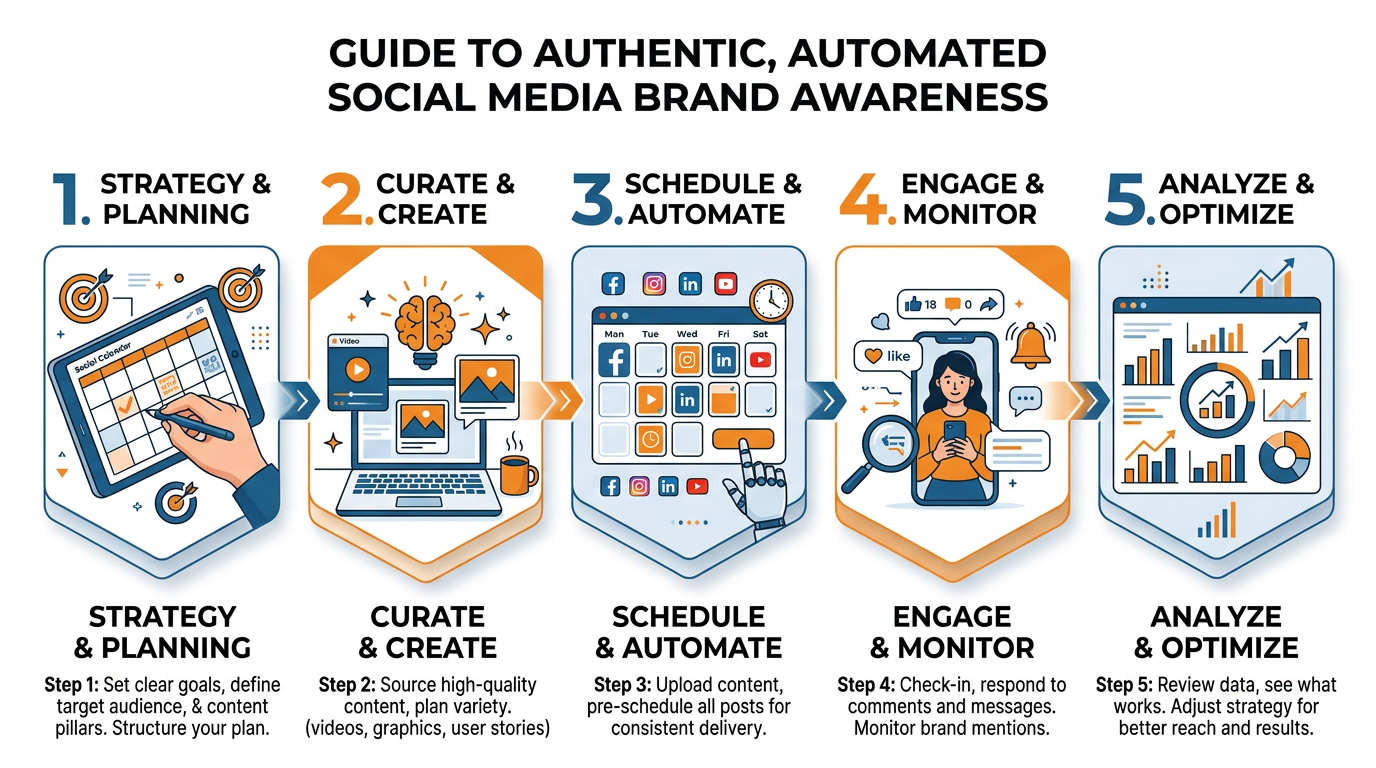
You then need to create a content distribution strategy across multiple platforms that prevents repeating the same content everywhere, but still enables some reuse.
My approach is this: I share the same message across all platforms, but I share different forms of the message.
The message itself is platform agnostic.
The platform I share it on isn’t.
The headline, the speed, the graphic design, these things are platform dependent.
I might share a customer story that has the same punchline across all platforms in a single week, but I need to make sure it has a different opening sentence, different first image, different layout so it makes sense on the platform.
This minimizes the impact of audience duplication, but also gives me some ability to see which version of the content performs best on which platform.
Different platforms favor different signals.
Next up, always-on amplification: choose signal posts, and then loop them forward into sequels, rather than copying and pasting them.
A signal post is something that gets more saves, shares, or profile views than baseline in the first 24-48 hours, not just likes.
The sequence for this is to find your winning angle and then ship three follow-ups: the contrarian one, the noob one, and the behind-the-scenes proof one.
This is how you repeat the same strategic message many times without repeating yourself, and it works because your audience doesn’t see everything, and the algorithm notices themes.
I’ve seen small accounts build outsized recognition by sequeling on a theme 4-6 weeks straight until they’re known for that theme. If you want more ideas in that direction, use generate social media ideas.
Last, add the automation that’s missing from most marketing strategies: amplification to your ecosystem of partners, creators, and adjacent companies while containing the risk of overexposure.
List 30-100 trusted partners, authors, and allied brands, segment them by alignment and whether they’ve responded well in the past, and agree on a simple sharing process where you regularly send ready-to-share assets (that they can modify minimally if needed).
The effort is low: for each signal post you release, prepare a shareable version and seed it to a small subset of that list so amplification becomes a closed loop.
Avoid overexposure by setting a frequency for each medium, by performing a basic brand safety review, and by having a zero-tolerance policy toward engagement bait that gradually undermines trust.
If you’re already producing on-brand variants quickly using WoopSocial, you can automate that shareable content and follow-up loops without increasing your manual load, and that’s when amplification starts to gain critical mass instead of being a bottleneck. WFA research found that 78% of brand owners surveyed said they are using or plan to use generative AI in their marketing strategies, with 89% citing improved productivity/efficiency as an immediate internal gain, in this WFA report on genAI in marketing plans.
Governance & human-in-the-loop: how to stay authentic while scaling automation
If you want to use automation to build brand awareness without making your brand a generic shout into the void, you need some things that are non-negotiable even for the automation.
You need to establish the voice of your brand in plain English, the default tone you should communicate in, the directness you should employ, and the specific words you should use all the time and never use at all.
You need to do the same thing for your visual brand, the colors you should use, where and how your logo should appear, the typography you should employ, and what a post should look like when someone is scrolling by it.
You need to define content boundaries, the subjects you should lead with, the subjects you should never broach, and the times when you will only speak if there's context.
And you need to establish engagement boundaries, the times when you shouldn't respond at all, lest you get sucked into an argument, a lawsuit, or a customer service issue.
When I develop these boundaries for small businesses, I strive to get them down to a single page that is strict enough that it will prevent your brand from drifting, but simple enough that you will actually adhere to it when you're busy.
You also need an approval flow that balances brand stewardship with speed.
The best way to do this is to preapprove a set of templates and claims, so 80% of what you produce is safe by design, not because it’s been proofed line by line.
Then establish a green-yellow-red review process: green posts go out without a deep review, because they’re based on approved templates and lower-risk subjects; yellow posts get a fast review, because they involve data, comparisons, or more assertive opinions; red posts need a full pause, because they’re about regulated topics, promises around price, customer results, or anything that could be construed as advice.
This keeps you responsible, but still fast, and avoids the most common scale mistake I see: applying the same level of review to everything, which means automation is simply a way to build a queue.
It’s at the quality control stage that your brand either stays authentic, or doesn’t.
Use a standardised checklist for every post that goes out.
You want a point of view that only your brand could say. (i.e. that no one else could say the same thing. You don’t want a neutral summary that anyone could write.)
You want a clear value promise that communicates to the audience what they will get in return for their attention.
You want one key message per post, because recall trumps complexity when it comes to brand awareness, and posts with too many messages are just scrolled past, even if they are accurate.
And you want consistent visual branding, because recognition is built through repetitive cues, and consistent brand presentation has been shown to increase revenue by as much as the low 20s, in many studies.
The same dynamic works for social recognition, even before you convert.
If you are using WoopSocial to rapidly generate and brand large numbers of posts, these are the control points you should be using to ensure that speed does not weaken your brand. Gartner found that 27% of CMOs reported their marketing organization has limited or no GenAI adoption in marketing campaigns, while among organizations that have adopted GenAI, 77% adopted it for creative development tasks, in this Gartner CMO survey on GenAI adoption.
Lastly, adjust the human-in-the-loop model to fit your business.
If you’re B2B, automation can be a bit more contained in terms of expertise: fewer claims, more granular, and more review for any language that might be considered a promise, since that’s the kind of thing your customers notice and screenshot.
If you’re DTC, you can be a bit more aggressive with content iteration, but you should always review health and safety, and any post that makes before-after claims, since those are the ones that will get you in trouble with people for trust if done poorly.
If you’re local services, you should bias more toward boundary conditions in response and offer, since a single misinterpreted response can be a promise you can’t keep to someone in your neighborhood.
And if you’re regulated, you should just assume you need to be heavier on the review side: pre-blessed words, no inferred consultative, and always flag anything that talks about results, legal, or client: the value prop is basic, as automation takes care of quantity, and you take care of curation, and your brand still sounds human even as the content scales.
Measure awareness as a system (not just reach): instrumentation that proves lift
If you’re going to automate brand awareness on social media, you need metrics that are more machine than highlight reel.
I start with a basic structure that most people ignore: baseline > leading indicators > lagging indicators.
Baseline is a snapshot of your last 28 days of “business as usual” activity, but it’s not just impressions: get the category mentions, branded search volume, direct traffic sessions, and an approximate breakdown of new vs. returning visitors.
That baseline is what will allow you to measure lift later, because a viral post is just a blip unless it shifts your trendline relative to your baseline (and your competition).
Here are some weekly leading indicators to test whether awareness is compounding.
The first is share of voice (your category mentions / category mentions including competitors). Even if you’re a tiny company and went from 2% to 4% share of voice in your category, you doubled your mindshare even if your overall impressions are still very small.
I look at the velocity of mentions too: the slope is more important than the absolute number, because the rate at which the conversation is growing is what generates algorithmic momentum and gets partners to share you with their networks.
I’d add some frequency-based metrics like profile views per 1,000 impressions or returning viewers, because awareness is a frequency game, not a reach game.
I’d then look at saves-to-shares ratio by format; in my experience, saves tend to indicate practical utility and intent to remember later, while shares indicate identity and social currency, so you want both, and you want to know which formats get you which.
Finally, I’d measure topic penetration by labeling each piece of content by topic, then seeing which topics are consistently mentioned in the comments and captions that get reshared. If the audience is repeating your themes back to you in their own words, you’re building mental availability.
On a monthly or quarterly basis, verify with lagging metrics that are less easy to manipulate.
The most important is branded search lift: track brand searches, which should be above baseline levels, and account for seasonal changes by measuring a category keyword that is not branded.
Second most important is direct traffic lift: when people are typing your URL in the address bar, or coming to the site with no referrer, you’re more likely to be a default mental choice.
For followers, look more at quality than absolute followers: we want followers coming from profile views and content sharing, not an empty bump that never comes back.
Also, look for trade-offs between frequency and unique reach: if impressions are increasing but unique reach is not, the system is just talking to the same small set of people; tighten up distribution partners and formats to broaden the funnel while maintaining enough frequency for memorability.
Now make that actionable with a simple optimization loop so automation gets better over time rather than just making more.
When SOV is flat, you pivot the creative direction to more category definition and controversial certainty rather than just more volume.
When saves are strong but shares are weak, you retain the subject but pivot to identity-based hooks and more divisive positioning.
When mention volume jumps, you immediately produce follow-ups in the same genre and syndicate through additional partners while the interest window remains open.
When volume increases but unique impressions remain flat, you shift content formats and entry points like converting a single idea to multiple platform-specific versions, and you reduce cadence to avoid fatigue.
I do this with a weekly dashboard and a monthly decision journal, and if you are producing on-brand permutations at scale with WoopSocial, this measurement cycle is what informs which topics to grow, which formats to cycle, and which narratives to kill so the machine builds upon itself rather than just churning. IBM reported a pilot where it generated 200 images with more than 1,000 variations and saw 26x higher engagement than its benchmark, according to this Axios report on IBM testing Adobe Firefly.
The sustainable way to automate brand awareness without becoming robotic
The only way to sustainably automate social media brand-building is to automate the machine, not the heart.
You need a content pipeline that fills itself, even when you’re busy with clients, distribution channels that will keep sharing the same essential messages over and over again in fresh new ways, and analytics to show you which ones are truly being remembered.
But you keep your message, your perspective, and your connections human, because the best way to create awareness is to leave no doubt that there’s a human inside.
I’ve watched small companies get bigger faster by doing less, and simply repeating the same things more consistently, than by trying to imitate mass media.
To bring this to life, begin by thinking too small: identify one awareness pillar you can control, develop one repurposing flywheel to translate every concept into a few platform-specific formats, commit to one distribution cadence you can sustain weekly, and monitor everything on one awareness board.
Take a 28-day floorplan for this to kick in, and focus less on absolute reach, and more on proxies for recognition, such as profile views per 1,000 impressions, and the balance of saves and shares.
As a gut test, if your posting cadence increases while unique reach plateaus over a few weeks, that’s typically a sign of fatigue or poor distribution, not a signal to post more.
The non-robotic part is the rule: automate what’s repeatable, and handle the exceptions that establish trust.
You can let a flow of work generate posts, permutations, and formats that are branded for you, but you’re the one that should approve the riskier assertions, handle the actual comments, and foster partner relationships that can supercharge your most successful sign posts.
When you do this correctly, your brand starts appearing back in the comments and DMs, which is one of the best signs that your awareness flywheel is creating mental availability instead of just creating content. TechRadar reported Adobe survey findings that 86% of creators surveyed said they use generative AI in their workflows, and 81% agreed genAI helped them make content they couldn’t have made otherwise, in this TechRadar report on creators using AI tools.
If your biggest problem is to create and post consistent on-brand content on social media, there are tools like WoopSocial that help you batch a month of posts quickly so you don’t lose the momentum while you perfect your pillar, your repurposing cycle and your awareness board. If you want a tighter operating rhythm, see plan social media content for a month.
THAT is the win for small businesses, as you continue to show up with the same recognizable messages at a frequency that allows for recall, while you use your limited time for strategy decisions and human conversations that should never be automated.
Related reads
4/27/2026
B2B SaaS social media benchmarks: Set the right targets.
B2B SaaS social media benchmarks: Set the right targets. The trouble with defining B2B SaaS social media benchmarks is that it's an inherently impe...
4/25/2026
Building a personal brand as a technical founder (without becoming a creator)
Building a personal brand as a technical founder (without becoming a creator) Creating a personal brand as a tech founder should feel less about ma...
4/20/2026
Creative Post Ideas for Sustainable Brands (That Don’t Sound Greenwashy)
Creative Post Ideas for Sustainable Brands (That Don’t Sound Greenwashy) That’s not what creative post ideas for sustainable brands should look lik...