Why Followers Don’t Automatically Translate Into Sales
Why Followers Don’t Automatically Translate Into Sales I once thought that more followers was the shortcut to making sales. But then I saw business...
Why Followers Don’t Automatically Translate Into Sales
I once thought that more followers was the shortcut to making sales. But then I saw businesses with hundreds or thousands of followers outsell those with 10 times as many, because they created a more direct bridge between attention and transaction. This is the underlying reason why your follower count won’t automatically translate into sales: Because your follower count is an attention-getting mechanism. Not a transaction mechanism.
In this article, you’ll learn what followers can do for you and what they can’t, so you can stop chasing vanity growth and start building predictable revenue. You’ll also get a simple exercise for finding the real cause when your followers are looking but not buying, whether it’s audience intent, your offer, your messaging, your calls to action, or the buying process itself. If you want a deeper system around consistency and distribution, see this guide on a social media content calendar.
If you’re a small business owner, the pivot that will actually make you money is this: instead of how do I get more followers, ask where are people dropping off. Once you can answer that with numbers, you can start fixing the right thing first, and turn the audience you have into leads, bookings, and sales. If you’re dealing with inconsistent output, this pairs with inconsistent social media posting.
Why followers don’t equal revenue: attention, intent, and the platform’s real incentives
The reason why followers don’t necessarily translate to income is that a follower is a poor proxy for someone who wants to buy something.
In the vast majority of cases, people hit that follow button because they like your content. They enjoy it. It’s fun. It’s relevant to their interests. It resonates with who they are as a person. Maybe it makes them feel like they’re part of a larger group.
But that’s very different from what it takes to buy something. To buy something, you have to feel urgency. You have to have the funds available. You have to feel that you’re taking on an acceptable level of risk. You have to feel like you have a specific reason to buy today instead of tomorrow.
So if you’re creating content that appeals to people who want to feel good, and your product requires people who have the money and the deadline, then your follower count is going to increase, but your income isn’t.
Platforms also don’t reward you for followers; they reward you for keeping users on the platform.
The algorithm’s reward function is view time, retention, and interaction velocity, so it will reward you for whatever gets a quick reaction, even if it brings the wrong audience for your offer.
You can go viral for a topic related to your offer and still be left with a feed full of onlookers.
I’ve seen accounts grow in views while their clicks and messages remained stagnant, because the content that was rewarded was one that had been optimized for scrolling, not buying. If you want to reduce the manual work in keeping distribution consistent, this connects directly to social media automation.
The most expensive action on social media isn’t a like, it’s a commitment
Engagement can be cheap because it can be driven by a low-risk call to action like a hot take, a trend, or a controversy that people can respond to in two seconds.
Transactions are expensive because they require trust, clarity, and confidence that the investment will pay off.
For a small business, there is a difference: you can get 200 comments from people discussing a topic and still have 0 bookings because none of those comments addressed the questions that the buyer actually had about value, time, match, and outcomes.
To correct this disconnect sooner, split engagement metrics from intent metrics and design your content to generate intent.
You need to start seeing indications like:
- DMs with questions about availability and cost
- comments that include words like price and deadline
- clicks on a specific solution page
- repeated questions that are indicative of buying concerns rather than curiosity
Before you post, ask yourself, does this attract the consumer or the commenter?
Craft content that pre-qualifies consumers by identifying the exact problem you solve, the exact person you solve it for, and what it costs to ignore it, so the ones who engage are closer to the sale rather than the scroll.
Why followers don’t equal revenue: the bottleneck is usually in the conversion path, not the audience size
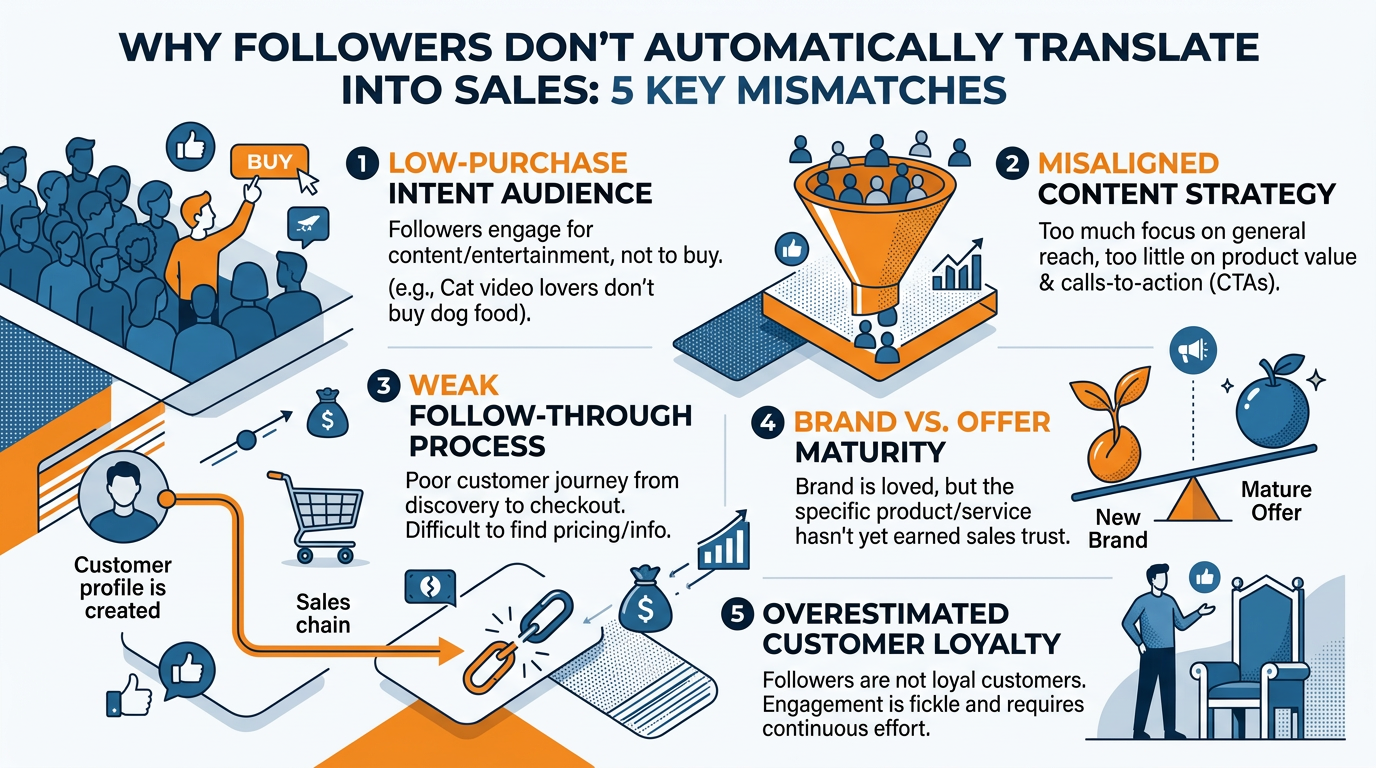
So why don’t followers make you money? Because the harsh reality is that most small businesses don’t have an audience problem, they have a leaky pipe problem.
I don’t play guessing games anymore. I just do a quick triage from reach to revenue: how many people saw it, how many clicked, how many turned into a lead, and how many bought.
Those 4 numbers will tell you where the money is leaking. And tiny tweaks add up quick.
If 10,000 people saw your post and your click-through rate is 1% then 100 people visited. If 2% of those people bought from you then you made 2 sales.
Double either of those rates and you just doubled your revenue without increasing your following at all.
A high view count with low click count means there is a disconnect somewhere in the promise and handoff.
To repair this, the post and the offer must be aligned so that they look like they were created to work together: the same problem, the same people, the same words.
The call to action must tell people what will happen when they click, not to just “see the link”.
I have even seen posts with good views and saves that generated almost no website traffic because the post was teaching something and the next step was just a generic shop page, and the brain didn’t get a clear signal to go from scrolling mode to action mode.
If you get a lot of clicks and not enough conversions, that means that your audience did their job and your page didn’t.
There’s friction on the page that you’re not seeing because you’re too used to it: slow page, too many fields to fill out, unclear pricing, unclear what the outcome is, no social proof.
You want one offer per page, one next step, and proof that removes risk like specific results, before and afters, or testimonials that address the concerns of your buyers. If you’re trying to quantify what’s working, this also fits with how to calculate engagement rate manually.
In the service business, this manifests as a lot of leads but not enough clients.
That’s rarely a follower problem, it’s a qualification and sales process problem.
You need to control who’s getting on the phone, what they’re booking the call for, and what decision they need to make by the end of the call.
If your rate is fine but the volume is terrible, that’s a distribution and consistency problem, not a follower problem.
The undiscovered cash flow poison is link-in-bio madness: a stack of choices with no clear next step and no continuity between post, page, and offer.
Your content should be a series, not a menu: one post, one next step, one page that delivers on the promise, one offer that’s hard to refuse.
Remove choices and add continuity and the same followers will produce an obscene amount of revenue.
1. Why followers don’t equal dollars: audience quality is quantifiable (and usually the culprit)
The reason why having more followers doesn’t necessarily generate more income is because not all followers are created equal and how they got to you is a sign of what they’ll do next.
If you gained your followers via giveaways, trending topics, memes, or more generalized content that made people feel good then you’re more likely to have followers that like you but can’t afford to, or don’t need to or have no desire to buy from you.
For a small business that is catastrophic because each subsequent post has to battle against an audience that has been conditioned to expect entertainment over value.
A gain like that doesn’t just not serve you, it actually reduces the effectiveness of your sales by filling your following with people who will never convert.
You don’t have to guess.
You can determine intent mismatch by isolating where your follower growth is coming from versus your lead generation.
Thirty days is plenty of time to figure this out.

If you measured this, you’d realize which of your posts have gained the most followers, versus which of your posts have garnered the most DMs, quote requests, bookings, or email responses.
They’re not the same.
I use a basic ratio.
How many inquiries per 1,000 viewers, versus how many follows per 1,000 viewers.
A post that generates a ton of follows but almost zero intent actions is drawing looky-loos.
A post that generates fewer follows but a larger percentage of clicks, saves, or messages is drawing buyers.
Once you begin to measure both, you quit arguing about content styles and you start doubling down on what’s generating money signals.
The words in your DMs and comments also go a long way to telling you if you have fans or customers.
Fans sound like “you’re so cool,” or “hey check this out” or “what’s your favorite _______” or even just an emotion, customer sounds like “how much,” “what’s included,” “do you have availability next week,” “can you work with someone in _________,” “can you deliver this to _______,” “can you do this in the _______ industry,” “what’s the outcome,” “what’s the process.”
You can make this measurable by counting how many messages contain the words pricing, timeline, location, or fit.
I’ve seen accounts with high engagement, but less than 5% of their messages contain any one of those buying constraint words and it’s a clear indicator the content is functioning as entertainment, not commerce.
Last but not least, inspect for geo/language/timezone mismatch: when you’re offering local or geo-restricted services or deals, and the majority of your audience isn’t in your service area, you can have a popular account but no significant income.
Content-offer fit is the underlying mechanism here: if the content that gets you followers isn’t the content that gets you sales, you’re teaching the algorithm and your audience to expect the wrong thing.
That’s also why niching down isn’t just a branding decision, it’s a revenue one: it increases the relative proportion of your audience that is in your service area, thereby increasing your conversion rate without needing more eyeballs.
Why followers aren’t revenue: revenue is distribution systems you control and partnerships you can scale
The reason followers don’t translate to money is simple: followers are rented attention.
The algorithm can screw you at any moment, your most viral post can reach 8% of your audience, and your sales funnel is as predictable as the weather.
Consistent income happens when you create channels that you actually control: an email or SMS list, a community that you can reach directly, retargeting audiences that allow you to follow people around the internet who are interested in what you offer, and a basic CRM that tracks who’s raised their hand and asked for what. One reason this matters is that full-time content-business creators reported an average of ~4K followers across all channels, according to a 2023 benchmark shared in this creator economy research preview.
When you own the connection, you don’t have to start over from scratch every time the algorithm flips out.
This is how small businesses can get paid quickly: switch from social as the endpoint, to social as the starting point.
Every good piece of content should be designed to create a next step on a medium that you own, then you should have a repeatable process to keep nudging visitors toward the finish line.
The math is fun because it turns into math and not motivation: if 300 people hit a page per month and you can bump a conversion rate from 1% to 2%, you just doubled your sales without acquiring a single new fan.
That’s the compound interest on distribution you own: marginal tweaks add up because it’s always possible to speak to the same audience the next day.
One of the most underutilized tools is partnerships and programmatic influence. That is because they give you access to an audience today instead of months later after your content has aged.
More content is linear. More partnership is leverage.
Someone has already established authority over a micro audience and they are more likely to actually generate demand from a recommendation than your cold content regardless of their audience size. This matches broader creator trends too: in 2022, 8.1 million Americans earned money as an independent creator, as reported in this creator economy trends report.
I have seen creators with a tiny audience with an offer that perfectly matches the audience’s problem in that moment blow away the results of a much larger account.
The goal is not to grow an audience in size. It is to find the best audience at the right time.
The gap between what you know and what you actually do is automation.
If you need to remember to respond to someone, follow up, invite them to a group or tag someone in your CRM, your follow up is broken and your cash flow is sketchy.
You need a system in place where every comment gets saved, every hot prospect gets a follow up series at the right time and every person who clicks on a link can be retargeted so that when people look at your stuff, it doesn’t stop at one scroll. The platform mix matters as well: one 2023 summary found 26% of creators said TikTok is their favorite platform and 26% said they earn the most on TikTok, shared in this survey-based creator economy report summary.
When you systematize follow up, social media stops being a vanity metric and starts being a money maker.
O Fim
Followers don’t equate to sales because followers is a really bad proxy for intent, distribution, and readiness to convert.
500 in-market followers ready to buy will outperform 50,000 followers entertaining themselves.
The numbers reveal it sooner or later: on most small business accounts, a small fraction of people click, and an even smaller fraction convert, so your sales are limited by the journey not the following.
To make revenue more predictable, you have to stop hoping for growth and start diagnosing it.
This means monitoring these 4 metrics over the same 30-day time period: views, clicks, leads, sales.
Low views high clicks means promise mismatch.
Low leads high clicks means friction or confusion.
Low sales high leads means a qualification or sales process issue.
Low volume OK conversion means distribution not follower.
This is the pivot that frees up any small business: first create a conversion funnel that makes the next step clear, then create distribution that repeatedly drives the right audience into that funnel. For brands trying to prove it out, it’s worth noting that 18% of brands cited “difficulty driving revenue” as one of their most challenging roadblocks in a 2024 poll, referenced in this influencer marketing trends PDF.
When you reduce options, improve continuity from post to page, and remove risk with proof and clear results, you can turn attention into action.
I’ve seen revenue double just by changing simple things like matching language from the post to the headline of the landing page, narrowing the next step to just one action, and shortening the time from first interest to follow-up.
My philosophy is this: I see followers as top-of-funnel signal, then I architect the funnel and the distribution engine that makes sales inevitable.
Use follower growth to tell you what topics have legs, but use intent actions to tell you what’s actually selling.
When you approach it that way, you quit playing the vanity metric game and you start playing a game where revenue is a function of inputs under your control.
Related reads
4/27/2026
B2B SaaS social media benchmarks: Set the right targets.
B2B SaaS social media benchmarks: Set the right targets. The trouble with defining B2B SaaS social media benchmarks is that it's an inherently impe...
4/25/2026
Building a personal brand as a technical founder (without becoming a creator)
Building a personal brand as a technical founder (without becoming a creator) Creating a personal brand as a tech founder should feel less about ma...
4/20/2026
Creative Post Ideas for Sustainable Brands (That Don’t Sound Greenwashy)
Creative Post Ideas for Sustainable Brands (That Don’t Sound Greenwashy) That’s not what creative post ideas for sustainable brands should look lik...