Bakery Instagram Promotion: Create a Local Order Funnel
This guide reveals a concrete framework for local bakeries to use Instagram, converting online attention into foot traffic, pre-orders, and repeat business.
The thing is, if you’re trying to market a local bakery, you’re not doing typical Instagram marketing. You’re not trying to sell a course, or an app, or some kind of product that customers can leave in their shopping cart for days before buying. You’re trying to sell something that goes bad if not purchased, in a geographically limited area, to customers who will likely decide what to purchase on the fly. So your content needs to fit your baking schedule, your promotions need to move quickly, and your outreach needs to be location-targeted, so that you reach the right customers while the croissants are still warm.
A lot of content on the web is created for likes and a pretty feed. That doesn’t keep the lights on. In this guide to Marketing a local bakery on Instagram, I’m going to show you a concrete, reproducible framework that converts eyeballs into foot traffic, pre-orders, and repeat business. You’ll find out how to get in front of people who are already in your neighborhood, how to organize posts and Stories around daily sell-outs and weekend drops, and how to funnel attention into tangible outcomes like directions taps, DMs, and pickup times. When I experiment with new Instagram tactics, there’s only one metric that matters to me: Did this generate legitimate demand at the counter, not just on a screen?
For context, there are now 25 million active business profiles on Instagram, and more than 80% of Instagram accounts follow a business.
Bakery Instagram promotion: How to create a local order funnel
Want to get more traffic for your local bakery through Instagram?
Well, the first step is being visible when people search for bakeries on the platform, not Google!
Approach your profile like local SEO - if you are a bakery on main street, in Anytown, USA, have that in your profile name since that is one of the primary fields for in-app search.
People often search for what they are looking for, and where they are.
Get your category right, add your full address, and add the contact buttons that are in-line with how people can buy from you - all of these are also reported to be part of the business intent signals, such as website taps, calls, and directions.
I have even seen cases where an account had beautiful photos, but since they forced the user to go to their website to find the location or to place an order, it wasn’t performing as well as they wanted.
And for every second you delay them, you lose an order!
Second, create a conversion-focused bio that answers 4 questions at a time: what you offer, your location, your hours, and your call to action.
This should be functional, not fluffy, since local customers are skimming to make fast decisions.
Your last line should drive one simple behavior, depending on how you handle most of your orders (e.g. order by DM for tomorrow pickup or stop by before 11 to see the full pastry case).
Speaking from experience, the majority of local business pages I see receive many more profile views than website clicks, so your bio needs to do the work upfront. If you want to tighten what you track, you can pair this with a simple baseline using an Instagram engagement calculator so you can compare changes week to week.
Next, utilize the pinned post as a mini FAQ that cuts down on DM conversations and converts curiosity to purchase.
Pin the questions that you have to answer all day while you’re serving:
- turnaround time on preorders
- what to expect when ordering a custom cake
- what time of day you offer what menu items
- base prices (so only people that can afford you reach out)
- how you handle allergens, etc.
The less confusion there is, the faster a decision is made, and in a bakery, that can be the difference between selling out by 12 pm and having to clearance out at the end of the day.
Lastly, make use of the Highlight feature as your store sign for easy access.
Create Highlights that are titled "Menu", "To Order", "Custom Cakes", "Pick Up Information", "Best Sellers", "Reviews" and update it like you would your counter display board. For bakeries looking to streamline their menu presentation online, tools like WhatsMenu can help create an organized, easy-to-navigate menu experience for customers.
Unify: choose one primary way that you’d like customers to place their orders (DM, text, fill out an online order form, website, etc.) and keep that consistent throughout all posts, stories, and even in your comments!
If you keep directing customers to one platform, Instagram will no longer just be a portfolio.
Content that matches your baking schedule
For a local bakery, an effective Instagram marketing strategy would be to generate content that corresponds with what’s happening at the bakery.
and that will sell out that day’s products
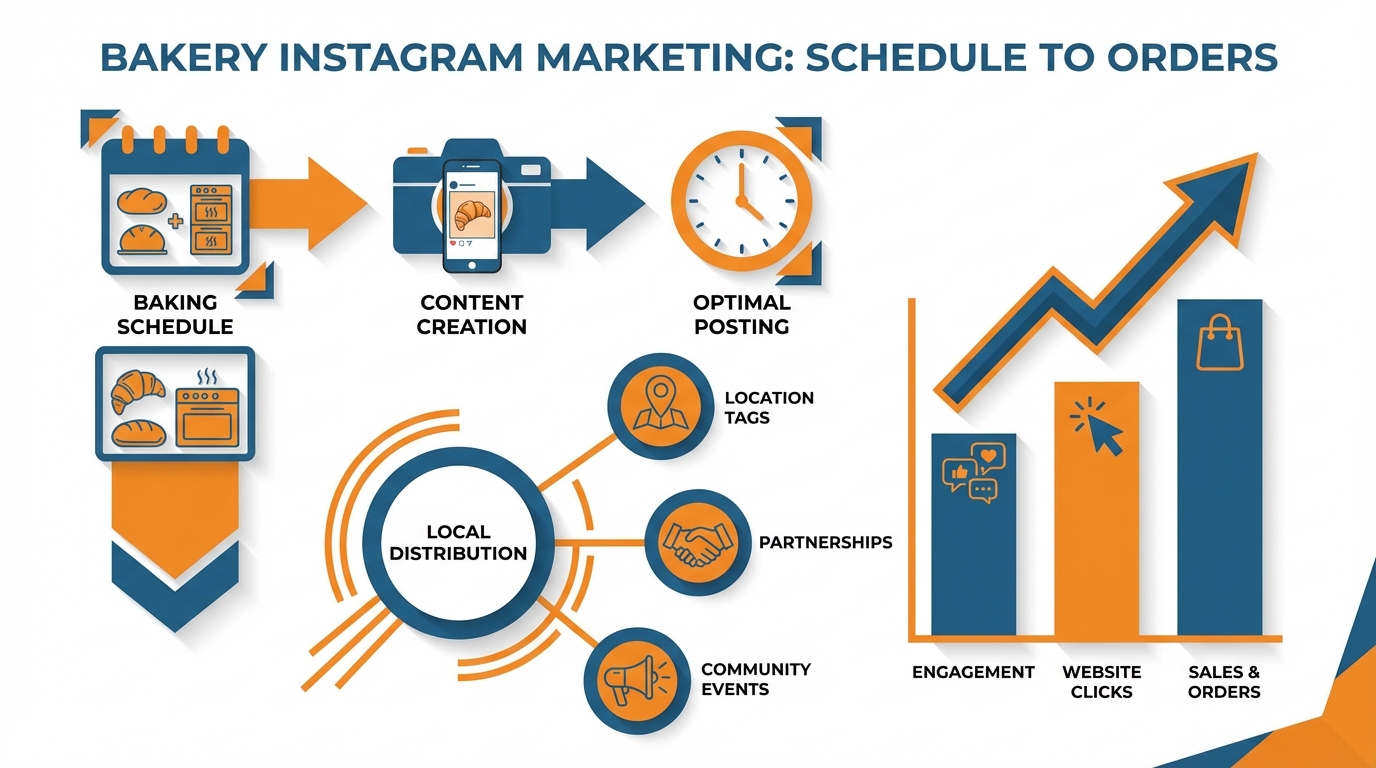
What I’ve found is that the ideal frequency for an Instagram account for a local bakery is whatever matches the frequency of your bread.
That means if you can get content up around proofing and baking time, decorating and glazing time, case reveal time, first batch sold out time, etc., and especially can consistently post about these events around the same times daily, that’s when you begin to really draw in local followers who will come back daily looking for those posts and translate their Instagram habit into walk-ins.
I call this your “daily meeting with the neighborhood,” and it’s much more valuable to a bakery than the occasional viral sensation.
Content should be curated according to business needs, not visual appeal.
Content should be chosen to support business essentials: profit, volume, and reliability.
For example, if every single customer purchases one more unit when they see that there’s something new and limited, then running a profitable product in the right frequency will grow average order value without additional foot traffic.
In an average week, I would intentionally have one hero item reappear in different themes because frequency is key for people to remember us in their morning commutes.
Approach each format as a tool, not a trend, as each format dictates a different action.
Reels are the discovery format, so have Reels targeting new customers with quick, sensory content, such as opening the oven door or unveiling the donut case, along with a location tag to attract local customers.
Carousels are the save format, so leverage Carousels for decision-making, planning content, such as the donuts of the week, an easy way to order, or a list of pickup times, as saves become a personal menu for customers.
Stories are the in-the-moment shopping format, so treat them as such: “the donuts of the day,” “what we still have in stock,” “what we just sold out of,” and polls to gauge demand.
And to avoid the what the heck am I gonna post today?! anxiety? Create themes for your account that are cyclical, and based on what you’re already doing: a case of the day, your process, reactions from customers, seasonal offerings, decorated cakes, employee feature… and create a selling out flow for your stories that aligns with your pickup schedule: pre-drop hype, countdown, drop alert, what’s left, final hour alert… and make it achievable for a small team by creating content in bulk, in small bursts, with a few simple shots from the same angle and same lighting that don’t affect your operations?
When I do this, I can film an entire week’s worth of moments in a few minutes because you’re already producing the content for me. If you want help structuring that cadence, an AI social media calendar generator can turn those recurring events into a repeatable schedule.
One more data point: the 2024 Social Media Industry Benchmark Report lists a median Instagram engagement rate of 0.43% (across industries), with a median posting frequency on Instagram of 4.7 posts per week (across industries).
Local distribution: location tags, partners, and collabs
Want to promote your bakery in town using Instagram?
A great way to get more locals in the door is by using location tags, but also by partnering with other local businesses or accounts.
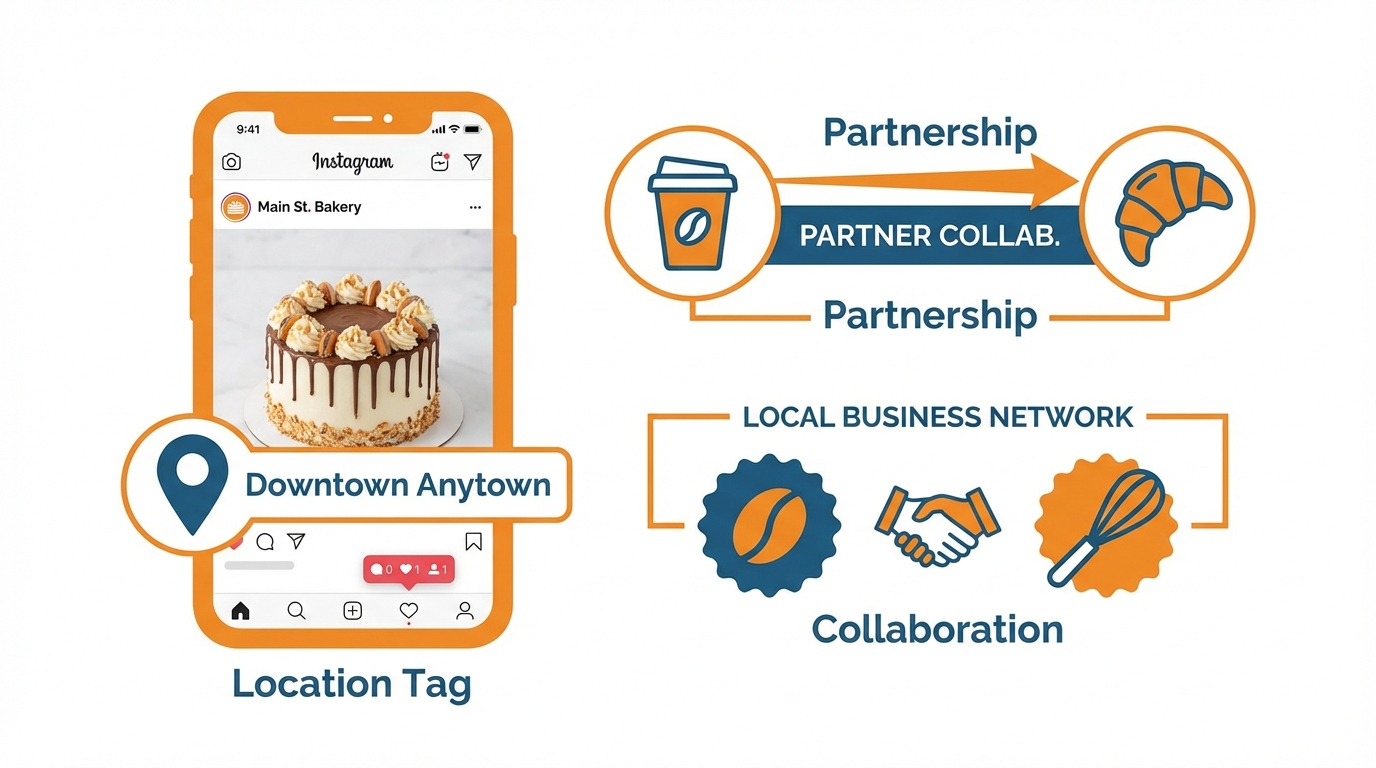
Want people to come to your bakery because of your Instagram marketing efforts? Then you’ll need to tag your bakery’s location on every Reel, post, and Story you create. I’m not talking about just getting the location right, but literally tagging the location. Here’s why. When you tag a location, there’s a page for that location where people can go and see all the posts tagged there. So when someone is thinking about going somewhere in their area, they might check the page for posts in that area.
Here’s why it matters. When I post a picture of cinnamon rolls, I don’t tag Chicago. I tag River District, Old Town, or Downtown Eastside. Why? Well, when I tag Chicago, it attracts people who don’t live in the area. It also attracts people who are just scrolling through their feeds. But if I use the specific neighborhood names, it attracts people who are actually looking to visit my area.
I also try to keep the text in the image and the caption consistent, so if I’m using Old Town as a tag, I’ll use it in the caption and text on the image too. This is because I want to give Instagram as much context as possible, and also because I want to make it easy for locals to know if we’re worth the trip.
2nd: Forget about publishing and focus on distribution in the local ecosystem.
The most important growth hack is when other accounts share you through Collab posts or stories, as these expose your product to their local, engaged audience which trust them as a tastemaker.
A Collab post on both you and the local coffee shop page lets you display the same Reel on both accounts, and you reach their daily customers without having to pay for their attention.
Approach this in a systematic way: each week, you are going to try and produce a few pieces of content which are meant to travel, such as a coffee pairing featuring your latest baked goods with their espresso shot, a new pastry that is meant to be a complement for their morning rush, or a special promotion where you and them offer a bundle but only if you visit during a specific timeframe.
This way, create a small list of partner businesses and treat it as a regular calendar rather than a random favor.
Begin with businesses that overlap in demographics and hours of the day, such as: coffee shops, gyms, schools, wedding venues, photographers, offices and even neighboring salons.
Treat each as a two way partnership, you share my post and I share yours.
You come into my bakery post sequence and I come into your morning routine post.
This way, each post will drive foot traffic, DM’s, and catering leads, and a partnership will develop because each post generates tangible business for the other.
Lastly, partner with creators by purchase intent, not by audience size.
Pages based on local food, micro-influencers that live within a driving distance, or event planners can drive more traffic to your store than large accounts because their following are more likely to be able to physically visit your business.
Track results tied to purchase such as directions clicked, direct messages asking about your pickup hours, and customers telling you about a post when they come in, not by likes.
Then incorporate viral triggers that make the post shareable such as a limited box of weekend orders that sell out, a new seasonal product with a specific order pickup date, an office catering order day that coworkers will share with other coworkers, and a fundraising box that can be purchased for a local charity.
They are naturally shareable because they tie into urgency, a local message, and an easy reason for someone to share your business with their audience.
Metrics and experiments that drive orders
Want to promote a bakery you own in town on Instagram:
Keep tabs on whatever’s making you money, and reinforce it with targeted advertising if possible.
When you switch to using the metrics that indicate purchase intent, instead of focusing on the metrics that indicate popularity, your local bakery’s Instagram strategy becomes less aspirational and more reality-based.
Profile taps (think, “is this bakery near me?”), website taps (think, “I’d like to order something now, please.”), directions taps and calls (think, “where is this bakery? I’d like to go now!”), direct messages (think, “I need a cake for my kid’s birthday party next week.”), saves (think, “I want to remember this bakery.”), shares (think, “I have a friend who would love this!”), and swipes on Story links (think, “I need a reservation for dinner this weekend.”) - these are the numbers I check every week (instead of daily, because same-day sales can be so skewed based on what you have fresh and ready in the display case - I like the weekly average better).
And when it comes to your local bakery, I’d argue that directions taps and DMs are probably more important than follower growth when it comes to revenue indicators.
Want to move quickly? Iterate on 2-week experiments the way a baker iterates on test batches: change 1 thing, hold everything else constant, and check your signal metrics.
You can experiment with the way you present the offer by changing from limited drop to fresh out of the oven timing, or change your call to action from pre-order for pickup to come in before sellout.
You can experiment with the frequency of your Reels by posting one additional Reel per week and observing whether profile visits and directions taps go up, not just views.
You can also experiment with your timing by posting at times when your customers are making purchases, like on their way to work, during lunch, or when picking up their kids from school - I’ve seen that same item do really differently if posted 2 hours earlier because it catches someone before they decide where to stop.
If saves and DMs go up and directions taps go down, that probably means you are succeeding at planning content but failing at communicating availability.
Once you have validated demand with your organic posts, bridge the gap from organic to paid, but do so in a way that removes all the risk.
Rather than placing ads for random items you think people might want, you can amplify posts that are already receiving clear signs of intent, such as saves, shares, and direct messages, per impression.
This is essentially your free in-built ad testing ground, because it’s paid for with attention you’ve already attracted.
Personally, I put a little budget behind a successful post, and monitor for an increase in direction requests and direct messages in the following 48 hours, because demand for baked goods is very perishable.
It also means you avoid one of the big pitfalls I see bakeries fall into, which is paid advertising of something that might look amazing but isn’t translating into footfall or sales.
If you decide to go with local ads, keep them sharp: targeted by distance to the store, limited in the time they run to what you can fulfill, and focused on account interaction for pre-orders and weekend releases.
This means, for example, a 3-hour ad for a 10am pickup window, mostly shown to account engagers (as that’s the group that already knows you exist, and just needs a nudge on timing and inventory).
And actually do some sanity-check attribution, since you won’t get perfect tracking at a small business: alternate Story promos where customers have to mention seeing your ad in-store, or use a unique keyword in your DMs to claim an order, or try to match the names on orders to people you messaged in the days before.
If all those metrics seem to rise and fall together, then Instagram is doing its job, even if you can’t trace each and every croissant back to the ad that sold it.
If you’re testing captions and calls to action at speed, an AI caption generator for Instagram can help you draft variations while you keep your offer and timing constant.
The End
Instagram promotion of your bakery doesn't have to feel overwhelming if you approach it as a system rather than a collection of random posts.
You can repeatedly rely on the same four-cylinder engine: An optimized profile that quickly addresses the questions that matter most, process-oriented content that reflects what's going on in your kitchen and display case, proximity-focused distribution that gets you in front of local customers who can visit today, and metrics-based amplification that increases the reach of posts that drive intention more than just engagement.
The benefit you have as a bakery over any other business is that you have a time-sensitive product, and your Instagram can create time-sensitive demand.
Your production schedule is exactly that-a schedule-and when you post in accordance with it, you’re not just posting, you’re creating Pavlov’s dog out of the local audience.
They know when the case is filled.
They know when new items are released.
They know when things sell out.
I’ve seen tiny local accounts with small followings deliver big results because they were optimized for directions taps and DMs, not beauty, and those two things are your biggest indicators of same-day foot traffic.
What you can do right now to stop losing local orders is to choose a single flow, and make that flow mandatory.
Choose one thing you want most local users to do, and lock your pinned posts and Highlights so they make that one thing as easy as humanly possible.
If you prefer DM orders, pin the ordering rules and pickup windows; if you prefer pre-orders, pin lead time and minimums; if you prefer walk-ins, pin when the case is fullest and when sellouts are likely.
The reason is simple: most local shoppers decide in seconds, and each additional hoop you make them jump through silently costs you orders.
This week, do one sell-out Story and use it as a micro-test.
Push it with an in advance the door Story, at the moment of decision inventory available, plus two more inventory notifications to show it’s scarce, but not be spammy.
If it works in the next 24 hours, you’ll see a lift in profile views, directions, calls, DMs, and shares, and if you do, you’ll have a weekly repeat button you can push locally.
Related note: the Instagram posts engagement by number of hashtags 2022 | Statista report found that posts with 3-4 hashtags had an average impression rate of 3.41% (March 2022 report), and engagement decreased when more than 5 hashtags were used (same report).
And for post-type context, Instagram Statistics Marketers Should Know in 2025 [Updated] reports an average engagement rate per post for Instagram influencers in 2024 of 1.8%, with Reels engagement rate (influencers) at 2.08% (highest among post types reported), carousel posts engagement rate (influencers) at 1.7%, and photo posts at 1.17%.
Also, Analysing celebrity and influencer marketing of food and beverages to adolescents on Instagram (Public Health Nutrition, 2025) analyzed posts from January 2021 to May 2023 and found brand tagging appeared in 96.9% of posts and brand logos in 94.2%.
Related reads
3/7/2026
TikTok to Reels Crossposting Workflow 2026: The Ultimate Guide
Learn the 2026 TikTok to Reels crossposting workflow. Optimize for speed, views, and Instagram-native quality to beat algorithms & grow.
3/2/2026
Threads for business: How to get started in 2026
Discover how small businesses can leverage Threads in 2026 for conversation-led growth. Learn to test offers, build a routine, and convert attention to action within the Meta ecosystem.
2/21/2026
How to Market a Law Firm on LinkedIn
Market your law firm effectively on LinkedIn. Learn a system that leverages individual lawyer profiles to build trust, relationships, and attract ideal clients.