Healthier Social Media Relationship: Stop Mindless Scrolling
Discover a system to stop mindless social media scrolling without abandoning the internet. Reclaim your time and boost productivity for your business.
A healthier relationship with social media (without abandoning my life)
I do not want to quit the internet. I want to stop the little leaks where my thumb opens social media and my brain doesn’t even get a vote. I’m checking a message for a customer or researching a competitor and before I know it, I’m 47 minutes deep in content that has nothing to do with money, love, or healing. If you have a small business, that’s not just frustrating, it’s costly. The average person spends 2.5 hours a day on social media, which is over 17 hours a week, and it’s not something that shows up on your schedule as something that needs to be solved. According to a Kagan survey analysis of U.S. usage patterns, American adults averaged 2.4 hours/day on social media in Q3 2025.
This is why most advice fails. A generic tip list can’t win against a reflex. You need a system for how to stop wasting time on social media that works even when you are tired, stressed, or in between tasks. In this guide, you are going to:
- Diagnose your specific scrolling trigger
- Set constraints that match your real work needs
- Build quick replacements that actually work in the moment
- Run a simple weekly review so the change sticks instead of resetting every Monday
Yes, I am assuming you might need social media for marketing, customer support, recruiting, or partnerships. We’re going for controlled use that preserves your attention, not naive abstinence.
The truth is, I’m scrolling to discover my trigger → craving → reward loop
If you want to learn how to stop mindlessly scrolling on social media, you first have to stop thinking of it as a moral failure and start thinking of it as a cycle.
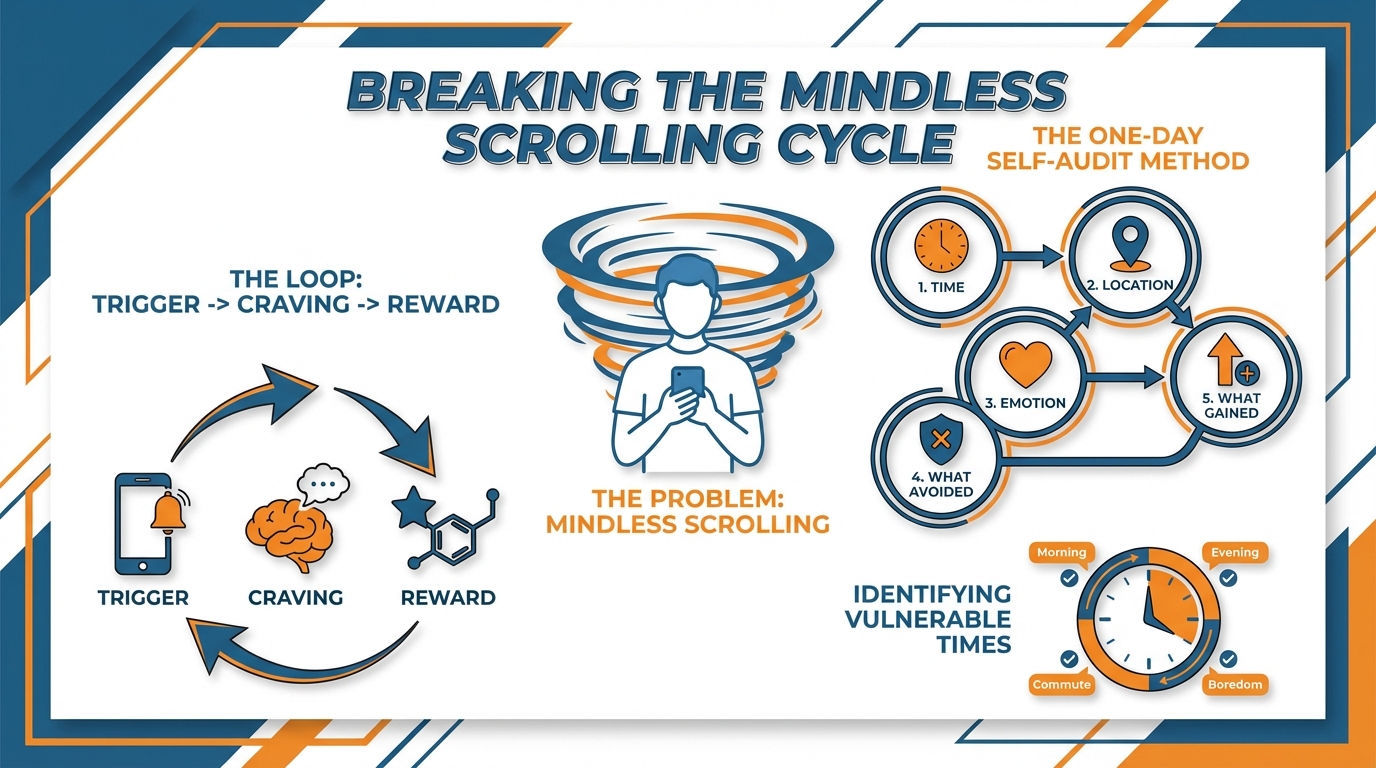
All mindless scrolling has a trigger -> craving -> reward, and the reward is often very small but very predictable.
I notice it when I open an app to do something that I need to do and my brain just decides to do some quick shopping for a feeling instead.
The same “how” won’t work for all the different “why’s,” so you might want to start by figuring out if you tend to do most of your scrolling for these common reasons: boredom and low stimulation, anxiety and avoidance, procrastination on a difficult task, loneliness and connection-seeking, habit and auto-checking, or work-related “just posting” that then turns into consuming.
Different “why,” different lever.
Do a one-day self-audit
Do a one-day self-audit. It’ll take you less than 2 minutes per occurrence.
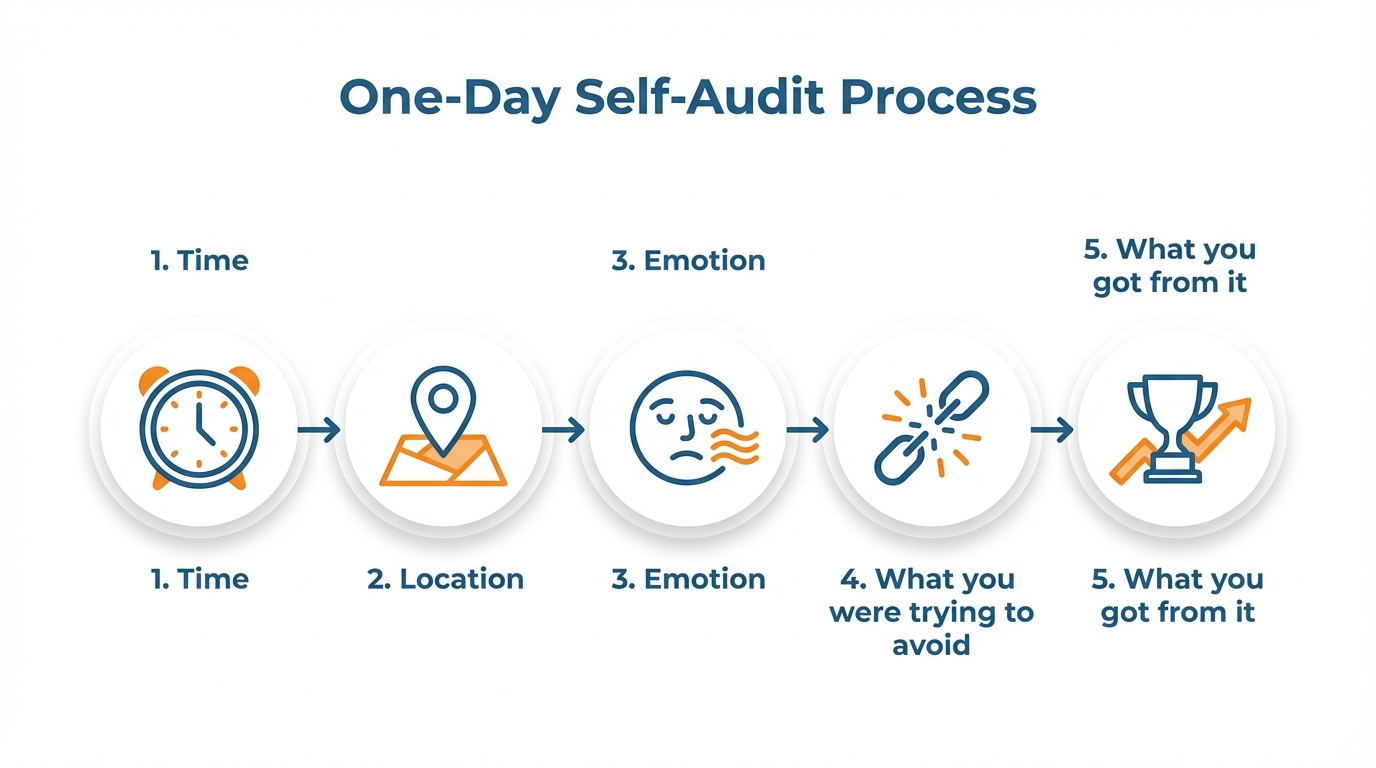
The next 3 times you open a social media app today, note 5 things:
- Time.
- Location.
- Emotion.
- What you were trying to avoid.
- What you got from it.
You don’t have to be right, you just have to be honest. And when you do, the patterns will be obvious.
If the emotion is “dazed” and the reward is “entertainment,” you’re probably seeking novelty. If the emotion is “anxious” and the reward is “relief,” you’re probably fleeing from stress. If the emotion is “neutral” and the reward is “that hit of done,” you’re probably hungry for completion, not information.
Then identify your vulnerable times
Then identify your vulnerable times.
These are the tiny intervals where most wasted time actually takes place.
In the lives of most small business owners, it clusters in four areas: in bed in the morning (when you’re unmotivated), in transition (when you want a dopamine fix), during a task (when you hit a rough paragraph or a difficult customer email), and at night (when you just want to “unwind”).
These intervals are important because they are regular.
Regularity trumps motivation.
Once you identify your danger zone, you can make one rule for that specific time instead of attempting to control your whole day.
Lastly, figure out what type of scroller you are
Lastly, figure out what type of scroller you are - the right constraint varies based on the type of user.
A comfort scroller needs to add better decompression that actually terminates, not more soothing content to soak up.
An avoidance scroller needs to add a way to resume a daunting task in small, palatable increments - so they don’t feel the need to hide in the app.
A habit-checker needs to add friction at the very moment their thumb acts, not massive life changes.
A work-justified scroller needs to add a stricter work sandbox, so posting doesn’t leak into reading, which is one reason I like having an app where I can create, on-brand content quickly and keep the work portion short, so the algorithm can’t decide what to do next. If you want a related system for structure and consistency, see Social media content calendar.
Give me a no-scroll setup
Make the default harder, not me.
Want to stop mindlessly scrolling through social media? Don’t count on willpower; just break the habit loop by removing the triggers. The trigger is not usually a choice; the trigger is a ping, a colorful tile, or a force of habit on your home screen.
Intentionally make your phone uninteresting: disable notifications until only a human can get ahold of you, arrange your home screen so social media is not on page one, use the grayscale setting, and add some friction to your logins so that each time you need to type in a password.
If you use social media for your job, separate work from personal profiles when you can, because hybrid profiles cause hybrid behaviors: you open for a customer glance, but the algorithm hands you fun in the next swipe. If you’re dealing with inconsistent habits, Inconsistent social media posting connects well with this problem.
Then use limits as guardrails, not wishes
The average time on social media is 2.5 hours a day, and the insidious thing about it is that it doesn’t come in one big chunk, but a million little chunks that destroy flow and increase the time tasks take.
Contain your social media use within the time frames that your business actually requires, use time limits that actually kick you out of the app, and establish areas where it is verboten: in the bedroom, at your desk, and in meetings are the big three.
You’re not trying to be a saint here, you’re just trying to preserve your attention where it earns you revenue and decreases your anxiety.
The key is to introduce just enough friction so that you don’t overcorrect and bounce back.
Add 1-2 constraints at a time to address your primary leak, not all the things at once.
If your leak is first thing in the morning in bed, make that time/space context phone-free until your feet are on the ground.
If your leak is the space between tasks, stay logged out of social media and make yourself log back in.
Add a constraint a week, not a day: your brain can only absorb one constraint at a time and gradual is better than going nuclear (which you will immediately revert the minute you have a bad day.)
Finally, prepare for the rebound effect as an entrepreneur, not an evangelist
When you keep overriding your own system, it’s not a sign of weakness; it’s a sign that you still haven’t made it hard enough.
Add friction or reduce options: fewer channels, fewer logins, fewer clicks.
Or shift the proxy behavior so that the urge has somewhere to be satiated and concluded, whether that’s a 2 minute walk, a 30 second note on the next action, or a 10 minute content generation session that keeps you within a work modality.
If I need social media for promotion but I don’t want to let it devour my day, I try to do batch creation in a single session, then quit; this is why tools like WoopSocial allow me to make the working portion fast and contained by rapidly producing on-brand posts rather than letting me get lost in browsing. If you want to go deeper on this approach, Social media automation fits this exact use case.
If I must use social media for work: treat it like a task, not a tab
If you rely on social media for your business, it’s not about spending less time online, it’s about spending time online intentionally.
The quickest way to figure out how to avoid social media procrastination without derailing your marketing is to create boundaries between content creation and consumption that you can actually maintain.
Assign a job description to social media: two short office-hour windows per week to create and schedule content, and one small window for necessary checks.
When you’re not in one of those blocks, social media should be closed - not sitting in a tab just waiting to hijack your next transition.
To prevent work from expanding, you require a workflow with a finish line.
Record ideas as they arrive, but do so without logging into the platforms: a one-sentence hook, a rapid-fire client question you find yourself answering over and over again, or a before-and-after snapshot of your solution.
Then, at your scheduled office hour, you produce in bulk: five to ten articles at a time, aligned with your offers, and that is it.
That’s how you preserve concentration: you are inventorying, not innovating, and you are not allowing the algorithm to hijack you into fun.
Consistency gets rid of the pressure of always being on, and consistency is something that comes from having a schedule. It doesn’t come from deciding what to do on a day-to-day basis.
I think most small business owners waste a lot of time because they make social a day-to-day emotional decision. That ends up being 20 micro-decisions, and it’s really those micro-decisions that waste your time.
Every time you get interrupted, it takes you out of flow and it takes longer to do things. If you put it on a schedule, you get the best of both worlds.
Your audience still gets consistency, and you don’t have to have an internal dialogue every day about whether you should do it, what you should do, whether you should just quickly check this one thing.
However, if I want to achieve this same consistency and not have to spend all my time in the applications, I plan an entire month’s worth of content with WoopSocial and post everything across all my channels at once. If you want a more structured cadence, Weekly social media system expands on that scheduling mindset.
The secret here isn’t the tool (although, again, it’s really helpful), it’s the fact that I can create, schedule, and then walk away.
As long as you approach your social media channels as an operation that has an opening and a closing time, you’ll reap all the rewards for your business without having to sacrifice your time.
Stick to it: my 2-week feedback cycle and relapse plan (the missing piece)
If you want to know how to stop mindlessly scrolling through your feeds and make it stick, it has to be treated as a two-week experiment not a life overhaul.
The first week is tracking: use the Screen Time app, and in addition make a quick note every time of the trigger that makes you want to go to social media.
After you have that data, identify the one time that is eating up the most time.
For many solopreneurs, it’s not all day long, it’s just one consistent time of day where they are losing hours, like the first 20 minutes of the day, between clients, or when they scroll before bed and end up working a second shift.
You’re not solving the whole problem, you’re identifying which time of day is the most expensive.
In Week 1, you use the minimum number of constraints to get a bit of traction plus an alternate behavior for each of your red flag moments so you give your brain an alternative destination.
Constraints remove the entry point; alternates fill the reward loop.
You are waiting or in a lull: you do something that fills that 2-minute time capsule: you open an article you saved, you take a short walk, or you write 1 offline note for the next day.
You are stopped in the middle of a task: you do a 2-minute restart: you breathe, you stretch, then you write 1 micro step to get yourself moving again without having to negotiate with yourself.
You feel anxious at night: you have a screenless signal for unwinding like you read a book, you take a shower, or you write in your journal so you let the signal end your day instead of open a new dopamine container. In a randomized study summarized by the University of Bath, a one-week social media break led the break group to average ~21 minutes of social media use during the week vs ~7 hours in the control group.
In week two, you make adjustments based on what didn't hold, not what ought to hold.
Go through your logs and make a simple inquiry: where am I still losing time and what would have been the minimum amount of friction that would have prevented that one instance.
Add friction there and only there or you will chafe and binge scroll.
Here's also where an identity anchor makes progress quantifiable: what is a 'normal' day for me like?
Perhaps I'm only allowed to check the site twice a day, I only post once during a certain time period, and I'm not allowed in otherwise.
When I do that, I quit debating with myself all day because the decision is already made, and my metrics show whether I'm abiding by it.
The relapse is not a failure; it’s an essential part of the script.
If you slip, there are 4 things to do: Minimize shame, Identify the trigger, Change 1 variable, and Don’t wait for Monday.
You don’t want the data point to be, “I scrolled.”
You want the data point to be, “Why did I scroll right then, and what would have made that harder or unnecessary?”
If you slipped because you had to create a post and you got sucked into scrolling, shorten the amount of time you have to create so it feels more like a defined sprint rather than an endless marathon; tools like WoopSocial can help you create a month’s worth of posts in a short period so you can get out, rather than linger on the platforms. Evidence also suggests measurable benefits from short breaks: a one-week social detox study in JAMA Network Open reported anxiety symptoms reduced by 16.1%, depression by 24.8%, and insomnia by 14.5% in young adults.
You want to get to a place where you can use these tools in a way that respects your time and your income, even on your most difficult days.
A healthier relationship with social media (without abandoning my life)
The most important lesson I learned here is how to stop wasting time on social media is not about changing who you are. It is about designing a scalable protocol.
You identify your leak loop, introduce just enough friction to break the leak point, create work-friendly exceptions so you can market and serve clients, and review it every week to adapt to your reality.
You do weekly reviews because most attention leaks happen around specific conditions like transitions, tricky projects, and mental fatigue at the end of the day, and that is why subtle adjustments in the right spot outperform radical solutions you can’t sustain.
Here’s the easiest thing you can do today: find your #1 trigger, and flip one default. Not ten defaults. Not a total phone reset. One.
If your trigger is between tasks, flip the default from “open social media app” to “write the next physical action for the task on a sticky note.”
If your trigger is anxiety, flip the default from “scroll for relief” to a two-minute decompression break that ends intentionally, like a short walk to fill up a water bottle.
If your trigger is boredom, flip the default from “novelty on demand” to a pre-selected, bounded alternative like reading a single saved article.
This works because “scrolling” is really just a quick attempt to change state, and you win by giving your brain a faster, cleaner state change than the algorithm can provide.
Still tied to social media because of work? Save your relationship by separating making from looking and by giving social media office hours.
You don’t need more hours on social media to post consistently. You need less of a gateway.
Post in batches. Post during sprints.
Save ideas in a separate journal and treat posting as a task like sending an invoice: it has a beginning and an end.
To put the time into perspective, if the average time spent on social media per week is 17 hours, it means 30 minutes of less social media a day is 3.5 hours a week freed up, which is enough time to send one week’s worth of follow-up emails for sales, rework one part of your client onboarding, or plan out a month of content.
Last, make the weekly review mandatory and ruthlessly factual: where did you waste time again, what prompted it, and what one thing would have prevented this one occasion.
I don’t aim for perfection; I aim to tighten the system by one leak at a time.
If your leak is that content creation pulls you into browsing, reduce the content creation time and make it easier to produce multiple posts at once so you can schedule and go; this is also where something like WoopSocial comes in handy, as it can generate on-brand content ideas very quickly and allows you to plan a whole month at once. Separate but related: a randomized controlled trial reported in BMC Medicine found the intervention group averaged 129.46 minutes/day of smartphone use during a 3-week program vs 264.19 minutes/day in the control group.
You don’t want to give up social media; you want to make it boring again unless you actually need it.
Related reads
4/27/2026
B2B SaaS social media benchmarks: Set the right targets.
B2B SaaS social media benchmarks: Set the right targets. The trouble with defining B2B SaaS social media benchmarks is that it's an inherently impe...
4/25/2026
Building a personal brand as a technical founder (without becoming a creator)
Building a personal brand as a technical founder (without becoming a creator) Creating a personal brand as a tech founder should feel less about ma...
4/20/2026
Creative Post Ideas for Sustainable Brands (That Don’t Sound Greenwashy)
Creative Post Ideas for Sustainable Brands (That Don’t Sound Greenwashy) That’s not what creative post ideas for sustainable brands should look lik...