Social Media for Pre-Launch Startups: Build Demand & Validate
Learn how pre-launch startups can leverage social media to validate demand, attract qualified leads, and build a powerful launch pipeline. Forget follower counts – focus on real conversions.
Social media for pre-launch startups
Social media for pre-launch startups is not about hyping something you can’t deliver yet. It’s about validating there’s demand as soon as possible, and populating your launch funnel with things that can be tracked until the traction arrives. If you’re bootstrapping a startup or small business, there’s no room for getting suckered into activities that look sexy in your bio but don’t produce money. You need important signals: qualified signups to a waitlist, beta testers who will share their insights, discovery calls with folks willing to pay you, and pre-orders that prove people are willing to pay you.
The issue I find is that nearly all the pre-launch advice is optimizing for followers first. That’s the wrong goal. 1,000 new followers who aren’t your target customer won’t help you dial in your positioning, price, or proposition, and they won’t buy from you on launch day. What will is using social as a demand test: throwing problems, promises, and propositions at a targeted audience and seeing who responds and why. When I think of each post as an experiment, I start to understand what types of language attracts the “right” people and what types of posts attract the “wrong” people.
This post will show you how to use social media for pre-launch startups, the practical way: Selecting the right networks for your target audience, creating the right pre-launch content when you don’t have any customers, and measuring impact to real results. You will leave with a simple strategy to build a pipeline before you launch so your first week is not a gamble, but a result of the effort you put in beforehand. If you want a deeper baseline on the mechanics of repeatability, see social media automation.
When you’re building something new, here’s a good rule of thumb for social media: instead of aiming to increase your number of followers, begin with a conversion in mind.
What does that mean? It means you figure out what action you want someone to take, and you reverse-engineer that process.
You build your social media presence around leading people toward whatever your conversion is.
What’s a conversion? It depends on what you’re building.
Maybe you need people to sign up for a mailing list.
Maybe you need people to fill out a survey.
Maybe you need people to make a purchase.
The key is that there is something specific you need people to do, and that thing should dictate how you use social media.
Because otherwise, you’re just throwing spaghetti at a wall.
And I don’t care what kind of foodie, artisanal, farm-to-table, local, organic, gluten-free, fair-trade, conflict-free, expert spaghetti you’re using.
Without a clear conversion in mind, it’s still just aimless.
Aimless activity is the enemy of the pre-launch startup.
So begin with a clear idea of what you want people to do.
Then use social media to make it happen.
In Social media for pre-launch startups, a conversion is anything that gets someone closer to revenue before you are fully launched. Most likely, that’s a waitlist signup, a beta application, a discovery call, or a preorder.
You should choose one primary conversion for the next 30 days, not four, because focus is what makes your messaging measurable. This matters because research like the survey summary on startup marketing strategy notes that 41.3% of startups do not have a digital marketing strategy (survey of 120+ B2C startups).
If you’re a local service business validating an offer, a discovery call might be the cleanest conversion. If you’re building software, beta applications filter quality better than a generic waitlist.
I treat everything else (likes, follows, etc.) as secondary signals if they increase that one conversion.
Build a funnel with intent
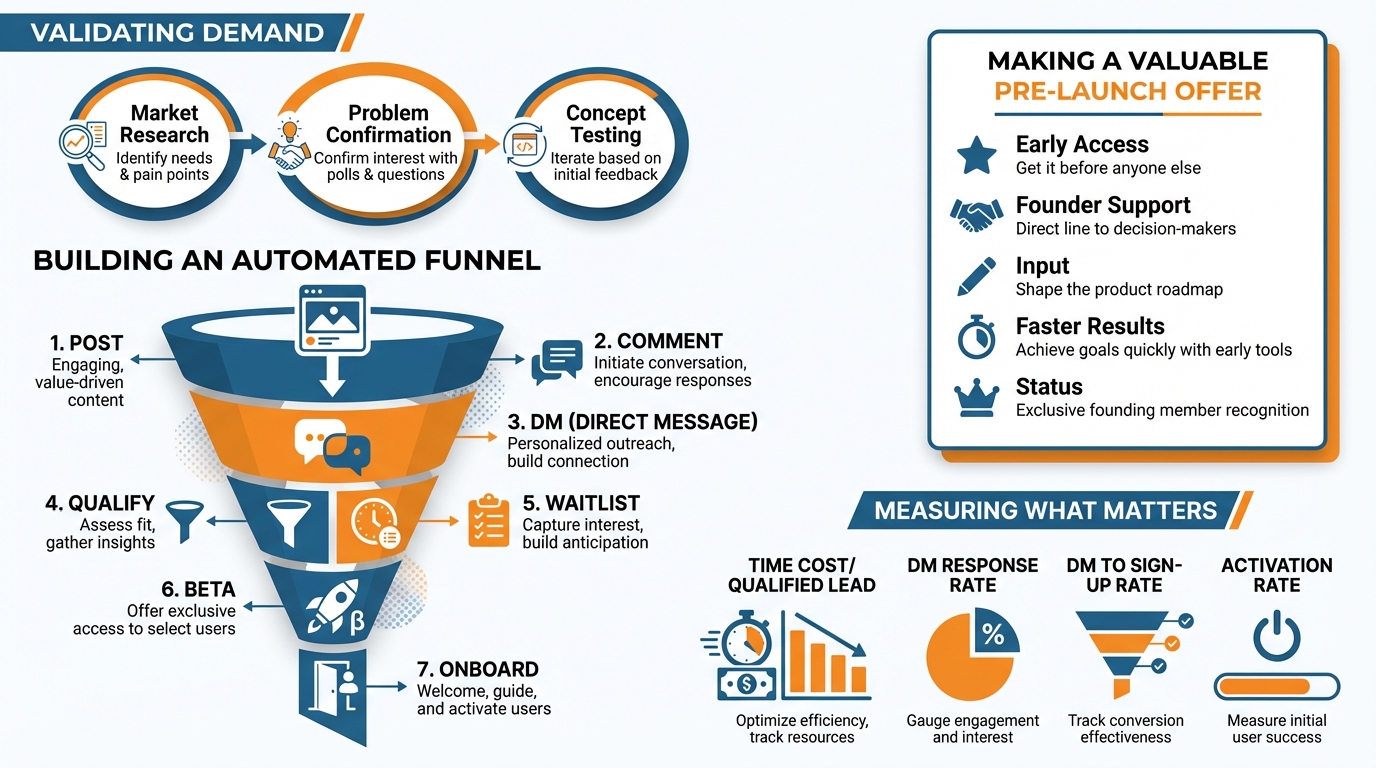
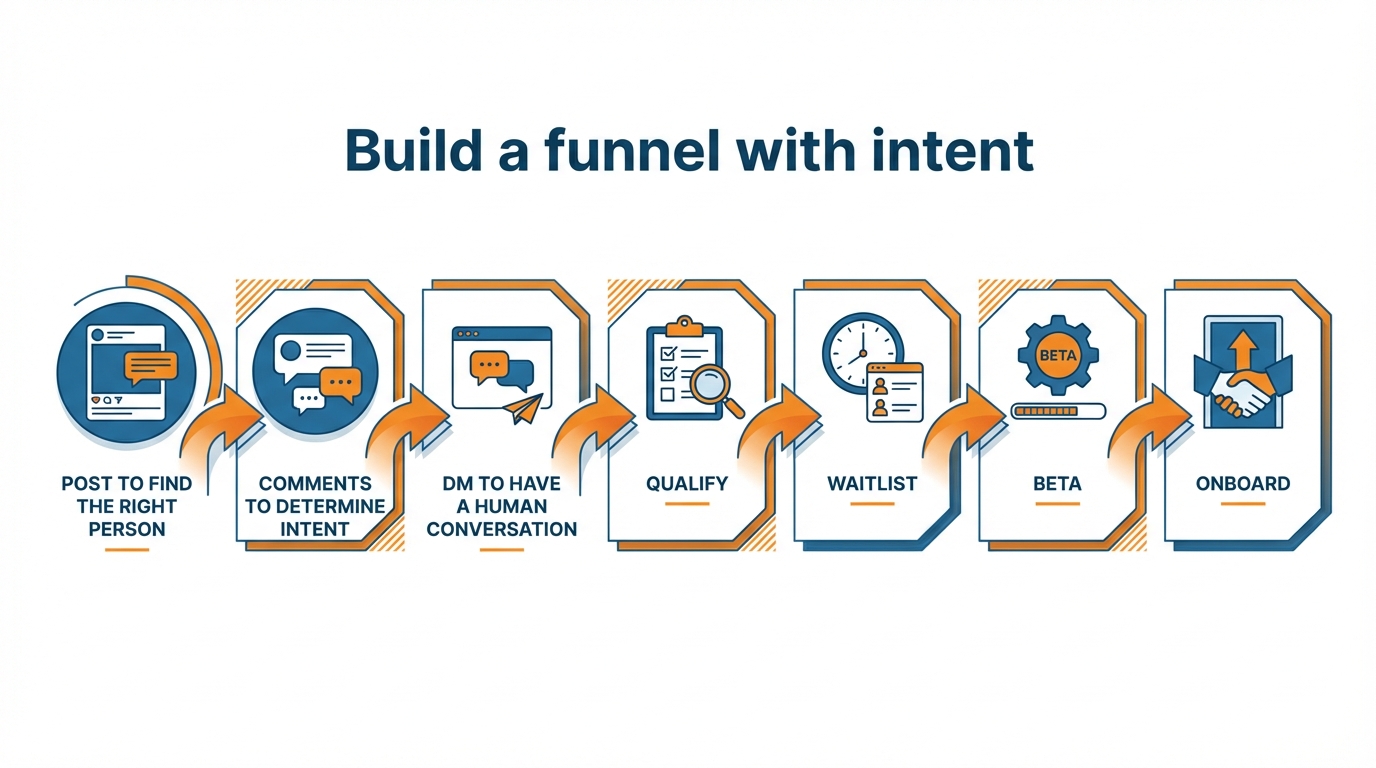
Construct a funnel, run it on autopilot, with intent: post to find the right person, comments to determine intent, DM to have a human conversation, qualify, waitlist, beta, onboard. If you need help turning this into a repeatable workflow, a social media content calendar can keep the sequence visible without turning it into busywork.
What I look for in a post is a pain and a person, not a topic.
What I look for in comments is self-identification, pricing questions, mentions of an upcoming deadline, descriptions of a current solution.
What I look for in DMs is evidence that this is an actual prospect: rough budget, decision-making authority, timeframe, is this an urgent problem.
Qualification is where most founders get lazy, but where you protect your time; if they can’t describe the problem in concrete terms, they’re not a pre-launch lead, they’re entertainment.
Make your pre-launch offer worth saying yes to
Your pre-launch offer is not just about what you’re building. It’s about what you’re asking people to do now and why.
Give them a reason that’s truly valuable:
- early access (with limited availability)
- direct support from the founder
- input on the product
- faster results than existing solutions
- a status boost from being a member of the first wave
The trick is to proportion the ask with the risk. A beta application is a much lower risk yes than a preorder, so that can work when the value proposition is clear but proof is still nascent.
I usually frame the pre-launch step as an exchange: they give me 15 minutes of context, I’ll give them a customized suggestion or a front-of-the-line pass, which makes the conversion feel like a win before you’ve even built the product.
Measure what matters (not vanity)
Focus on metrics that tell the truth. Vanity metrics are deceiving; for more on this, see vanity metrics.
Monitor your time cost per qualified lead, response rate to DMs, DM to sign-up rate, and activation rate (how many waitlist or beta signups take action, complete step one, or respond with feedback in 7 days).
DM to sign-up rate <10% means unclear offer or unclear qualification. Activation rate <30% means promise is curiosity-driven, not needs-driven.
Still feel free to share buzzworthy content, but tie it to next steps and pipeline: every BTS content, mini success story, or even hot take should flow into a question or prompt that attracts the correct audience into the comments and into the DM.
Which social media networks should pre-product startups focus on?
Which social media networks should pre-product startups focus on?
Well, it depends on the type of startup: B2B, B2C, and dev tool companies.
There are slightly different considerations for each.
For pre-launch startups, which social media platform you choose depends more on who is buying and how they decide than on what platform is currently hot.
To choose which social media platform you should use to launch your startup, start by defining your buyer and their context as well as the evidence they will need to buy from you.
A good heuristic is that if the buying decision is a group or risk-averse, your social media strategy should emphasize credibility and clarity.
If it is a personal or identity-driven decision, your social media strategy should emphasize emotion and social proof.
If it is a technical user decision, your social media strategy should emphasize evidence that they can examine.
When you pick the platform based on the decision, your social media strategy stops being “random social media posts” and starts being a “repeatable pre-launch marketing machine”.
If you’re B2B
If you’re B2B, focus on environments where credibility is key and your target audience is accustomed to thinking out loud, which means you probably start with LinkedIn. That also matches the Forrester-based view on B2B social that 87% indicated they have a paid relationship with LinkedIn (Forrester’s 2024 B2B Brand And Communications Survey).
What you’re doing pre-launch is problem definition and authority, not hyping the solution: how much does the problem cost, how do teams address it today, and what shifts when it’s resolved.
I generally write in a first-person founder voice and use micro case studies, even when I don’t have logos yet: here’s what happened when I ran this process with 3 companies in the same vertical, and what went wrong.
Your conversion language will be similar, matching B2B intent: you’re filtering for B2B intent, so you funnel towards book a call or apply for beta, and you view comments as qualification signals, not cheers.
If you are B2C
If you are B2C, you are not selling a spreadsheet, you are selling a feeling, a new identity, or a better story someone tells themselves.
This typically makes TikTok and Instagram more impactful, since distribution is creator-led and discovery is quick, particularly if the product is visual, habit-based, or socially shareable.
Before you launch, you win by making the customer the main character: show the before state, the moment of friction, and the after state in a way that people see themselves in.
I lean into creator distribution here, because a small business can borrow trust from a niche creator faster than it can create it, and your conversion step usually looks like join the waitlist or get early access, because the buyer is deciding with emotion first and rationalizing second.
If you’re building devtools
If you’re building devtools, your social media is a technical demo in disguise.
The right platform is wherever devs publicly vet new tech.
X for reach and discussion, GitHub for validation, and a community platform like Discord for stickiness and feedback loops.
The right content looks like a technical history: build logs, benchmarks, migration guides, design decisions, and head-to-head comparisons against the default tool.
My successful asks are less about convincing you to take a leap of faith, and more about inviting you to take a look: try this, star this, join this community.
If you can only do one platform well, pick the one that aligns with your most valuable activity: X for discovery, GitHub for demand capture, or Discord for account management.
Then double down on a single type of content you can push every week and a single ask you can track, because if you do a little of everything, you’ll always seem busy but never actually learn anything.
Social media for pre-launch startups: content pillars when you don’t have users yet
This is where people get stuck with social media for a pre-launch startup.
You can’t use testimonials, UGC, or customer stories yet.
The solution is to alternate between four things that generate demand signals without faking traction:
- problem evidence: show proof of the problem (what is broken, what it takes, what workarounds exist)
- build evidence: show what you’re building (as outcomes, not features, so they can imagine the new behavior your product will enable)
- perspective: share your contrarian view of the category and what’s changing (clear views of the world attract the right customers faster than generically useful tips)
- participation: use polls, “help me decide”, Q+A, beta feedback requests to get customer language in your comments and DMs (also works for validation and research).
It needs to be actionable.
The way I do it is: make each update a promise, a decision point, and a next step.
Don’t say I made a new dashboard.
Say You said your biggest pain point is seeing gaps before Friday, so I am building a weekly view that will show you what is off in 30 seconds; I had to decide whether to make it fast or right, which is more important to you?
Now there is a story to it, now there are stakes, now you’ve put the reader in the driver’s seat.
I follow this format because it makes each build update answer the one question the future customer will care about: how does this affect my life tomorrow?
Make it attributable with simple tests
To make social media for pre-launch startups attributable, you need tests and not inspiration.
For every week, test the following 3 things - Hooks, Pain, and Positioning.
- Test the first sentence of your text as your hook, and see which one gets more comments or DMs that qualify.
- For the pain statement, test between abstract (“struggling to do marketing”) vs. concrete (“spending 2 hours every Sunday writing the same posts”).
- For positioning, test “who is it for” and “what does it replace” and see the types of questions you get back (Price, Timeframe, Comparison with current tool); these are intent signals.
Comments and DMs are your research source, and the fastest founders treat every reply as a micro-interview they never had to book.
Then the multiplier effect is language mining: You use those same words to create your copy, landing page, pitch, etc. before launch.
When you get the I just want a simple way to know what to post without staring at a blank screen do not repurpose it, make it a headline and build a copy around it.
Then run a learn, refine, repost cycle: same message, refine the hook using the best of the audience language, and repost a stronger version in a new format or in a new medium.
This is how you make your content stronger, not just louder, and this is how your pre-launch social becomes a positioning machine that generates demand for your product even before it launches.
Social media for pre-launch startups: distribution systems that create reach without ads
Social media marketing for pre-launch startups fails when you mix up posting with distribution. Posting is something you do; distribution is something you design: who sees what, when, and why.
Before you press publish, treat your distribution as a mini-campaign: figure out the single conversion you want to drive this week, then identify in advance 20-40 people and channels where your post will be especially relevant on day one.
This isn’t about algorithm hacking; it’s about minimizing cold-start risk.
A rough but useful heuristic I try to hit is 10-20 intent-driven engagements in the first hour from the right audience, because early engagement velocity compounds reach predictably across all the different platforms.
You get that velocity by scheduling those conversations ahead of time, not by praying your followers are awake.
As for non-ad channels, I find partnership-led distribution is the most powerful way to generate immediate results.
It’s all about finding a way to distribute through someone else’s permission, and there’s no better way to do this than having others share your content to their audience.
I like to create a list of 15 to 30 mini-influencers (founders, smaller businesses, adjacent accounts) that all share a specific audience with me.
I’ll share a really strong post that they’ve done with some specific “founder insight” that adds value to my audience, and they’ll share a post of mine with their audience because it provides value to them, and we’ll agree on a specific way to push the distribution even further (asking people to reply, asking people to DM a specific keyword).
I like to keep this as a portfolio - this is more of a scaled-out strategy (think of it like building a mini-syndicate). If you want to operationalize this kind of repeatability, smart social media automation can help you keep the system moving without turning it into noise.
Community seeding
Community seeding.
When done correctly, it’s not a choice between spreading the word and asking for permission. Instead, it’s about being a productive member of the community who just so happens to have published a relevant resource.
First, identify 5-10 relevant communities where your customer is looking for advice, such as founder groups, local business communities, subreddits, Quora questions, etc. (You probably already know where your customer hangs out.)
Before sharing a link to your post, actually help the people there a few times.
Once you do share a link, do it within the context of their discussion, not the other way around.
Start your post by restating the problem, summarizing your conclusion in a couple sentences, and asking for a particular type of feedback to get the discussion going.
Then, circle back and respond to everyone who’s commented with one question in the thread, before sending them a follow-up direct message with a one-sentence summary and one follow-up question.
It’s in this transition from public to private, where you start talking about time, budget, urgency, etc., that you filter out people who just want to “learn” from you, and also save yourself from people who just want to chat.
A minimum viable operating system (not a fantasy)
To make this feasible for a founder, you need a minimum viable operating system, not a content calendar fantasy.
2-3 anchor posts per week, 20-30 minutes per day on engagement by quickly responding and dropping high-signal comments in your space, and repurposing to make one idea many assets: a post becomes 3 mini posts, 5 comments, and a DM starter that you can use the next time the issue arises.
What you should automate is what doesn’t require judgment, such as sorting out partner lists, labeling conversations for intent, and automating your first message, but making sure you add a line from their context.
You should systemize, not automate.
Automating the human part of the job will break trust, and may trigger platform alarms.
Systemizing the parts that are not human will help you scale your community work while keeping it human.
The end
Social media in pre-launch is just like everything else in pre-launch: there’s one metric to optimize, how fast you learn, and one outcome to strive for, audience attention, energy, and engagement, not for its own sake, but converted into email signups. That urgency also matches what founder sentiment data highlights: 57% of pre-seed/seed founders were more optimistic about raising capital (January Ventures survey coverage reported by TechCrunch), which makes learning speed and pipeline clarity even more important.
If the content you’re creating isn’t answering for you, directly or indirectly, who your audience is, what they believe, what they are trying to solve, and what it would take for them to take the next step, then you aren’t marketing, you are entertaining.
The unique benefit of social in pre-launch is time, you can get feedback on messaging in days and weeks, not months, and you are getting language in the form of comments and DMs that you can reuse elsewhere.
If you do just three things, you will be beating most SMBs trying to get off the ground online.
Choose one conversion goal for the next 30 days, and everything else is a signal that either supports or harms it.
Choose one medium that aligns with your customer’s decision process, because trying to juggle multiple platforms is the quickest path to getting busy and remaining muddled.
Create a cycle: create a single messaging test, push it out to the mediums that will get it in front of your target audience, collect responses, then iterate and repeat.
I’ve seen a single strong positioning concept improve the number of signups, merely because the second iteration used the exact words the prospects used in the feedback.
If you’re doing well pre-launch, it won’t be apparent from the number of followers you have. It will be apparent from how easily you can explain what you’re doing in one sentence (and how that sentence doesn’t have to change week-to-week). It will be apparent from how confidently you can estimate how many signups you’ll get from social (based on what you post week-to-week). It will be apparent from how well you’ll be able to activate your signups on day one. As a reminder that traction can come fast when the funnel is real, Stripe reports that 20% of Atlas startups land their first paying customer within 30 days of incorporation.
And as a rough guideline, you’ll know that your pre-launch engine is humming when a lot of signups come from conversations, not clicks, and when your activation doesn’t tank because people joined for something specific, not out of curiosity.
Treat your pre-launch social media like a product dev sprint: every post is a hypothesis, every thread is user research, and every DM is qualification.
If you do pre-launch social media this way, launch day stops being a praying game and starts being a calendared certainty, because you’ve already tested what people want, what they name it, and what gets them to say yes.
Related reads
4/27/2026
B2B SaaS social media benchmarks: Set the right targets.
B2B SaaS social media benchmarks: Set the right targets. The trouble with defining B2B SaaS social media benchmarks is that it's an inherently impe...
4/25/2026
Building a personal brand as a technical founder (without becoming a creator)
Building a personal brand as a technical founder (without becoming a creator) Creating a personal brand as a tech founder should feel less about ma...
4/20/2026
Creative Post Ideas for Sustainable Brands (That Don’t Sound Greenwashy)
Creative Post Ideas for Sustainable Brands (That Don’t Sound Greenwashy) That’s not what creative post ideas for sustainable brands should look lik...