Social Media Content Generators: Money in Your Pocket
Don't just generate content; generate revenue. This post shows how to use social media content generators effectively for consistent branding, leads, and sales.

A quick social media content generator for business is only useful if it puts money in your pocket.
A quick social media content generator for business is only useful if it puts money in your pocket. Not just content. If the captions aren’t in your voice, aren’t accurate representations of what you’re selling, or don’t tell the audience what to do to ask a question, book, or buy from you… you don’t need 30 more posts like that in your feed. You need fewer, better posts that generate consistent conversations with the right people.
So what should you be optimizing for? Time to create. Time to post. And results. Results are leads, bookings, sales, and retention. Not engagement, and definitely not quantity. If a tool generates something in 10 seconds but takes you 45 minutes to edit, it is not fast. If it makes posts that get likes but no DMs, it is not working. I think of speed as a metric that only matters insofar as it reduces your journey to revenue.
In this post, I’ll demonstrate how I assess and utilize a rapid social media content creator for business in an enterprise-level manner: making sure the voice is consistent and resembles my own, integrating it into a scalable weekly process, how to batch effectively without loss of topicality, and refining results over time based on leads and sales.
You’ll come away with a framework you can employ immediately, even if you’re a small business owner with marketing to do on the side of client projects.
Speed alone is not enough: what a business-grade generator has to provide
A fast social media content generator for business is not enough.
What’s non-negotiable is goal-based content: you input the desired outcome, and it creates content aimed to achieve it.
There needs to be a “goal switcher” of sorts: be it booked calls, store visits, quote requests, email responses, or free trial signups, as all of them demand different copy.
It needs to be channel-based: a trustworthy LinkedIn post is worded differently than an attention-grabbing Instagram caption. If you want channel-specific drafting, tools like an AI LinkedIn post generator can help keep the format aligned to the platform.
If the tool doesn’t take this into account, you still need to edit.
Last but not least, a guaranteed “hook-value-proof-ask” structure: attention, education/information, credibility, and a logical Call To Action that humans actually respond to.
The big differentiator is brand voice.
Generators say on brand, but they don’t do anything to enforce it.
You have to feed the algorithm something to follow every time.
That is the tone we want, the vocabulary we use, the words and phrases we don’t want to see, and the promises we can’t make as it relates to claims, compliance, or guarantees.
When you can establish that, the content quits sounding templated and starts sounding like a member of your team who knows how you sound and what you don’t say.
If you are in a regulated industry or simply do not want to make too many promises, those controls are not just a nicety, they are a must.
One sentence that crosses the wrong line can mean significant customer support issues and more.
The main reason good posts are different from bad captions is the data inputs.
It works way better when you can tell the generator exactly what problems your customers are facing: which specific problem that your target customer wants to solve this week, which services do you offer and not offer, what makes you unique, what do you have to back it up, which push-backs do you get on the phone and at the till, and what do you want them to do next because if your prompt is vague, your output will be vague.
You should be able to look at any of your posts and say, this one is targeting one specific customer, one specific problem, one specific promise, one specific trust, and one specific ask.
Re-purposing is the real magic because you no longer have to create things from scratch.
Re-purposing is the real magic because you no longer have to create things from scratch.
You take a single thing you already have (blog post, email to clients, case study, webinar, product update) and re-purpose it into different answers to real customer questions.
Why?
How to avoid.
How to choose.
How much does it cost?
What to expect.
Results.
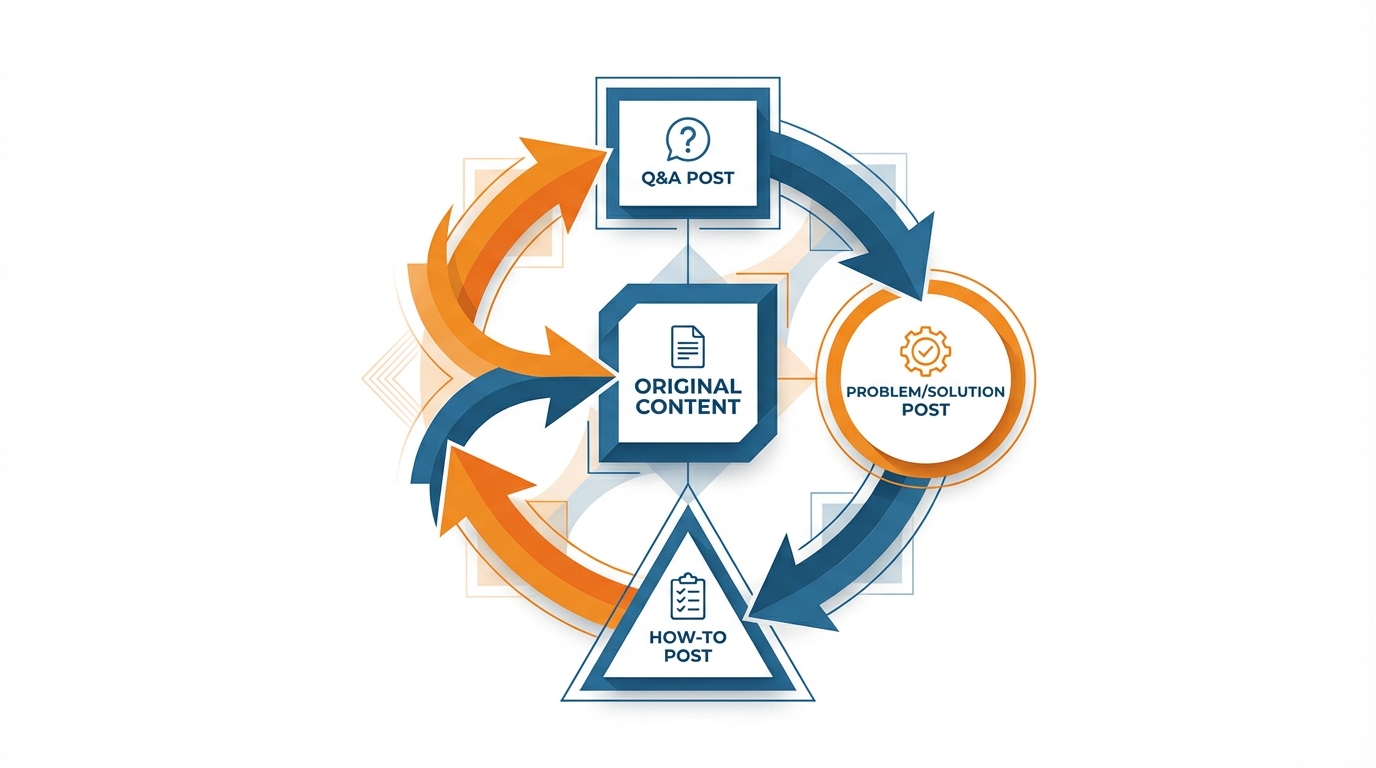
I’ve found that I can take a single topic and create a series where each post answers a different objection or use case so you’re not duplicating.
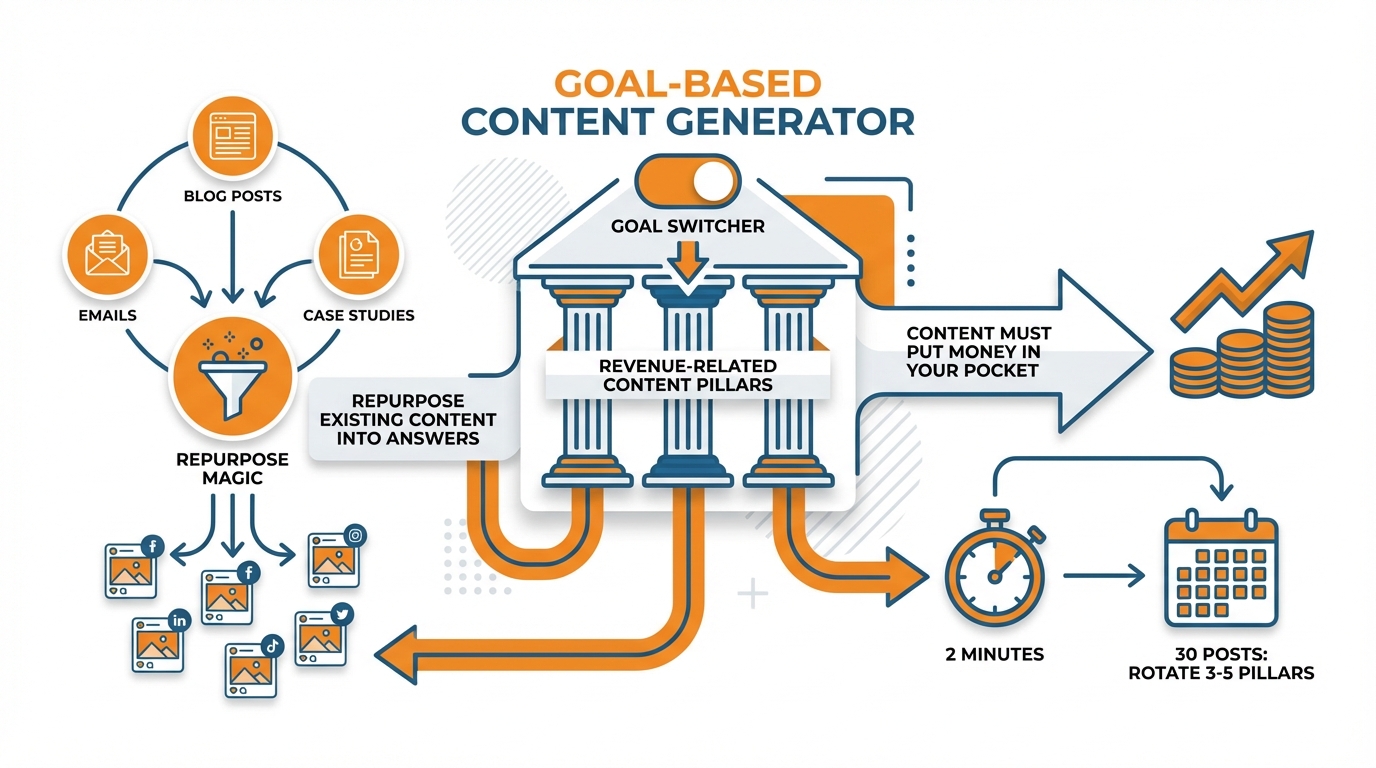
This is where something like WoopSocial can come into its own - if it can produce multiple versions quickly but still within your voice and framework then you’re no longer posting - you’re publishing.
Industry adoption supports this direction: in a Salesforce breakdown of 1,000+ marketers, basic content creation (76%) and writing copy (76%) were top genAI use cases, and marketers predicted genAI will save them ~5 hours per week, according to Salesforce’s generative AI stats roundup.
2 minutes to 30 posts: how I batch content that adheres to SMB time realities.
You don’t have to live on social media to succeed on social media.
The best way to batch while maintaining quality is to choose 3-5 content pillars that are directly related to revenue, and then intentionally rotate through them.
Examples include problem and solution posts that pre-qualify buyers, proof posts that reduce risk, behind-the-scenes process posts that reveal how you achieve the result, offer posts that make the next step clear, and authority posts that signal you’re the safest option.
In a single sitting, you can outline 30 posts by attributing to each post a pillar, a customer pain, and a clear ask.
The simple act of applying that constraint will keep you from the random content trap, where you’re posting a lot but nobody knows what you do or why you’re the best.
Second, you want to align your frequency with your business model to prevent over-posting.
- As a service business, the strength of your content is far more important, and you can typically get more mileage from 3-4 posts a week while letting the proof and process speak for themselves.
- As a SaaS, you’re educating and reducing churn, so you may be able to skew to the higher end, 4-5 posts per week.
- As an e-commerce, you can do even more, but only if the balance is there, and not 10 offers in a row.
- As a local, your unique value is the locality and trust, so you can get away with 3-5 posts a week of actual jobs, actual timelines, actual guarantees you can actually stand behind, and a repeating weekly offer.
Finally, create a calendar you can actually publish by mixing quick wins and heavier hitters.
Quick wins are your throughput engine: tips, myths, FAQs, mistakes to avoid, what it costs, what to expect, and simple comparisons. They are fast to produce and they compound because they answer the same questions you repeat in sales calls.
Heavier hitters are your conversion spikes: a case study with before and after, a customer story, a new service announcement, a limited-time launch, or a partnership.
A practical split for most small businesses is about 70% quick wins and 30% heavier hitters, because quick wins help you be consistent while the heavier posts create the urgency and trust needed for people to book, buy, or reply. If you want this to be even more repeatable, a dedicated social media content calendar process can keep the rotation stable.
In order to ensure batching is as quick as possible, I need a quick social media content generator for business that can generate 30 days’ worth of social media ideas for my business in minutes while still being unique to my voice and hook-value-proof-ask structure and not some generic template.
In other words, I need to know if I can enter my pillars, my offers, and a few proof points and be able to generate a month’s worth of draft posts that I can review once and schedule across the major platforms at the same time.
This is why I like tools like WoopSocial because they allow you to take your pillars and generate a month’s worth of posts ready to post as quickly as possible so you can then spend your time refining your messaging and proof. If you want to keep the drafting consistent, an AI social media post generator fits that “month’s worth of draft posts” use case.
The fastest way to turn posts into a sales funnel
Sure, I can try that.
To get a fast social media content generator for business that drives sales, you need to give each post its job in the buying process.
You do this by linking content to intent stages: awareness posts define the problem in your customer’s words, consideration posts educate and evaluate, decision posts mitigate risk with evidence and an offer, and retention posts reward customers with utility and memories.
By using these in a cycle, your feed goes from being a chaotic mess to a money funnel: awareness leads to consideration, consideration to intent, intent to purchase.
The next step in your stack is connecting the ask to the friction of purchase to the sales cycle and make it easier to measure: if you have a high-trust or high-ticket offer, the strongest CTA will likely be a conversational prompt rather than a link because it’s lower commitment (e.g. after a post that answers a big objection, say to DM me).
If you have a low friction offer, it can be a link (e.g. to a product or booking page) because they are close to the purchase decision anyway.
A useful heuristic here is that the longer the sales cycle, the more your CTA should be designed to be the next step rather than the full leap, and the more you clarify the next step, the easier it will be to attribute it to posts creating new leads.
Another way that going too fast can hurt your authority is without boundaries.
Businesses can’t be leaking trust from every pore.
This means no overblown results or unclear benefits.
Your customer will suspect you’re full of it immediately, especially in 2026 with their B.S. meters on high from all the terrible AI writing. This is also becoming measurable at scale: one research dataset tracked ~2.4M posts (Jan 2022-Oct 2024) and reported AI Attribution Rate rises on Medium from 1.77% to 37.03% and on Quora from 2.06% to 38.95%, per an arXiv study on monitoring AI-generated text on social media.
Instead of results, talk about limitations and specifics.
What is this for?
What is this NOT for?
What kind of timeframe can you commit to?
What specific outcome can you really guarantee?
Instead of “I will 2x your business,” say “I serve [specific type of business] and help them get [specific result] by [specific action]” and give one tangible example (speed of completion, average starting point, specific before-and-after statistic you’ve observed in clients).
You don’t need any additional tools to be conversion-first; you need one job per post.
Before you post, assign it to one of the four jobs - attention, trust, desire, or action - then only write what helps it do its job.
This is where a tool like WoopSocial can truly pay for itself: not by dumping “content ideas” on you, but by making enough drafts that you can use your precious hours on the money parts - making the specificity sharper, adding the proof, picking the next step for the next stage.
Once every post has a job and a stage, fast content isn’t just “fast” anymore; it’s stacking up into leads and sales.
The optimization loop that many generators neglect: optimization for speed and performance
Yes, you can hack a content generator for business and use it to fuel growth, but that will only happen if you think of posts as hypothesis-driven bets you want to test, not just pieces of creative content.
Your goal is to increase engagement week-to-week, so look at the key variables that can impact that: hook style, topic angle, content style, call-to-action style, the exact sentence that resulted in engagement.
If you monitor this for a month, you’ll quickly identify patterns that many businesses aren’t aware of.
For example, you’ll find that a question hook may bring more DMs than a contrarian hook, which may bring more saves.
You’ll find that a short proof-style post may perform better than a long educational post, even when both are equally successful at getting reach.
I use a single spreadsheet to track all this.
Each post gets one line.
I’m only concerned with metrics that get me closer to a revenue conversation.
Finally, turn your content into tests by varying one variable at a time.
Choose a core post format and test it three times: same topic/different hook, same hook/different way of presenting an offer, same offer/different proof.
You aren’t looking for diversity here, you’re looking for insight.
When you find a winner, don’t just cheer and go on to the next thing; replicate it.
Test that same format three times for three different types of customer pain, and watch your response rates smooth out as your audience gets accustomed to what to expect from you.
This is how you can get both faster and better at the same time, with less decision fatigue and more relevance.
The trick to better content is to update your inputs, not your prompts. If the outputs from your generator are sounding a bit vanilla, it’s because your inputs are old, not because you need to prompt the AI more.
Each week, keep three things updated and grounded in the real world:
- Your best “reasons why”
- The current top objections you’re running into
- The precise words customers use when they tell you about the problem.
You want your content to sound like the last 10 sales calls, not a sales page. When you give the generator new “objections” like: too expensive, no time, done this before, will this work for my niche?, you quit guessing and start generating content that pre-sells the conversation.
A tool can go a long way here, and in a nuanced way: Consistency is what compounds, and it’s hard to be consistent when you are fighting fires every day.
If I can produce a month’s worth of on-brand content drafts in a few minutes within WoopSocial, I am essentially buying back the only time that actually matters: The time to analyze what worked, refine the brief, and test the next round of ideas.
This is the flywheel that most companies never kickstart, and it’s why they remain in the speed vs quality trap instead of making progress on both week-in, week-out. Marketing leaders are explicitly seeing the efficiency gains too: 64% of marketing leaders who use AI say it’s substantially or greatly increasing overall marketing efficiency, as shown in Salesforce’s State of Marketing report.
If you want more on building this into a repeatable system, social media automation can support the consistency that compounds.
Finding a social media content generator that amplifies your results
The fastest social media content generator tool is not the tool that can create the fastest captions.
It’s the tool that helps you stay on-brand, that supports your funnel, that makes it easy to batch and repeat.
There is a tax to speed.
You spend more time editing.
You post more “meh” content.
You teach your audience not to pay attention to you.
The way you want to move fast is time-to-revenue conversations.
And the only way that happens is if every post in your feed sounds like you, if every post points to one clear next step, and if every post fits inside of a repeatable monthly routine.
The easiest thing you can do is simply stop trying to sell everything.
Choose one thing you’d like to sell in the next 30 days, and then put your voice guardrails in a fixed state so that your generator has something to adhere to every time: who you serve, what you never promise, the words you like to use, and the few proof points you can share without embellishment.
From there, generate a month’s worth of pillar-based posts that rotate through awareness, authority, affinity, and application, and standardize them enough that your followers can begin to anticipate your templates.
I do this because standardization is what drives memory, and memory is what converts a stranger into a DM.
Next, make optimization a natural process by approaching your schedule as a series of tests rather than a collection of material.
Track key indicators of results, rather than measuring popularity: responses, DMs, link taps to a scheduling or sales page, and repeat questions that signal interest in purchase.
Real-world experience will often reveal that a few subjects yield most of the sales, commonly following the 80-20 rule, in which 20% of your topics yield 80% of your qualified chats, particularly for smaller companies with a defined specialty.
As you discover which ones are working, develop by changing just one element, whether the hook, proof, or ask, and allow the outcome to decide what to expand.
If you want a solution that enables you to create a month’s worth of content ideas at the push of a button, makes sure your branding is consistent with your website and lead magnets, and allows you to schedule for the major networks all from a single location, something like WoopSocial could work very well for you within this process.
Just keep the priority straight: the tool accelerates the system, but your offer focus, voice guardrails, and iteration loop are what make the results compound month after month.
You just have to remember why you’re using the software.
It enables the process to happen faster, but it’s the value proposition, the tone boundaries, and the feedback process that enable the process to stack as the months go by.
As creators move faster, the baseline expectation is rising too: 86% of surveyed creators use creative generative AI, and 81% say it helps them create content they otherwise couldn’t have made, according to Adobe’s report on creators using generative AI.
For more on building a repeatable monthly routine, plan social media content for a month fits directly into this process.
Related reads
4/27/2026
B2B SaaS social media benchmarks: Set the right targets.
B2B SaaS social media benchmarks: Set the right targets. The trouble with defining B2B SaaS social media benchmarks is that it's an inherently impe...
4/25/2026
Building a personal brand as a technical founder (without becoming a creator)
Building a personal brand as a technical founder (without becoming a creator) Creating a personal brand as a tech founder should feel less about ma...
4/20/2026
Creative Post Ideas for Sustainable Brands (That Don’t Sound Greenwashy)
Creative Post Ideas for Sustainable Brands (That Don’t Sound Greenwashy) That’s not what creative post ideas for sustainable brands should look lik...