Promoting SaaS Beta on Social Media: No Vanity Waitlist
Promote your SaaS beta on social media strategically. Focus on finding quality testers who provide actionable feedback, avoiding vanity waitlists to accelerate development.
Promoting a SaaS beta on social media (without a vanity waitlist)
You don’t want to play a game of impressions when marketing your SaaS beta on social media. It is a precision play: Find a handful of the right people that will sign on, get to value fast, not churn immediately, have enough time to form an opinion, and send you actionable feedback that you can implement this week - not some day.
This is your “unfair advantage” if you’re a small business. You don’t need thousands of signups to go fast. You need 20-50 qualifying beta testers who fit your use case, have a problem to solve, and will respond when you follow up. In this article you’ll learn how to do a social media beta promotion sprint without building a “vanity waitlist,” and connect every post, comment, DM to onboarding, qualification, and product learning. If you want a related lens on the “vanity waitlist” problem, see vanity metrics.
I’ll walk you through how to organize a sprint as a measurable funnel from one end to the other: targeting an audience, restricting supply, easy-to-understand criteria, rapid onboarding, and feedback loops that turn social buzz into product decisions. You’ll leave with a framework you can execute in days even with a small audience and still get the kind of signal that will make your beta worth the effort.
To talk about promoting your SaaS beta on social media, we need to talk about the funnel first.
I know, I know, funnel, not content.
But just hear me out for a second.
On social, unless you focus on just one metric, you won’t see the impact you want on your beta.
Define a specific goal that indicates a true beta signal; for example:
- completing a major workflow within 24 hours
- 3 sessions within a week
- reaching a retention milestone by day 14
Then you’ll know that social is the starting point for a specific funnel, rather than a venue for broadcasting posts that won’t lead to any clear outcome.
I’ve watched a few companies spend months trying to get signups to their beta, only to realize the cold, harsh truth that an enormous waitlist without activation is just noise. Second, plot out the entire beta experience before typing up a single post: social impression to click or DM, then qualification, then acceptance waves, then activation, then tight feedback loop, then update post that shows what changed.
The acceptance waves step is the secret button for small teams: you can limit seats, onboard in batches, and maintain fast response times so beta testers actually reach value while they still have high motivation.
Social works better when people feel like something is moving and somewhat scarce, but the real operational reason for waves is that it keeps your product learning clean: each wave has a similar build and onboarding experience.
Next, choose which call to action you will use for each medium, considering both friction and your responsiveness.
If you have time to respond immediately, a comment-to-get-access mechanism or a DM sign-up will likely perform better, because it’s more personal and you can qualify them in the same conversation.
If you’re busy, a waitlist page with two to four qualifying questions will preserve your time and increase the quality of your testers, even if it reduces the overall number.
In either case, develop the minimum trust-building resources that will make your beta feel safe: a quick demo that explains the workflow you will ask them to perform, what their participation in the beta entails, how long you think it will take, your policy on privacy and data, and any caveats so that people don’t sign up with false expectations. For context on how social is influencing purchasing behavior right now, the 2024 PwC data notes that 46% of consumers report directly buying products through social media (up from 21% in 2019) in PwC’s 2024 consumer survey.
Last, add tracking that ties every platform and post to activation (not just clicks).
You don’t need fancy analytics to stop estimating: add a platform and post tag to every link and require a consistent identifier (e.g. email) at sign up so you can track back to the source. If you’re tagging links, a practical companion is a UTM link builder.
I also track time-to-first-value by source because it tells me which social messages produce motivated users and which produce curious clicks.
Once you can see which posts produce activated testers and useful feedback, Promoting a SaaS beta on social media is a predictable process you can perform in short, high-impact blasts.
The effectiveness of social media depends on finding the right testers
The effectiveness of social media to promote a beta for a SaaS application depends on my ability to find the right beta testers, not just the quantity of them. Social media marketing becomes much more effective for a SaaS beta when you can effectively weed out users.
The first tool in your toolbox is a clear statement of who this beta is for, and who it is not for, to prevent them from signing up in the first place.
It should be specific, by role, company size, and even the day of the week they encounter the problem.
I try to write this in such a way that the right candidate will say “that is me!” and the wrong candidate will say “not for me”.
That is important because incorrect signups will balloon your waiting list and undermine your learning.
Real-world, the side effect of smaller businesses that add some level of fit text is that they typically get fewer signups, but an increased proportion of those signups will activate, and activation is the most predictive metric we know of for getting actual feedback. This also matches how discovery works: HubSpot’s 2024 consumer trends data says 26% of consumers prefer to discover new products via social media in their write-up on where consumers find products on social.
The second thing is use seat limits and waves as an operational mechanism rather than a marketing gimmick.
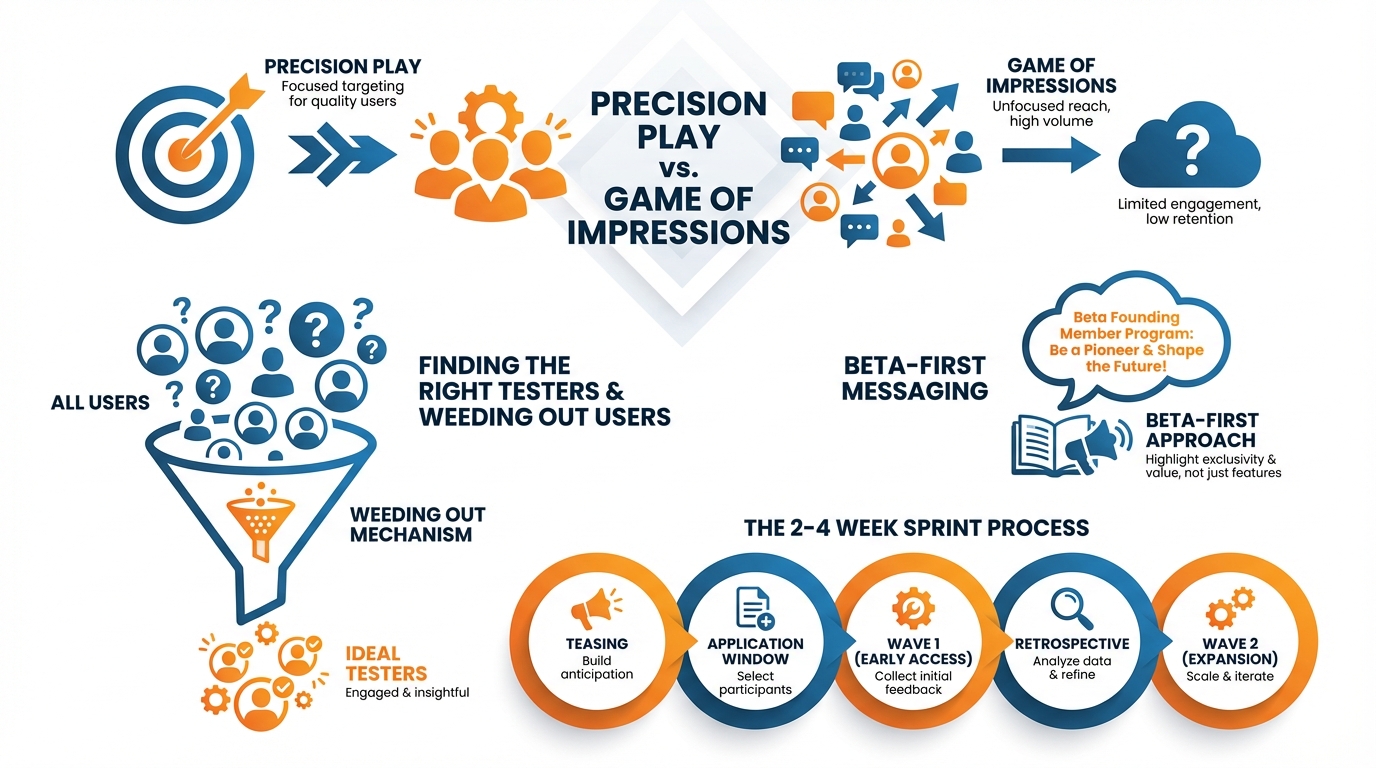
If you say there’s only 30 seats in Wave 1, then you know you have to get them onboarded quickly, you have to respond quickly, and you have to have a consistent enough experience that you can actually compare between the different people.
And it also allows you to create some urgency around the product without any marketing fluff.
Because people know that you only have so much capacity.
You’re trying to maintain the integrity of this cohort.
So, when I’m doing a wave, I try to use each wave as essentially a clean experiment.
So if Wave 1 has trouble with this one thing, I’m going to go fix that, and then I’m going to do Wave 2.
So you avoid the issue of having 200 people all going through the same thing and having the same onboarding issue.
And you calling that ‘data.’
Next, layer on a small amount of screening which ensures ICP fit and can be asked to feedback in under 60 seconds.
You don’t need a full application; you just need a few high-signal questions: what is your job title, what do you use today, how often does this issue come up, and are you willing to do one short check-in after you try the key workflow.
This is where a SaaS beta promotion on social media acts as a quality filter: you’re not just screening for interest; you’re screening for people who already do the workflow, already experience this pain once a week, and can already tell us what stopped them, what they didn’t understand, and what would make them switch.
Lastly, differentiate your early adopters and prioritize your efforts to maximize learnings.
It’s also important to clearly communicate to all participants what you expect from them to avoid no-shows.
I think of people who are a good fit to be design partners as “gold.”
They’re rewarded with special onboarding, quicker responses and inside access to shaping the product roadmap.
My other beta testers experience the norm.
I clearly communicate to both groups what I’m asking them to do, approximately how long it will take and what information is most valuable to me.
This includes a screenshot of where they got hung up, what they expected to happen next, and if they would be likely to use the feature again the next day.
When you clearly communicate what you’re asking for, you screen out the tire-kickers and you get higher completion rates.
This separates a “cool” beta from one that will yield actionable insights that you can implement this week.
Beta-first messaging that de-risks the ask
When it comes to social media, your goal is to promote your SaaS beta.
The right message should de-risk and provide confidence.
Again, this messaging should always be beta-first.
One of my favorite ways to do SaaS beta promotion is via social media, but the key is to not promote it as a beta, promote it as a beta founding member program or beta designer program.
All of a sudden you're attracting a much better kind of people, you're attracting people that are looking for influence rather than people that are looking for completion, so you can define what influence looks like, for example, you're going to help us figure out which two features to build next or your experience will inform the onboarding flow.
I found that when I do it that way I get fewer signups but I get much higher activation because these people know what they're signing up for, they know they're coming in to help us build it, not just use it. If you want to systematize the posting side of this, an AI social media post generator can help you keep the messaging consistent across platforms.
The way you get confidence in a beta is through transparency, not credibility, so you must declare what is incomplete and then make it clear why it’s still a good deal for the right small business.
Go ahead and say the quiet part out loud: there may be bugs, there are features we’re missing, and support is only available during business hours.
Then make the tradeoff make sense by grounding it in what the product does, not what it will do.
If you’re saving time, show the time being saved; if you’re reducing errors, show the exact error you prevent.
My favorite counterintuitive metric here is that when you call out limitations, you’ll often find that you’re getting fewer clicks but more completion of the first core workflow, because you’ve filtered out the tire-kickers before they even get into your funnel.
This is why you have to be super explicit about what they get from you right now and what you are asking from them in return - in every post, every comment response and every DM.
You have to specify what they’ll get in the next few days: a test this week, immediate support from me and a goal for that first week.
And you have to specify what you are asking in return: any feedback you need to actually make something with it, a few sentences about where they had trouble, access to anonymous usage data and a single interview after they go through the core flow.
Having this structure makes it feel like a partnership, rather than a free attempt at an unproven idea of mine.
You also need proof that fits the current phase. You can’t just display finished testimonials that you don’t have yet.
Instead display beta proof like a little taste of the workflow, a really clear statement of the solution, construction logs that show progress, and testimony from early users that speaks specifically to their first taste of the outcome.
Then amplify that trust through targeted referrals instead of broadcast announcements. You’ll get more qualified testers if you just work with a handful of fellow service providers and makers that specialize in your micro niche because they have a qualified audience already.
I’d prefer three partners that also serve my target audience to send 10 qualified leads than to shout out to an entire community to send 300 unqualified signups that can’t be onboarded, supported, or learned from. This is even more important given that PwC’s 2024 highlights say 70% of consumers seek reviews to validate a company before making a purchase in their survey highlights write-up.
Run it like a 2-4 week sprint with waves and retrospectives
With an operational rhythm, messaging process, and a feedback mechanism in place, your SaaS beta social media promotion can follow a consistent pattern.
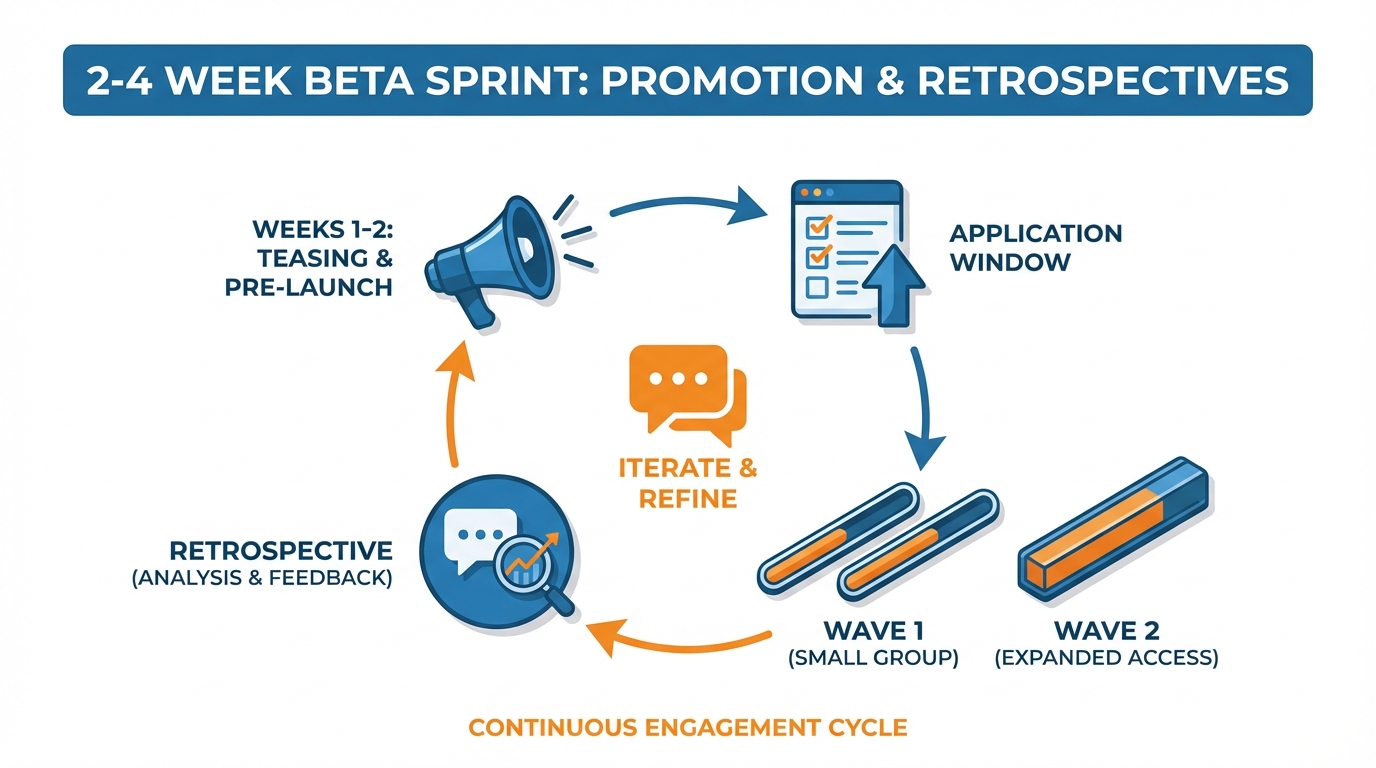
Social media promotion of a SaaS beta stops feeling arbitrary when you treat it as a 2-4 week sprint with distinct stages: teasing, application window, wave 1, retrospective, wave 2, retrospective, wave 3, etc.
You’re not attempting to be consistently present; you’re attempting to build momentum, with a cadence your small business can maintain.
In reality, you’ll want each wave to have a tangible goal, such as Wave 1 tests onboarding and the first workflow, Wave 2 tests day 7 retention, Wave 3 tests a monetizable use case.
I do this because it converts social from a bullhorn into a scientific instrument: each wave gets a better build, a better message, and better data. If you want to go deeper on building these waves into a repeatable schedule, see social media content calendar.
The conversion layer isn’t about your post, it’s about what happens after the post, which is comments & DMs.
You can’t leave answers sitting for hours if you want to keep up the momentum, particularly with betas where risk is perceived to be higher.
Your goal is to establish a simple triage: ICP-worthy, needs a clarifying question, not a fit at this moment.
When a person comments, you’re gonna let them know one next step that will clarify any uncertainty (e.g. asking what solution they’re currently using, what they want to achieve by this week), and you’ll then direct them into a proper wave or a waitlist.
I handle every DM as if it were a mini-sales funnel: get back to them ASAP, ask one question, and hand off to onboarding in a way that doesn’t let interest dwindle; if you want reps to practice that transition, an Ai sales coach platform can help rehearse these conversion-critical conversations before they happen live.
Community operations is where most betas die silently. Overbuilding.
Choose going in whether you even need a private community.
If your beta is complicated, has many edge-cases, or requires discussing with others in order to persist then a small private community will help with retention. Otherwise, just use email and maybe a couple scheduled calls.
Either way, you want a feedback cadence that protects attention. Less often. Better.
I try to ask for a single thing, aligned with a particular time in their journey.
Example: when they achieve first success.
Example: the first time they get stuck.
When you ask for too broad of feedback on a weekly basis, you get awful feedback you cannot use.
The predictability comes from implementing feedback like a system, not a feeling: what you ask, when you ask it, and where you send it so that it links to product outcomes.
You want structured data like what did you try to do, what got in the way, what did you expect, and how important is the issue, all linked to their original post and wave.
Then you have iteration posts that outline what exactly got fixed because of beta testers, which creates a flywheel effect: it shows you are listening, it gets inactive people back in the game who were waiting for things to happen, and it improves the quality of the applicants because people who are serious about the product are drawn to things that get done.
I have found that just calling out what changed, why, and the old vs. new behavior gets formerly inactive users to become engaged beta testers because they can see that their work is influencing the product. In B2B, this matters even more because social is a serious channel: Insider Intelligence reported that 50% of marketers said social media is the most effective B2B channel for top-of-funnel strategies in their analysis on why marketers need to refresh social strategies.
Conclusão
Em conclusão.
Social media is the area where indie shops tend to squander the learning potential of a beta, because attention is cheap and activation is not.
If you focus on likes and reach, you’ll find yourself over-acquiring low-intent signups.
And that’s when the math starts getting ugly: I’ve seen betas where 60-80% of signups never finish a core workflow, meaning that most of the incoming traffic is not data, but noise.
Think of social as the front door to a qualification-and-feedback machine, where every post has one job, every reply has one next step, and every accepted beta-tester is expected to perform a certain task within a certain timeframe.
You’ll go quicker by consciously inviting fewer, better testers.
By defining a spec, limiting your batch size, and tracking the metrics that count in a beta: time to first-milestone, day-7 retention, and can the tester describe where they got stuck in two sentences or less.
And by tagging each link and monitoring activation by referrer you will discover a truth that most teams overlook: yes, fun posts get clicks, but posts that outline limitations and specify the scenario you’re testing get completions.
That’s how you convert social from a bullhorn to a testing device.
The most powerful tool at your disposal is how quickly and precisely you follow up.
Responding to a comment or message isn’t about being friendly, it’s about preserving momentum: you ask one more screening question, funnel them into the correct wave, and hand them a first task that they can complete today.
I’ve done betas where the theoretical group size wasn’t huge, but because the expectations were clear and the follow-up was rapid, most of the accepted applicants got to the first finish line within 24 to 48 hours, and the feedback was actionable enough to make actual changes to onboarding text, defaults, and first-run experience.
If you maintain that mindset, social changes from being about getting the right people to notice you to a scalable process for improving the product every week.
Less signups, more real usage, better patterns, better positioning, and iteration posts that show the world you are making progress.
That is the difference between doing social for attention and doing Promoting a SaaS beta on social media to actually move the product forward. And if you need one more reason to treat social as a primary channel, 2025 survey coverage found 50% of U.S. consumers agree social media has become a primary way to learn about new brands and products in this report on social media as a primary brand discovery channel.
Related reads
4/27/2026
B2B SaaS social media benchmarks: Set the right targets.
B2B SaaS social media benchmarks: Set the right targets. The trouble with defining B2B SaaS social media benchmarks is that it's an inherently impe...
4/25/2026
Building a personal brand as a technical founder (without becoming a creator)
Building a personal brand as a technical founder (without becoming a creator) Creating a personal brand as a tech founder should feel less about ma...
4/20/2026
Creative Post Ideas for Sustainable Brands (That Don’t Sound Greenwashy)
Creative Post Ideas for Sustainable Brands (That Don’t Sound Greenwashy) That’s not what creative post ideas for sustainable brands should look lik...