The Best Time to Post Instagram Reels for US Startups
The Best Time to Post Instagram Reels for US Startups There's no one-size-fits-all posting window for US startups that will automatically boost you...

The Best Time to Post Instagram Reels for US Startups
There's no one-size-fits-all posting window for US startups that will automatically boost your Reels based on a static chart.
Selling across the nation instantly means working with the four main US time zones. The ideal time to share a post changes with your business model (B2B vs. B2C) and target demographic (founding teams vs. consumers), and results become more unpredictable as the number of posts you’ve tried becomes smaller.
Sometimes a Reel can take off because of its topic, hook, or shares and then another one can bomb at the same time of day so don't look at the timing as something you have to do as a rule and more as something to pull a lever off.
You’ll get two results from this guide you can put straight to use, namely an easy US-wide default schedule that works well when you don’t have much data or just need to start somewhere. Second, a lightweight way to quickly validate and optimize your prime posting times, without a massive content team or months of trial and error.
You will also define what best actually means to a startup: more than just views, it’s about profile visits, DMs, email signups, demo requests, and app installs. I'll walk you through selecting optimal posting windows to boost downstream conversions, giving each Reel a defined, strategic purpose.
If you want more structure beyond timing, a content system helps this stay consistent week over week; see social media scheduling for a related workflow.
Recommended posting time for US startup Reels: default US time zone (ideal when you're promoting products at a US national level)
If you want the most effective posting times for your Reels for US-based startups, I have found two basic time slots.
These allow you to post across the US without worrying about the difference between Eastern Time, Central Time, and Pacific Time.
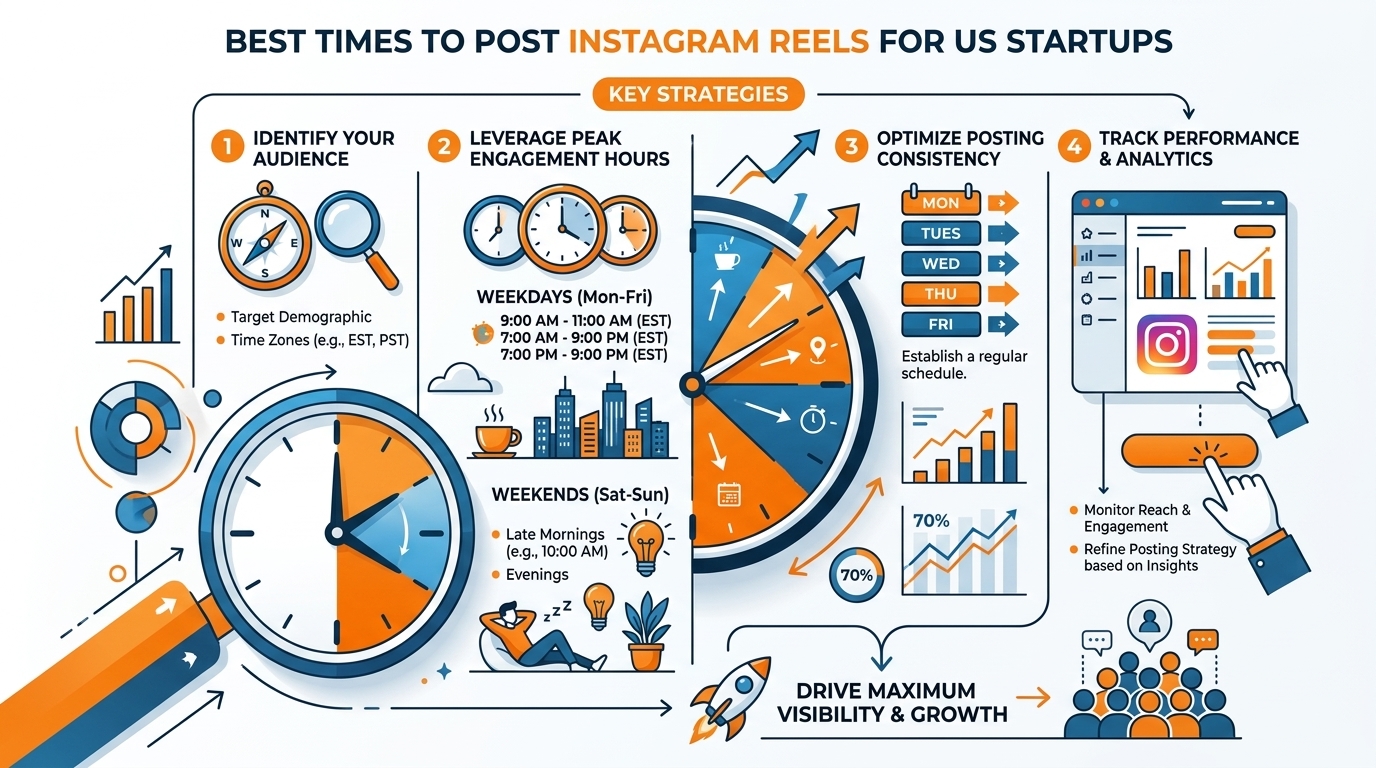
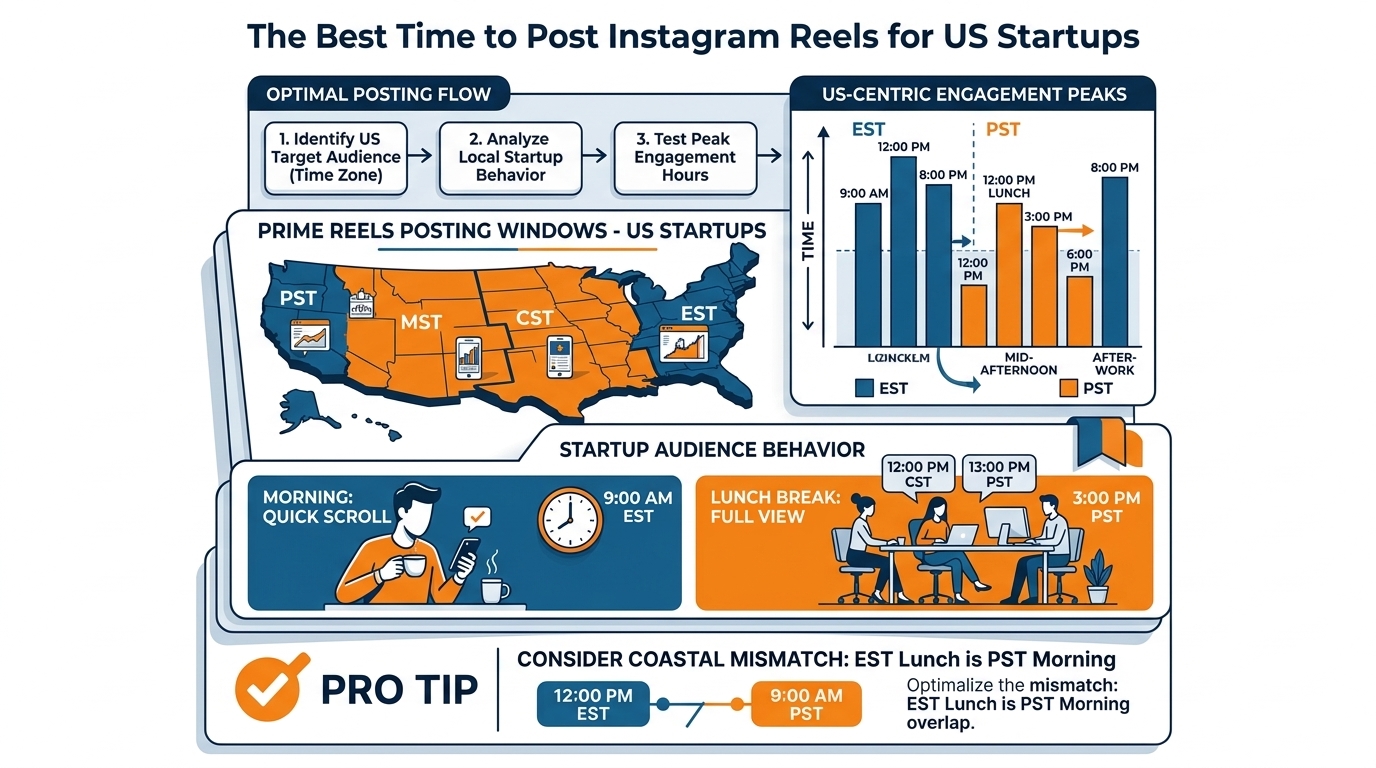
- First, aim for 12pm-1:30pm ET to capture East and most Central Coast scrolling during lunchtime.
- Second, aim for 7-9pm ET to capture the 4-6pm PT zone, which is when West Coast viewers are scrolling after work and before they go to dinner.
I suggest that startups post twice per week, one slot in each of these two time windows.
Or, if you have time to post three times per week, I suggest using the two evening slots and one lunch slot since the second slot usually gets more watch sessions and shares for startups.
These windows are built on top of organic check-in patterns, which is vital to distribution.
Reels are judged quickly, so it’s even more important for startups, because you’re likely sharing to a smaller follower group, and that first 30 to 90 minutes of velocity could mean the difference between a Reel dying or being distributed further.
Lunchtime is a quick burst window: there’s a lot of activity for a quick break.
Your Reel needs to be worth saving or sharing right away.
The evening is a more long-form window: there’s a lot of consumption happening, people are more likely to watch longer, rewatch, and share, meaning higher retention signals and a second wave. For a broader benchmark, Sprout Social’s data-backed posting times notes its analysis is based on data from more than 30,000 brands.
When choosing between committing to a single time zone or continuing to A/B test split times, use your audience’s location as the deciding factor rather than your own.
Within Insights, I look for clustering, not perfect uniformity.
If about 60 percent or more of your US followers are in the ET/CT zones, I treat ET as the default and prioritize the 12:00-1:30pm ET slot first.
But if you’re genuinely dual coastal, meaning neither ET/CT nor PT dominates and your leading metro areas feature some mix of New York, Chicago, LA, and Bay Area, then a simple test, with the same post type and hook style, alternating between the lunch window and late afternoon window, over the course of 2-3 weeks then selecting the “winner” according to your desired metrics (profile taps, DMs, website taps, etc) divided by reach, rather than by raw views, will yield the most conclusive results.
Startups should make strategic rather than habitual decisions on weekends.
In the B2C arena, when targeting creators or when your product functions as a habit-forming lifestyle, weekends will actually beat the weekdays because longer attention spans and more casual sharing on Saturday late morning and Sunday early evening usually yield a better completion rate and a greater volume of sendings.
In contrast, weekends usually won’t perform for B2C or even B2B results (assuming your product is more B2B oriented) for qualified results, even though views look acceptable, since you get entertainment mode engagement instead of work mode.
In such cases, reserve weekends for top-of-the-funnel trust or credibility content.
You can keep your highest-conversion rate Reels for Tuesday through Thursday for both the US-wide time slots above. If you want a wider comparison of timing guidance across sources, Search Engine Journal’s roundup notes a consistent recommendation trend: Wednesday is frequently cited as a top day for Instagram posting across sources it compared.
Ideal times to publish Instagram Reels, broken down by startup category, whether it’s B2B, B2C, a marketplace, or a local business
If you run a B2B SaaS company or you’re a founder, your best times for posting Reels to US startups are not when people are in meetings but when they’re between meetings.
I would recommend keeping your “go to” times Tuesday to Thursday 12pm to 1:30pm ET for qualified eyes from operators, managers, founders who will scroll on their lunch break.
Then 7pm to 9pm ET if you’d like longer viewing sessions from execs, because most people only log into Instagram when the day winds down; my analytics show stronger retention here because people actually watch the Reel instead of stopping in the middle during an inbox dip.
For Reels intended for top of the funnel, Monday evenings can be effective for impressions.
But for Reels intended to convert, whether that’s for a demo sign-up, webinar, or direct message, we tend to see more qualified leads mid-week 12pm to 1:30pm ET because people are actually in work mode when they scroll and can act right away. For another data-backed angle, HubSpot’s Instagram timing cheat sheet says its recommendations are backed by its 2024 Social Trends Report plus other HubSpot research.
Shift the timing track to off-hours and impulse behavior for B2C apps and consumer startups: weeknights, 7pm to 10pm ET, weekends late morning, that is where you are earning installs, not just impressions.
The nuance here is aligning the Reel with the behavior.
If you are doing discovery, trying to get shares, I like Saturday late morning, Sunday early evening.
Longer sessions, more sending.
If you are trying to get installs, you want the viewer to have the phone in their hands with no friction.
Go during the evenings, when they are willing to go ahead and download, but keep the value immediate, within the first two seconds.
And if you are doing conversion Reels, do not put them at the very end of the night; I think the 8pm ET hour still catches both coasts while they are alert enough to go through the app store. One dataset-focused reference is Adobe Express’s analysis of Reels posting times, which analyzed 22,125 Instagram Reels uploaded by 200 top content creators (likes, views, comments + time/day) to identify best posting times.
As marketplace platforms and two sided platforms know better, don't time like an audience. You have supply AND demand.
They scroll at different times of day, so time your posts for when they are active: supply is early morning / early evening, while demand is lunch / night.
Prioritize posting for each side of the market each quarter based on your constraint: if supply-constrained, post early morning ET and 7pm-9pm ET using conversion / education / trust content designed to lower friction / objections; if demand constrained, post lunch and weekend discovery time using reach / share content.
Also vary the Reel job: a week of heavy TOF posting targeting the side you need more of, followed by a midweek Reel designed to drive DMs / waitlist signups for the side that is closer to transaction.
The error local or geo startups going national make is creating one account for each city instead of using layered city based windows in a single account.
I recommend that you have one slot that’s consistently national (7pm to 9pm ET) so that you catch every time zone and maybe a second slot that you can turn on local (for example 12pm to 1:30pm city time in your city if you’re trying to drive city based traction for lunch hour discovery). If you want to systematize this, a social media content calendar can help you map national versus local slots without overthinking it.
During launch, make these even tighter.
I.e. if you’re launching a new product, press hit, featuring on the app store, a raise or any partnership, you want to ride the wave and hit your audience with two posts within a 24 hour window: one in the lunch hour window, when people are chatting online, and one in the evening window to catch after work scrolling and secondary sharing.
If your reel is trying to drive conversions during launch then make it mid week so the viewer can convert right away, rather than “save it for the weekend” when nobody’s there.
The ideal moment to publish Reels if you are targeting US companies and lack a significant amount of data (like small follower counts, or inconsistent engagement)
The vast majority of 'best time to post' charts that get published don't apply to startups because the assumptions are things you just don't have yet like stable reach, consistent high frequency of posting, and stable numbers to average.
They're built from blended accounts of (Posts, Stories & Reels) across countries to larger accounts where any single post will behave the same as any other.
For a small business/earlier startup account, one post from the right person sharing it, one lucky boost from explore, one slightly awkward hook for that Reel can cause a 5x jump in results.
Trying to copy and paste a generic time will probably just teach you the wrong lessons.
Without enough data, you need to run a low-volume test where timing is the primary variable, yielding a reliable 14-28 day window.
You do this by keeping your creative format the same for the entire test, similar length, similar hook style, similar pacing on screen, and one clear job per Reel.
This way, you’re not accidentally testing out creative production as much as you are the timing.
Rather than come up with your own new posting time whenever you post, rotate through a small pool of time slots that you go back to and repeat.
I typically keep the pool to two or four slots at most.
If you’re a U.S.-based audience, that means a lunch slot and an evening slot.
And then if you can post three times a week, go back to the same three time slots over and over, getting multiple tries in each window with similar creative conditions. If you want a simple system for staying consistent while you test, see plan social media content for a month.
For small accounts, we’re really interested in normalized metrics to de-skew any weird spikes in reach.
So instead of asking yourself which Reel got the most views, I want to ask you which time block delivered the best result per unit of reach.
That’s the real answer to how much efficiency was there, even if the distribution is skewed.
We also want metrics that reflect what the startup is trying to do with Reels.
For distribution power, we care about shares per reach.
For consideration, we want profile visits per reach.
For high-value conversation, we want DMs per reach.
For educational content, I like to track saves per reach because that indicates the video will show up again down the road and have more life over a longer period of time.
But likes and views, just raw numbers?
They’re not as important to me, because at such a low volume, they’re easy to game.
But the hard part is figuring out false negatives, so you don't optimize the wrong thing.
Posting a good reel at a bad time will have good retention and share rate for who got to see it, but there was not enough of the initial velocity to push it further. This would be a timing issue.
A bad hook posted at a good time will have the first few reaches, and it will drop off fast on watch and shares. This would be a content issue. Time will not fix it for you.
Here's how I separate the two when I look at tests: if the first wave has higher shares/reach, high profile visits/reach, but just low reach in total, you posted the good reel at a bad time.
If shares/reach and profile visits/reach are low even when reach is good, that means you had a decent time but a bad hook.
The best time to post reels depends on your signals, not coincidence!
Optimal Posting Times for US Startup Reels: It’s about timing and distribution matters as much as the clock.
The Best time to post Reels for US startups is when you can guarantee you’ll hit your Reel’s first hour, not when your target audience is active.
Time doesn’t help as much as distribution does. When you’re too small or don’t have the budget to compete with bigger brands, distribution is what gives you an edge.
In my tests on startup pages, going from no Reel in first hour to a Reel that was on the first hour in a coordinated manner could result in a 2x or greater increase in shares per reach, the difference between the Reel stopping after reaching your followers or getting a second wave of distribution from outside of your followers.
Treat the timeslots like multipliers and treat distribution like the engine that drives your Reel.
If your goal is to rack up early engagement without triggering the spam algorithms, the first hour needs to be a pre-planned launch sequence rather than a best-case scenario.
Reach out to partners, influencers, customers, complementary brands, or even founders who know you, so your Reel is greeted with immediate, authentic viewership from actual humans interested in your content.
You don't need a legion of allies, just the coordination of a small crew of collaborators.
If you can mobilize three to ten people to sit through the content and share it on their stories during the initial half-hour to hour, the engagement data will reflect a clear endorsement of high-value, organic distribution.
I make this work by asking for a simple timeframe and a simple action: watch the video all the way through, then share it on your story if you genuinely think it'll resonate with your followers.
High watch time and shares will beat the hell out of an army of low-intent thumbs-ups.
After that, broaden your seed viewers by using cross-posting and community touchpoints you already own to avoid paid media.

The idea here isn’t to blast links into all of the places possible, but instead funneling the reel into audiences where they’re already expecting to find relevant content: a founder community, a customer Slack, a niche Discord, your email list, a personal network thread where the audience match is strong.
Why? Because shareability is psychology.
People will share reels when they can say, “I’m smart, I’m early, I’m helpful, I’m relatable.”
Create this kind of win for the viewer in the first two seconds, offer a payoff that feels sharable, and even offer a reason for them to save the reel to their collection.
Saves and shares might sometimes outperform the timing of the reel, especially in B2B and education-heavy startups.
Tie your posting time to distribution, and execute from there.
Plan your launch time around when collaborators are online, when your respective audiences are likely engaging with posts, and when your own team members can stay responsive to comments and DMs (and yes, that activity in the first hour helps boost the next wave).
If one of your key collaborators is most active during the evening ET (because she lives on the West Coast), then that might be the slot you want to go with.
If you know that your audience spends the afternoon scrolling, then a midday ET slot might feel like the best choice.
But again, the best time to launch is the one you can replicate consistently each week with the same distribution approach.
You’ll get better results from the consistent early engagement of a planned start time than an accidental hit on a perfect time.
Epílogo
The Best Time to post Reels for startups in the United States is not a time, it is a framework to implement.
Start with the national best time to post for Reels for US to hit the entire country including both coasts with no effort, and choose the one of the two time frames that aligns with your type of startup, and A/B test for a defined short period of time where you only vary timing in the test and measure outcomes in metrics such as DMs per reach, Profile visits per reach, and Shares per reach.
And then once a winner pops out of the testing, continue to post at that time without change, so that the compounding of Reels can actually accumulate as we need to see more and more data points over time to know that the timing works.
Consider your analytics as startup metrics rather than mere social media folklore.
Your objective is to minimize noise.
Keep both the Reel format and your job description static; test only a narrow range of posting times.
Evaluate each time slot by its downstream impact, rather than by attention-grabbing spikes.
I use normalized metrics, as smaller accounts are prone to erratic distribution anomalies.
A time slot that generates 0.8 percent DMs per account reached is more important than a time slot that generates 30 percent more views but half the DMs, because DMs represent user intent, and it’s intent that ultimately grows your community.
You'll also need to boost distribution because relying on the timing algorithm isn't enough for you.
That initial 30 to 90 minutes are going to make or break that potential second wave, so you need to schedule your post for when you have a good chance of generating early views, comments, engagement, and shares, and when you'll be able to actively respond to all of that attention in real time.
When I line up a group just so people can view a video in its entirety and share it within the first hour or so, I'll consistently notice an uptick in shares per reach.
That's the kind of signal you want to see; it helps you determine whether a particular time slot is worth trying again.
It’s a growth hacking approach: you’re targeting specific, repeatable results such as direct messages, sign-ups and calls.
You aren’t looking for an average graph.
The best time to post a reel (for US-based startups, at least) is the one you’ve proven on your own account via a controlled experiment, then repeated for the following week, under the same conditions, until you can consider it to be data.
Related reads
4/27/2026
B2B SaaS social media benchmarks: Set the right targets.
B2B SaaS social media benchmarks: Set the right targets. The trouble with defining B2B SaaS social media benchmarks is that it's an inherently impe...
4/25/2026
Building a personal brand as a technical founder (without becoming a creator)
Building a personal brand as a technical founder (without becoming a creator) Creating a personal brand as a tech founder should feel less about ma...
4/20/2026
Creative Post Ideas for Sustainable Brands (That Don’t Sound Greenwashy)
Creative Post Ideas for Sustainable Brands (That Don’t Sound Greenwashy) That’s not what creative post ideas for sustainable brands should look lik...