A social media launch checklist for startups
A social media launch checklist for startups A social media launch checklist for startups doesn’t help if you don’t know what you’re launching for....
A social media launch checklist for startups
A social media launch checklist for startups doesn’t help if you don’t know what you’re launching for. Not vibes. Not awareness. A specific goal that you can measure this week.
What do you want to happen before you click submit? Waitlist, free signups, demo requests, or paid conversions? Choose just 1 goal.
Next, quantify what success means, not how it feels.
e.g. You want to get 300 waitlist signups in 10 days, 120 freemium signups with 12% landing page conversion, 25 qualified demo requests from LinkedIn, 15 paid signups without exceeding a CAC maximum threshold.
“If you can’t define success in one sentence with a number and a deadline, then you don’t have a launch plan, you just have content ideas.”
Why do most startups fail when they launch their social media? It’s because they focus on sharing while completely disregarding the three activities that will have the most impact for a small team with limited time and budget.
All we need is proof, distribution, and an executable runbook.
Proof is the trust that makes people go to the next step, like a tight demo, a clear before and after, a customer quote, an actual number, or screenshots that wipe away any suspicion.
By distribution I don't mean wishing and hashtags. I mean your designed distribution chain: partners, communities, founder accounts, early users, and warm networks.
A runbook is the playbook you actually have time to implement, while still planning who is going to do what, when, and what we will do if the results are disappointing.
I’ve also seen launches succeed with tiny audiences because the offer was so compelling, the promotion was pre-arranged, and they followed a basic, repeatable process instead of flying by the seat of their pants.
This is what we’re going to do here: create a startup social media launch checklist that will deliver results even when you have two people, a short runway, and no time to f*** around.
You’re a small startup, so you need a social media launch plan that is lean. If you’re also trying to solve inconsistent social media posting, see inconsistent social media posting.
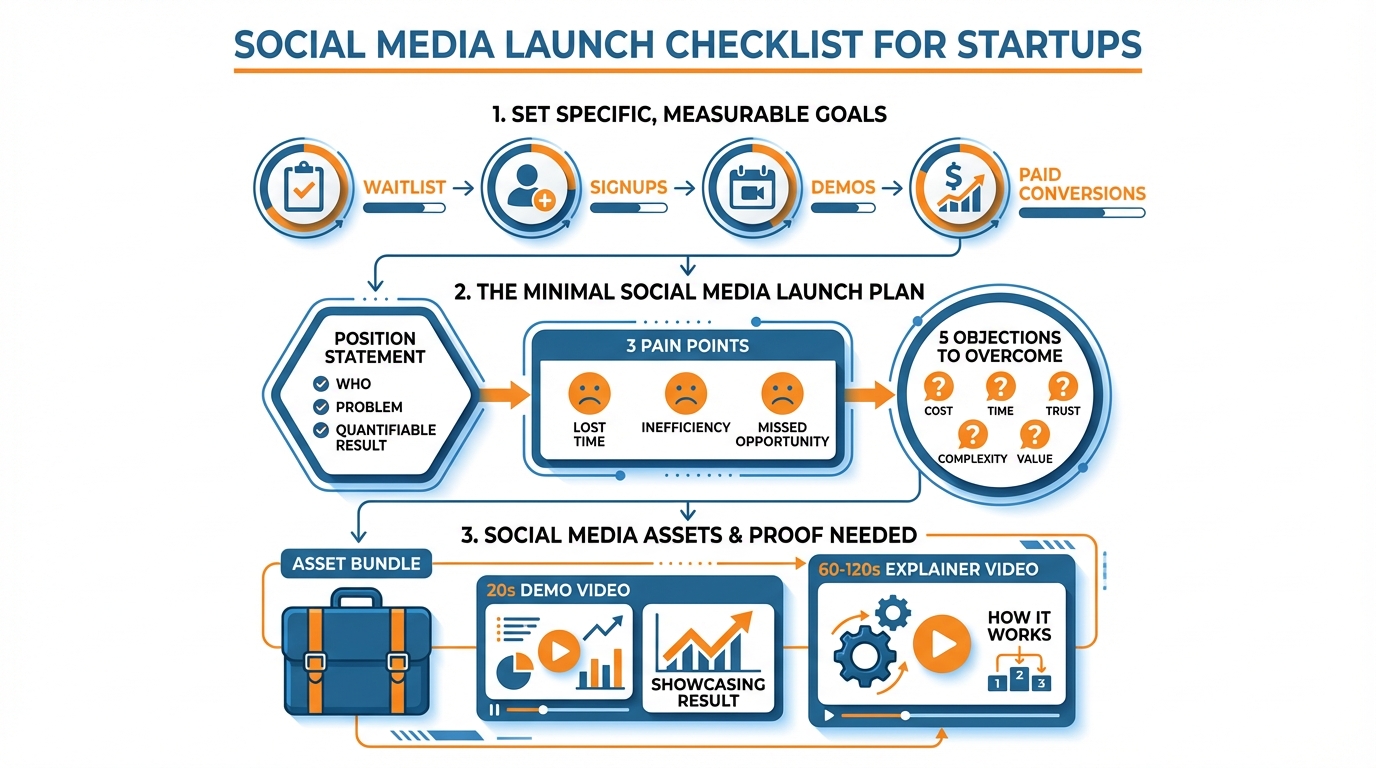
Here’s the minimal social media launch plan for a startup
Let’s begin with a position statement so simple that you could recite it under torture.
This is one sentence that contains: who it is for, the painful problem it solves, and the quantifiable result.
From here, outline the three pain points in your customers’ own words, and the five objections you have to overcome on day one.
I find most launches get stuck because someone makes a negative comment, and you get stuck; I just avoid this by scripting a few canned responses ahead of time, because in reality the first hour after posting is when your conversion rate is most sensitive to trust signals and uncertainty.
Do the same with the next thing - choose the number one conversion you are aiming for and the number two, then hook up all the signals to these 2 things.
Number one is the thing you really want most of the people to do, e.g. join the waitlist or request a demo.
Number two is the thing that keeps the sale going if people aren’t ready for number one, e.g. subscribe to a newsletter or the reply-to-my-DM funnel.
Be ruthlessly single-minded: one launch - one action.
I see small teams trying to push for 3 conversions, and it fills up the page, it waters down the communication, and you are left with a ton of engagement but not that many conversions.
Now select your channels like a realist, not a brand deck.
You need 1-2 core channels where you can post often and learn quickly, and 1 community channel where you earn attention by contributing.
Decide based on where your buyers live, and how they like to consume tool information: some want quick proof and operator perspective, some want extensive discussion and peer input. For context on where people actually spend time, the Pew Research breakdown of Americans’ social media use in 2025 reports a survey of 5,022 U.S. adults (Feb 5-Jun 18, 2025), including that 84% ever use YouTube, 71% ever use Facebook, 50% ever use Instagram, 37% ever use TikTok, and 10% are daily X users.
If you’re small, it’s not ideas that’s the constraint, it’s execution, so select fewer mediums and invest in proof, handling objections, and answering comments rather than trying to cover 5 mediums.
Lastly, determine how much of your content should be coming from a founder account versus a brand account since that will affect how you execute distribution.
Founder led content will perform better in the beginning since it’s people, not logos.
Meanwhile, the brand account will be used for proof, product, FAQs, and all the things you can point to when responding.
If you have zero audience, that’s okay too.
Line up some pre-arranged swap arrangements with similar companies, get amplification from advisors and investors lined up prior to launch, post to the community without shilling so people become familiar with you, and put up some founder-led pieces that show the problem, trade-offs, and some behind the scenes decision making. If you want examples of that style, see behind-the-scenes content.
I’ve seen launches go with virtually zero followers since distribution was pre-committed and the first several pieces of content addressed the most immediate questions.
Founders want to know: what all do I need for my startup’s social media launch?
Here’s a list of social media assets & proof you need
Want this Startup social media launch checklist to work? Then you must not think of your launch as a post but as an asset bundle.
Before you press the publish button, you must have a 20s demo video that showcases the result. A 60-120s video that explains how it works. If you’re leaning into video, note that Wyzowl’s 2026 video marketing stats are based on a survey of 266 respondents in late 2025 and report that 91% of businesses use video as a marketing tool.
A set of clean screenshots you can reuse across all media: the problem, the key part of the UI, the results page, the A-HA moment.
You need multiple benefit-led descriptions of what your launch is about:
- 1 that speaks to speed
- 1 that speaks to saving money
- 1 that speaks to saving risk
- 1 that speaks to simplicity
- 1 that speaks to eliminating a duct-taped solution
This way, you’re not producing content. You’re producing a launch media bundle you can apply in all situations, on all platforms, in all comments.
Second, take out the two most powerful objections that can wreck a small business sign up on the fly: confusion and sticker shock.
You must have a short description of your pricing and plan that a busy owner can read in ten seconds that describes who the plan is for and what happens when you outgrow it.
You also need a comparison and alternative framing, because the prospect will play the comparison game with or without your help, so you might as well frame the game: instead of using spreadsheets, instead of a slow agency, instead of a jury rigged tool suite, instead of manually chasing people.
You also need canned answers to the questions prospects are going to ask at comment velocity: how long does it take to get set up, how is my data protected, what integrates with this, what is the cancellation policy, who is this not a good fit for, what kind of results can I expect in the first week.
The landing page headline promise, proof, and single call to action must match the social promotion word for word or you will convert the click to a bounce.
Then the part most founders omit: proof.
No proof makes a launch sound like an infomercial without testimonials, and makes users default to disbelief.
You want quotes from early users telling in simple words what changed, even if it's five beta testers, not fifty paying customers.
You want at least some numbers, because numbers cause belief: Saved 2 hours a week, cut response time from 24 hours to 2, reduced no-show rate by 15 percent, got the first 10 orders in 7 days, went from 3 leads a week to 6.
I have seen small startups outsell their larger, better-funded competitors because they could show one simple metric and one simple transformation, while everyone else stayed vague.
Here’s why these micro versions of those kinds of stories are the gas for your conversion machine: they squeeze your origin story down into something that you can imagine yourself in - the client, the attempt, the pivot, the price, the outcome.
Then you add proof that isn’t a boast - a client whose work you recognize, a certification, a picture of the workflow, an open build log, a low-key signal of social proof like a few comments from other operators.
Finally you add some “why now” to help with the timing - a change in the law, a seasonal demand, an inevitable trend, a workflow that people are now being forced to do, or a status quo that you demonstrate is broken with an example I can check for myself in a minute.
All of that mixed together turns a launch announcement into a useful decision shortcut, backed by assets and evidence.
Here’s your go-to social media pre-launch checklist for a startup
Determine distribution channels (organic reach, partners, influencers, communities)
For your Startup social media launch checklist to generate any real signups, it needs to outline the distribution chain, not just the post.
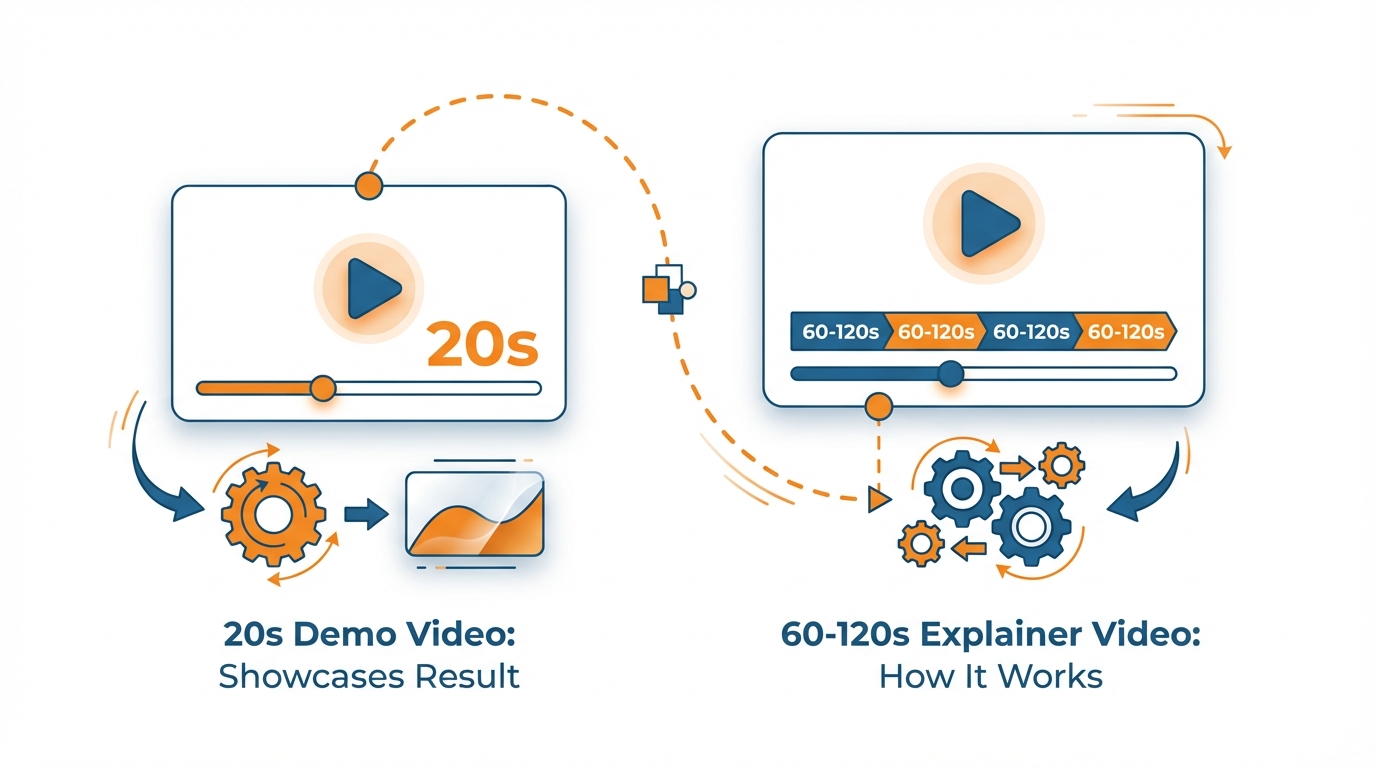
Figure out precisely how people will see your content outside of your followers.
How does it go from first touch on your personal account to validation on your company account to amplification on other people’s accounts?
I create a relatively small list of allies and influencers that is shallow enough to maintain but deep enough to create multiple impressions because it’s through repeat exposure that action is produced.
In general, plan on having a strong post produce material conversions only after multiple views; attempt to get at least 3 unique distribution touchpoints within 24 hours, e.g. founder post, partner share, group discussion post.
For partners and influencers, make it frictionless: agree to share their launch-related content in exchange for them sharing yours - but only if you make it valuable to their audience.
Instead, provide them with already-written talking points that allow them to maintain their authority: a quick rundown of a problem, a milestone metric, or an inside lesson that positions them as knowledgeable for sharing.
Stagger your communication: an introductory email 5-7 days before launch to gauge interest and discuss the type of content to share, a follow-up 24 hours in advance with the content and suggested text, and a final email as you launch, allowing them to piggyback on the initial buzz.
Whenever I’ve managed large partner campaigns, the line between a success and a headache has always been whether there was a clear mutual agreement about what will be shared, when, and why their followers will care.
Community distribution is where most products go to die.
This is because people copy-paste a pitch into channels that have different rules and will penalize you for copy-pasting a pitch.
When posting to Reddit, focus on the problem and trade-offs, show your working, and ask for feedback.
When posting on Indie Hackers, talk about your numbers, what you tried, what didn’t work, and what you’re going to try next.
When posting in Product Hunt-style communities, talk about the use case, the demo, and short, clear answers to questions people ask before they are willing to trust a new tool.
Your posts should be 80% value and 20% about the thing you made because communities punish non-value add with non-visibility.
A good rule of thumb is that if you remove the product link from your post, it should still make sense.
Then intentionally convert replies into reach: your responsibility in the first hour is to generate comment velocity and volume, as it’s used by platforms as a quality signal. Ask a follow up question, ask people to show how they currently do it, and grab social proof as it’s posted.
If someone posts a great reply, comment back with a summarized mini-testimonial and a request to reuse it, then incorporate it into your next post or thread.
Finally, establish second wave distribution 48-72 hours later: resurrect the winner by repackaging the winning hook, strongest objection-handling reply, and best proof metric into a new take, and resurrect the same partner list with an update on what happened, what I learned, and how things have changed since launch day, rather than posting again for no reason.
As a social media launch checklist for startups, here are some ideas: a runbook for launch day, plus a KPI that follows the funnel
On launch day, you need a script, not a plan.
Launch on the channel where your buyers trust you first, because the first reactions serve as proof for all other channels.
Use a founder account to seed credibility and narrative.
Then immediately use a proof post on the brand account that answers every comment with receipts: demo clip, pricing clarity, and one metric that proves the outcome.
Then roll the announcement on your second channel.
Finally roll the announcement in your community.
Communities reward context and discussion, not the first wave of hype.
Do it in this order, and you can reuse early questions as copy, reuse early praise as proof, and keep the message consistent as it travels.
Treat your comment section as a customer support funnel, not an improv show.
I pre-write canned responses for the top-five things that usually happen on day one: what does it do in one sentence, is this for me, how much does it cost, does it integrate with X, why should I trust you.
I try to make my responses short, specific, measurable, and always conclude with a single next step that aligns with my single launch conversion.
I pre-write two de-escalation responses, too: one for a skeptical objection that is fair, and one for a hostile comment that tries to derail the thread, because the goal is to preserve trust without getting sucked into an argument.
Then I set a monitoring schedule like a metronome: every 5 minutes during the first hour, every 15 minutes for hours 2-4, then hourly until the end of the day, because the first 60-120 minutes typically determine whether the algorithm continues to show you to people.
Escalation rules keep something minor from becoming a public fiasco.
If someone reports a bug, you acknowledge, ask one clarifying question, and send it to whoever can fix it while you drop a status update into that same thread within 30 minutes.
If someone is confused about pricing, you treat it like a conversion funnel leak, not a branding problem: you respond with the 10-second summary of pricing and who each tier is for, and then update the landing page copy that same day so you quit losing clicks.
If someone is just angry, you draw blood to tell signal from noise by asking what specifically upset them and whether they had that experience themselves; if it’s legitimate, you own it and say what you’ll change, and if it’s bad faith you close the loop fast and move on.
Who owns what should be clear: you own posting and responding, someone else owns fixes, someone owns price and policy questions, and one person owns tone when it gets heated.
If you’re going to get your business metrics to move, you need to measure like a startup, not like a media company. Here’s what that means:
- Metrics are tied to the funnel: Instead of measuring the success of a social media post, you measure how it contributed to the customer acquisition funnel. This means tracking how many people clicked, signed up, activated, and paid, from each channel and post.
- You use UTMs: to measure each channel and post separately, so you can see what worked and what didn’t. If you need one, use this campaign tracking builder.
- You measure Impressions and Engagement as leading indicators, to see if your post is working, but CTR, Landing page conversion, and Activation are how you decide what’s working and what isn’t.
- You measure and report Revenue, so your business can see that social is driving results.
- You set clear baseline expectations so you don’t freak out. For example, for a small business on a good launch post, you might expect: Social CTR: 0.8-2.5% Landing page conversion: 5-15% for warm traffic, 2-8% for colder traffic Activation: depends on how long it takes the product to deliver the promise
Use decision rules to iterate: If engagement is high but CTR is low, then your hook worked but your CTA or offer framing is bad. Rewrite the first line and the ask. If CTR is high but signups are low, your landing page is breaking the promise. Tighten headline match, remove distractions, and add proof above the fold. If signups are high but activation is low, you have an onboarding problem. Shorten time-to-first-value, and reflect that shortcut in the next round of posts.
Day 1 was rough, but now you can move into a tight iteration loop for the next 7-10 days: Double down on the one channel/post combo that’s producing the best cost per activated user. Take the best objections, and turn them into new content. Keep reporting results in business metrics, so your social media launch is judged on activation and revenue, not likes. If you want a more systematic approach, see weekly social media system for.
Fin
An ultimate Startup social media launch checklist is only useful if you stop using it as a one-and-done task list, and start using it as a repeatable launch framework.
Your responsibility is to repeat the same 4 plays every time you launch: building proof that eliminates uncertainty, designing distribution that gets eyeballs, running a crisp playbook that doesn’t lose steam, and measuring against the funnel to understand what generated signups, activation, and revenue.
As a small business, this mindset is your secret weapon because you don’t have the budget for random content.
You win by building consistency: each launch adds more proof snippets, objection handling and a promise that can match your landing page.
I’ve seen small teams turn one good metric into a compounding asset where each launch makes the next one convert better because the best comments turn into future copy, the best questions turn into future FAQs and the best objections turn into future posts that pre-sell before the click. If you want to lean into repeatable operations, see smart social media automation for.
Now add some rigor: every post, determine how you'll iterate based on funnel, what you'll leave, what you'll cut and what you'll adjust.
If you're in the 0.8-2.5% CTR range but conversions suck, you're going to fix message-page congruence and proof locations.
If conversions are fine but activation is weak, you're going to fix time-to-first-value then update your next posts to reflect the shortcut.
THAT is how you make social media a scalable channel instead of a faith-based effort.
The main conclusion here is straightforward: a startup social launch is not a day.
It is a cycle that you can repeat, refine, and layer with each new launch-whether that’s a feature, product, offer, or geography.
When you treat your Startup social media launch checklist like an operating system, each launch becomes another controlled test that refines your proof, expands your distribution channels, perfects your playbook, and progresses your KPIs. Also, arXiv research on board member activity on Twitter and venture success uses a dataset of about 500 U.S.-based technology startups (per abstract) and finds that startups whose board members are active on Twitter attract additional funding over the years, though they do not generate additional sales (per abstract).
Related reads
4/27/2026
B2B SaaS social media benchmarks: Set the right targets.
B2B SaaS social media benchmarks: Set the right targets. The trouble with defining B2B SaaS social media benchmarks is that it's an inherently impe...
4/25/2026
Building a personal brand as a technical founder (without becoming a creator)
Building a personal brand as a technical founder (without becoming a creator) Creating a personal brand as a tech founder should feel less about ma...
4/20/2026
Creative Post Ideas for Sustainable Brands (That Don’t Sound Greenwashy)
Creative Post Ideas for Sustainable Brands (That Don’t Sound Greenwashy) That’s not what creative post ideas for sustainable brands should look lik...