Outsource Social Media to AI Safely (Without Brand Risk)
Discover a working operating model to outsource social media to AI. Increase content throughput, maintain quality, and secure your brand.
How to outsource social media to AI (without risking your brand)
If you’re looking for a way to outsource social media to AI, you don’t want yet another rundown of the latest AI bells and whistles.
You want to get your social media to take less time, cost less, and do more, and you want those wins without having to wake up to some errant post, an unsubstantiated claim, or a comment thread you now have to go scrub clean.
This is the standard to communicate from the outset: relying on AI does not mean that a robot gets to publish whatever it chooses. It means offloading the replicable, labor-intensive tasks to AI, such as conceptual assistance, draft writing, long-form to short-form conversions, and content creation based on your recommendations, which will then be ready for your review. You remain responsible for the strategy, the messaging, the parameters, and the ultimate content approval. AI can provide the muscle, but it’s your responsibility to remain accountable for everything that’s published and your brand reputation.
The result was designed for the small business owner that has their time back, for the agency that has to produce more for its clients without adding to staff, and for the marketing executive that’s expected to do more with less but still has to reduce the brand risk as much as possible. I applied AI in a way that standardizes the repeatable and secures the sensitive so that scaling does not have to rely on doing things in a heroic fashion, like any high-leverage system.
The core value proposition of this article is simple: you will walk out with a working operating model to outsource social media to AI. Not tools. Not hacks. An actual framework you can execute on a weekly basis, including responsibilities, degrees of freedom, rails, approval processes, and metrics, in order to increase content throughput while maintaining quality and brand safety. For a broader system view, see social media automation.
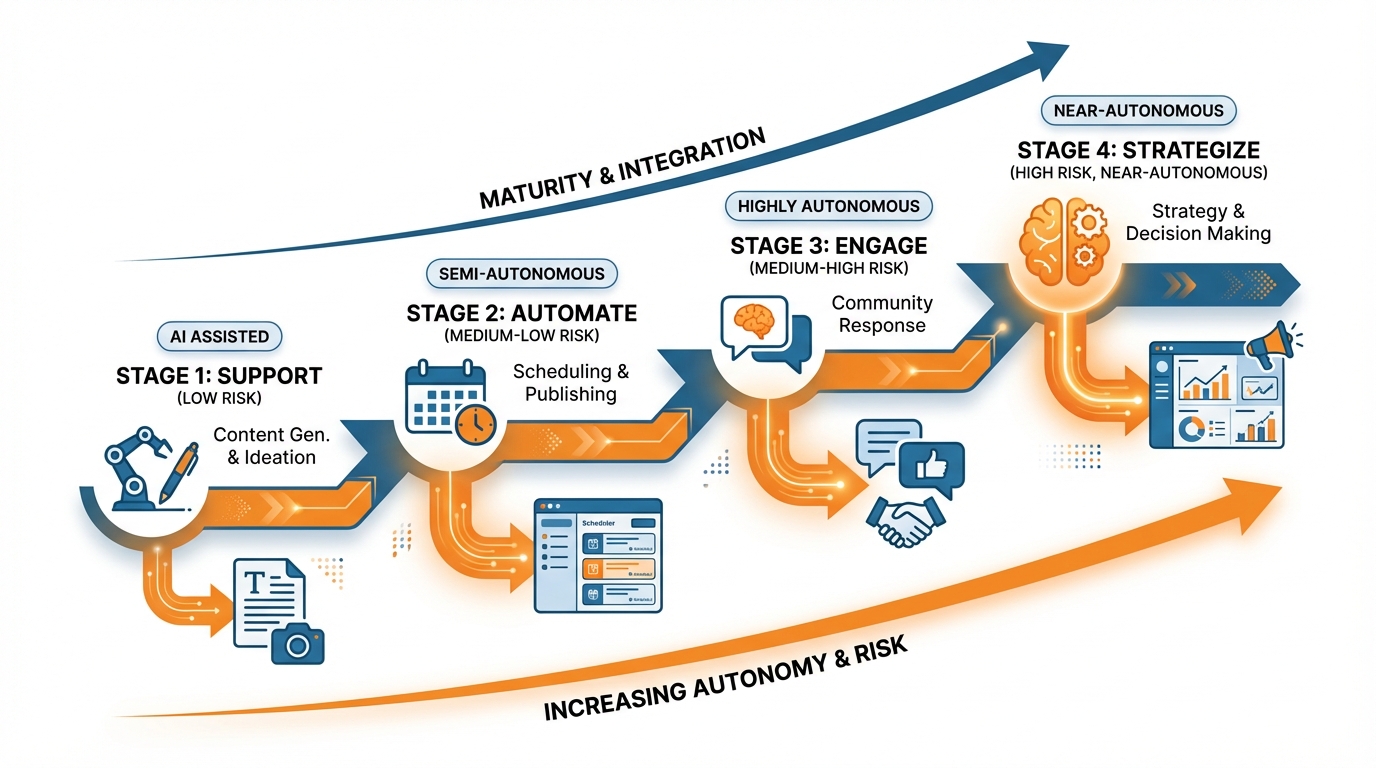
Which tasks to outsource: a maturity curve of support to near-autonomous
So the problem in these cases is to figure out how to outsource your social media to AI such that you minimize your risk and maximize your speed.
As I said above, the best way to do that is to find the right balance between using the minimum effective automation and trying to do the maximum automation.
I talk about this in terms of a maturity ladder, with five rungs:
- Assist: AI gives you a suggestion but you still have to do the work (e.g. AI says, “how about posting this?”)
- Drafting: AI generates the content for you to quickly review and approve
- Managed Production: AI creates a whole batch of content (including variants, etc.) for you to approve and it also repurposes content at scale according to your rules.
- Guardrailed Autonomy: AI can do most of the work, but it’s configured to require human sign-offs in key points (where the risk factors are highest)
- Near-autonomous: AI does the work, subject to posthoc audits and exception handling (e.g. the AI notices a problem, but rather than blindly posting, it tells you)
I find that most SMBs actually get the best bang for their buck with either the second or third step, since that allows you to radically reduce the amount of time you’re spending to create the content, while still retaining control over the key steps (strategy, review, approval, etc.) If you want a more structured cadence to support that, reference a weekly social media system.
Here are the examples of how the usual tasks are done at each of those levels, so you can safely decide what can be delegated.
When it comes to conceptualizing, work in Assist or Drafting: the positioning is yours, the AI creates 30 different angles, hooks and formats within minutes, and you choose the ones you want to roll with.
Copywriting works best at Drafting: AI does the captions, you refine the claims, add facts and figures, and approve. If you want to speed up Drafting, you can use an AI social media caption generator.
When it comes to conceptualizing visual assets, I suggest working with the Human and Hybrid level for as long as possible, as visual identity is part of what makes a brand recognizable; I allow AI to suggest the layout and theme, but the decision what is on brand and what is not is still mine.
When it comes to formatting, Managed Production is the right level: you supply one source asset and the guidelines, and the AI delivers all derivatives according to your rules.
When it comes to planning and scheduling, you can safely move to Guardrailed Autonomy if you have a good approval process in place, and the content is not too risky; when it comes to responding to comments, I suggest you stay at Hybrid unless you operate in a very low-risk niche, because a single bad response can destroy months of credibility; when it comes to analytics, AI can support by pointing out trends, but the final analysis and interpretation should be a human task, lest you end up optimizing for the wrong KPI.
If you need to determine which tier is right for you, count yourself down on the five friction factors: vertical risk, audience expectation, volume requirement, internal approval capacity, and brand tone.
If you’re regulated, or you make claims, or you talk about health or finance, or your audience expects expert interpretation, keep public-facing pieces in Assist and Drafting, and use Hybrid as the response standard.
If you need volume but can only review once or twice a week, move the remix and formatting to Managed Production, and hold your final sign-off to a weekly batch to avoid creating a publishing log jam.
If your brand tone is a major value, treat it like sensitive IP: leverage AI for volume, but retain the tone filter as a human function until your style guide is strong enough for the AI to incorporate it properly.
DIY vs outsource (and when to go hybrid)
Lastly, decide whether to DIY or outsource.
If the task is routine, low risk, and you can quickly fact check the output, it’s probably a tool. A useful support layer here is an AI social media content generator.
If you require innovative creative direction, stakeholder engagement or sophisticated narratives (think launches, collaborations or sensitive verticals) then it’s probably a person.
And if there is risk to getting it wrong then it’s probably hybrid: AI writes, human fact-checks and approves tone, and you sign off whether it is on-brand (think responses to community, anything that could be construed as a claim or commitment or a recommendation).
If you have very deep pockets, the above might not be necessary but for everyone else, do what WoopSocial did for us: spend a day briefing it and then get a month’s worth of content in a few minutes.
Then we could focus on editing and approving rather than staring at a blank page.
Next, we’re gonna talk about building your operating system: your roles, your SOPs, your approvals and your quality control.
(Which is where most advice stops.)
Build your operating system: roles, SOPs, approvals, quality control
If you want to learn how to outsource social media to AI without risking your brand, begin with identifying the irreducible human parts even in an otherwise AI-driven process.
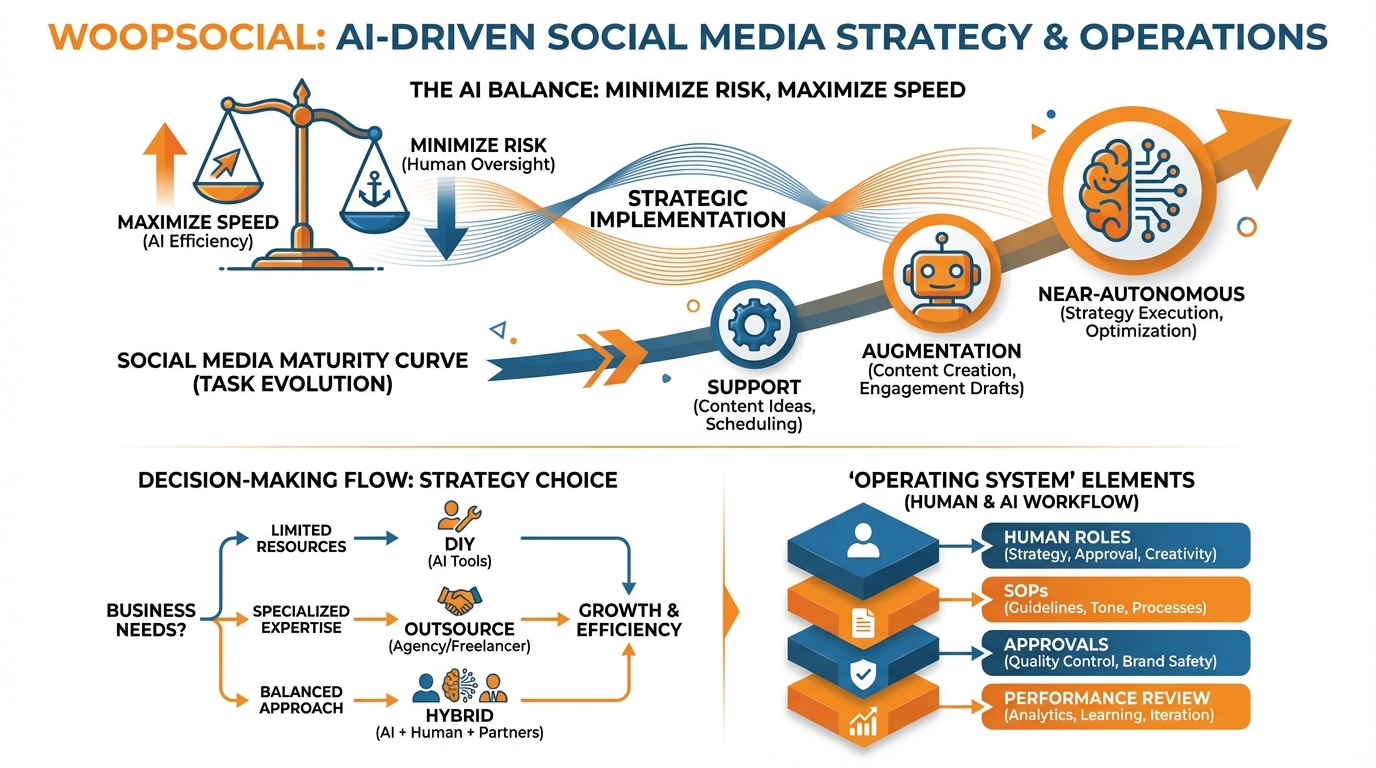
There has to be a content approver responsible for the content that gets posted.
There has to be a brand approver responsible for ensuring the voice and visual identity is correctly executed.
There has to be an offer or CTA approver responsible for ensuring that each piece of content leads to the right product on the right terms.
And there has to be an escalation approver for sensitive situations like customer complaints, media inquiries, rate issues or quasi-legal questions.
In a small shop, one person can play multiple roles, but the roles have to exist.
I’ve seen AI processes zip along until an ill-defined responsibility suddenly becomes a public error and all of a sudden everybody is in the comments trying to figure out who approved what.
Second, you need to define a weekly rhythm that is maintainable for 6 months, not a sprint for 2 weeks.
You need to chunk content production into a defined amount of time, you need to defend a defined amount of time for review, and you need to have a defined amount of time for scheduling, so that you are never held up waiting for an approval.
Your goal is to commit to results, not to quantity: define one thing you want to achieve per week (calls booked, quotes requested, foot traffic etc), and then allow AI to generate as many ideas as it takes to only choose the top-performing variants.
Personally, I like to focus on evergreen content that builds credibility, and proof content that removes risk from a purchasing decision, as those two themes will keep delivering dividends even if you pause for a week.
If you’re using a tool like WoopSocial to create 30 days’ worth of content in a short amount of time, the objective isn’t to post more, it’s to create time for curation and consistent publishing. If you want the scaffolding for that rhythm, a social media content calendar can make the review-and-scheduling loop easier to sustain.
Quality control standards (concrete and verifiable)
The biggest flaw with any outsourced content relationship is the QC process, so your standards need to be concrete and verifiable.
It must include fact-checking against one of your true sources, like your pricing page, your list of services, your guarantee, or recent case studies, because AI will invent facts if you allow it. This aligns with how quickly genAI has become a day-to-day tool: PR teams’ AI adoption surge reported that 75% of PR pros use generative AI at work, including for brainstorming (82%) and writing first drafts (72%).
It needs to include maximum claim thresholds to prevent claims of unsubstantiated results or superlatives that put red flags up for readers.
It needs to include tone requirements to establish how you do and don’t speak, using language that can be enforced.
It needs to include audience-match checks to ensure every article solves a customer problem instead of chasing platform trends.
It needs to include platform formatting checks to ensure that concepts are translated to the new format instead of copied into it.
And it needs to include link and UTM hygiene to prevent lost attribution, busted landing pages, and traffic intended for a special promotion being sent to last month’s offer. To keep that clean, use a UTM generator.
Approval workflows, audit trails, and access security
Workflows for approvals should speed up process, not just ensure accountability, so determine what gets automated and what should always be approved.
Tips that are evergreen and low risk, or just show a peek behind the scenes or share some culture can be fast tracked as long as it adheres to the style guide, but anything that has to do with prices, health, financials, warranties, or mentions competitors or includes a testimonial should always require review and the approver to include a reason for approving.
A full audit trail can be maintained without needing full-on oversight, just keep the approved version, the source links for fact checking, and approver name with each post.
Because when a problem happens, you should know what went wrong, not have to guess.
And because 3rd party vendors usually means more than one tool and login, so secure the accounts, and know what it will take to maintain the same levels of access separation: what should have publish rights, never share the master password, keep the recovery codes in a secure location, and establish a procedure for what should happen in the event of a vendor going out of business or losing the ability to log in to the account.
This is the difference between going as fast as you can and going as fast as you can until you can’t. In practice, this matters because AI is already mainstream in small business operations: AI-enabled tools are nearly universal in small business noted that 98% of small businesses said they use an AI-enabled tool.
How we train an AI to sound like me
Today I thought I’d go a little deeper into how we train an AI to sound like me.
First, it’s not actually me. This AI, whose name is hiding in plain sight, has its own voice.
So the more accurate way to say it is that I put our brand voice into the AI. Think of the AI as a platform, like an operating system.
Our brand voice is an input to that platform, and we need to continually add to and update it. So how do I do that?
It starts with having a very strong sense of what our brand voice is, and what it isn’t. Some people call this a “north star” to guide the content.
When you know what your voice is and isn’t, you can train the AI on that. But here’s the thing: the AI needs guidance on where it can and can’t go.
These are “boundaries.” So our inputs include both our brand voice and boundaries around it.
Finally, we need to be disciplined about the source of truth for our content. Is it the AI, or is it the humans?
For us, it’s the humans. Our source of truth is a content management system that we keep up-to-date.
When the AI regenerates our content, it needs to reference that source of truth to make sure it’s staying on the rails of our brand voice.
Brand voice falls apart for 90% of the AI processes I see because it gets defined like a feeling, not a framework.
You ask the AI to be friendly, bold, premium, conversational, etc. and you end up sounding like anyone else on the web.
If you want to figure out how to outsource social media to AI and make it not feel outsourced, you need to teach the AI the three things it can actually execute: A voice spec that is measurable, some examples of posts I would be proud to post today, and some no-go zones to cut out the gray area.
When I train a voice spec, I define sentence length, reading level, how direct I am, how I structure hooks, how often I use numbers, how I handle objections, and what words I never use, because tiny constraints generate shockingly consistent tone at scale. This is part of why generative AI is now a standard workflow for marketers: marketers’ genAI usage at work reported nearly 90% of marketers have used gen AI tools at work, with 71% using them weekly or more.
Use examples as your voice fingerprint
The best way to get to accuracy fast is to use your examples as your voice fingerprint.
You should give the AI 5-10 posts that have done well already, or that you consider to be examples of your best thinking, and tell it to copy the structure, not just the topic.
I will often give it one that is calm and authoritative, one that is energetic and punchy, and one that is story-driven, and tell the AI when to use which based on intent.
You can also give it one example that you hate, and explain why, because contrast training can cut revision time in half.
In real life, teams that switch from vague adjectives to specific examples and rules typically cut back-and-forth edits to about half, because the AI stops trying to intuit what you mean by “on brand” and simply follows a pattern it can observe. This also matches broader benchmarks: how marketers save time with genAI notes marketers estimate genAI could save ~5 hours per week.
Hard negatives and “no-go zones” prevent costly errors
That’s where you avoid costly errors.
Include hard negatives that the AI is never allowed to violate, such as ‘No promises of success’ and ‘How to discuss use of regulated or dangerous products’ and ‘When to acknowledge a competitor’ and ‘How to address sensitive situations where posting is an own goal’ and the like.
I also use strict rules like ‘Don’t discuss ongoing lawsuits, customer complaints, political situations, tragedies or pricing in public’, because the risk isn’t in what you intend to post, it’s in the edge cases.
The ‘Never do this’ and ‘Never say that’ rules are how you make it safe to outsource, because they change risk from a grey area into a bright line the AI can’t rationalize itself over.
Source-of-truth discipline and branding hygiene
Last but not least, you need to establish source-of-truth discipline to prevent the AI from hallucinating features, inventory or pricing.
You need to determine which pages and documents it is permitted to leverage, such as approved product pages, your current positioning document, your most recent offers and a short list of proof points that you can defend.
Then you establish one non-negotiable rule: If it can’t find it in approved sources, it needs to ask, not invent.
Some platforms can accelerate that by crawling your website to infer consistent branding, then automatically applying your logo, color palette and style to visuals.
That means less manual creative hygiene and fewer off-brand pieces slipping into the output batch, and there are tools like WoopSocial to make that branding hygiene easier to keep once your inputs and guardrails are established. This kind of metadata support can move the needle: AI-generated titles improving watch behavior found that providing AI-generated titles increased valid watches by 1.6% and watch duration by 0.9% in a large-scale field experiment.
Governance and measurement
Finally, Governance and measurement: This is how you ensure your brand remains safe and that all the work can be connected back to the business results.
If you want to master how to outsource social media to AI without waking up to a brand fire, you will need a basic brand safety playbook that outlines the boundaries of autonomy.
What AI can’t be allowed to do on its own are things that can become a matter of legal record or a reputation event: customer complaints, crises, legal/medical/financial advice, and high-risk DMs where a single sentence gone wrong can generate liability or refunds.
You establish escalation rules, like a traffic light: Green content that can go live after it passes a content checklist, yellow content that requires approval by a human, and red things that can only be answered by you or another designated owner.
I apply the same rules to replies, because the majority of brand damage comes from reactive messaging rather than proactive content.
But most of the AI social media blog posts gloss over that boring-ass compliance part, which is where SMBs get nailed.
If your content does not make clear that a statement is an endorsement, a testimonial, an affiliate, a freebie, and follow the requirements of the platform and the region you are in, you will get tagged.
If you are close to a regulated claim, fitness, supplements, finance, real estate, or anything that could be construed as a promise you’d better be setting claim limits and maintaining records of the backup proof, too.
And if you have a decent governance model then it should also automatically create a paper trail for each piece of AI content created, including what was created, what content it was based on, any edits that were made, who approved it, and the date it was approved.
That will become your go-to record the first time a customer challenges a claim or a competitor turns you in.
Metrics are where outsourcing falls apart when likes and comments are the only thing you look at.
Set up KPIs that are related to how you make money; intent actions like quote requests or form fills, booked calls, influence on your pipeline in a CRM, conversions in e-commerce, and intent signals like map taps and direction requests in local.
You can always still look at engagement, but use that more as a health-check than an objective.
I tend to look at one main KPI per campaign theme and one health-check KPI to keep things in line, and then month-over-month to keep an eye on when content generation outpaces offer-acceptance.
But at scale, that has to be designed into the process, not retrofitted on it, and you keep it clean by using consistent CTAs and running a few campaign themes long enough to be able to tell something, and being religious about UTMs that associate each post to a specific landing page and intent, and ensuring the landing page lives up to the promise of the post (or you’re going to misattribute the results, and end up blaming the content).
Then simply have a loop going once a month: what campaign themes generated conversions, which hooks generated interest but no conversions, and what value props or messaging increased the objections.
That’s also why an AI-first batch production workflow helps: it lets you generate a month’s worth of content in one session, and it lets you schedule it for optimal posting times, and it lets you keep a consistent flow going, and tools like WoopSocial can help with the production and consistency part, but governance and measurement are how you ensure volume actually delivers results and not just noise.
How you can actually use this this week (without risking your brand)
The real-world answer to 'how do you outsource social media to AI?' is that you outsource the doing, not the accountability.
You retain strategy, what we say, and approvals.
AI does the production, which is repeatable.
You begin on the lowest rung of the ladder, you add absolute guardrails, and you only loosen the reins once you've seen a few cycles of good results.
That way, you achieve velocity, but you don't risk waking up to a post that generates refunds, screenshots, or reputation debt.
Now, to lower your risk this week: limit the scale by design.
Choose one medium, choose one content pillar you can support with evidence, and create one month of content around it.
Part of your role is to determine what must always be true, what can never be true, and what sources are truthful; then, to review the posts in one go, and to only approve that which matches your criteria.
I achieve this by making every post tie to one business metric, such as quote requests, scheduled calls, or foot traffic, because content that can’t be attributed to income is make-work.
Your key metrics are those of a business owner, not a content producer.
Within a month, you should be looking at trending topline metrics like link clicks on your offer page, form starts, call taps, and direction requests, and some basic quality checks like zero corrections to product information and zero tone violations.
If the AI batch is driving awareness but not intent-based actions, you don’t need more volume, you need more compelling offers, more convincing proof, and more precise targeting within that same pillar until the math shows you that it’s working.
Need a shortcut to get to batching content with your brand voice and visual branding applied?
Consider layering an AI social tool like WoopSocial on top of your governance and approval process.
The benefit is that you can now go from zero to a month’s worth of draft posts in a matter of minutes, and then apply your limited bandwidth to the only thing that actually safeguards your brand: fact-checking, editing the language to reflect your strongest position, and approving content you’d be comfortable signing your name to.
When that’s solid, it’s not a risk to extend to a second content pillar or social channel.
Related reads
6/14/2026
YouTube API Alternatives in 2026: start developing right away
Skip the YouTube quota system caps and API calls. Compare the best YouTube API alternatives with code examples, pricing and understand recent changes.
6/12/2026
Best Facebook API Alternatives for Developers in 2026 for direct access
The Facebook Graph API review can take weeks. Compare the best Facebook alternatives for posting, scheduling and more.
6/12/2026
Best LinkedIn API Alternatives in 2026 - instant access for developers
See a list of all the LinkedIn API alternatives for all types of use cases so you can skip the waiting time and get right on automating your work on LinkedIn.