Perform a Social Media Audit in One Day: Ultimate Guide
Tired of exhaustive social media audits? Learn how to perform a fast, actionable audit in just one day, focusing on key insights for small businesses.
The Ultimate Guide to Performing a Social Media Audit in One Day
There are a ton of social media audit templates out there, and most of them don’t work for you because they aim for exhaustive instead of actionable. This is the kind of thing a full-blown social media audit looks like. It can take a week or more to prepare, and it includes every metric, every content type, every competitive activity, and every target audience you have. That’s useful, but most small businesses don’t need to go that deep.
What you need is to go fast without sacrificing accuracy so you can nail down the answers to the only three questions that matter today: Where are we shining, where are we leaving money on the table, and what should we do next. This guide on How to perform a social media audit in 1 day is meant to get you there. If you want a broader operating approach beyond the audit, see social media automation as a companion system for keeping execution consistent.
Going into a typical day, my goal is to deliver this within hours: a reliable starting point of everything you have live on your networks, what is good enough to keep going, what is bad enough or wildly inconsistent that needs repair ASAP, and what a total waste of time. I like to have a basic outline of exactly what you can DO about it, too, down to a basic prioritized 30/60/90 day plan connecting content+engagement to calls, bookings, foot traffic, email signups, repeat customers etc.
The only way you can get this done in a day is by applying a simple law: only accept high-signal inputs, set a time limit for everything, and be output-driven. It means you won’t get trapped arguing over vanity metrics or scrolling all day to learn something new. You will work with just a few key metrics that are strong leading indicators of the outcome, you will make fast keep, fix, or kill decisions, and you will capture them in a straightforward format that you can share on the same day. I do this whenever I need to move fast. I will always choose speed over perfect reporting.
How to do a social media audit in a day: define your scope, get access, and identify your minimum viable data set
Prior to starting your audit, fill in this sentence, because this determines what metrics you’ll prioritize.
Today my goal is to get more: awareness, leads/sales, or community/retention.
If I’m focused on awareness, I’m concerned about my reach and the content formats most likely to get me distribution; if I’m focused on lead gen, I’m concerned about profile visits, link clicks, and whether they actually deliver on my landing page; and if I’m focused on retention, I’m concerned about engagement rate, saves, DMs, and whether they return to my profile.
I’ve watched countless SMBs spend hours pulling all of the above, only to realize none of it answers the business owner’s most important question. For a baseline on cadence, Canva’s social media audit guidance recommends a full audit quarterly, with monthly check-ins on core metrics (engagement rate, impressions, conversions).
2nd, scope this like a project plan: What are the specific platforms we are looking at? What is the specific time frame (usually 30 or 90 days so we understand the present situation and not benefit from the viral hit from last year)? What is out of scope (no paid media asset audit, no comprehensive brand sentiment analysis, no competitive landscape overview)?
That last line alone is a time-saver, because it keeps you from falling down fun fun fun rabbit holes that will not impact the day’s decisions.
Time to do the dirty work that allows the cool stuff to happen: Verify access and ownership.
- Admin access
- Associated emails
- Business manager access (if applicable)
- Recovery options
- Analytics access
- And so on.
I’ve seen so many small business accounts created by an ex-employee, agency, or personal email.
You can’t get metrics like exported analytics or edit a bio, so there’s no way you can optimize.
While you are at it, create a quick inventory of every handle and page you can find (including duplicates, old regional pages, and abandoned accounts) and figure out what to keep within the scope (is it active, on-brand, associated with current offer).
Given locked scope and access, gather the least amount of data that would give us just enough of a view to really say whether you’re succeeding at posting content that is effective at driving customers: posting frequency, reach or impressions, engagement rate, profile visits, link clicks, follower growth, top 3 posts, bottom 3 posts by period. If you want to sanity-check performance quickly, you can also use an engagement calculator to standardize comparisons.
These 6 metrics and 6 posts will provide insight to give us confidence about whether or not there’s frequency without distribution, distribution without engagement, engagement without conversion.
Lastly, conduct some superficial audits that may deliver disproportionate value in the short term: completeness of profile, clarity of bio and CTA, appropriateness of pinned content, whether links lead where they promise to, brand consistency, and whether basic UTM tracking is in place or, at a minimum, consistent link protocols to gauge which channel is truly delivering customers. If you need to standardize tracking quickly, use a UTM generator so link hygiene stays consistent across channels.
Want to do a social media audit in a day: conduct a timeboxed content performance and business diagnosis (what should you keep doing? Fix? Stop doing?)
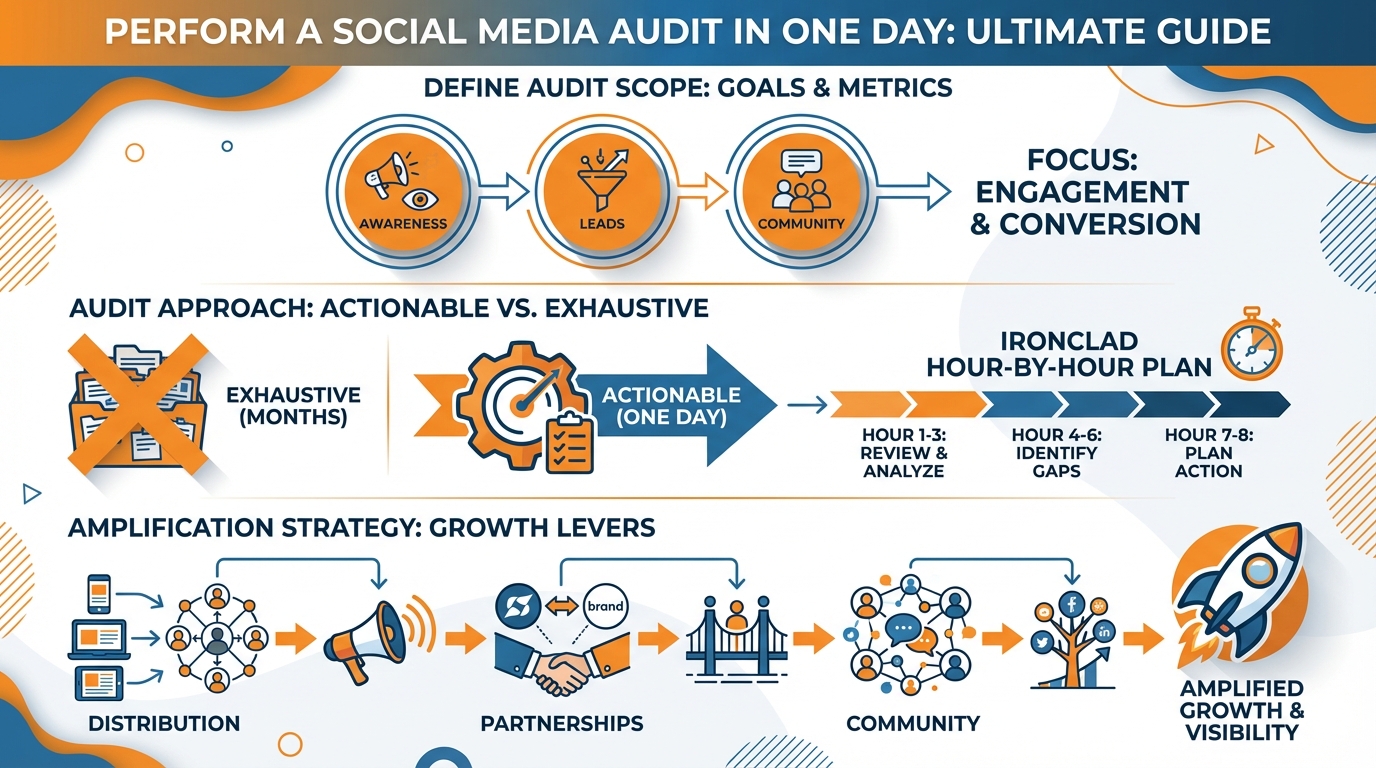
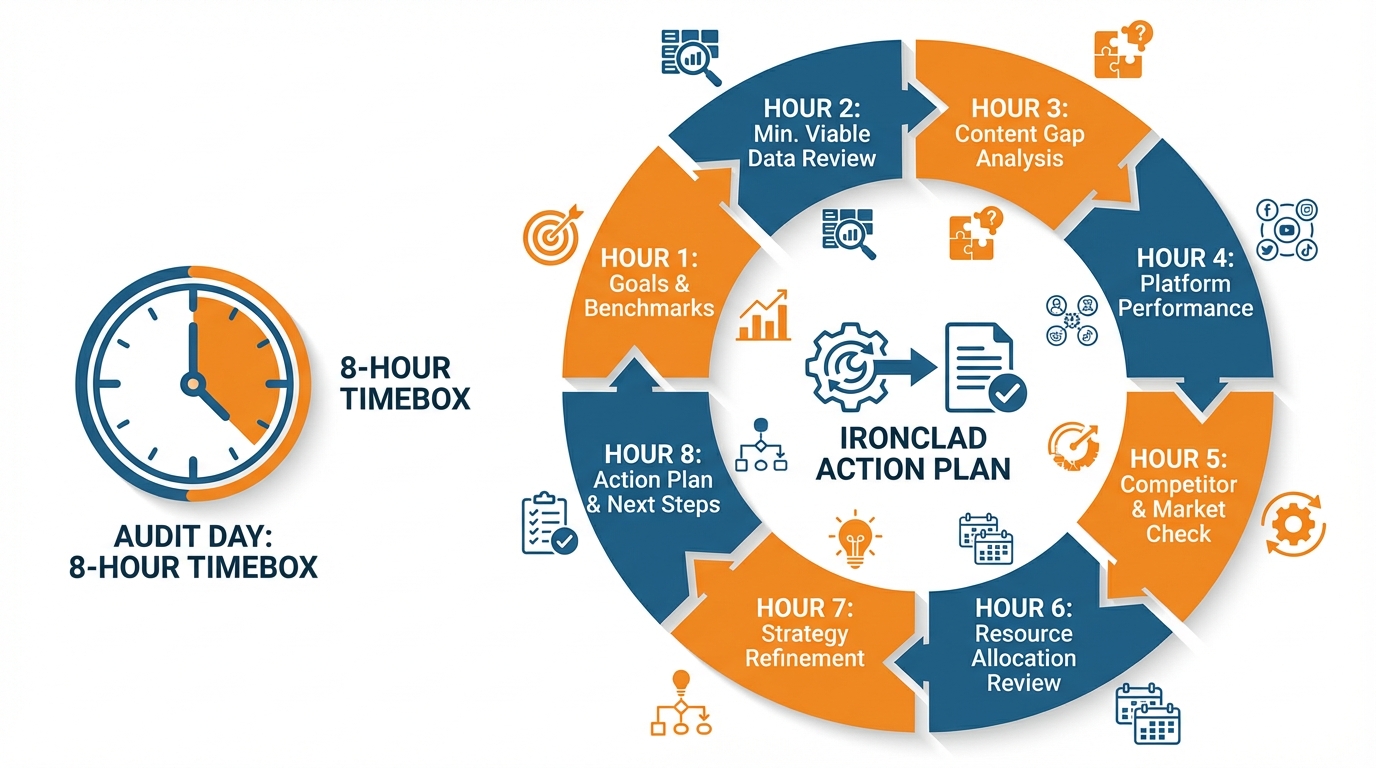
To make How to perform a social media audit in 1 day function, you require an ironclad hour-by-hour plan that pushes decision over indecision.
I do it as follows: Hour 1 is goals and benchmarks per platform, Hour 2 is a review of your minimum data, Hours 3 and 4 are an assessment of your content based on patterns, Hour 5 is a top and bottom half assessment to identify key patterns, Hour 6 is a review of what is failing using a standard framework, and the last hour is a review of recommendations of what to keep, fix and stop based on a small testing plan for the following week.
The ironclad rule? When the clock goes off, move on, even if you think you could do more.
You get more once you get the basic version out the door.
Next, I don’t think anything until I have decided on the ideal metric for each objective and each medium - because you don’t want to treat TikTok like LinkedIn. To contextualize benchmarks during this step, the Rival IQ 2023 social media benchmark report reports a median TikTok engagement rate (per post) across industries of 5.69%, and notes Instagram engagement rates took a 30% dip year-over-year (per the report summary). For newer macro trends, the Rival IQ 2025 industry benchmark report summarizes engagement rates down 36% on Facebook, down 16% on Instagram, down 34% on TikTok, and down 48% on X (Twitter), which is useful when interpreting declines during an audit.
For Awareness, I use reach per post and watch time or retention as my main metrics on video-first mediums, but on LinkedIn I’m more interested in impressions and quality engagement such as comments with intent.
For Lead Generation, I’m more interested in profile visits and link clicks over likes, and also proxies for conversions such as DM replies or questions about pricing.
For Retention, I’m more interested in saves, shares, and repeat-engagement.
This way, you don’t fall into the small business trap of “that post got so many reactions” when it generated no profile visits, or “TikTok is awful, we’re taking it off the menu” when it’s getting a ton of high intent link clicks with less visible engagement.
Second, evaluate content by pattern rather than post-by-post analysis.
What is your mix of formats like, for example video vs. static vs. carousel? What are your opening lines (or seconds)? What topics do you discuss? What is your frequency of posting? What is your distribution of calls-to-action, such as, for example, comment, DM, click or save?
When I do this fast, I add just a few labels to the top and bottom posts, and count the trends. Counts are better than opinions.
Maybe you find you’re posting 80 percent promotional static content, which has low reach, but the 20 percent educational short-form videos are pulling all the visits to your profile.
Or maybe carousels are where you’re getting all your saves, but you’re almost never posting carousels, which is an easy fix that means you don’t need to claim that the algorithm is broken.
Next, break down winners and losers to identify themes to apply to this week’s content: style of hook, duration, format, timing, alignment with intent.
Then, analyze why things didn’t work using a single consistent framework that leaves you with an actionable takeaway every time: distribution if reach is below your norm, message if reach is fine but response is weak, offer if response is good but response is poor, friction if response is good but completion is weak.
From that, identify algorithmically-friendly tweaks you can test this week, such as: better hooks, better retention, sequels that incentivize repeat consumption, and porting successful content to other platforms (but NOT copying the same intro).
That way you can get to the end of Day 1 with a clear sense of what’s working, what’s not, and what you need to STOP, plus a list of tweaks you can run this week that are fast and impactful.
If you want to do a social media audit in a day, focus on distribution, partnerships, and community
They’re the growth levers most audits ignore.
But if you end your analysis there, you’re neglecting the true source of momentum: amplification.
Within 24 hours, plot your amplification channels by looking at the last 10 above-average posts and recording where the bulk of that extra amplification happened.
This might be through employee sharing, customer tagging, partner sites, influencer inclusion, local groups, community comments, newsletter inclusions, or multi-channel strategies like email to Instagram, Instagram to email, or LinkedIn to webinar signups.
Bonus fact: for most SMBs, 60-80% of amplification can be attributed to amplification channels outside of your own audience because platform algorithms weight early amplification and conversation more heavily than basic posting volume. To benchmark top-of-funnel visibility during this step, Socialinsider’s 2026 benchmark page shows average views per post on TikTok moving from 6268 (2024) to 6496 (2025), and average views per post on Instagram moving from 2635 (2024) to 3403 (2025).
Then create an influence map, so you can focus on relationships rather than individual shoutouts.
This involves 30 days of analyzing your comments, mentions, and shares to categorize people into existing audience, adjacency to your target, and repeat sharers.
What matters here is consistency more than size, and I’ve witnessed a local services client receive more booked calls from three repeat community voices than a shoutout from a massive creator that was a one-off.
What you want to know is simple: who re-appears more than once, who produces content related to your product, and who has a following comprised of your buyers rather than other creators.
Next, test for partnership potential with a content shareability audit.
Even if a partner likes you, they won’t share your stuff if they have to edit your caption, resize your graphic, or figure out what to say about you.
Your audit should ask whether your top content can be shared as-is, whether the benefit is clear in the first second or sentence, and whether there’s a clear benefit trade like: you feature me, I feature you; we co-create a tip that makes us both look smart; I give their audience a useful little asset they can use now.
I also check whether your bio supports the partnership narrative because collab partners don’t like it when a page is inconsistent, inactive, or unclear about what it’s selling.
Lastly, you need to optimize for leverage, since that's a hidden scalability hack.
This means you should track how fast you respond to comments and DMs, make sure you have a standard commenting playbook for converting curiosity into dialogue, and diagram your DM funnel to pinpoint holes.
You need to find where you can automate without being too mechanical, like basic directional queries, canned knowledge responses, and rules-based moderation, and reserve the high-trust interactions for humans, like money discussions, conflict resolution, and contextual advice. If you want to systematize this ongoing cadence after the audit, social media calendar automation can help keep the same tempo without turning it into a one-time event.
Your 30-day wins should be a very short list of handpicked high-fit partners, plus a standard content cycle, e.g., say every other week, you coauthor a post, every week, you support each other's comments, and once a month, you have a low-key community check-in that provides a talking point for others to tag you in again.
Take your social media audit to the next level: auditing a brand in one day, scoring your channels, making tough choices, and deliver a complete social media audit packet to your boss or client
To make How to perform a social media audit in 1 day useful, you need a way to cut ruthlessly and prioritize where to put your time in the next 30 days.
I evaluate each channel on a 1-5 scale on four criteria: channel fit (is your target audience here and does it buy on this channel), traction (do you have any repeatable reach, saves, comments, clicks, or DMs), effort (how many hours a week does it take to stay credible), and business value (does it reliably drive leads, calls, foot traffic, or repeat customers). If you want a longer-form framework for this process, you can cross-check it against a social media audit workflow.
I multiply these 4 scores together to penalize your weakest links.
5x4x2x5 = 200, but 5x4x1x5 = 100.
So even if there’s great potential, if there’s zero effort being put in, it’s a risk.
This is 30 min or less per channel if you just look at your minimum data points and your top and bottom performing posts.
Second, define decision rules to make sure you are making objective, not emotional choices:
- Optimize when fit is good and impact is high, but traction is variable, and you can identify easily-solvable issues such as poor hooks, the wrong formats, lack of calls-to-action, or broken links.
- Put on hold when fit is unknown and effort is high, or when you are posting regularly but see low-signal performance for a full 30-90 day window, such as flat reach, low retention, and virtually no profile engagement, even after basic profile optimization.
- Sunset when fit is poor and impact is low, or when the channel introduces operational risk, such as unmanaged DMs, negative reviews you cannot reply to, or multiple duplicate pages confusing customers.
One bad month is not the trigger; the trigger is a pattern, and an opportunity cost you can quantify, such as 6 hours a week for 2 leads a quarter.
One rule I use for SMBs is that if a platform cannot be maintained at a minimum quality bar of 2 posts per week and responses within 24 hours, it does not get to stay in the active mix.
What you output every evening should be simple enough to send to an owner or manager with little to no explanation.
I send no more than 5 pages: core takeaways in simple terms, the top risks in terms of financial and brand damage, things that can be changed immediately, a keep/kill/fix table by channel that includes the score and a 1-sentence explanation, and 30/60/90-day next steps connected to business results.
Use notes to indicate when scenarios were used and why they’re still valid: if you didn’t have access to analytics, use publicly available data like posting frequency, engagement rate heuristics, follower growth, and link destination confirmation; if tracking isn’t available, include the fact that clickthroughs are still directionally relevant and link hygiene should be addressed; if you have multiple markets, highlight any places where page duplication is occurring and suggest a primary page and a clear exception for each market; if bandwidth is a concern, highlight the bare minimum required to maintain response time and message consistency.
Lastly, turn results into action today because otherwise, this audit goes into a folder and dies.
By the end of Day 1, you should have 3 things:
- What you will be testing next week
- What you will be stopping today
- What you need from stakeholders moving forward.
Tests for next week are 2 new hooks, 1 new format, 1 post from a partnership, 1 script change in your DMs all attached to a metric you can measure in a week.
What to stop today are the time sucks: 1. Platforms you can’t maintain 2. Types of content that get engagement but never generate intent 3. Posts that lead people to dead links or offers that are no longer relevant.
What you need from stakeholders should be just as specific: who has access to analytics, who can approve your brand engagement, what offer are you promoting this month, and what is your actual capacity because the easiest way to blow up a 1-day audit is to assume you have a Facebook budget and team when you have a mom and pop shop time schedule.
Conclusão
The goal of a 1-day social media audit isn’t to produce an ‘A’ report. The goal is to achieve speed-to-clarity.
This time tomorrow you want a defensible view of the current state - plus a short list of prioritized actions you can execute immediately - not a document to be defended in a conference room.
If you can end the day with clean keep, fix, or kill decisions - a few social channel scores you can justify in one sentence - and a few next-week experiments connected to actual business metrics (phone calls, booked appointments, store visits, email newsletter signups, etc.) - you’ve won.
The hidden strength of the exercise is the ability to run the same exercise, with the same data and the same scoring function, on a monthly or quarterly basis, to see how you’re doing.
As long as you’re looking at the same time period (e.g. last 30 days, last 90 days), measuring the same proxy metrics, then you’re not making assumptions: are reach per post increasing, are profile views turning into clicks, are saves and shares truly increasing, is partner reach amplifying?
The simple act of charting these metrics over 3-4 cycles has already helped many small businesses make more timely decisions, because when you see the trend, you can’t be blinded by the success of a single post.
That consistent tempo is your ace when it comes to evaluating effort.
Increase effort when the channel grows, and don’t feel bad about simplifying, shifting medium, or stopping altogether when you’ve gone 2 cycles without growth.
Small businesses lose when they lose focus, and your audit is the necessary preventative to ensure you don’t spend 6 hours a week on a channel that’s bringing 2 leads every quarter while letting the format that drives really valuable DMs slide.
So the goal isn’t to do more auditing, but rather to maximize the most impactful platforms, content formats, and amplification channels that deliver results.
If you treat your audit as a fast operating system rather than a one-time event, you create momentum: fewer platforms done better, tighter content patterns that earn reach, and a repeatable amplification engine through partners and community.
That is how a one-day audit turns into compounding growth instead of another document that goes stale.
Related reads
4/27/2026
B2B SaaS social media benchmarks: Set the right targets.
B2B SaaS social media benchmarks: Set the right targets. The trouble with defining B2B SaaS social media benchmarks is that it's an inherently impe...
4/25/2026
Building a personal brand as a technical founder (without becoming a creator)
Building a personal brand as a technical founder (without becoming a creator) Creating a personal brand as a tech founder should feel less about ma...
4/20/2026
Creative Post Ideas for Sustainable Brands (That Don’t Sound Greenwashy)
Creative Post Ideas for Sustainable Brands (That Don’t Sound Greenwashy) That’s not what creative post ideas for sustainable brands should look lik...