Shifting from Founder-Led to Brand-Led Social
Shifting from Founder-Led to Brand-Led Social Shifting from founder-led to brand-led social is one of the most impactful things a small business ca...
Shifting from Founder-Led to Brand-Led Social
Shifting from founder-led to brand-led social is one of the most impactful things a small business can do once social kicks in. Founder-led social works initially for three obvious reasons: trust, speed, and algorithmic juice. People trust people, not logos. You can publish opinions, lessons, and behind-the-scenes commentary in minutes without a committee. And most platforms give that type of native, human content more reach because it gets more watch time, saves, and more substantial comments. If you want to systemize that consistency, social media automation can help keep the cadence steady while the handoff happens.
But the same set of advantages will at some point become a constraint. Your business becomes limited by one person’s time, their health, their image. Your posting frequency becomes erratic when sales pick up, when your life gets in the way, or when you get exhausted. Your content perspective is locked into a single perspective, making it a challenge to hire help, reach more people, and create a business that can be sold without a buyer fearing that everything stops when the creator account is deactivated. I’ve seen businesses with amazing offers hit a limit, simply because the founder became the system.
Brand-led social is not corporate content. It’s not the founder vanishing. It’s not one repeatable distribution channel. Done right, it’s several: The brand account is your hub, while your team, partners, and collaborators are your spokes that maintain reach and authority but retain their personality. Rather than relying on a single person to educate, prove, and convert, you establish a decentralised ecosystem in which the same story keeps reappearing albeit through different channels and voices. In short, you achieve continuity when you’re having a busy week and reach beyond your own capacity. This also pairs well with building a repeatable process like a social media content calendar.
The key idea is straightforward: I don’t switch off the founder. I shift focus, proof, and storytelling from the founder to the brand. You start with the founder’s account to explain the brand’s worldview. Then you ground that worldview in the brand account with customer proof, product stories, and offers. Finally, you get other people to repeat it and amplify it until the brand account can generate demand without the founder.
When to switch from founder-led to brand-led social media (and how to avoid the engagement drop-off)
Before I diminish the founder’s content, I ensure that the brand itself can convey the same message without needing the founder’s face.
You do that by nailing down four key boxes: positioning clarity, audience segments, content pillars, and minimum viable brand voice.
- Positioning clarity means that you can state who you serve, the problem you solve, and why your approach is unique in a single sentence, because wishy-washy brands require a face to interpret.
- Audience segments means that you quit speaking to the world and instead create content for 2 to 4 distinct customer avatars, each with their pain points, desired outcomes, and objections.
- Content pillars means that you determine the handful of repeatable topics that you will dominate so that both the algorithm and the marketplace can pattern match you quickly.
- Minimum viable brand voice means that you translate the founder’s tone into a set of guidelines that you can hand off to someone else, such as the brand always educates with a bias, the brand always demonstrates proof within 72 hours of making a claim, and the brand never masks an offer with generic inspiration.
When I execute this well, the brand account is able to achieve content consistency within 30 to 45 days because the brand no longer sounds like a sales page and begins to sound like a perspective.
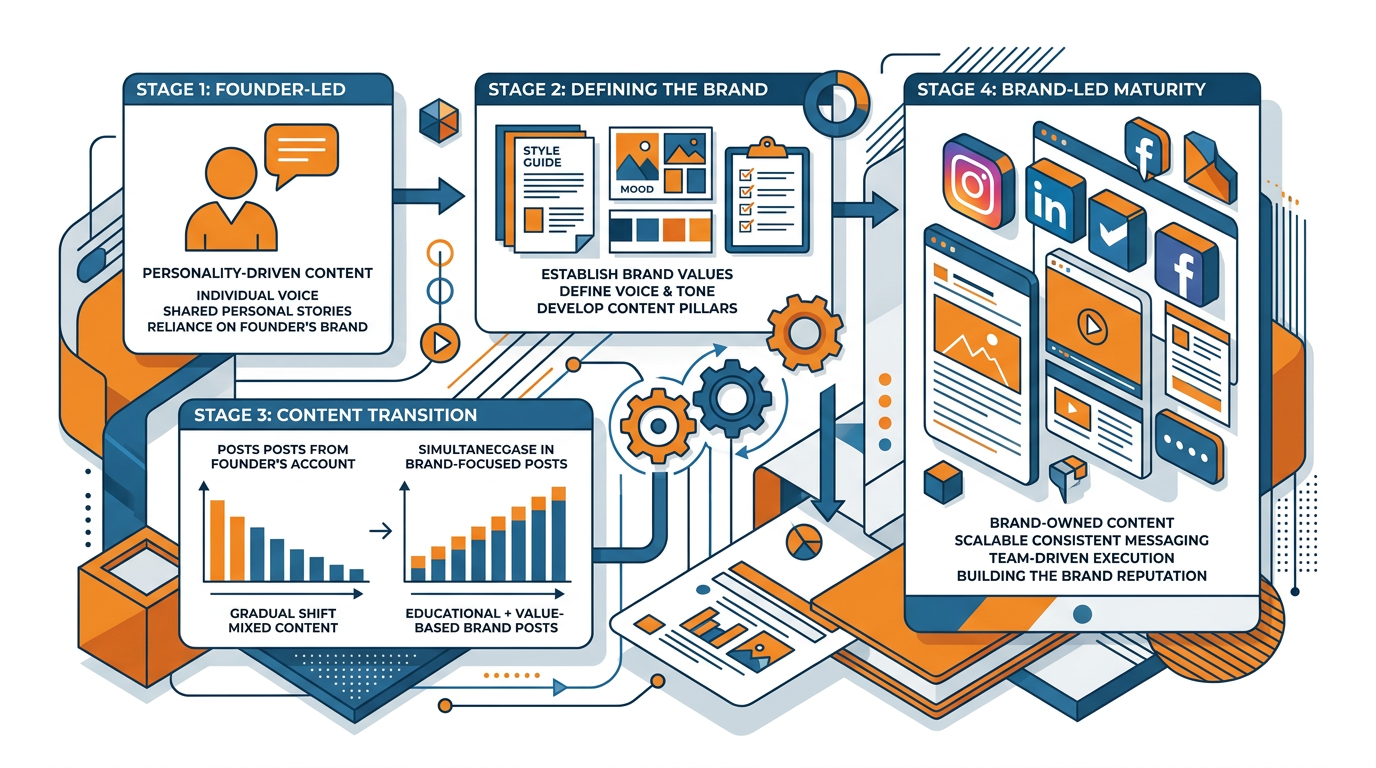
This is a staged rollout, because a hard flip causes an engagement drop-off.
You want to have a mix of content shift gradually over time, where the brand account is posting more, and gaining credibility and authority, and the founder account is posting less frequently, but also less repetitive content, not less content overall.
In reality, this means moving frameworks, customer testimonials, product explanations, etc. over to the brand account first, because those are the things that should be permanent and discoverable later on.
The founder continues to do what only they can do, which is hot takes, experience shares, relationship posts, but they should be doing less of the content that explains the basics over and over again.
You’re also delegating amplification to others; your team can take one of your ideas and create 3 posts, your partner can add their spin, your customers can share their experience and act as a trusted messenger.
I view this as a ratio change that happens over a few weeks, not a switch flip, and the idea is that a new viewer can land on the brand page and understand the entire worldview without having to go through the founder’s entire page.
You anticipate this so you can adjust for it instead of panicking.
Algorithms optimize for surface area and signal.
Surface area is volume and consistency, signal is how strong your content signal is to a particular audience and behavior pattern (save, share, useful comment).
When you reduce output, you preserve surface area by filling the content gap with the brand account and other accounts so your weekly post volume doesn’t drastically decrease.
Then you strengthen signal by narrowing down topics, formats, and hooks.
You reduce the amount of generic posts you publish and increase the type of content that gets saved like decision templates, compare and contrast posts, and posts that address one thorny issue per block.
I monitor leading indicators and not vanity metrics. If you need to tighten what you track, the idea of vanity metrics is a good companion to this section: vanity metrics.
As long as saves per impression and profile visits per impression stay consistent, you aren’t fading into irrelevance, you’re simply shifting engagement from one account to the other, and that bounces back faster than it takes to recover likes.
The least messy way to handoff trust
The least messy way to handoff trust is to curate handoff moments where the market comes to understand that the brand is the authority.
I design it like a relay: founder explains a thing, brand makes it concrete, team and partners add perspective, and brand is what gets referenced.
You can do this in a single week cycle: you publish a founder piece that defines a problem and stakes, you publish a brand piece that makes it a formula with evidence, you have a team member talk about how it shows up in delivery, and finally you have a partner or customer give an external view that verifies it.
I have used this pattern to make the brand account the default destination, while the founder remains the ignition to start discussions.
Eventually the founder ceases to be the sole engine of distribution, and instead becomes an accelerator of a system that works even while you’re busy.
Shifting from founder-led to brand-led social.
That has a voice and governance model that scales.
Voice and governance that scales
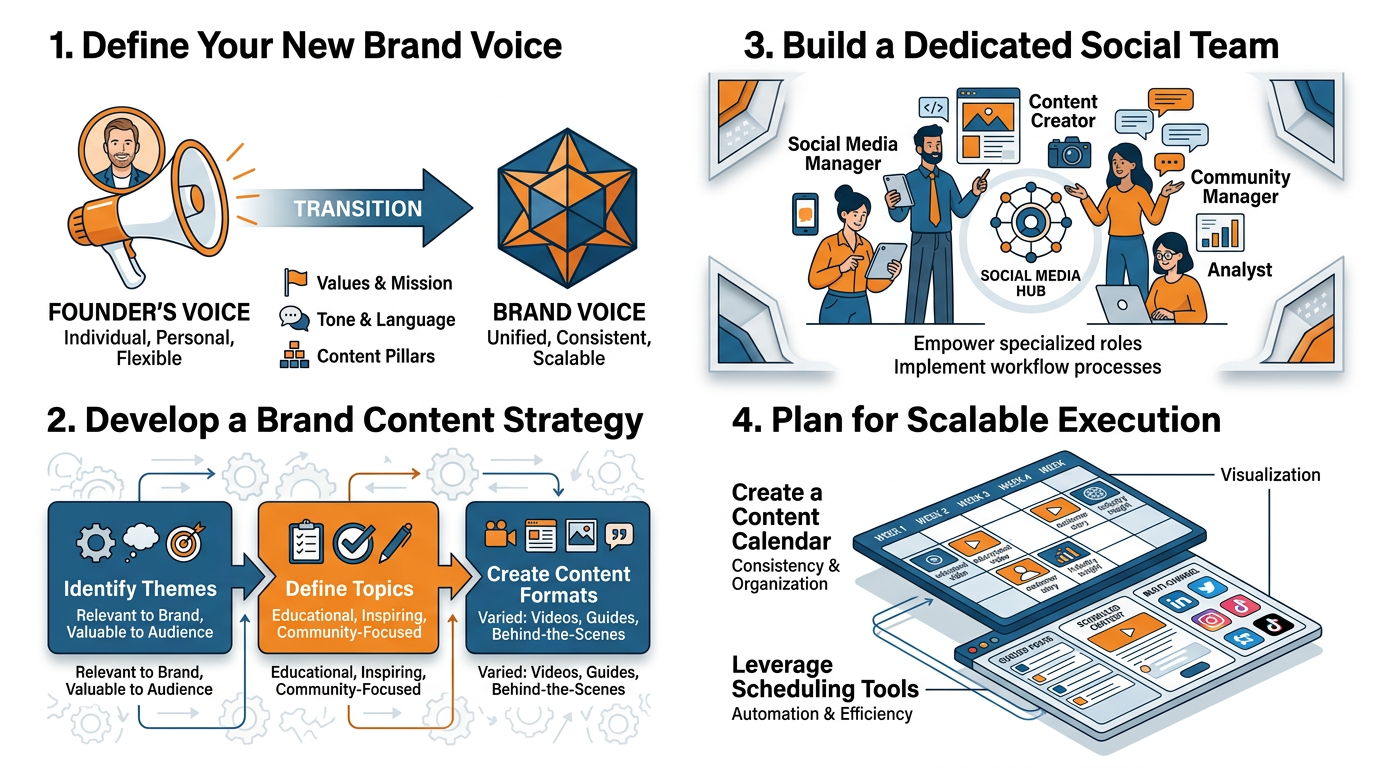
The path from founder-led to brand-led social involves taking your founder instincts and shaping them into a brand point of view that can be handed to a surrogate without the wheels falling off.
And you do that by defining these four things: your defining opinions, your language habits, your forbidden fruit, and your never-say list.
I take 30 days of founder social posts and identify the recurring ideas, the repeated motifs and metaphors, the perpetual villains that the founder is always vanquishing, whether that’s complexity, agency fluff, discount buyers, or shallow tactics, etc.
Then I translate that into brand rules that can be enforced: we teach with a bias, we choose clarity over cleverness, we give a reason before we give a recommendation, we do not speak in vague superlatives.
This is where the majority of small businesses get their quick wins: when your voice is a set of choices rather than a feeling, you can scale production without scaling dissonance.
Here are some best practices to maintain velocity while keeping your content sane:
Establish a system to record ideas as fast as you can talk, then create approved content with as few handoffs as possible.
You need one place where people can share rough concepts the moment they pop into their heads, particularly sales calls, support tickets, and customer objections that keep coming up, since they’re inherently vetted topics.
Then you need a basic content development process: one person does hooks and an outline, a second does the evidence and details, and then there’s a final decision-maker.
You also need to develop a de-escalation procedure before you require it, so that sensitive content isn’t ping-ponging around frantically.
When content relates to competitors, legislation, customer results, price guarantees, layoffs, politics, or a crisis, it needs to go to a designated approver that day, with a turnaround time specified so content doesn’t get stuck in limbo.
In my experience, teams that add a deadline to the approval process wind up publishing more and bickering less, because you’re optimizing for decisions rather than perfection.
Without guardrails, you’re exposing your reputation and inviting legal liability.
But with guardrails, your creators can be bolder and more fearless.
You create a clear line between personal and brand voice by deciding that the brand speaks in evidence, the founder in experience, and your employees in role-specific truth.
For any outcomes-based claim, you determine what evidence is required: a certain number of data points, a sample size, a bounded scenario, etc.
If you don’t hit that bar, the statement remains an opinion or a lesson learned.
You also determine what types of subjects your employee voices can cover, what topics they can’t, and how attribution should be handled when they mention customer names or internal metrics.
The gray area will arise when the brand narrative and the founder narrative conflict.
This will inevitably occur as the organization scales.
You resolve it by deciding in advance who wins in the brand channel, and by creating another channel where the founder can test ideas, keeping those ideas from inadvertently becoming official policy.
Last but not least, don’t allow the brand to be reduced to a faceless logo by creating a bench of voices with defined lanes and repeatable formats.
You identify 3 to 6 individuals throughout the organization and give them a content responsibility that matches their actual role: an exec is responsible for direction and tradeoffs, a subject matter expert is responsible for deep explanations, customer-facing staff are responsible for objections and wins, and a community manager is responsible for conversation and response loops.
You make sure to keep it maintainable by defining a tight remit for each individual and a cadence they can truly keep up with, because consistency is where the magic happens.
I’ve worked with founder-heavy startups that managed to significantly reduce that reliance once the brand developed multiple credible narrators; once customers hear the same perspective from delivery staff, sales staff, and customers, it stops feeling like someone is marketing at them, and starts feeling like this is simply how the company sees the world.
Stepping down: From founder-led social to brand-led social through trust transfer (without sounding corporate)
When you can trust your brand to carry the torch for you.
When you treat trust as an asset that you can port over, rather than a feeling you must maintain.
It starts with understanding which type of trust asset can prove which type of point, so that you no longer need to narrate everything:
- customer proof is before-and-after examples, with constraints and context
- third-party validation is screenshots with short explanations of why that source matters
- product evidence is demos and teardowns that show inputs and outputs
- behind-the-scenes execution is delivery logs and decision notes
- community credibility is conversations where customers correct, recommend, or defend you
And the nuance is that each trust asset addresses a different fear, so that the goal of your content is to reduce uncertainty, not generate engagement.
The rule of thumb I use is that the posts that move trust the fastest are the ones that remove risk, with details such as time frames, sample size, and what would make this not work.
This is how you make proof feel earned: you stage it like a relay rather than a brochure.
The founder sets up the problem and the stakes so everyone knows the frame, then the brand lays out the process with data and reproducible procedures, then customers or partners confirm the results in their own voice, then employees retweet with function-specific testimony from the trenches of execution.
This makes the brand account a knowledge base and the founder the ignition switch, and you can track the handoff in a very straightforward way: brand tweets should begin to outperform or at least match founder tweets in saves per impression and profile visits per impression within 4-8 weeks even if the likes aren’t keeping up yet.
I use this order because it follows how humans are actually persuaded: definition, then evidence, then testimony, then proof. This aligns with what the 2024 Edelman-LinkedIn B2B thought leadership report reports: it surveyed nearly 3,500 management-level professionals (fielded December 2023) and says roughly 7 in 10 decision-makers agree that consistently producing high-quality thought leadership is a more trustworthy basis for assessing capabilities than marketing materials/product sheets.
You diversify away from a person when you create a partnership and creator flywheel that makes distribution a network effect instead of a personality effect.
You find a small, tight list of adjacent creators, customers with an audience, vendors, and local business peers, and you negotiate a clean value exchange: you offer them ready-to-post proof, co-created educational content, or access to a real process, and they offer you their perspective and their distribution.
The cross-pollination loop is the magic: your brand publishes the core asset, partners publish their spin, your team replies and adds nuance in the comments, and the partner audience now has multiple paths back to your brand hub.
I have seen small businesses crack the code on consistent inbound when they stop treating partnerships as one-off shoutouts and start treating them as recurring content lanes where everyone wins on repeat. This matches what Deloitte Digital found in new January 2024 research on social business transformation: social-first brands achieved an average revenue increase of 10.2% as a direct result of social strategies in 2022.
The biggest pitfall is so straightforward it’s almost too easy: you sacrifice the honesty and humility of founder-led social for the vacuous gaslighting of brand-led social, and your reach decreases because people feel sold to instead of served.
The fix is simple; every single post from your brand account needs to be grounded in something proven, a tradeoff, or a decision that taught you something; anything else is just pompous self-praise.
If you find yourself running your brand account with pithy victories, ambiguous accomplishments, or motivational nonsense, you’re not transferring trust, you’re eroding it; replace that noise with things like what we changed, what that took, what we had to stop, what the customer had to do, and what could make it not work, and keep the celebration of it working.
Simple.
Transitioning from founder-led to brand-led social is a scaling opportunity, not a tax.
Shifting from founder-led to brand-led social: measuring, attributing, and how to wean yourself off the drug long-term
Moving from founder-led to brand-led social only matters if the business will survive without the founder posting every day, so you need KPIs that focus on dependency, not dopamine.
Calculate a basic dependency ratio every month: what percentage of social-driven everything are coming from the founder account, the brand account, and everyone in between, including employees, partners, customers?
If you’re doing this right, the brand and everyone else should increasingly take share without overall impact declining, and I like to see founder contribution go from dominant to supportive over the course of a quarter.
Add in share of voice and branded search lift to verify that the market is remembering the brand name, not just the person; even a 10-30% lift in branded search over 60-90 days is a solid indicator that the baton pass is taking hold.
Then verify that attention is translating into commerce with assisted conversions and audience quality indicators, like an increasingly large % of profile visitors who also visit your services page, more comments that include an actual use case, and DMs that reference a specific proof-point asset instead of generic love.
Context matters for channel expectations as the handoff manifests differently on different channels.
On LinkedIn, a good handoff is when the brand page is established as an authoritative source of content that can get saves, clicks, and quality comments even if the brand page is posting rather than a human, you want the founder to be the provocateur but you want the brand page to be the one winning on proof, clarity, and repeatability that sales teams can reference weeks after the initial publish. For channel-specific expectations, the LinkedIn algorithm 2026 discussion fits this part of the article.
On short-form platforms, a good handoff is when the brand page is able to carry the conversation forward without needing to feature the founder in every single video: customer spotlights, how-to explainers, product explainers, addressing common concerns, etc.
The expectation should be that raw engagement drops as the brand page starts posting more frequently, but the expectation should also be that consistency and volume pick up much faster, and the win condition is when the brand page is able to generate more completion signals and more qualified clicks even if it isn’t generating as many comments.
Because this is where most small businesses either delude themselves, or get defeated, don’t get too ambitious.
You want a robust framework that can withstand algorithmic changes, not a single-digit confidence interval.
You don’t need last click attribution, but a system you can repeat to attribute social to pipeline: track branded search trends, track direct traffic spikes after high-performing posts, and tag every social link so you can see which themes create high-intent sessions over time. (LinkedIn’s own platform updates reflect this shift toward trust and influence: in an October 2024 LinkedIn News post about new advertising capabilities, LinkedIn reports Thought Leader Ads generated 2.3x higher CTR vs. single image ads, based on LinkedIn analysis of 67 A/B tests from Oct 2023-Sep 2024.)
Whenever I want to implement a system that withstands the whims of algorithms, I connect social to revenue by creating 3 buckets: First touch: Signals that tell me you were introduced to the brand.
Assist: Signals that resurface before conversion.
Conversion: Signals that are lead gen.
If you do this every week, you’ll stop caring about going viral, and you’ll start doubling down on the topics that predictably boost deal confidence, shorten the sales cycle, or increase the likelihood of a closed deal.
Instead of guilt, the founder’s part should be governed by decision rules: Enough so that they can maintain the relationships and the narrative momentum but what the founder should be doing should be higher leverage and less repetitive: original opinion, lived lessons, partner relationship-building, and context that only they can credibly provide.
Anything that should be permanent, that should be searchable and teachable should be moved to the brand: core frameworks, proof assets, product explanations, objections, and updates on how you deliver results.
We will remove the most dependency on the founder the fastest if you commit to one rule: if a post will still be useful in six months, it should be on the brand account; if it is only useful because it came from the founder’s mouth today, then it should remain founder-led.
Over time you will feel the shift in operation: the founder is no longer the content calendar; the founder is now the strategist that occasionally steps in to create spikes of attention that the brand and the advocates can then convert into compounding demand.
O Fim
The shift from founder-led to brand-led social media is when your company switches from needing a person to be loud every day to actually creating a compounding asset.
Your end state is simple: you get to shift from being the single point of failure to the strategic amplifier, and you shift the brand from being the megaphone for your voice to being the home base for narrative and proof.
That is what allows your marketing to be more durable than your mood, your calendar, or the week you get sick; the story still moves and the evidence still piles up even when you’re not the one posting.
To nail that outcome you have to think of the brand channel as a knowledge base not a best-of page. That kind of operational framing is easier to keep consistent when you build around a system like social media scheduling.
You keep the founder in their unique strengths of context, insight, and orbit, while everything timeless goes into the brand: the models needed to decide, the evidence needed to de-risk, the logistics needed to trust claims.
I’ve seen tiny companies drop founder dependence by a factor in one quarter by just getting this right: the founder gives the initial signal, the brand then handles all the explication, proof, and execution and the market starts to trust the brand not just the founder. This sits inside a broader trust reality that the 2024 Edelman Trust Barometer global report quantifies: “‘My employer’ trust” is 79% (global 28-market average, 9-point scale, top 4 box).
If you’re doing it well, the KPIs that matter for safety move in the right direction.
If the brand is your North Star, generally you’re going to see more consistent weekly content creation, less fall-off in engagement, and more robust attribution due to continued shared perspective across different tones.
If things are going smoothly, you should see the brand content equal the founder content for saves per impression and profile visits per impression within 4-8 weeks even if the likes aren’t there yet, and a branded search lift of 10-30% over a 60-90 day period is a very good indicator that recall is transferring from personality to brand.
This is how you de-risk while continuing to grow.
The real promise is your social engine stays human. It’s just no longer brittle.
You still sound like humans who have done the work, learned the lessons, and can prove the outcomes, but you are no longer hostage to the founder being present, perfect, and prolific.
That’s what consistent growth feels like: less scrambling, fewer reputation edge cases, clearer market positioning, and a brand that can carry the narrative and the proof long after any single post, or person, is gone.
Related reads
4/27/2026
B2B SaaS social media benchmarks: Set the right targets.
B2B SaaS social media benchmarks: Set the right targets. The trouble with defining B2B SaaS social media benchmarks is that it's an inherently impe...
4/25/2026
Building a personal brand as a technical founder (without becoming a creator)
Building a personal brand as a technical founder (without becoming a creator) Creating a personal brand as a tech founder should feel less about ma...
4/20/2026
Creative Post Ideas for Sustainable Brands (That Don’t Sound Greenwashy)
Creative Post Ideas for Sustainable Brands (That Don’t Sound Greenwashy) That’s not what creative post ideas for sustainable brands should look lik...