How to Market a Law Firm on LinkedIn
Market your law firm effectively on LinkedIn. Learn a system that leverages individual lawyer profiles to build trust, relationships, and attract ideal clients.
How to Market a Law Firm on LinkedIn
Are you looking for ways to market a law firm on LinkedIn? This is the right guide for you because LinkedIn is consistent with how legal services are sold in real life. Most people don’t buy legal services like they buy software. They buy based on trust, reputation, and relationship-building after multiple touch points and usually when the stakes are high. LinkedIn is the only major platform where proof of credibility is displayed right there for everyone to see in the moment when the prospect is researching you: your title, your skills, your network, your history of posts, mutual connections, and your public thinking. For a small law firm, that’s a huge advantage. You can compete on substance and authority instead of ad spend. If you’re building this into a repeatable channel, it helps to think in systems like the ones outlined in social media automation.
The issue is that most LinkedIn advice that firms get is to post more, use hashtags, and be consistent. This approach doesn’t work in legal because activity is not authority. You can post three times a week and still be bringing in the wrong matters, triggering ethics concerns, or getting likes that don’t lead to consults. I’ve also seen firms approach their company page as if it is the engine of the platform when, in fact, lawyer profiles are the distribution channel. Clients hire people, not logos, and LinkedIn privileges individual accounts over company pages.
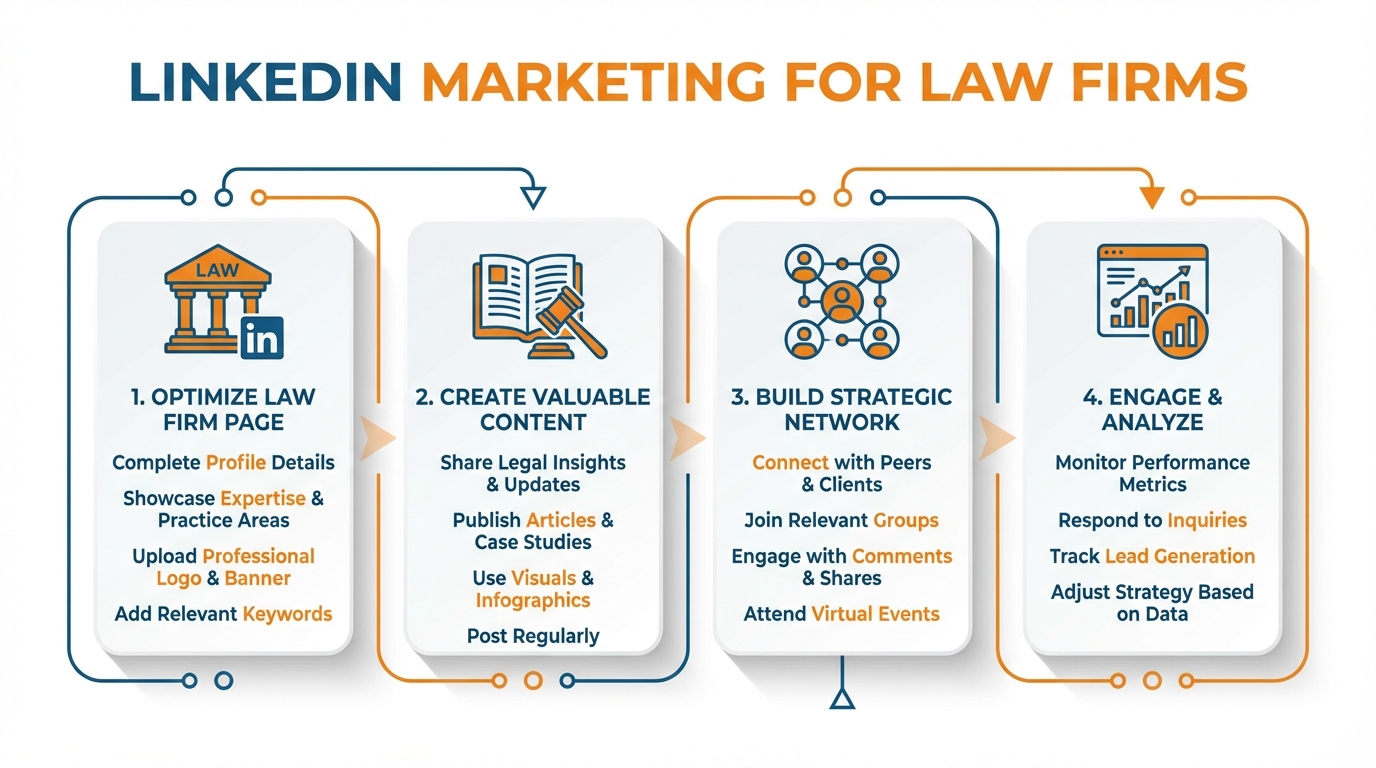
Instead, in this guide, I’ll teach you a system. You’ll learn how to integrate four pieces into one repeatable growth cycle: messaging that defines what you do in a single glance, content that shows expertise without crossing the advertising boundary, distribution that leverages lawyer bios to get in front of ideal clients and referrers, and analytics that links your LinkedIn activity to a tangible funnel that you can monitor and optimize. If you want LinkedIn to generate leads instead of vanities, you’re going to architect it like a business system. If you want a practical framework for tracking outcomes, prove social media ROI to investors maps well to the measurement mindset described here.
What's the best way to market a law firm on LinkedIn?
By picking a practice area that aligns with how clients shop.
So how do you market a law firm on LinkedIn?
For me, it begins with a step that most firms don’t take: setting your LinkedIn strategy up in relation to how your particular law-firm clients really acquire legal services.
I break strategy up by business model, because a B2B employment practice that targets HR and in-house counsel is going to play out very differently from a consumer family-law practice targeting stressed-out individuals, and a bet-the-company litigation practice is going to convert quite differently from a high-volume traffic or immigration practice.
Once you’ve determined where you fall on the four spectrums of B2B v. consumer, high-stakes v. high-volume, local v. national, and hourly v. contingency, then your LinkedIn strategy ceases to be one-size-fits-all and becomes actually trackable.
It becomes immediately obvious who needs to see your content, what types of objections you have to overcome, and what types of proof are needed to get a prospect out of the background and into the foreground.
B2B buyers are the C-level and director level and such, and they take a long time, and it's a high risk.
You don't write to an age group, you write to a job title, founders, CFOs, HR managers, GC, Ops, etc.
You need to demystify, not with law stuff, but 'If I make a decision, here's what will happen', so when to hire a lawyer, how much it costs to screw up a termination, what happens when this provision of a contract doesn't hold up in practice, etc.
In my experience, across many markets, the single biggest indicator for B2B conversions on LinkedIn is if someone has seen your thoughts on practical, and this is huge, PRACTICAL, considerations, multiple times over a period of months, then checked your profile, and then checked mutuals, and then checked the comments you've made before deciding to reach out. This lines up with the 95-5 framing from LinkedIn B2B Institute research, which emphasizes that most category buyers are out-of-market most of the time (5% in-market / 95% out-market).
The typical window for B2B conversions is 6 months or so, but that's OK because you don't need a ton of them.
If you sell to consumers, you can still use LinkedIn, but you have to acknowledge it’s not where they come to begin a search, so you win by being the clearly trustworthy option when they DO arrive via referral, a spouse, an employer, or an old connection.
That shifts the nature of your evidence and arguments: now you prove trustworthiness with calmness, clarity, and process.
You’ll want to share content that addresses emotional concerns in simple terms, describes the initial consultation, manages expectations around timing and paperwork, and demonstrates your ability to manage emotional cases without inflaming them.
High-volume consumer practices should approach LinkedIn as a filter that improves closing rates and referral quality, not as the lead tap, while contingency practices should focus on case selection and credibility signals that prove you take on serious cases and know how to cultivate them.
Now fill in the rest of the model.
If you need to establish that you’re a low risk choice for serious, high stakes problems, you should be creating content around exercising good judgment: trade-offs, how to think in gray areas, what goes sideways in important matters, and how to prevent it, with results described in a careful and responsible way.
If you need to establish that you can handle a high volume of work, you should be showing your process, your speed, how you triage matters, and what a good client looks like.
If you are a local practice, your content should be tied to local issues, local courts, local industries, and local community issues to establish you as a proximal expert that can be trusted.
If you are a national practice, you should be creating content around industry trends and recurring problems that exist regardless of which state you’re in.
If you’re an hourly firm, you need to establish your value and your predictability, so you should be teaching your clients how to minimize their risk and avoid excessive fees.
If you’re a contingency firm, you need to establish your selectivity and your leverage, so you should be establishing which facts about a case make it stronger or weaker and which types of evidence have the most impact.
Once you know which segment you’re in, you can stop trying to get likes and start establishing the kind of authority that your client segment needs in order to hire you.
Compliance-first content that still stands out
It is 100% possible to have a unique and differentiating content strategy on LinkedIn for your law firm that still abides by the ethical rules.
In fact, I would argue that following the rules actually makes your content stand out more.
Here are some ideas to get you started:
When it comes to advertising legal services on LinkedIn, and not violating ethics rules, the solution is that the content must not be possible to construe as individualized legal advice.
You can do this by writing for a persona, and situation, but not for an individual and their specific situation: For example, things that an HR manager should record before terminating an employee, things that a business owner should confirm before entering into an agreement with another business, or things that a wife should collect before consulting with an attorney.
In every post, include the disclaimer that it is educational, I do not invite people to share private information in the comments, and I point people with questions specific to their situation to a very safe portal that first screens for conflicts of interest and my jurisdictions.
I also have internal rules:
- no specific advice
- no language of immediacy for people in a vulnerable state
- and I do not permit DMs that could be construed as micro-consultations.
Success stories and testimonials are the areas where attorneys unintentionally violate the rules, so I view them as a compliance project rather than a copywriting project.
You discuss the results, but you remove the client-identifying details, you don’t suggest that similar results are expected in the future, and you talk about what determined the results rather than the results themselves.
Rather than “we won this amount of money,” you talk about what shifted the balance, what was important evidence, what the other party did wrong, what provision kept you from getting into that situation, etc.
Testimonials, you get permission to use, you verify that the quote is correct, and you use it with the proper disclaimers for your state (which varies) so that it can function as social proof without running into the promised results problem.
I do not use a “wall of text” disclaimer on my posts or responses because I prefer a short statement that should make it clear that the content is information only, not advice, and that no attorney-client relationship is formed.
That statement should be repeated for clarity and efficiency.
When appropriate, I add to that statement that the information is not intended for readers in a particular jurisdiction, or that prior results do not guarantee future outcomes.
I incorporate this into my template so I can provide a timely response while also protecting myself.
I include the disclaimer in my profile’s featured content, in posts about results, and in response to comments where a user is providing me with information I should not have.
For the content to be both compliant and truly unique, you must have an easy-to-use internal approval process, and a point-of-view approach that means you are not retelling changes to the law.
You can have two tracks of content: lower-risk topics like tutorials that fall under preapproved guidelines, and higher-risk topics like results, press, or specific subjects that need attorney approval before distribution.
I also maintain a minimal archive of what was posted, with which disclaimer, and who approved it, because, in my experience, “I’ll remember” is not a compliance plan.
The unique value is not to be the first to summarize a new law; it is to be the best at explaining what the law means in reality, what good teams should do on Monday morning, and what factors differentiate a smooth result from a disastrous one.
Turn lawyer profiles into a distribution network (without chaos)
A couple of weeks ago, I wrote about the mismatch between how lawyers use LinkedIn and what law firms need to accomplish in order to market on the platform.
My conclusion was that the key to a law firm’s success on LinkedIn lies in creating a network of distributions out of individual lawyers’ networks.
In this post, I will take a closer look at how a law firm can go about scaling up the individual lawyer LinkedIn profiles into a distribution network without creating utter chaos in the process.
Want to know how to market a law firm on LinkedIn? Quit thinking of the firm page as the real driver and start thinking of your lawyers as the real driver.
The LinkedIn platform isn’t going to favor your firm page and neither are your customers, as they are hungry for substance, not branding.
You still have to scale without splintering, so you need some rules that you can live with.
First, you have to define the purpose of the firm page vs. attorney pages: the former for, say, news, press, announcements, events and policy-level insights and the latter for on-the-ground perspectives, such as what’s new, what does it mean and how can a savvy client mitigate risk.
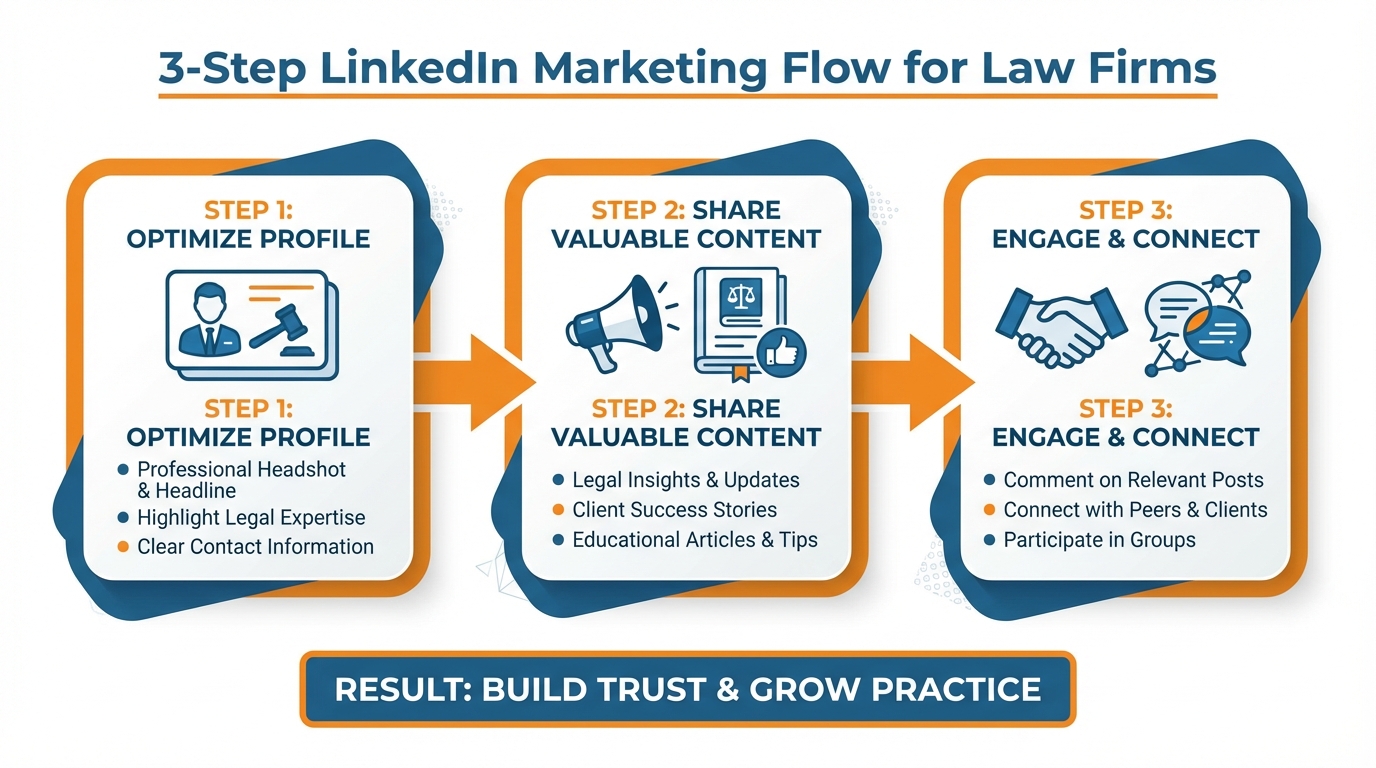
Next, you have to define what should be consistent across all pages, such as practice descriptions, the language of your compliance statement and the types of information you cannot share publicly.
That’s how you get 10-30x the real estate on the platform without letting it go rogue. For a broader playbook on building repeatability, smart social media automation for fits the operating-system approach used here.
The trick to getting buy-in from your partners is making it practical instead of inspirational.
You define a functional position for each partner within the channel - one is the plainspoken advisor, one is the danger-interpreter, one is the trend-spotter, one is the “how we do it” person, one is the case-law annotator.
Then you get them all to line up behind a single concept a week so that the firm seems cohesive and every partner sounds like themselves.
Sometimes I take one topic like why severance negotiations go off the rails, and ask you to rewrite it multiple ways - an employment partner does the strategic error that CEOs commit, an associate does the paperwork essentials, a litigator does the initial litmus test that lands you in a courtroom, and a managing partner does the smart things that companies should do to sidestep the whole issue.
Same theme, different voice, and the audience compounds because LinkedIn spreads it through each person’s 1st-degree connections not your page’s followers.
This is how you do it when you’re a small shop - instead of playing for reach, you’re playing for network effects.
You create a list of top 100 (200, etc.) people, including your best clients, top 50 referrers, key accountants, lawyers, agents, recruiters, consultants - along with a handful of industry players you want to know about you.
You don’t need 1,000 followers - you need 100-200 people who can generate deals, referrals, or simply do a credibility check on you.
In practice, this means you need to treat comments as little notes sent to those folks - because comments have higher quality distribution than posts.
So if you can hit the comments of the stuff those people are already looking at - you are essentially borrowing a little credibility, but you’re doing it in a way that feels safe and human. If your team struggles to keep this consistent, the pattern described in inconsistent social media posting maps directly to this problem.
This is why I’m such a huge fan of collaboration.
When done correctly, you can multiply the reach of your content (even without using automation tools, LinkedIn groups or “growing your audience” by simply hashtagging posts).
For instance, we’ll collaborate on content pieces with clients, referring partners or other professionals, where they contribute just one insight to a question that we’ve prompted, and we keep the content educational and case-study-free (to keep things compliant).
Or, we’ll orchestrate the timing of content posts, where one partner in a law firm publishes a valuable insight, and two others publish follow-up pieces of content within a 24-48 hour window, and the rest of the firm contribute thoughtful comments to the original piece to keep the conversation going, and give practical examples.
This is one of the techniques I love, because it creates that amplification effect without appearing to be staged, and we’re teaching the algorithm that the professionals in the firm are contributing to meaningful conversations, and not just making announcements.
The result?
Brand uniformity, amplified reach, and a LinkedIn profile that appears to be a sharing community, not a publishing schedule.
A step-by-step promotion and measurement cycle
Here is a step-by-step guide to promoting a law firm on LinkedIn with a post-to-consult conversion and measurement cycle:
- Identify the types of clients you want to attract.
- Develop a posting strategy that appeals to your target clients.
- Create and schedule posts.
- Engage with your target audience through comments and messages.
- Offer consultations as a call-to-action.
- Track conversions from posts to consults.
- Adjust your posting strategy based on analytics.
What is the best way to market a law firm on LinkedIn?
The best way to market a law firm on LinkedIn is to stop writing for engagement, and to start writing for intent. That is, the best way is to have every single post lead to a next step that aligns with where the reader is in terms of intent to hire, and what your ethics rules allow.
For readers who have never heard of you, your next step is to invite them to engage in a process that does not involve them telling you the facts of their situation, like asking them to validate a decision tree or describe how they mitigate a risk.
For readers who have heard of you, but aren’t yet sold on hiring you, your next step can be to invite them into a process, like telling them you can describe what usually happens in an initial consult, the types of documents they’ll want to gather, and the typical turnaround time.
And for readers who are ready to hire you, you can invite them to reach out to you directly, with a call to action that limits the types of questions they can ask to those related to jurisdiction and qualification, since knowing the answer to those questions allows you to make an informed decision about whether or not to work with someone, and also limits your exposure to giving out legal advice in a public setting.
After you’ve convinced them to click, the information funnel is where most small practices lose money.
You need a pathway that acknowledges how intake actually works: conflict check, jurisdiction fit, subject matter fit, fee anticipation, etc.
I build the funnel so that it only collects the information needed to route and qualify, not a whole story, because long factual accounts introduce risk and delays.
You can do this with drop-downs for subject matter, state or other jurisdiction, opposing party name for conflicts, and a text box with a note to leave out confidential information until conflicts are cleared.
If you do consumer work, you may also want a simple text that sets expectations for what’s next and typical turnaround times, because the speed of first response is often what separates retained consults from the ones that slip away even after your content conquered the hard part.
The LinkedIn DM is a strong tool, but it can also masquerade as unpaid consulting and ethics problems if you approach it as an informal chat.
Treat DMs like the intake at a law firm: I respond quickly, I don’t get into the weeds, I do not review their “situation,” and I point them towards a more structured intake process the moment they indicate that they are looking for legal representation.
Have a firm demarcation: you can ask about the subject of the issue and the geographic scope, but you can’t engage in exchanges that resemble advice, and you cannot invite them to share files or detailed stories until conflicts are cleared.
You want to be responsive and friendly while steering the exchange in a lane of information, evaluation, and intake logistics.
I measure LinkedIn as a true channel by measuring activity beyond the post, not just on the post. Post-level metrics such as impressions and likes are interesting as a leading indicator; my key metrics are profile views by target titles, relevant direct messages received, qualified intakes started, consults booked, matters initiated, and time from first touch to consulting request.
Attributing the channel is far simpler than most companies imagine: you use UTMs on anything that you own, you tag every lead source inside your CRM or even a spreadsheet, and you make one intake question mandatory: where did you hear about us, with “LinkedIn” as a named choice, plus a free-text field for post or referrer.
I then correlate two metrics every month that few companies ever tie together: number of consulting requests from LinkedIn, and realization rate of those matters, because a channel that delivers a smaller number of leads but a better grade of clients can be far superior to a channel that is “busier” but clogs up your diary. This kind of measurement discipline pairs well with GA4 social media traffic when you want to connect clicks to outcomes using UTMs.
Also, the 2023 American Bar Association marketing tech report notes that, of firms that maintain a social media presence, 83% have a presence on LinkedIn, which is exactly why the “beyond the post” metrics matter more than just showing up on the platform via the ABA’s 2023 report on law firm websites and marketing tech.
Em conclusão:
What’s the key to marketing a law firm on LinkedIn? That’s easy: when you run LinkedIn like an ethical, practice area-specific sales funnel, it works.
You don’t care about impressions. You care about creating a series of repeatable connections that leads the right folks from consuming your ideas to validating your authority to engaging a properly filtered intake process.
LinkedIn is uniquely well-suited to this for a simple reason: intent is public. We don’t raise our hands; we research you in situ, we look at the common connections we share, we scroll your recent posts, and make a decision about whether or not to trust you.
Once you think of it like any other lead channel, you will begin to make more rigorous decisions.
Most organizations miss the fact that, for most B2B legal services, LinkedIn is not an overnight success channel but a flywheel channel where results occur once a certain threshold of value is perceived.
I have seen this flywheel play out in my own work on B2B legal matters: often, the lag between the first exposure that delivers value and the first legitimate outreach is a few months.
This is precisely why consistency is not the key.
The key is alignment: practice-specific messaging, content that de-risks the real world, attorney-driven amplification that produces network effects, and analytics that inform you whether your efforts are resulting in qualified leads or just activity.
Need to generate momentum? Focus on one reform and make it tangible.
If your positioning is too broad, focus on one discipline and one client persona so you can better gauge its effectiveness.
If regulatory risk is the concern, adopt a basic approval process and standardized disclaimer to encourage content-sharing.
If reach is the issue, leverage lawyers’ existing networks, so that the firm is featured in multiple channels simultaneously.
And if there is no measurement, mandate it: identify LinkedIn as a specific lead source during intake, and tie it to consults and matters - because often, a lead source that delivers fewer consults with a higher rate of conversion to matter is superior to one that delivers more consults. This direction is reinforced by the 2022 American Bar Association marketing tech report, which reports that 25% of respondents’ firms hire a consultant/agency to undertake social media work, highlighting how common it is to treat this as an operational function via the ABA’s 2022 websites and marketing report.
Once you do, LinkedIn ceases to be a content-throwing hobby and turns into a resource that you can optimize from one month to the next.
You’ll have a sense of what you should publish, who should publish it, how to keep it professional, and how to know it is working, in the only way that really matters to a small business: better-quality leads, fewer time-wasters, and a funnel that looks like your business, not the algorithm’s notion of engagement.
And as adoption accelerates, it’s worth noting that Clio reports 79% of legal professionals report using AI tools, as reported in Clio’s 2024 Legal Trends report, and Clio’s press release also notes AI usage jumped to 79% of legal professionals, up from 19% in 2023, while a secret-shopper study found over 50% of law firms ignore client inquiries via Clio’s Legal Trends press release.
Related reads
3/7/2026
TikTok to Reels Crossposting Workflow 2026: The Ultimate Guide
Learn the 2026 TikTok to Reels crossposting workflow. Optimize for speed, views, and Instagram-native quality to beat algorithms & grow.
3/2/2026
Threads for business: How to get started in 2026
Discover how small businesses can leverage Threads in 2026 for conversation-led growth. Learn to test offers, build a routine, and convert attention to action within the Meta ecosystem.
2/17/2026
Vertical Video Aspect Ratios for Every Social Platform Guide
Learn the optimal vertical video aspect ratios for TikTok, Instagram, YouTube, and more. Shoot once, edit once, and publish everywhere without cropping.