Facebook Marketing for Local Service Businesses in 2026
Facebook marketing still matters for local service businesses in 2026. This guide shows how to use ads and content to establish credibility and convert leads into booked jobs.
Facebook marketing for local service businesses in 2026
Facebook marketing for local service businesses still matters in 2026 for three simple reasons: attention, trust, and intent. Your customers are still scrolling through Facebook every day, however, they are also using it as a local search and recommendation engine. Between neighborhood groups, business pages, reviews, and before-and-after shareables, there’s an added level of legitimacy to a Facebook presence that a generic website can’t provide.
When they do have a problem such as a leaky pipe, AC unit that is out, or a new fence that is needed, Facebook is often one of the first places they turn to see who answers the phone, who is reputable, and who has already been hired by their neighbors.
The reason why most advice on Facebook marketing doesn’t work for local service companies is that it’s playing on the wrong scoreboard. You’re advised to go for likes, post generic content and target anybody within a 10 mile radius who’s vaguely interested in what you do. That builds vanity metrics, not booked jobs. (If you want a deeper companion piece on this, see vanity metrics.)
But more importantly, it neglects the most impactful profitability driver, which is what happens once the lead is generated. Without a follow-up process, the speed to response and a simple way to transition a prospect from interested to scheduled, you will continue to pay for leads that never turn into revenue.
I’ve watched it happen time and time again… some good ads, some poor targeting, no pre-qualification, slow response times and voila… Facebook doesn’t work.
This guide is designed to deliver one result: booked jobs and revenue. You’ll learn how to use ads and content together to establish credibility in a micro-local market, how to craft offers and targeting that get good jobs instead of tire kickers, how to create a systematic process that converts messages and form submissions to actual appointments, and how to track the things that actually matter so you can scale the things that make money and cut the things that don’t. If you want to know how to use Facebook to generate consistent calls, quotes, and projects, then you’re in the right place.
Start with the offer (and stop attracting tire kickers)
First things first, when it comes to Facebook advertising for a local service-based business, you need an offer that weeds out the tire kickers. But here’s the thing: local service business marketing on Facebook isn’t just ecommerce by any other name.
Yes, a promotion often means discount and speed in ecommerce, but on the local service side, your offer needs to do four things at once: establish enough trust to earn a quick response, match the speed at which you’re responding, align with the size of job you actually want, and exist within a realistic service area with real seasonality.
If you’re a roofer in storm season, or an HVAC company in the midst of the first heatwave, you don’t need more leads; you need the right leads, right now.
Personally, I approach local service business offers as a promise and a perimeter: it communicates what we do, who we do it for, and what’s next, helping Facebook find intent signals instead of just grabbing cheap clicks.
Another way to filter for better customers is to price your service as a solution instead of a discount. Most of the time you’ll sell better jobs by offering packages and results like a system check and first-come-first served, or by selling a seasonal special with all the add-ons homeowners don’t remember until they’re already paying you money.
If you’re fast, put a time requirement on it, like same-day or 48-hour service, since most urgent jobs are a quality filter in themselves and tend to close at higher rates in home service industries.
Price in a risk-reversal that sounds like a policy instead of a trick, like a workmanship guarantee or satisfaction guarantee, and you’ll get fewer price shoppers as well.
The best price filter I have found is diagnostic charge with credit for the repair: it knocks out price shoppers looking for free advice, and homeowners trying to get things done happily pay for a diagnosis and credit the amount to the repair.
Qualification should be built into the offer, not retrofitted by tweaking the targeting. You do this with a minimum job size stated, with tightly bounded service areas, with property type specified (e.g. owner-occupied only, single-family homes only, if that’s your target), etc.
You can qualify by urgency as well: if you want to focus on high-intent leads, have the offer be about immediate availability; if you want to focus on planned projects, have the offer be about a scoped assessment and a clear next step.
With a good offer like this in place, you can leave the targeting somewhat wide and the lead quality will still be high, as the “wrong” leads weed themselves out before they ever submit a form or message you.
Make sure the offer is aligned to the service type so Facebook sends you the correct intent. Emergency services require availability, triage, and certainty because the customer is trying to de-risk as fast as possible; planned services require evidence, methodology, and a clear scope anchor because the customer is evaluating multiple bids; ongoing services require reliability and a reason to retain because the customer is focused on hassle removal.
If you’re getting leads but not the right leads, do a message-market alignment audit: if they’re too small, increase the minimum and shift the offer to emphasize a full solution; if they’re too far, make the geo language in the first sentence of your offer more precise; if they’re too cheap, eliminate any discount-focused language and replace it with warranty, scope definition, and speed.
The most efficient way to repair lead quality in Facebook marketing for local service contractors is rarely more targeting; it’s a more defined offer that clearly communicates who you’re for to both the algorithm and the customer.
The one Facebook funnel that converts clicks to booked jobs
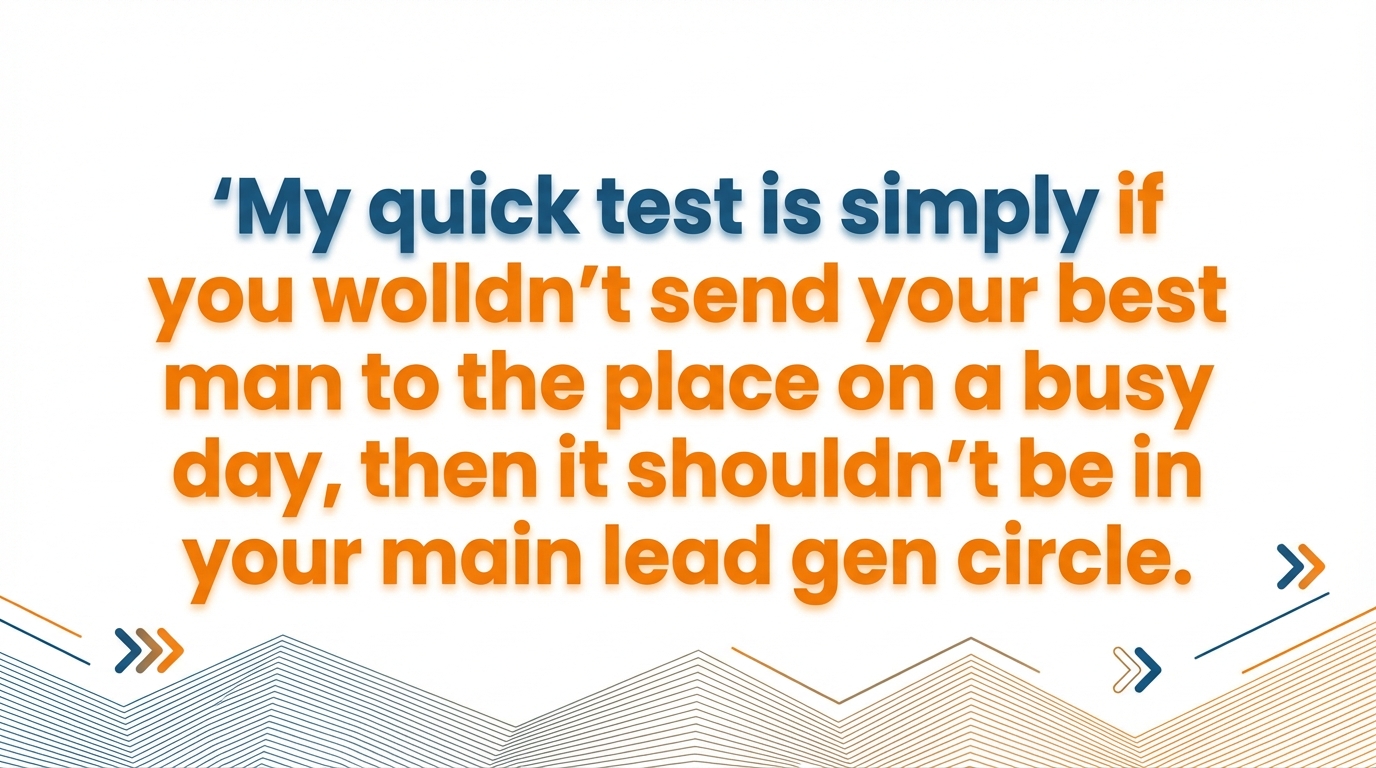
If you’re a local service business owner, it’s a good idea to follow along because today I’m going to share with you the one Facebook funnel that converts clicks to booked jobs, that I see working, time and time again.
Knowing when to use calls, messages, or forms (or landing pages) in your Facebook campaigns makes local service advertising really straightforward. I like to think of them as offering different “on ramps” for how a customer can hire you.
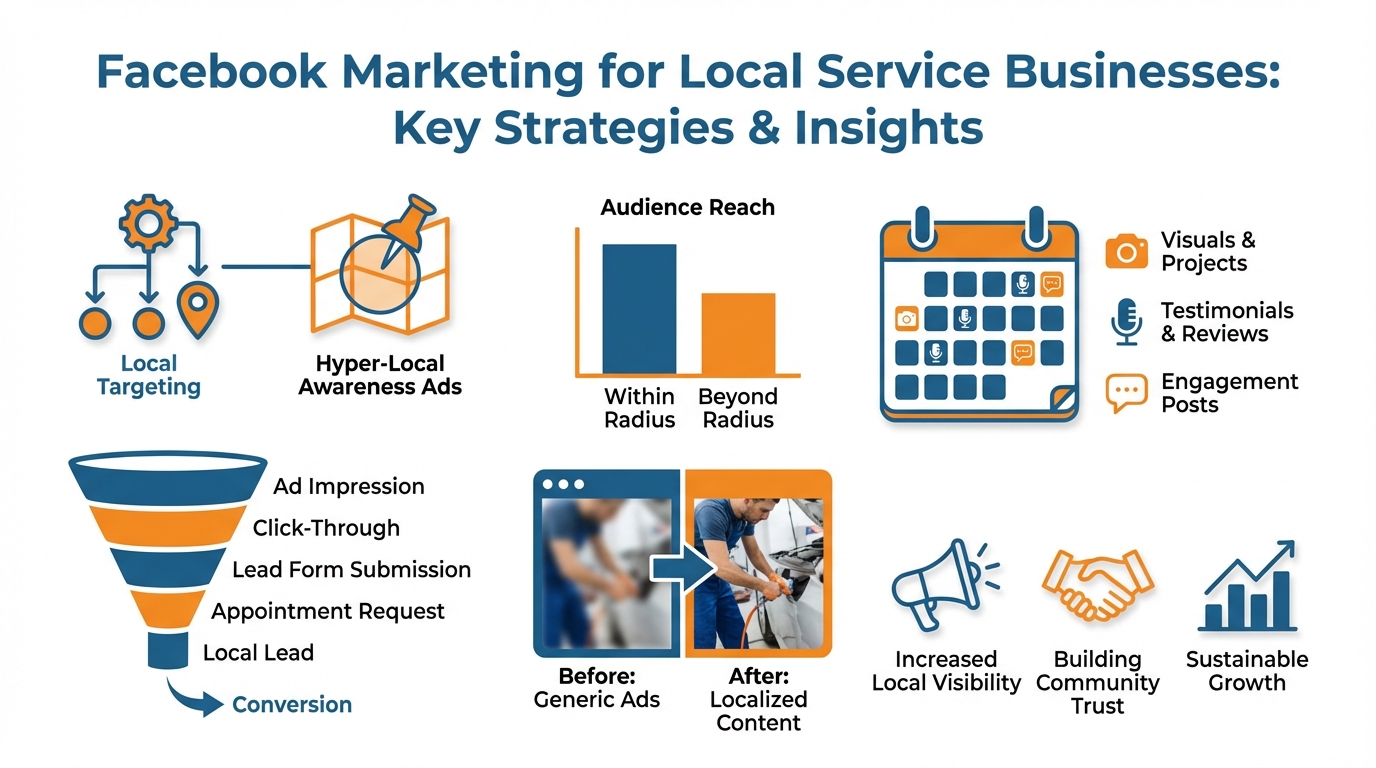
- Use calls when you have an urgent, high-value offer that requires same-minute certainty, since calls are higher-converting than the other methods, even if they’re more expensive.
- Use messages when your audience is likely to be comparison shopping or your service isn’t offered around the clock, since messaging requires less work from the user and can still result in a fast conversion with the right messaging.
- Use forms when you want a lot of volume over a small area, and you have other pre-qualification factors built in, since Facebook can optimize for completed forms quickly, and the cost tends to stabilize.
- And use landing pages when you have to explain a lot, you want to show off some proof, or you need to anchor a minimum price point, though in general landing pages will lower your conversion rate unless you have a mobile-friendly page that doesn’t require scrolling or multiple steps.
If you’re not sure which one to use, think of them like this: emergencies → calls, planned → messages or forms, explanation needed → landing page.
Another huge lever is speed-to-lead, and this one is very easy to quantify. Contact rate tends to decay the longer it takes to respond in the local services space; I have worked with many accounts where the difference between a sub-5 minute response time and 1 hour response time is a 2x difference in conversion rate (into booked appointments), despite ad asset (copy/image/ad relevance) staying constant.
You should treat the first 5 minutes like an auction: if they call, you should call back; if they message, you should message back; if you miss the call, you should auto-text something that tells them who you are, tells them that you operate in that area, and asks one simple next-step question.
After-hours matters, too; if you are running overnight ads but not answering until morning, you are buying leads for your competitors; either pause ads after hours or make sure someone is responding to overnight leads with a clear promise of follow-up timing.
When you finally get leads flowing in, what most companies have isn't an ads problem. It's a leaky pipe.
You fix this by taking ownership over a basic funnel with someone who owns each stage: new lead, contacted, qualified, booked, completed, won, lost.
You should be able to look at yesterday and know how many leads weren't contacted, how many were contacted but not qualified, how many were booked but no-shows.
Then you harden the booking flow: confirm the appointment same day, restate the address and time window, and set expectations for what will happen when we arrive on-site so the customer becomes psychologically committed. I've seen no-shows plummet when you start treating confirmation as part of the service experience instead of a paperwork exercise.
Pre-qualification is okay on Facebook - if it saves your time. You want as much as it takes to filter out bad fits - but no more than that, or you’ll kill the good ones. That means Service Area, Property Type, and Job Type are all musts because they filter out out-of-range and out-of-scope leads for pennies.
Pick one value-based filter to match your model, such as minimum job size or diagnostic fee acceptance, and leave everything else optional to maximize form completion rate.
Max out your returns with retargeting and reactivation: follow up unbooked leads in 7 days with proof & next step, past estimates with a seasonal message, and past customers with maintenance and upsells/cross-sells. That’s how acquisition cost decreases without hoping for lower CPC: you keep booking the leads you’ve already paid for - and Facebook gets smarter because your pipeline generates more booked jobs, not just lead form submissions. (For more on building systems like this, see smart social media automation.)
Facebook ads for local service businesses: targetings and creative approaches in small geographies
Facebook ads for local service businesses: What targetings and creative approaches deliver in small geographies
Service area targeting: I’ve seen a lot of money wasted on attempting to target a perfect circle. I try to build circles around where I want my guys to go, not what I can create with the radius drawing tool.
So that often looks like smaller circles around key neighborhoods, multiple circles with a hub of towns around each that I can send the same crew to, and breaking into different ad sets when the average driving time is higher, the competition is different, or the average ticket is different.
I’ve found it delivers better when you don’t try to mix a wealthy suburb into the same ad set with an outlying rural area, as the algorithm detects one as the real pattern, and then your lead quality goes all over the place.
My quick test is simply if you wouldn’t send your best man to the place on a busy day, then it shouldn’t be in your main lead gen circle.
Here is how I minimize wasted spend: avoid weak interest stacks, rely on intent signals and exclusions, and let the creative filter.
Don’t target people who are interested in home improvement, target the entire serviceable area, and make the first 2 seconds of video and first line of text qualify heavily: service area mentioned, job type mentioned, next step.
Couple with exclusions to filter out obviously mismatched requests such as excluding recent lead submitters from prospecting for 30 to 60 days, excluding renters if you are only targeting homeowners, excluding your existing customer list if you are trying to expand net-new, etc.
This strategy tends to stabilize the cost per qualified lead as Meta is optimizing for people who actually complete the action and your messaging filters out out-of-bounds requests before they even click on it.
You will feel the difference in your email inbox: less “are you available in my town” questions and more “I have this exact issue, what’s the next step.”
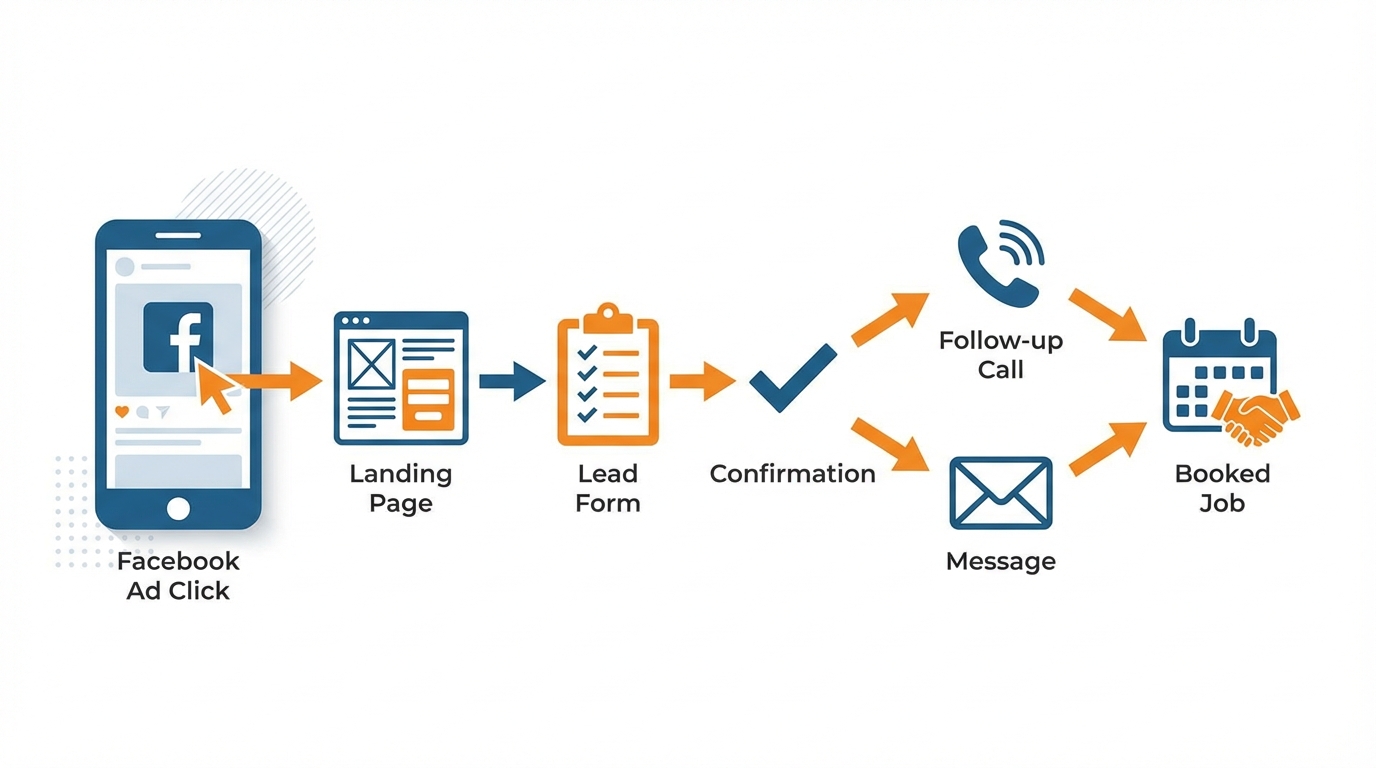
If you show the same geography for too long you will burn it out, which is why I try to diversify my local-service ad creatives instead of trying to optimize the same ad into oblivion. You need an assortment that appeals to different buying motivations: before-and-after (results), introduction of the technician (authority), what to expect (fear), price anchoring (value), comparing to avoid something (urgency), and review-based (credibility storytelling where the review is the narrative and the video demonstrates the experience).
The more you can make the credibility elements appear local and authentic, the better: quick flash of license, insurance, and guarantee “policy”, B-roll of local imagery or street signs, job-site video with ambient audio, and reviews that mention specific conditions and area instead of generic “great” service verbiage.
Optimizing for reuse means that a single job can be used to make a proof skit, photo gallery, tech presentation, and review commercial, which is how you keep your ads fresh without always having to shoot new content.
On Meta, controlling quality is a different story. With forms, we want to minimize the number of questions while making them strategic, so you select the service area, property type, and job type (if necessary) as well as add one quality filter, like willingness to pay a diagnostic fee or minimum project value, but not ask 7 questions and kill the fill rate.
With SPAM, you sharpen your language to show that you’re a legitimate, local provider, use higher-intent form options if volume allows it, and monitor for signals like repeat names or phone numbers with out-of-area codes then tweak your qualifying copy instead of interests.
With Messenger, you use the immediate response to get the three pieces of information needed to dispatch the work: address/zip code, the problem, and desired timing, then choose when to transition to a phone call versus a form submission based on urgency and dollar value, so if the work is urgent or of high value you immediately push for the call because it lifts conversion rates but if it’s planned work that lends itself to comparisons, you keep the conversation in messages as long as it takes to provide proof and set expectations before moving to booking once the customer is mentally committed.
Make Facebook work even when ads aren’t running
You can also leverage Facebook for your local service-based business in other ways besides running ads, such as growing your page organically, creating a Facebook group, and partnering with other page owners to multiply your efforts.
If you want Facebook ads for local service companies to work even when your ads aren’t running, your page needs to act as a trust engine, not a billboard.
Posting proof of work that makes the invisible visible (before and after pics, short job walk-throughs, short videos of you arriving, diagnosing, and explaining the fix in simple terms) along with educational content that removes fear (because most homeowners are actually purchasing de-risking, not just a service) such as a 30 second video that explains what a normal quote includes, what can cause the price to vary, and what you inspect on-site will presell your service and greatly reduce the number of tire-kickers you get.
Getting as hyper-local as possible by mentioning neighborhoods you actually serve, showing streets you recognize, and speaking in terms of seasons (first heatwave AC repair, post-storm roof inspections, etc.) will typically improve both engagement and memory in small geos where everyone sees the same few providers.
Address objections in advance such as price, time, mess, warranty, who will actually come to the door, etc. because each objection you remove in a post is one less you have to overcome in Messenger.
You can get your content in front of more people much faster through local groups than you can on your page if you know how to operate inside those groups and add value there.
You can share value first posts that teach people something they need to know like how to turn off their main water shut off valve or what a tripped GFCI outlet means or what pictures they should take before their service tech shows up and you’d be surprised how many times people save and share those posts because they’re useful instead of being pitchy…
You can share asked and answered style posts like taking the top 10 questions you get on a weekly basis and answering one per week in the group because if people keep asking the same question it’s not because they’re bored, it’s because they’re demanding the information…
Just make sure you’re playing by the rules in the group because just like on the platform itself, getting your content removed from a group one time can drastically affect your ability to reach group members in the future and be consistent by posting one valuable piece of content weekly for 12 weeks instead of a handful of posts all at once that make you look like a spammy fly-by-night salesperson. (If consistency is your bottleneck, see inconsistent social media posting.)
When I share content in local groups, I share as a neighbor, not as a service provider and that distinction in the tone of my content is what helps people to later click over to my page when they actually need assistance.
Treat reviews as content source material, not just as reputation. Ask for reviews at the point of relief (immediately after the job), not weeks after the fact, in order to maximize response rates and specificity of language.
Get permission to use review text and first name for reuse elsewhere.
Convert strongest reviews into two pieces of content - a written story post and a talking-head video - where you restate the problem, constraint and outcome (specificity like “they arrived in 2 hours” in “my neighborhood” is more compelling than a generic positive review because it proves a fit and capability).
Respond to every review like it is a landing page - reinforce service area, restate the type of job done, and subtly set expectations for the next customer (since review responses are read by shoppers and can improve conversion even at strong star ratings).
One job can yield 3 assets here: the review itself, the response to it, and a proof-of-work post that precisely matches the language that your best customers use.
Messenger is a great lead source when you treat it like a human, not a bot: just get on quickly, and make sure the homeowner can track the conversation.
In the first minute, all you need is to get them to respond with their zip code (or city/state), a brief description of the job, and approximately when they’d like it done.
The sooner you respond, the higher the lead-to-call conversion rate will be, and in service businesses, the first company that creates certainty usually gets the job.
Use simple and direct questions, mirroring their language as much as possible, and based on the job urgency and value, consider inviting them to a phone call. Higher-value jobs and emergencies convert better when you jump to a call ASAP.
To amplify your reach, think of local business partnerships as an extension of your hiring process. Don’t do one-off deals with random companies; instead, you want to consistently promote businesses that serve the same customer you do, but in a different way. In the home services world, that could be realtors, property managers, fence builders, pool installers, house cleaners, etc.
Instead of trading discounts, trade useful content so you benefit from their credibility without teaching your shared customer to expect a promotion.
Then, find local influencers and Facebook groups by pitching them an ongoing content idea: for example, quarterly maintenance lists, what to expect guides, or stories from the job site.
To avoid making this too complicated, I maintain a simple spreadsheet of which partners we’ve worked with, what content we posted, and which pieces generated conversations and phone calls. That way, this process is a lead-generating engine and not a one-time fluke.
Measurement: tie Facebook to job-level performance (not vanity numbers)
O fim.
If I want Facebook marketing for local service businesses to be simple and repeatable, I only do it in one order: offer, funnel, ads and creative, organic and partnerships, measurement. You can do it in that order because everything downstream leverages everything upstream. If your offer is weak, all the targeting in the world won’t help your lead quality. If your funnel is broken, new creative just gets you more missed calls.
I’ve taken accounts where I changed nothing in the ad account except solidifying the offer and improving the lead handoff that resulted in double the booked appointments, on the same budget, because we stopped paying for people to learn they were not a good fit.
If you get no leads, fix the friction and the signal before you mess with the budget. Make the next step obvious in the first line and first seconds, make the action to take clear and singular, and make sure you’re not sending them to a dead end where they wait.
If there are no leads, it’s almost always a path problem, a value promise problem, or an ‘am I in your area and do you solve my problem’ problem. I think of that as a clarity problem more than a platform problem, and once that clarity is fixed, the lead volume usually normalizes fast because the algorithm now has a clear pattern to chase.
Don’t try to target tighter than the city. Let your offer filter. Lock down service area, be explicit about property or job fit, add one values filter like acceptance of a diagnostic fee or a minimum project size, and the cheap clicks will filter themselves out.
If you are getting leads that don’t book, the answer is almost never to launch another campaign. The answer is speed-to-lead, certainty, and a strong qualification script. In local services, the first business that wins confidence typically wins, and the biggest hidden leak is between I’m interested and I’m scheduled.
The last concept I want to sear into your brain is this: The only way you can make Facebook marketing predictable for a local service business is by tying it to lead handling and job-level performance, not just campaign-level results.
You cannot use cost per lead (CPL) as the ultimate measuring stick, because two campaigns can have the same CPL but drastically different revenue results based on factors like service area, response time, and lead-to-job conversion rate. By tracking every single lead from contacted > qualified > booked > completed > won, you’ll know precisely what to tweak next week to buy more revenue, not just more leads. (For a practical way to think about proving impact, see prove social media ROI to investors.)
Benchmarks and context (external sources)
When you’re pressure-testing CPL and CPC expectations, it helps to compare against current benchmarks: WordStream reported an average Facebook Lead Ads cost per lead (CPL) across industries of $21.98 in 2024 in their 2024 Facebook ads benchmark data. In 2025, LocaliQ noted the Leads objective average CPL (all industries) was $27.66 in their 2025 Facebook advertising benchmark roundup, while also reporting Traffic campaigns (all industries) average CPC of $0.70.
If you’re in a category where clicks vary wildly, WordStream’s 2025 dataset shows examples like Restaurants & Food CPC: $0.74 (among the lowest listed) and Dentists & Dental Services CPC: $9.78 (among the highest listed) in their updated 2025 Facebook ads benchmarks. For home services specifically, LocaliQ cited examples like Landscaping avg. CTR 1.79%, avg. CPC $1.13, avg. CPL $58.56 and Plumbers avg. CTR 1.11%, avg. CPC $1.92, avg. CPL $72.97, plus a consumer behavior stat that 87% of people read reviews for local businesses, in their home services advertising benchmarks report.
And at the platform level, Meta’s own study found its personalized ads technologies were linked to nearly $550B in U.S. economic activity and 3.4M jobs in 2024, and that AI-driven advertising tools drove a 22% improvement in ROAS, according to the Meta Newsroom update on AI-driven ads impact.
Related reads
4/27/2026
B2B SaaS social media benchmarks: Set the right targets.
B2B SaaS social media benchmarks: Set the right targets. The trouble with defining B2B SaaS social media benchmarks is that it's an inherently impe...
4/25/2026
Building a personal brand as a technical founder (without becoming a creator)
Building a personal brand as a technical founder (without becoming a creator) Creating a personal brand as a tech founder should feel less about ma...
4/20/2026
Creative Post Ideas for Sustainable Brands (That Don’t Sound Greenwashy)
Creative Post Ideas for Sustainable Brands (That Don’t Sound Greenwashy) That’s not what creative post ideas for sustainable brands should look lik...