Done-for-you social media content: how to pick the right model without losing your voice
Done-for-you social media content: how to pick the right model without losing your voice If you’re looking for a solution to getting social media c...
Done-for-you social media content: how to pick the right model without losing your voice
If you’re looking for a solution to getting social media content created for you, it’s probably not because you’re struggling to come up with ideas. It’s because you need consistency that doesn’t cost quality, your brand voice, or business results. For a small business, the goal isn’t to post more. The goal is to post the right things, in your voice, that will drive awareness, leads, or sales.
Here’s what most people fail to realize: done for you social media content is a spectrum. It might mean completely outsourced content creation, partially outsourced content creation (where you still have to provide raw materials), or automated content creation (where you still need to provide a strategy and some guidelines). Each one requires something different from you. It might be that you need a defined offer, or a defined customer, or examples of your brand voice, or the ability to give feedback quickly. And if you choose the wrong one, you’ll end up with what you’ve always ended up with: a regular stream of “meh” content that’s just…fine. But that doesn’t serve your business.
In this post, I’ll help you select the right done-for-you model for your stage and budget, sidestep the most common outsourcing pitfalls that eat months and money, and establish a basic framework that delivers results rather than merely a number of posts. You’ll leave with a clear understanding of what to outsource, what to retain, and what details you need to share to ensure your content engine fires on all cylinders.
Figure out what done for you means for my business (and what success looks like)
If you are interested in learning how to have social media content made for you, the first step is to identify a business result, not a task.
More followers is a vanity metric unless it ties to something concrete like authority in a niche, lead generation, demand capture from intent searching, customer retention through education, recruitment, or community. If you want a deeper take on vanity metrics, see why vanity metrics mislead.
Choose one business result for the next 90 days and assign a volume to it: You might measure DMs per week, email opt-ins from social, discovery calls scheduled, lift in branded search, or repeat business that was influenced by social.
I do this because it saves you from the most common mistake of paying for a content service that delivers a stream of posts that looks pretty but doesn’t affect any business metric.
Then, you need to get REALLY clear on what kind of done for you service you’re looking for because that can be 5 different things.
- Are you looking for someone to develop strategy and content pillars for you? Or just the writing?
- Do you want design templates and brand visuals included? Or just captions?
- Do you want them to edit videos for you from footage? Or do you just want ideas and hooks?
What I’ve found works best is that you outsource the things that tend to be a bottleneck for you and hold onto the things that are your differentiators.
Like I can outsource writing and design but I like to keep the final say and data points because that’s how you build trust as a small business.
Or if you want something a little more basic, WoopSocial can also produce a whole month’s worth of content drafts for you in a short amount of time based on your website, which is great if the issue is just needing it faster and needing it consistently but not necessarily needing it to be a full content strategy.
Next, test and validate the system against your constraints before spending a dime.
If you’re in a regulated environment, you need pre-approved claims, disclaimers, and a “do not” list or you’ll lose momentum in revisions and compliance.
If more than one approver is required, assign a single owner and a 24 to 48 hour turnaround or the flywheel will break down.
If your firm lacks content resources, determine a basic, repeatable monthly content creation process that works for you like 30 minutes of voice notes or a handful of phone videos; if you’re a founder-led brand, determine what must come “from” you like your phrases, your contrarian takes, and your boundaries or the outsourced content will become generic “bland-tastic” advice.
Lastly, determine healthy boundaries and rhythm that can endure past 14 days.
Use done-for-you content if you have offer clarity, a defined audience and are ready to move quickly, it’s a loss if you can’t define what you sell, if you think it’ll make you go viral overnight or if you won’t make decisions.
Determine your rhythm based on bandwidth and platform realities: a small business might get more mileage from fewer, better posts that drill the same key points over and over (because people often need to see messages several times in order to remember them and respond). If you’re struggling with consistency, read more on inconsistent social media posting.
Determine a rhythm that you can maintain for 90 days, and then adjust based on what works to get your desired outcome, not what gets the most likes.
Decide which way to implement: freelancer, subscription DFY, agency, or AI automation
If you’re looking for how to get social media content done for you, you should now be able to choose the execution path that best suits what you are actually trying to take off of your plate.
A freelancer can generally deliver writing, design, and editing once you’ve defined it, but they generally don’t deliver a consistent strategic framework unless you give them one, and you still need to provide briefing, feedback, and stewardship to ensure that posts are on-brand and on-offer and on-audience.
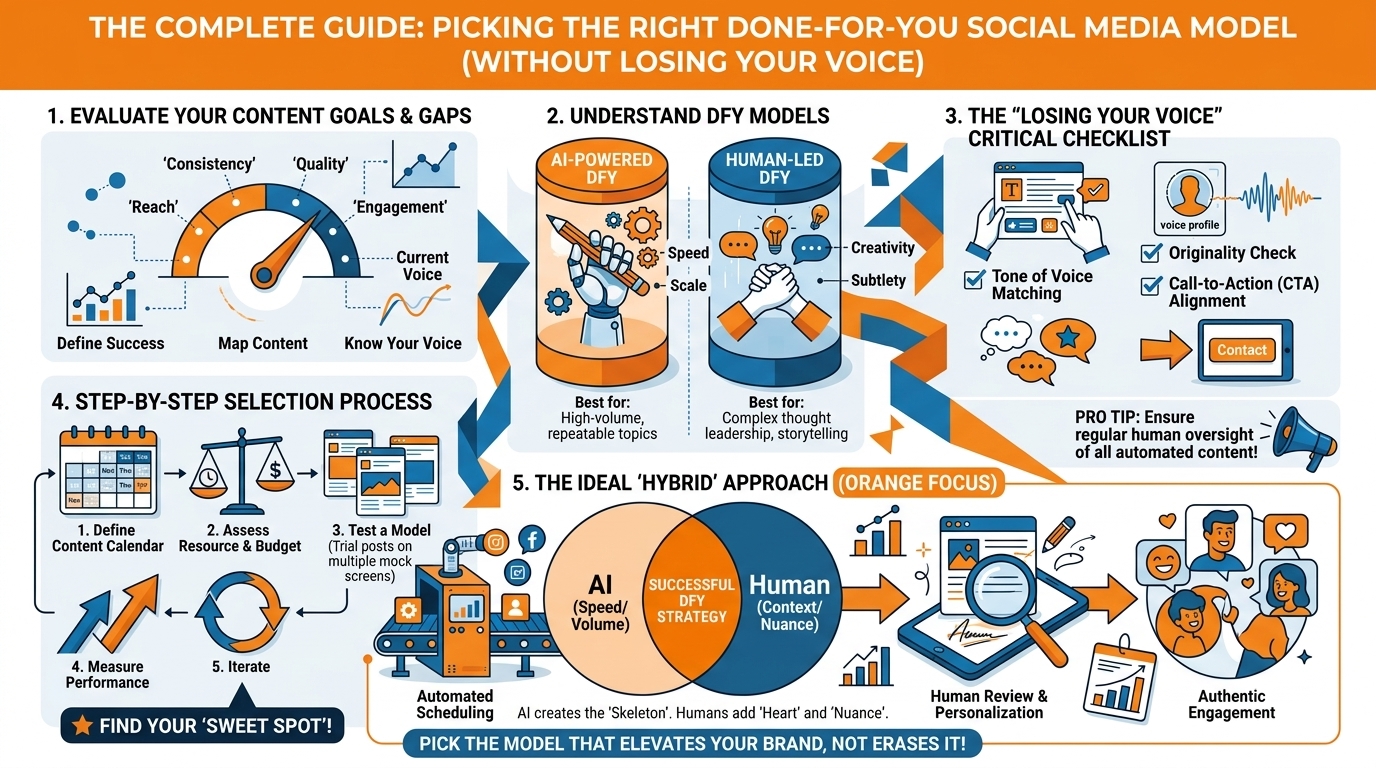
A done-for-you subscription service can generally deliver consistent monthly content and a more streamlined process, but they generally don’t deliver really deep brand insight or much innovation because they optimize for output, and you still need to approve and supply product information, promotions, and context to prevent content from feeling generic.
An agency can generally deliver more full-stack thinking and execution, but they generally can’t deliver speed, and you still need to deliver stakeholder alignment and fast decision-making to keep the project from languishing in approvals.
AI-enabled automation can generally deliver as much speed and volume as you need, but it generally can’t deliver judgment out of the box, and you still need to supply rails like content pillars, a “do not say” list, and ultimate brand ownership. For a broader view, see social media automation.
The cost of content is not so much about the number of pieces and is much more about the amount of risk and complexity you’re transferring.
The price tag increases when you need more substantial planning and messaging work, more content in more formats, more sophisticated content (e.g., custom-designed images or video production), more rounds of revisions, quicker turnaround, or more flexible reuse rights (to feature the content in advertising, on landing pages, or with partners).
I describe it as moving parts: the more platforms, the more offers, the more personas, the more approvers, the greater the management time.
If you’re looking for more transparent costs, reduce the moving parts: fewer content pillars, fewer formats, more defined voice guidelines, and shorter approval windows.
And you know where you’re going to falter too.
Content mill “solutions” deliver on quantity, not quality; they get you consistent posts that are perfectly readable, but don’t string together into a cohesive story that gets attention and results.
Freelancers deliver on quality, but don’t manage the direction of your business, and you risk their reliability, because you lose everything they do the moment they stop showing up to work.
Agencies manage the direction of your business, but will probably bloat the process with meetings and slow approval times, and you’ll probably end up sounding generic, because everything an agency writes sounds like it was produced by a committee.
Automation gets your speed back, but if you don’t have someone actively overseeing your process, it’ll probably default to the same generic language, or will make promises it’s not safe for you to keep, especially if your business is in a regulated industry, or you’ve made specific promises and disclaimers that you have to keep up.
Pick accordingly based on your limitations: Speed, when you have a defined brief, when you need to pick up the pace this month and when you’re okay with retaining ultimate responsibility.
Control, when brand sensitivity is your differentiator and when tone-deaf content isn’t an option.
Whitelabel Support, when you need the most comprehensive of compliance and when you need the most watertight of approvals.
Partner Network, when you need a partner network to help with reach and when you need a partner network to give your content some legs through their other partners, affiliates and vertical networks.
Done for you, when you need the energy of a done for you service, but aren’t willing to sacrifice your brand by outsourcing it completely.
Especially when you have an AI that can learn your website’s tone and apply your brand assets to each post to keep them consistent, which is what platforms like WoopSocial solve.
It also aligns with where the market is going: in a CreatorIQ creator marketing report for 2024-2025 (it notes that 94% of organizations believe creator content drives more ROI than traditional digital advertising), creator content is increasingly treated like performance creative rather than “nice-to-have” content.
Ok, actually, just have it done for me, a clear process that preserves my branding voice and minimizes my time to almost nothing
If you are looking for ways to have social media content created for you without sacrificing your brand value, this is the acid test: you have to provide input that conveys voice and positioning as much as your logo and key words.
This is best done in a quick and structured briefing format, where you supply a few examples of content you like and dislike, your competitive differentiators, your key offers and a clear list of things you would never say (so no-one ends up accidentally making promises for you that you would never make).
The surprising secret is that your brand voice is faster to clone from contrasts than descriptions: it is easier and quicker to say, ‘I never sound like this, I always sound like that’, than to write a 2-page brand document that no-one reads.
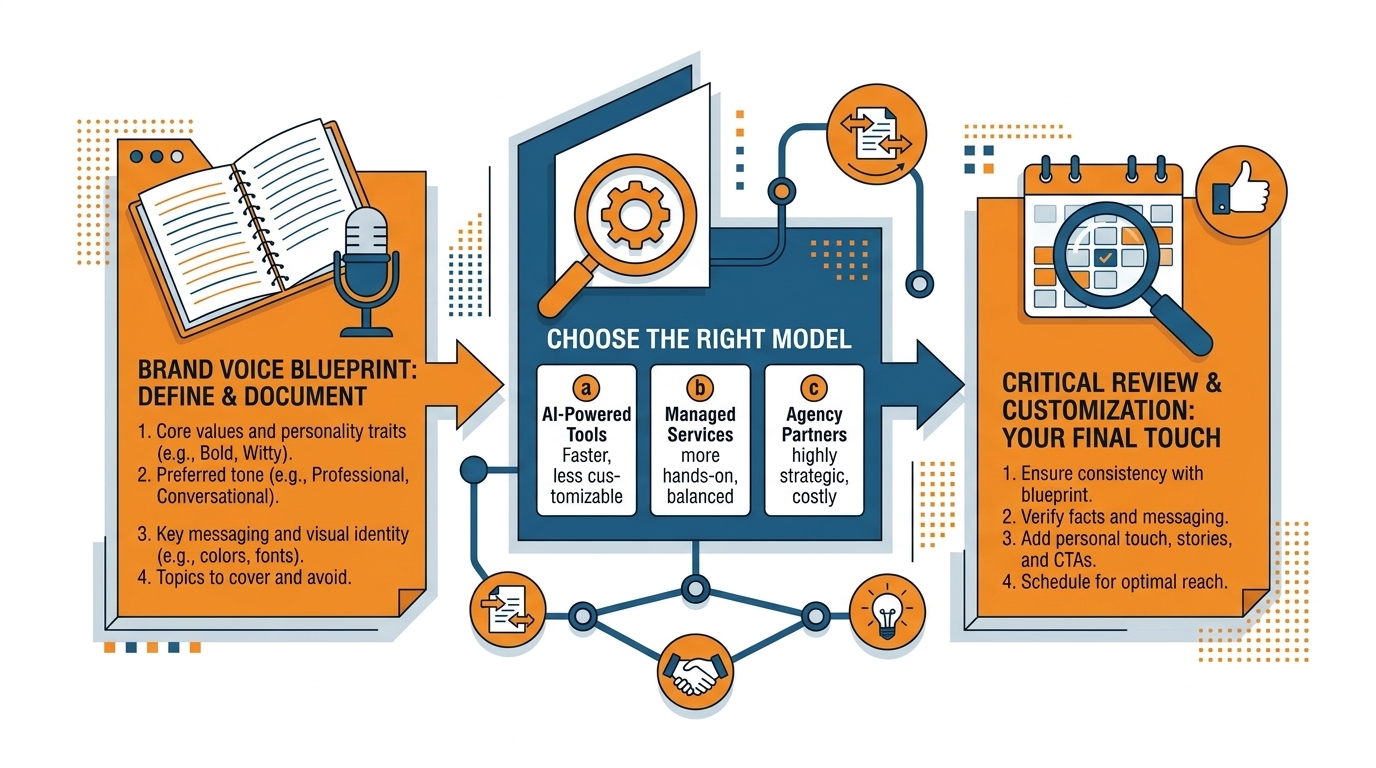
You only have to do this once, and it means you can stop paying the revision tax each month.
Second, you need content pillars that mirror offers and customer needs so there is always something to talk about even when there is no news.
Pillars get built around questions customers have before they buy, the objections that get deals stuck, the proof that mitigates risk, and the behind-the-scenes that builds trust. If you want a practical guide to building this structure, use a social media content calendar.
So, if you sell a service, this might be one pillar that describes what the outcomes and process look like, another pillar that addresses pricing and timeline questions, another that shares case-style learnings, and another that busts common myths.
I use this because small businesses do not have a news cycle, but they do have a sales cycle, and content that mirrors the sales cycle has a longer shelf life and converts better.
You should have a clear view of what you’re approving and when: the topic outline, then a batch of drafts, then a low-round edit, then articles are scheduled.
Your time remains small, because you’re measuring it in minutes not hours: You’re sending an asset dump and doing quick approvals and occasional feedback from sales calls or customer queries.
My target is to see most small businesses needing 20-45 minutes a month once the core topics and tone have been nailed, as more time than this is a sign that there’s a lack of structure, there are too many stakeholders, or the vendor is getting you to create content from scratch.
If you want it to be fully “done for you,” your asset capture has to be time-neutral, too.
Use a combination of regularly scheduled capture that’s realistic for your week (e.g., 2 minutes of video while setting up for a job, before-and-after photos at delivery time, 1 minute of audio after a customer service call) with liberal reuse of existing content (FAQs, email, proposals, webinar snippets, reviews, support tickets, etc.), and front-load with policy & brand risk protection around claim language, disclaimer templates, sensitive issue escalation procedures, and ownership rights around media, file access, and account permissions.
Or, if you want as little effort as possible, it’s possible to get a month’s worth of compliant draft content from your website with just a few minutes of work on a platform like WoopSocial, although even here the best outcome still requires upfront effort to feed the system right, and a monthly process of approvals.
That speed matters even more as video becomes the default: in Wyzowl’s 2026 video marketing statistics (it reports that 69% of video marketers have created social media videos), video production is now a baseline expectation rather than a specialized capability.
Quality control and iteration: how I don’t get charged for “vanity posts” that don’t do squat
But if you want to learn how to have social media content created for you without losing money, you need to establish quality benchmarks before you spend a dime.
I use this as a pre-publishing checklist: is the voice on-brand (does it sound like you)? is the copy concise (can a busy reader absorb the value in three seconds)? is the lede compelling (does it demand attention in the first line)? does the call to action align with your current offerings? and does the content feel native to the platform (is this social content or a resized brochure?)?
When you force agencies to meet those benchmarks, you start paying for results instead of shine.
You can insist on a small pilot project, then evaluate each draft based on those five benchmarks before anything is published, because quality control is far more cost-effective before publication.
Next up is a measurement mechanism that doesn’t require a whole analytics stack.
On a weekly basis, you are looking for signals that are linked to business intent: saves because they want to come back, comments with a specific question, profile views as a signal for interest, link clicks when the offer is clear, DMs that mention the subject, sales team feedback that prospects reference your content in calls etc.
I have a simple weekly note with those numbers and 1 sentence on what I believe caused them, because frequency wins over sophistication.
A rough yardstick for SMBs: If your top performing content does not generate a few drops of inbound intent signals within 7-14 days, it’s probably fun but not attached to a customer journey.
This is the step that outsourced content programs usually break down at, so you want to have A/B tests that are actionable for a small team.
You can only change one thing at a time: have the same topic but change the hook between posts, or the same hook but change the post type from short text post to simple carousel, or the same post type but change the call to action from comment to DM, or everything the same but post at a different time for two weeks.
I like this because it allows you to identify exactly what is working and turns optimization into a process rather than an art.
You’re not looking for the silver bullet, you’re looking for your bread and butter, and then turning it into a template that your partner can copy.
Last but not least, guard against outsourcing gotchas and amplify your successes without amplifying your time.
If a supplier can’t offer a discovery phase to match your style, omits an outline and approval stage, restricts you to a single edit with a flimsy brief, supplies generic copy and off-the-shelf graphics that lack a brand bible, or can’t articulate how their content supports your solutions, you’re looking at a content mill rather than a content multiplier.
When you do find the good stuff, you amplify it by repurposing it across other channels, turning successes into a recurring content series, and establishing a low overhead habit of distribution whereby you, your partners, your network and your team share content that has already demonstrated demand.
And if you want the convenience of done for you content without sacrificing quality, tools like WoopSocial that can generate initial drafts from your website and apply your brand identity can help you get to first draft faster, leaving you to focus on reviewing and editing.
That “authentic” feel is not optional: in Wyzowl’s user-generated content research (it highlights that consumers are 2.4× more likely to view UGC as authentic vs brand-created content), the bar for credibility is increasingly set by real customer voice, not polished brand language.
The closing remarks: I want less content work, and more reliable results
“Done for you” social media content stops being a crapshoot when you approach it as operations, not art.
The “done for you” thing only works if I define the outcome I want, select an implementation that fits my parameters, and demand a process that lets me review everything before it goes live.
The “predictable” part comes from eliminating unknowns: single overarching objective for the upcoming 90 days, small set of content pillars connected to actual customer concerns, and definition of “on-brand” to prevent endless revisions.
If you want to make this process feel simple, decide to do one thing, then stick to it instead of trying to do different things every week.
Use a monthly approval cycle that can be maintained even when things get crazy, and keep it simple: you approve topics, then content, then one final revision, then you’re done.
In small businesses, the danger isn’t lack of creativity, it’s the drag that approvals introduce, so treat your turnaround time as if it’s cash: every time approvals go from 2 days to 1 week, output drops, break the consistency, and lose the algorithmic love.
The most successful I’ve seen all but eliminate the time cost for the owner because the framework itself does the work.
Instead, commit to a 30-60 day cycle and not getting it right on day 1.
Your role is to provide immediate feedback to refine the next iteration: which posts sounded like you, which generated inbound activity such as saves, profile views, comments, and direct messages, and which one felt like a vanity metric.
Frequent little bets will always trump sweeping changes: if you’re only changing one thing per iteration, you can actually understand what’s working, and typically by month’s end, you have two-three post styles that consistently perform like assets, not a fluke.
If the real challenge in your content strategy is just to create consistent, on-brand content and plan a month without having to handle an agency, then something like WoopSocial will give you the vast majority of the done-for-you value for a fraction of the cost.
You can generate a month’s worth of content ideas in a few minutes, create copy in your brand’s tone by pulling it straight from your website, automatically add your branded templates, and schedule a month’s worth of content across multiple media in one go.
All of those things together are how you achieve the predictability of results: you retain full control of your tone and final say, but the grunt work is automated out of your hair.
And the dollars are following that shift: in TVTechnology’s coverage of an IAB creator economy report (it cites creator-economy ad spend increasing from $13.9B in 2021 to $29.5B in 2024), overall ROI is increasingly treated as the top KPI for creator campaigns.
Related reads
4/27/2026
B2B SaaS social media benchmarks: Set the right targets.
B2B SaaS social media benchmarks: Set the right targets. The trouble with defining B2B SaaS social media benchmarks is that it's an inherently impe...
4/25/2026
Building a personal brand as a technical founder (without becoming a creator)
Building a personal brand as a technical founder (without becoming a creator) Creating a personal brand as a tech founder should feel less about ma...
4/20/2026
Creative Post Ideas for Sustainable Brands (That Don’t Sound Greenwashy)
Creative Post Ideas for Sustainable Brands (That Don’t Sound Greenwashy) That’s not what creative post ideas for sustainable brands should look lik...