Community Engagement & Sales: Growth Lever for Small Business
Uncover how community engagement drives sales for small businesses. Track key metrics, connect engagement to revenue, and prove its value as a powerful sales channel. Get your roadmap.
Community Engagement and Sales: The Underutilized Growth Lever in Small Business
One of the most underutilized and poorly understood growth levers in a small business is community engagement. Unfortunately, its effects are usually felt in a counter-intuitive way.
You notice likes, comments, attendees, and nice words, and you call it soft marketing. Meanwhile, in the background, the kind of engagement that matters is steadily affecting the hard metrics that you actually care about: conversion rate, repeat purchase rate, number of referrals, average order value, and how long it takes for a maybe to become a yes.
This has to be defined, because otherwise it won't be useful. Let me clarify what I do and don't mean by 'community engagement.' I’m not talking about surface-level social media engagement that doesn’t translate into buying customers.
I’m not talking about support queries masked as community building.
And I’m not confusing local community like sponsoring a youth football team with online community, like a Facebook group, or a forum, or a newsletter.
These are different engines. They have different sales funnels. Different price points. Different proof points. Separate them and now you can start measuring the right things and cease worrying about competing vanity metrics.
In this article, you’ll learn the actual pathways from engagement to revenue, explained through the lens of a small business. I’ll cover what you need to track in order to connect the dots between engagement and pipeline and revenue, and how to demonstrate cause-and-effect instead of just drawing conclusions based on correlation.
You’ll leave with a clear roadmap for your next steps, what you can start measuring right now, and how to prove to yourself (or your doubting co-founder) that community isn’t just a feel-good thing to do, but a sales channel you can manage. If you want a related system for consistency, see weekly social media system.
Definitions: The Type of Community
The role that community plays in driving sales begins with definitions and the type of community. Why is it hard to measure the relationship between community and sales? Because we're lumping a lot of different concepts together under the same term.
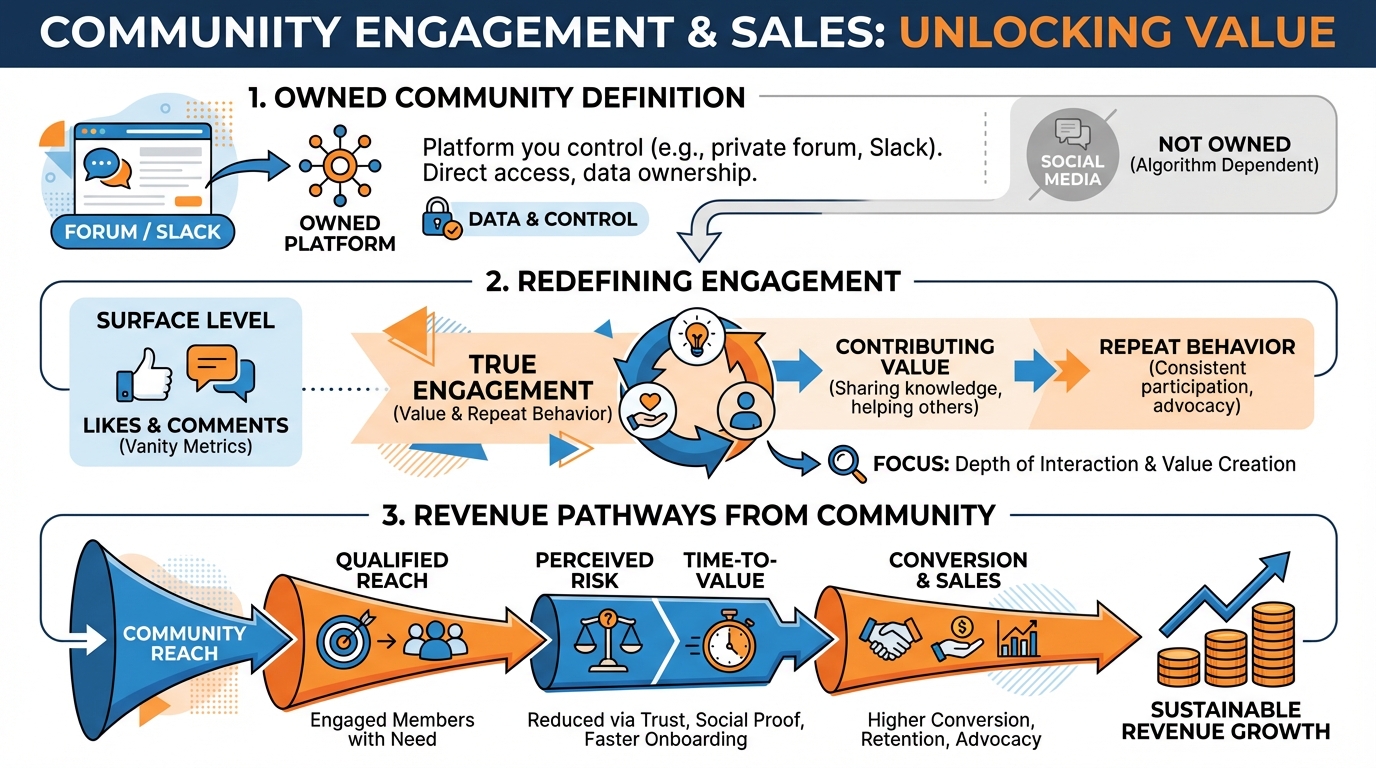
- An owned community is one you own: a forum, a Slack or Discord, where people can communicate with each other without an algorithm determining whether people see their posts.
- A social-first community exists on platforms like Instagram, TikTok, LinkedIn, or Facebook groups, where you're renting your reach and much of the engagement is performative.
- A creator/influencer community isn't really a community so much as a network you tap via partnerships.
- A customer community is organized around getting customers onboarded, using your product, and getting results, often after the purchase has been made.
- A local/IRL community is a trust and proximity-based community you build through events at a store, classes, popups, collaborations with other local businesses, etc.
All these concepts are not created equal: if you conflate them, you'll end up measuring the wrong signals, and expecting the wrong type of revenue.
The key is that each form shifts different pieces of the customer funnel, so you first need to determine whether you need more acquisition, conversion optimization, or retention and upsell.
Social-first and creator-based communities are often the best for acquisition because they generate attention and social proof at scale, which can reduce your blended CAC if you do it consistently.
Owned communities and customer communities are best for conversions and retention because they can address concerns, alleviate fear, and provide proof precisely at the point when a customer is considering your offer.
Local and in-real-life communities can generate fewer leads, but leads that are more trusting of you, which can raise conversion rates and make customers less sensitive to price, especially for service-based businesses.
I’ve seen small businesses with more room to grow by building a tight-knit customer community that raised the rate of repeat purchases and referrals, which can be much faster to compound than the grind of finding new, cold customers on social media. If you want to support this with a more systematic approach, see social media automation.
Define Engagement So Your Bank Account Understands
The second thing you need is a definition of engagement that your bank account understands.
It's really important to make this distinction: a Like or a comment is an attention signal, not a purchase signal, and both are ridiculously cheap to manipulate with no business impact.
So define engagement as contributing value and repeat behavior: people asking questions, posting results, posting a picture of their gear, providing feedback, etc. on their own.
Or define it as problem solving and support: questions answered by other customers, time-to-first-helpful-response, and whether people come back after getting help.
Or define it as advocacy: referrals, testimonials, being a case-study, posts where you get tagged, customer -> customer introductions, or even people defending your brand when you're not around.
Once you start measuring that stuff, you stop hypothesizing about the impact of community engagement on sales, and you start observing the specific levers that affect conversion, retention, and expansion. But segment changes everything, so please don’t borrow a playbook if you can’t map it to your business model.
Engagement matters to B2B and consideration sales because it reduces risk: you’ll see it in the length of the sales cycle, the demo-to-close rate, and in the number of objections (since customers can now see a real person solve a real problem).
But engagement matters in different ways to B2C and impulse buy purchases: here you’ll see it in repeat purchase rates, in average order value, and in referral velocity, not in long sales cycles.
Product-led growth businesses benefit from communities that support activation and habits, whereas sales-led growth businesses benefit from communities that generate warm leads and credibility that sales teams can leverage.
Physical businesses should focus on the trust loops that get customers to come back and visit, while digital businesses should focus on building knowledge and member testimonials that are both discoverable and reusable 24/7.
So your goal here is to identify the right community type for your segment and then define engagement in terms of the actions that lead to revenue for your segment.
A Funnel Map: The Revenue Pathways from Community
The influence of community building on sales plays out in particular revenue streams throughout the funnel: Why community works on sales is not magic, it’s a funnel map.
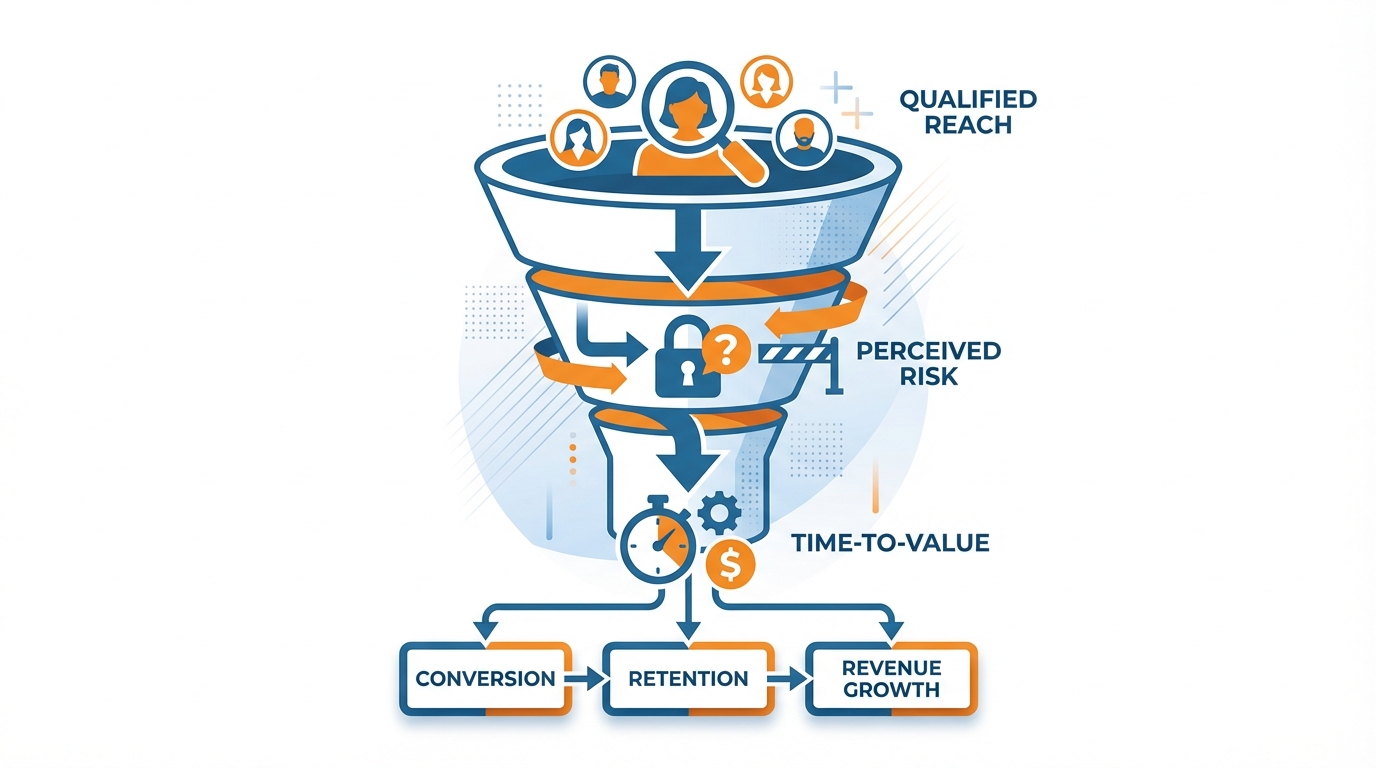
Community works on sales when it moves the dial on a particular step: qualified reach at the top, perceived risk in the middle, and time-to-value on the other side.
It doesn’t move the dial on sales when you pursue engagement that has zero relation to purchase intent, like generic memes or comment bait.
To instrument this, you measure touchpoints with community the same way you measure campaigns: 1st touch to measure reach, mid-cycle to measure credibility, and post purchase to measure retention, and then compare conversion and retention between people who engaged with community and those that did not.
If you do nothing else, start by marking every lead and customer in your CRM as community-touched or not, because that one field unlocks the entire revenue pathway view. If you need structure for this, a social media content calendar helps keep community touchpoints consistent enough to measure.
Top of Funnel: WOM Loops and Cheaper Distribution
Community’s power comes from creating WOM loops at the top of the funnel that can be measurably cheaper than paid reach.
When a member shares a win, a photo, or a tutorial that others replicate, you get distribution you don’t have to pay for, and your CAC drops because that same content continues to recruit for you.
Cross-pollinating with other creators or partners can multiply that: you borrow trust and audience, and your community is the proof that the partnership was worth paying attention to.
In practice, this means designing UGC prompts that produce shareable artifacts like before-after results, setup photos, short videos of the product being used, or mini case studies, and then making it easy for members to tag you and for you to reshare.
I’ve seen small businesses create a steady stream of inbound leads simply by making member stories into a recurring community ritual, because reach compounds when members start competing to participate. This lines up with evidence that brand community participation is associated with adoption: in a 2023 Frontiers in Psychology paper, participation correlated with new product adoption (β = 0.162, p < 0.01) and out-degree centrality affected purchasing/adoption (β = 0.032, p < 0.01) in the study, as summarized in research on brand community participation and early adoption.
Middle of Funnel: Trust Relay and Objection Removal
Further down the funnel, community acts as a sales accelerant because trust is relayed from person to person. Buyers trust other buyers more than they trust brands. A thread where users discuss questions, weigh options, and share raw tradeoffs accomplishes what most sales pages can’t: objections are overcome at scale.
That’s where community appears in your finance team’s KPIs - in the form of shorter sales cycles, higher win rates, and less price haggling because buyers already feel understood.
You can make this actionable by extracting a simple objection library from your community conversations, then proactively pushing that content into places where buyers get hung up: your FAQ section, as addenda to proposals, in follow-up sales emails, and as pinned posts.
If you want a clean test, compare your demo-to-close rate, or your quote-to-close rate, between buyers who have had at least one engaging community experience and those who haven’t.
If your community is working, you’ll be removing risk. For another lens on measurement, note that CMX’s 2022 report found 79% believe community has had a positive impact on their organization’s objectives, yet only 10% said they can financially quantify the value of their community, per CMX’s 2022 community industry benchmarks.
Bottom of Funnel & Post Purchase: Retention, Expansion, and Habit Formation
Finally, the bottom of the funnel & post purchase: community creates a retention & expansion flywheel by accelerating onboarding, activation, & habit formation.
When you help customers achieve their first win sooner, churn plummets.
When they watch others achieve their wins, expansion & upgrade is perceived as natural.
When they feel seen, price sensitivity decreases because they are buying belonging, not just outcomes.
Referrals come into play here too: satisfied members bring new members, & community itself becomes the proof that renewal is a good idea.
Community-enabled selling must not degrade into selling 24/7; I tie community to selling by detecting intent & diverting: you answer high intent questions publicly with value, then follow up 1:1 with the concrete next step, contextualized to them.
You maintain community as a safe space, & you allow selling to be the outcome of utility, visibility, & low-friction handoffs. This also matches broader community impact findings: in a Salesforce.org report, 40% of surveyed customers reported being better able to strategize and prioritize and 49% reported better communication and relationships, as described in Salesforce.org’s 2022 community impact report.
Why the “Engagement Spike → Sales Spike” Line Rarely Shows Up
While the effects of community engagement on sales are quantifiable (if I treat it as a revenue channel and measure it as such), I think the biggest issue with the impact of community engagement on sales is that we are looking for a beautiful line connecting an engagement spike to a sales spike and that very rarely happens.
Engagement is a leading indicator and sales is a lagging, noisy one: someone consumes a thread today, watches three member wins next week, asks a question in month two, and makes a purchase in month three, when budget and timing allows.
That lag opens up the classic correlation vs causation rabbit hole, where you either over-attribute to community sales that were going to happen regardless, or under-attribute because the time doesn’t match up.
Measuring stage, conversion, and churn removes the whole calendar sync issue.
Are prospects who engage with the community moving through stages faster?
Are they converting at a higher rate?
Are they churning less often than untouched prospects?
KPIs to Evaluate Community as a Revenue Engine (SMB)
Here are the KPIs I use to evaluate community as a revenue-generating engine in an SMB business:
First, track the pipeline generated directly by the community (i.e., first known touch is the community), as well as the pipeline that the community influences (i.e., community touches are somewhere between first known and close).
Then, measure the three lifts: conversion rate lift (by stage), cycle time lift (i.e., days from first contact to purchase), and retention lift (e.g., churn reduction or repeat purchase lift).
Next, track expansion revenue, because the best communities do not just close the first purchase, but make the 2nd and 3rd purchase an easy choice.
Last, don’t dismiss support deflection, because it preserves margin (members answering each other, lowering the number of tickets, are essentially funding growth by reducing service costs per customer):
In my own reporting, I treat every deflected ticket as equal to hard dollars by multiplying deflected tickets by your average fully-loaded cost per resolution.
Instrumentation (Simple Enough Without a Data Team)
To do this, you will need some instrumentation, but it can be simple enough to implement without a data team of an enterprise company.
First, you will want to be able to tag interactions in your community so that every lead and customer that has been community-touched can be flagged as such, with a simple classification like: attended event, posted question, got answer, shared win, referral from member.
Next, you will want to capture self-reported attribution at various points, e.g. how did you first hear about us, and what convinced you to buy, since this will get at influence that isn’t captured by link/UTM data.
Then you will want UTMs and events on-site that map to fields in your CRM so that traffic from community, signups from community, and other key behaviors from community show up in the same way that your sales data or your invoicing data does.
Finally, you will want to create an influence period, say 30 or 90 days depending on your sales cycle, so that you only count community as having influenced a deal when the interaction took place within a time window where it could have actually had an influence, as opposed to saying that it counted forever. If you need the mechanics, using a UTM generator makes those fields consistent.
Incrementality: Establish Trust with Leadership
Incrementality is how you establish trust with your leadership, and you can do it in ways that are a great fit for small businesses.
You can use holdouts, where you only invite a subset of your list to a community effort, and track the differences in close rate and cycle time for those who did get the invite versus those who did not.
You can use matched pairs, where you match leads on offer, price tier, acquisition channel, and then compare the outcomes between those who were touched by community versus those who weren’t.
If you’re a local business, geo tests are a great tool: you can run a community effort hard in one region, keep a second region steady, and then compare conversion and repeat purchases.
I’m also a fan of time-boxed pilots that have been well validated: you choose one revenue metric, one audience segment, and one 30-day behavioral outcome you want to see, and then measure the results at 30/60/90 days for conversion lift and velocity, and at 6-12 months for churn, expansion, and referrals.
The ROI on community will likely be back-loaded because trust compounds: the early benefits are faster sales and reduced objections, but the real money is usually made later on retention, expansion, and member-driven acquisition that pays dividends long after the work is done. In wider community benchmarks, TrueLoyal reported 73.6% of consumers are more likely to purchase more frequently because of an online brand community, as collected in community-powered marketing statistics.
Distribution, Partnerships, and Operations (Without Losing Authenticity)
I find that the effectiveness of community engagement for sales increases as I expand distribution and operations while maintaining authenticity. The sooner you can make sales through community predictable, the more effective you’ll become at it.
It’s hard to keep hunting whales for partnership opportunities.
It’s better to think about partnerships as volume * relevance.
I’d rather have 30 mid-sized partnerships that each bring me a small stream of highly relevant customers than 1 large partnership that brings me a huge stream of irrelevant customers.
You want to create a partnership that’s easy to replicate, not hard to pitch:
- Could be a co-branded educational content piece,
- Could be a co-branded live Q&A,
- Could be a win story of one of your members,
- Could be a bonus bundle, or
- Could be a customer success story that makes the partner look good in front of their own audience.
And then you want to optimize on the two metrics that matter for partnerships that I can measure in my small business:
% of traffic from that partnership that becomes community-touched, and conversion rate of leads from that partnership compared to my baseline.
To prevent that system from falling apart as it scales, your secret sauce is relationship intelligence.
You’re not just gathering contact information, you’re modelling the influence dynamics in your niche: who controls purchasing decisions, who is the go-to for “how do I set it up?” questions, who handles objections, and who is added to threads with “what do I buy” questions?
My solution to that was to build an influence map: per micro-influencer / partner, I had target audience fit, common questions their audience had, content formats that work, and where a handoff to my offer made sense.
You can do the same, and then turn it into a simple activation playbook: warm up with value into their community, do a small test collab, then scale what works, while leaving a window of influence open so you can attribute revenue impact rather than fighting for credit forever.
Automation Without Losing the Personal Touch
The thing that trips up most small businesses and makes them lose the personal touch is in the automation of the community operations.
But you can automate consistency without automating the personality.
You can standardize moments, but not the tone of the responses themselves.
So for example, you might want to automate the moments when you welcome someone to a community, or when you reply to a high intent question, or when you follow up with someone after a meaningful conversation.
But the text itself should be very human, very specific, and contextual to what the person has said.
I have a rule which is, if you could send this message to 100 people without modification, you shouldn't send it at all.
And you should also automate pacing and the varying of templates in order to protect deliverability and the trust of the platform.
You should also prioritize responses to intent signals such as how much does this cost, how does this compare to that, how does this work, or can you recommend something?
Because those are the conversations that actually require a fast and thoughtful response.
If You Have High Engagement and Dead Sales
If you have high engagement and dead sales, don’t conclude that community doesn’t work, figure out the failure mode.
Common failure modes are: wrong audience, wrong offer, no conversion path, weak handoff to sales, and measuring engagement not tied to intent.
Wrong audience is solved by narrowing topics to problems that only buyers have, not general interest chatter.
Wrong offer is solved by making entry products/service packages mirror what members ask for over and over.
No conversion path is solved by making the next step clear in context immediately after value is delivered.
Weak handoff is solved by tagging high intent threads and sending them to a real follow-up that references the exact objection.
Low intent engagement is solved by measuring intent signals, not comments.
But guardrails are key: when something is promotional, be clear.
Never scrape or spam.
Never use dark patterns to artificially create urgency.
Treat community trust like inventory because once you spend it, it’s expensive to earn back. Additional ROI context: among respondents who reported being able to quantify community value (n = 56), 23% reported $1M-$4.9M in ROI attributable to community and 27% reported $5M+ in ROI attributable to community, as shown in the CMX 2022 report excerpt hosted on Scribd.
Community -> Sales
Finalmente
Community -> Sales is really, really clear when you start designing engagement to generate sales.
You’re responsible for building the right community for your company, designing funnels that help people understand the next step after value, and establishing attribution that you can stand by when sales is loud.
Once you do, you can start working with community as a sales channel, like any other.
The easiest way I can summarize it: engagement is input, trust-proof-activate is a system, revenue is output that can be measured and optimized.
For this to work in SMB, you have to make it a system: you pick the 3-5 engagement behaviors that are key (intent signals, member successes, referrals, etc), you identify the system you want to improve (risk reduction, confidence increase, time to first success), and you identify the business KPI you want to monitor weekly (stage conversion, cycle time, repeat purchase, churn, upsell).
That one-to-one-to-one relationship is how community goes from content to revenue.
This is the part that makes it work: Even a little bit of lift adds up.
When your community-influenced leads convert 10 to 20 percent more often than your community-ignorant leads, or 15 percent faster, not only are you getting more conversions, you’re also unlocking cash and bandwidth.
I’ve seen the same offer seem too pricey to a cold market and obvious in a community because community members could see evidence, get answers, and remove roadblocks quickly.
The offer didn’t change, their confidence did.
This is also why you track the difference between your community-exposed and community-naive audiences, not whether the post went viral.
So if you want to operationalize this, think like a systems designer: increase audience relevance, reduce time to next step, and amplify proof of results from members.
You’ll know you’re on the right track when engagement is less about quantity and more about intent, your artifacts speak to concerns before you have to, and your revenue report highlights a clear signal that you can optimize quarter on quarter. For a practical way to reduce inconsistent execution, see inconsistent social media posting.
That’s how you build community as a sustainable competitive edge rather than just another hopeful marketing ritual.
Related reads
4/27/2026
B2B SaaS social media benchmarks: Set the right targets.
B2B SaaS social media benchmarks: Set the right targets. The trouble with defining B2B SaaS social media benchmarks is that it's an inherently impe...
4/25/2026
Building a personal brand as a technical founder (without becoming a creator)
Building a personal brand as a technical founder (without becoming a creator) Creating a personal brand as a tech founder should feel less about ma...
4/20/2026
Creative Post Ideas for Sustainable Brands (That Don’t Sound Greenwashy)
Creative Post Ideas for Sustainable Brands (That Don’t Sound Greenwashy) That’s not what creative post ideas for sustainable brands should look lik...